- The paper shows that search tasks increase ethical importance ratings by 0.31 on average (p<.001) by triggering gap recognition.
- It employs a mixed-method design, using pre–post assessments, PCA clustering, and regression analysis to isolate cognitive triggers.
- Findings highlight that ease of sense-making and recognition of decision gaps drive sustainable consumer behavior regardless of baseline ethics.
The Role of Search in Bridging the Intention–Behavior Gap in Ethical Consumerism
Introduction
The persistent discrepancy between expressed ethical purchasing intentions and actual consumer behavior remains a central focus in consumer research. "Search Changes Consumers' Minds: How Recognizing Gaps Drives Sustainable Choices" (2604.08079) investigates the mechanisms through which the process of information retrieval influences explicit consumer valuations of ethical aspects—encompassing social, environmental, and governance concerns—when making purchase decisions. Through a mixed-method experimental design, this study dissects how the recognition of informational and decision-making gaps, and the subsequent sense-making processes, serve as pivotal modulators in consumers’ propensity to shift toward more sustainable choices. The research departs from intention-centric perspectives by empirically demonstrating that neither prior ethical motivation nor mere search activity are sufficient drivers for altering importance ratings of ethical product attributes. Instead, the cognitive process of gap recognition and the ease of sense-making are identified as fundamental mediators.
Conceptual Framework
The foundation of the study relies on classic consumer decision models, notably Engel–Kollat–Blackwell (EKB) and related information-processing paradigms, in which the consumer journey comprises need recognition, information search, evaluation, and choice (Figure 1). Traditional models under-represent the emergent complexity introduced by ethical and sustainability considerations, wherein information asymmetries, cognitive overload, and green-washing phenomena further obscure responsible consumption.
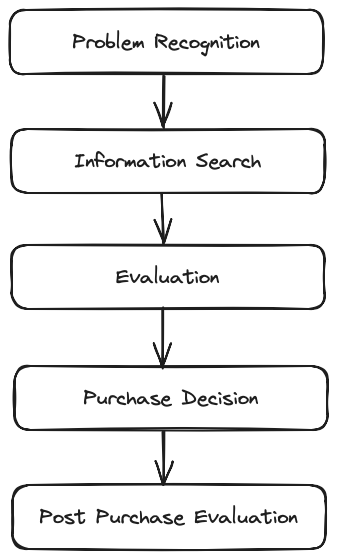
Figure 1: A simple model of the consumer buying process by Engel et al. (1990), emphasizing the iterative cycle of recognition, search, evaluation, and purchase.
With the evolution of the socially responsible consumer—those weighting societal and environmental externalities alongside private utility—the literature evidences segmentation in ethical saliency depending on product category and aspect. Previous research highlights both the proliferation of intention–behavior gaps, perpetuated by information asymmetries and habitualization, and the conditional efficacy of accessible sustainability information, predominantly among already ethically-inclined cohorts.
Experimental Design and Methodology
The authors deploy a task-based, mixed-method protocol with N=308 participants engaged in real-world purchasing scenarios. The key methodological innovation is the integration of a pre–post assessment of importance ratings for randomly assigned ethical aspects across various products, embedded within active search tasks conducted via an instrumented web search engine. Participant segmentation leverages the Ethically Minded Consumer Behavior (EMCB) scale via KMeans clustering with PCA visualization, yielding three intention strata (low, medium, high). Search log analysis, factor analysis of subjective experience (EFA with KMeans clustering on appraisal responses), and qualitative comment coding (human-verified, AI-assist via GPT-4o) provide multimodal analytic coverage.
Strong statistical controls preclude attributions to product category or aspect per se. Linear models, ANOVA, and conditional effects (emmeans) analyses supplement cluster-level and behavioral log regressions.
Key Empirical Findings
Ethical Importance Ratings and Search
The central finding is a statistically significant post-search increase in the assigned importance of ethical aspects across the sample (mean change =+0.31, p<.001), independent of product category or attribute class. However, detailed post-hoc analyses reveal no specific aspect or product category as a main driver, suggesting the effect is orthogonal to these variables.
Role of Ethical Motivations
Contrary to intuition and parts of the extant literature, the shift in importance ratings (Δ-importance) is not driven by baseline ethical orientation (EMCB clusters)—high-EMCB and low-EMCB users show parity in search-induced change (F(2,308)=1.93, p=.147). Instead, high-EMCB participants display higher initial importance ratings but not greater change.
Search Activity and Process Appraisal
Raw behavioral metrics (query count, URL count, dwell time) are not predictive of importance change. Rather, subjective appraisals extracted from the post-task survey exhibit high explanatory power. Two latent factors crystallize:
- Decision-Making (Recognition): Awareness of knowledge or decision gaps, need for additional information, and uncertainty.
- Sense-Making (Ease): Perception of the search as tractable, available, and comprehensible, including trustworthiness of discovered information.
Regression analysis demonstrates that both factors independently and significantly predict change in importance, with decision-making recognition more influential for low-EMCB participants (interaction β=−0.28, p<0.05). Sense-making positively affects all user strata. Information overload, information asymmetry (trust/credibility), and lack of actionable or comparable data emerge as recurring qualitative and quantitative barriers.
Qualitative Insights
Thematic analysis of open-ended comments corroborates quantitative findings: participants who explicitly recognize previously unacknowledged gaps (regardless of prior intention) recalibrate ethical salience; those encountering access or trust barriers do not. Ease of sense-making (i.e., information transparency, clear sustainability claims) catalyzes positive attitudinal change; information turbulence, cognitive load, and skepticism suppress it.
Theoretical and Practical Implications
The results demand a paradigm shift in both academic modeling and system design for ethical consumption:
- Responsible Consumption as Partial Information Problem: This work reconceptualizes responsible consumption as a sense-making problem under partial information, challenging the sufficiency of intention-based and pure exposure models.
- Prioritization of Cognitive Triggers Over Motivation: The critical lever is activating consumer recognition of decision-relevant gaps—irrespective of their a priori ethical orientation.
- Design of IR Systems and E-Commerce Interfaces: For practical impact, IR system designers should expose informational gaps, increase signal-to-noise ratio for critical ethical metadata, and facilitate trust calibration over attribute comparisons. Applications include facet-driven ethical tags, knowledge context overlays, and viewpoint-diverse retrieval methodologies.
- Regulatory and Platform-Level Interventions: Mitigating information asymmetry and green-washing requires regulatory oversight ensuring data transparency and third-party verifiability.
Discussion and Directions for Future Research
While search intervention robustly shifts ethical importance ratings (explaining 10% of variance in a complex behavioral outcome), the modest effect size indicates the presence of other latent factors (e.g., price sensitivity, habitual inertia, or structural market features). Social desirability bias is a potential confounder, especially given the monetary incentivization and self-report regime in the study. Future developments should deploy implicit attitude assessments, A/B test IR interface augmentations (e.g., query priming, decision visualization), and field experiments in longitudinal frameworks to corroborate and extend these findings. Integrating frameworks from sense-making theory and information foraging in responsible consumption contexts is a promising theoretical direction.
Conclusion
This study provides compelling empirical evidence that search-driven change in the ethical salience of product attributes is fundamentally mediated by subjective recognition of knowledge or decision-making gaps and the consumer’s capacity for sense-making. Motivation and effort are necessary but not sufficient. The main theoretical contribution lies in framing responsible consumption as a tractable information problem, modifiable via targeted IR, e-commerce, and regulatory interventions. As the epistemic environment of consumers becomes increasingly complex and adversarial, system-level focus must shift toward cognitive and metacognitive triggers to foster sustainable behavioral change.

