- The paper introduces a framework that quantifies resilience as the maximum disturbance tolerated and effort as the minimum control input required.
- It employs robust optimization and scenario-based methods to handle linear and nonlinear systems under temporal logic constraints.
- The approach bridges multi-objective optimization with formal synthesis, providing actionable insights for safety-critical control applications.
Resilient and Effort-Optimal Controller Synthesis under Temporal Logic Specifications
Introduction
This work provides a rigorous framework for synthesizing controllers for perturbed dynamical systems under finite temporal logic specifications, focused on two central metrics: resilience (the maximum disturbance the system can withstand while satisfying its specification) and effort (the minimum input bound necessary to achieve specification satisfaction under disturbances). The novelty lies in the formalization and tractable computation of these metrics under input constraints, the explicit quantification of effort-disturbance trade-offs, and the algorithmic synthesis of controllers maximizing resilience subject to input limitations.
The paper considers discrete-time control systems, both linear and nonlinear, subject to additive bounded disturbances and input constraints. Trajectory behavior is specified via temporal logic requirements, with specifications encoded as (typically polytopic or LTLf) constraints over finite horizons. The resilience metric gψ is defined as the supremum disturbance μ such that there exists a controller ensuring all system trajectories remain within the specification under all disturbances with ∣∣d∣∣∞≤μ, subject to input bounds. The effort metric hψ, dually, seeks the minimum control bound ε required to robustly satisfy the specification under a prescribed disturbance level μ0.
For practical deployment, a Pareto-type resilience-effort trade-off is formalized: maximizing a weighted combination w1μ−w2ε, yielding the set of optimal controllers that interpolate between resilience maximization and effort minimization.
Theoretical Results
Linear Systems and Exact Synthesis
For linear time-varying (LTV) systems with linear controllers and polytopic temporal specifications, the paper derives an exact characterization of the resilience-effort trade-off as a tractable robust optimization problem, ultimately reducible (via Farkas' lemma and constraint aggregation) to a finite (polynomial or linear, depending on controller structure) program over the controller parameters and the disturbance/input bounds.
The Pareto-optimal trade-off between resilience and effort admits closed-form expression in the following form:
ε,μ,α1,α2,P≥0maxw1μ−w2εsubject toPAb=μE(α1), PBb≤F(x,α1,α2,ε)
where all variables and matrices are constructed to encode the trajectory/state/input constraints over the time horizon.
The exactness and computational tractability extend to open-loop controllers, for which the program reduces to bilinear/linear depending on the variables. These formulations facilitate the systematic exploration of the full resilience-effort Pareto frontier.
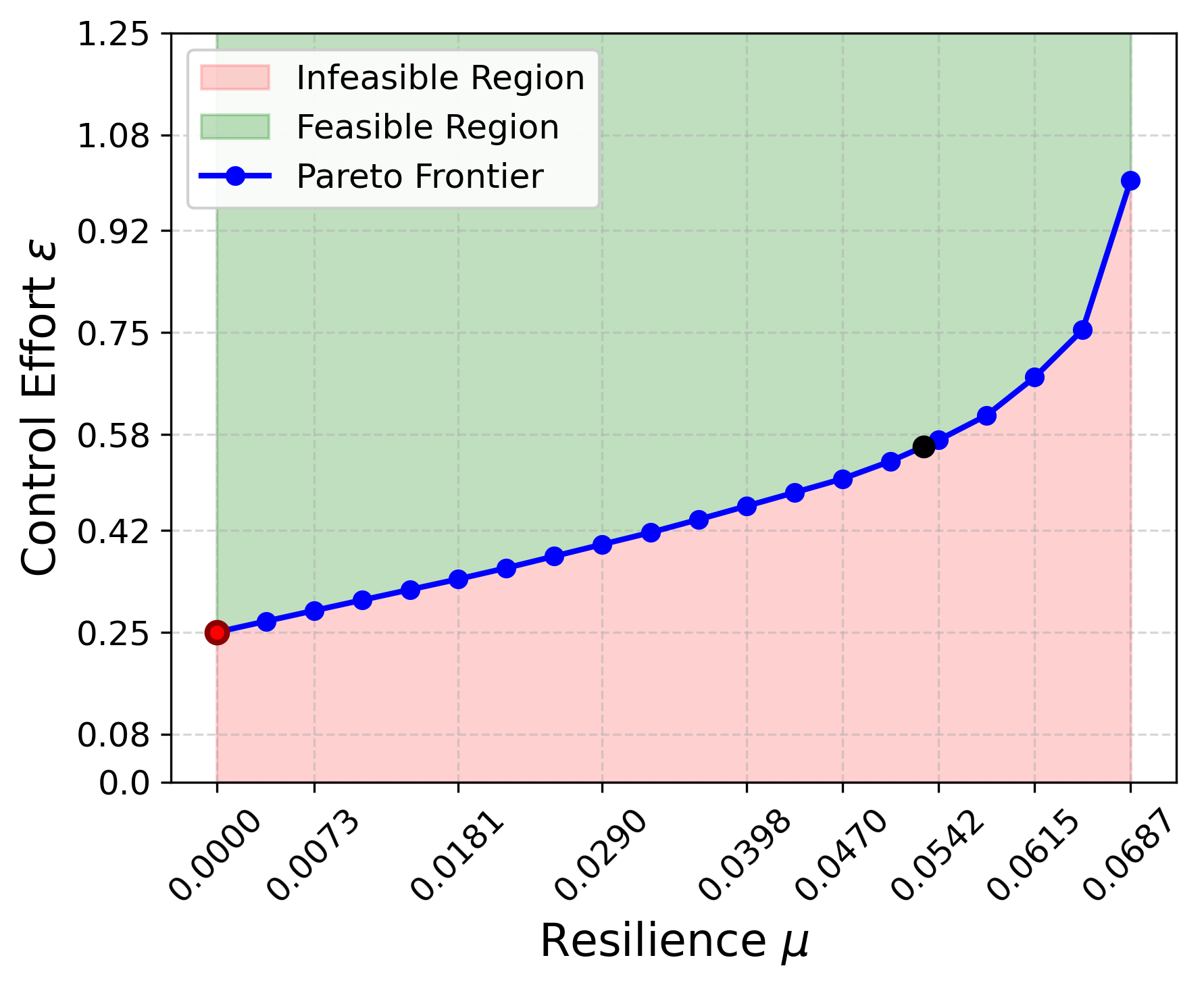
Figure 1: Illustration of the Pareto curve in blue which corresponds to the optimal trade-off for resilience and effort metric for controlled trajectories of the robot under the specification ψ.
Nonlinear Systems and Scenario-Based Robust Optimization
For nonlinear systems or specifications, the resilient and effort-optimal synthesis problems are nonconvex and in general computationally intractable. The paper leverages scenario-based optimization, sampling instances of the disturbance space and enforcing robust satisfaction across all samples. The resulting solution enjoys probabilistic generalization guarantees: for a chosen confidence level gψ0, and gψ1 disturbance samples, the violation probability of the returned controller can be explicitly upper bounded as a function of the scenario complexity and gψ2.
This scenario approach is model-free—it requires only access to system rollouts for sampled disturbances, not explicit system dynamics.
Numerical Evaluation and Case Studies
Several case studies demonstrate the applicability and tightness of the proposed framework:
- Mobile Robot: For a 2D integrator with temporal logic constraints, both closed-loop and open-loop controllers are synthesized. The resilience-effort Pareto curve precisely delineates the feasible (green) and unachievable (red) operating regions, with minimal effort and maximum resilience points highlighted.
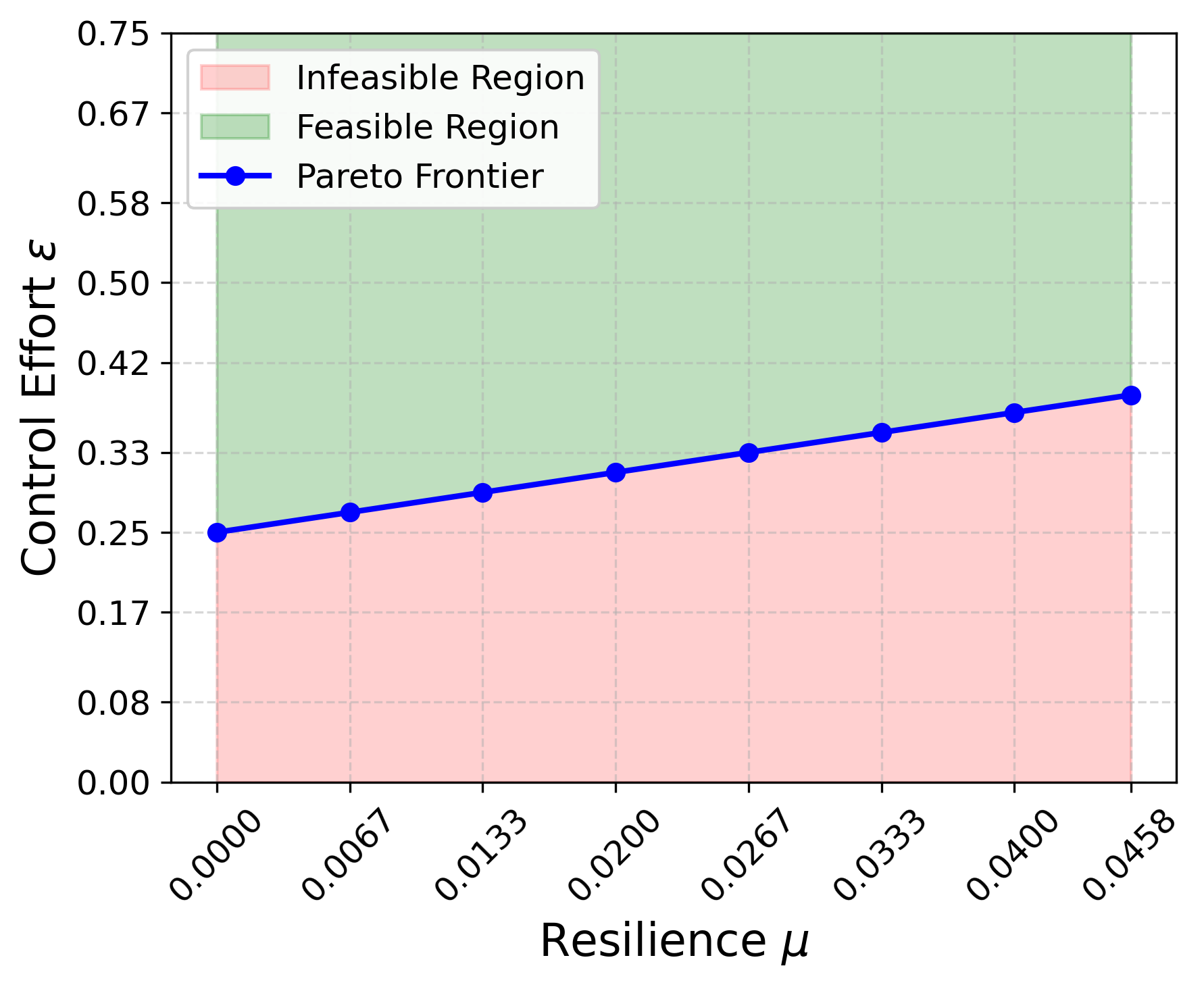
Figure 2: Illustration of the Pareto curve in blue for the open-loop controller case for the mobile robot, showing achievable and infeasible zones.
- Adaptive Cruise Control: Nonlinear system templates are used with scenario optimization. For example, optimizing with gψ3 disturbance samples, the resilient controller robustly satisfies reachability and safety specifications with a violation probability below 0.046 at 99% confidence.
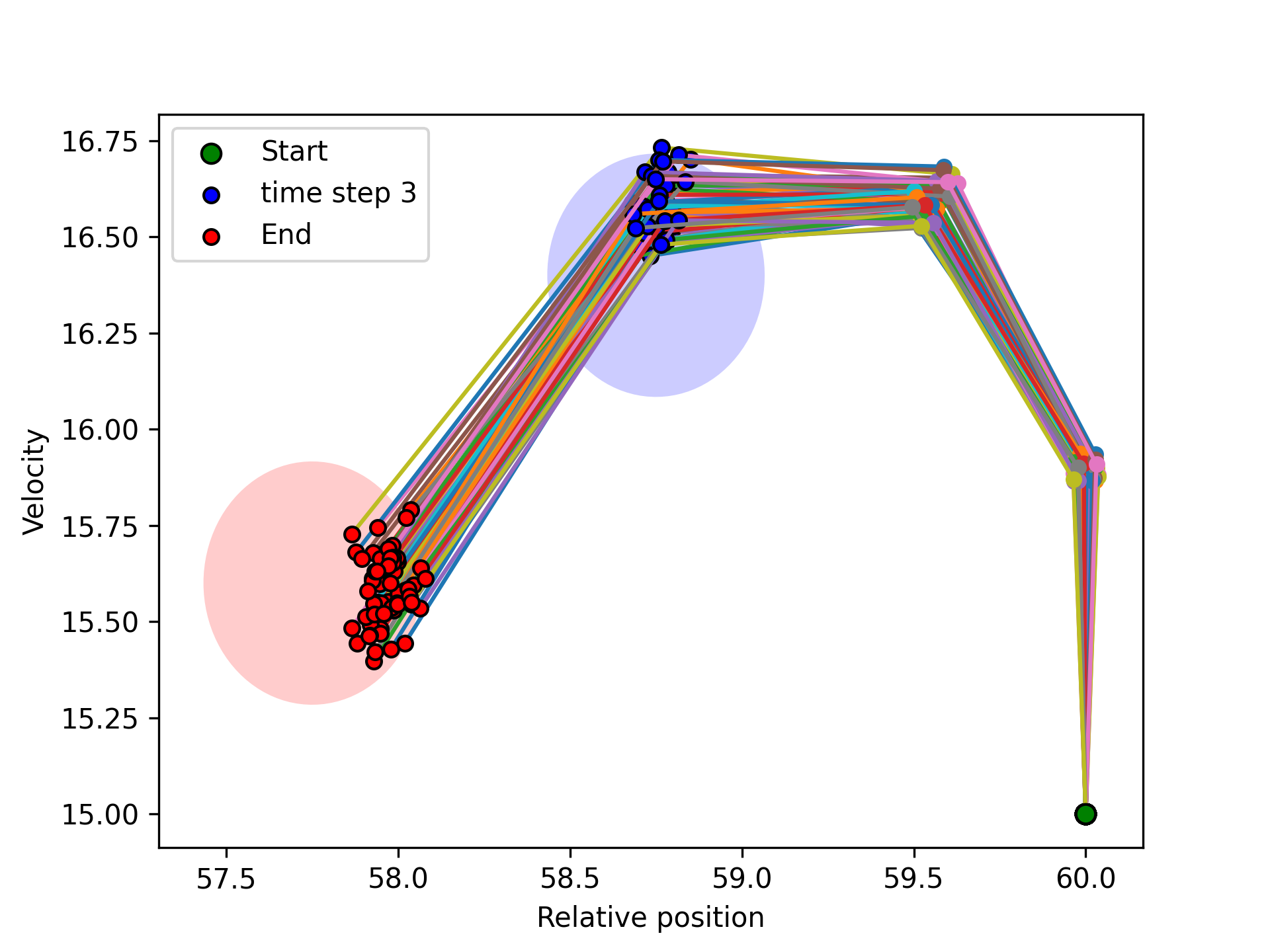
Figure 3: Sample trajectories for adaptive cruise control, showing robust specification satisfaction under the synthesized resilient controller.
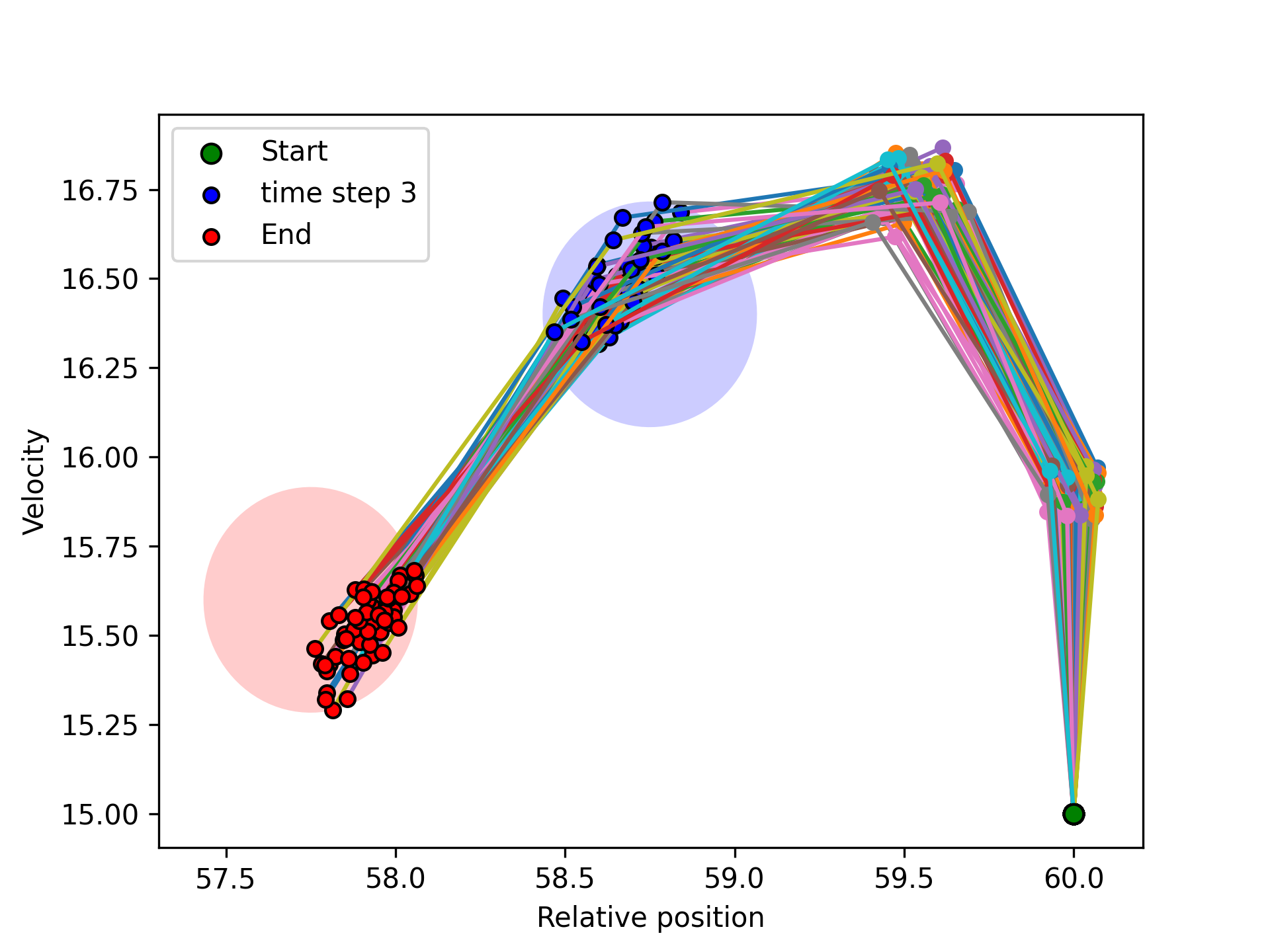
Figure 4: Sample trajectories for adaptive cruise control with a polynomial controller, showing improved resilience compared to linear control.
- Collision-Avoidance: The framework robustly quantifies maximal disturbance and designs control to ensure guaranteed safe operation (minimum inter-vehicle distances) in intersection scenarios with adversarial disturbances.
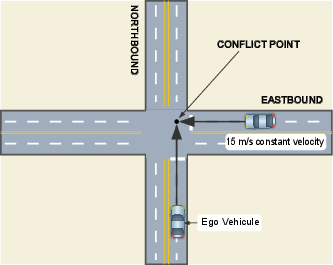
Figure 5: Illustration of the collision-avoidance scenario between the ego and intruder vehicles.
- Synchronous Generator Regulation: The methodology is demonstrated on a nonstationary (LTV) model of a synchronous generator with automatic voltage regulation, synthesizing open-loop inputs that ensure robust stabilization and reference tracking.
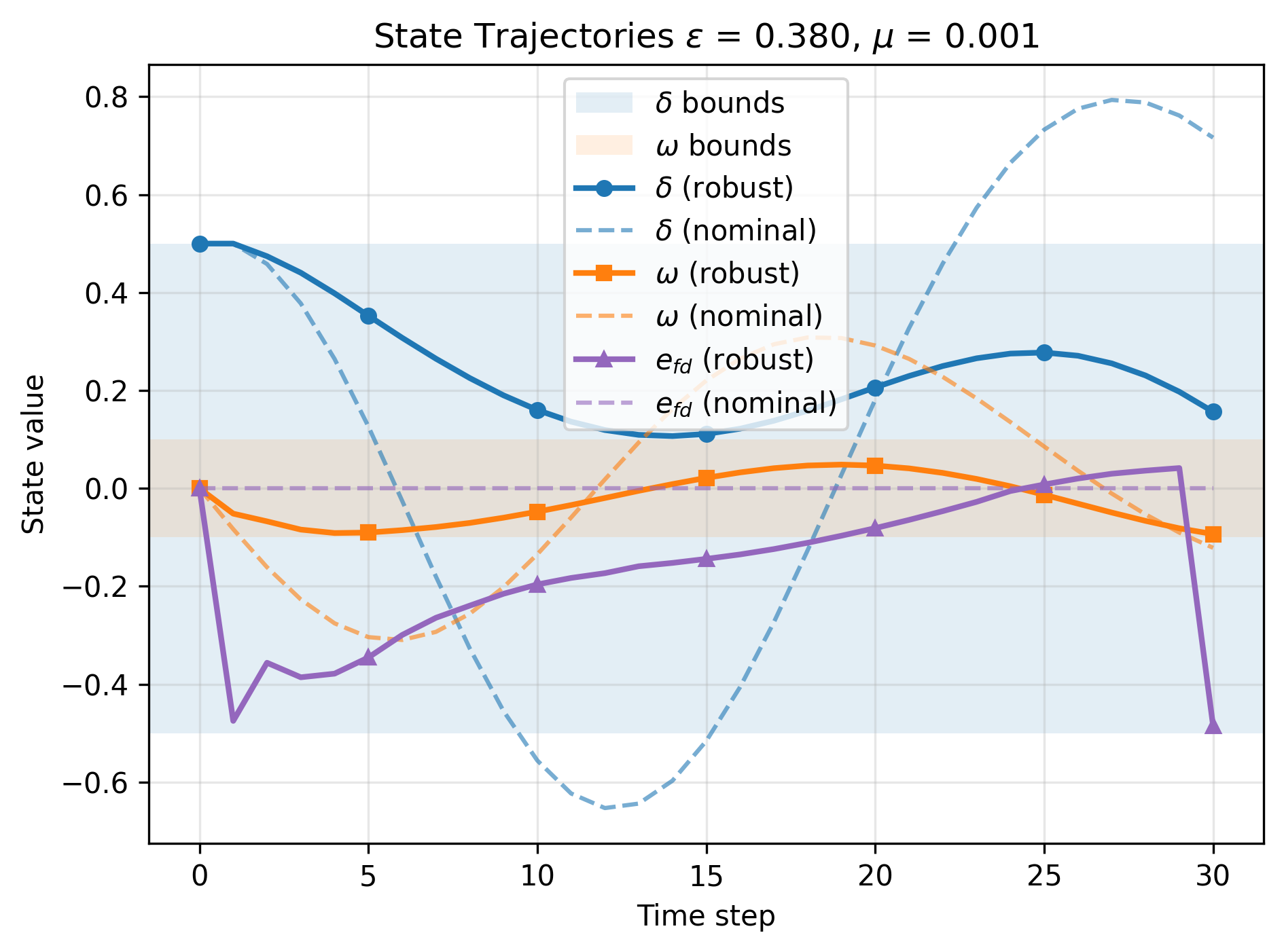
Figure 6: State trajectories of a synchronous generator, illustrating satisfaction of bounds on angle, speed, and excitation field voltage.
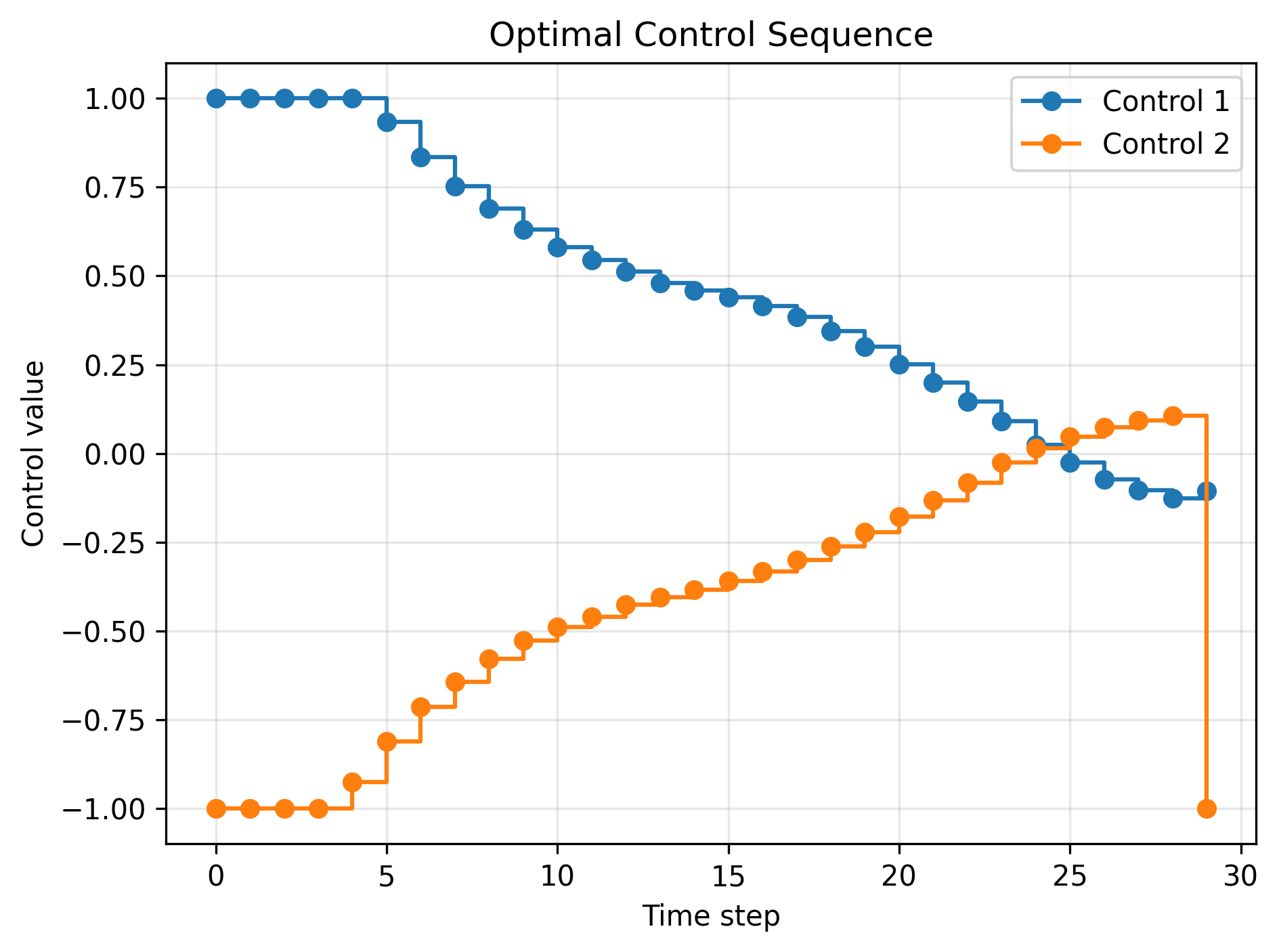
Figure 7: The synthesized open-loop control inputs (mechanical torque and AVR reference voltage) for the resilience-optimal trajectory.
Implications and Future Directions
The explicit quantification of resilience and effort, and the tractable synthesis of controllers achieving the resilience-effort trade-off, is foundational for safety-critical CPS domains. It enables principled controller deployment where environmental uncertainties and strict actuation bounds coexist with rich temporal specifications.
On the practical side, the framework supports deployment in domains such as autonomous robotics, vehicle safety systems, and power system operation, as evidenced by the diverse case studies.
Theoretically, the formulation exposes deep connections between robust control, temporal logic synthesis, and multi-objective optimization. The scenario-based approach opens avenues for risk-aware controller synthesis even in the absence of tractable system models. Extensions to interconnected systems, continuous-time domains, and compositional (assume-guarantee) synthesis are direct future research avenues.
Conclusion
This work establishes a comprehensive and tractable methodology for resilience and effort-optimal control synthesis under temporal logic constraints, providing both exact (for LTV/linear cases) and probabilistically-certified (for nonlinear, nonconvex, or black-box cases) guarantees. The proposed metrics and synthesis paradigms set the stage for future advances in robust temporal logic control, including distributed and continuous-time generalizations.
Reference:
"Resilient and Effort-Optimal Controller Synthesis under Temporal Logic Specifications" (2604.10680)