- The paper introduces a formal framework that quantifies resilience as the maximal disturbance amplitude a system can tolerate while meeting STL specifications.
- It leverages advanced trajectory-envelope bounds using Jordan canonical decomposition to obtain tighter estimates on perturbed system trajectories.
- Scenario optimization approximates worst-case robustness, with validations on case studies such as DC motors, temperature regulation, and collision avoidance.
Temporal Logic Resilience for Continuous-time Systems
Introduction
The paper presents a formal framework for computing a lower bound on the resilience of continuous-time (non)linear systems subject to external disturbances, with guarantees of satisfaction for signal temporal logic (STL) specifications (2604.14714). Crucially, resilience is characterized not as robustness—quantifying specification satisfaction under fixed disturbance—but as the maximal disturbance amplitude a system can tolerate, starting from an initial state, without violating STL constraints. This distinction enables a formal, quantitative assessment of disturbance tolerance, foundational for safety-critical cyber-physical systems tasked with meeting temporal logic specifications under uncertainty.
The system is defined as Σnl=(X,D,f), evolving under additive disturbance d, with D=B∞(ε) representing the admissible disturbance set as an ∞-norm ball of radius ε. STL specifications are specified via recursive Boolean and temporal operators. The satisfaction and robustness metrics ρψ are central, with robustness evaluated by a Lipschitz continuous metric whose sign indicates specification satisfaction, and whose magnitude signals the degree of satisfaction or violation.
The resilience function gψ(x0) is defined as the supremum disturbance radius ε for which all system trajectories from x0 under disturbances remain within B∞(ε) and satisfy d0. This formalization translates the resilience question into a maximization problem with an infinite constraint set—requiring satisfaction across all admissible disturbance signals.
Tight Bounds on Perturbed Trajectories
To enable computational tractability, the paper develops trajectory envelope bounds leveraging Jordan canonical form decomposition and absolute-value matrix methods. The Jordan-based approach yields time-varying, tight bounds on perturbed trajectories, forming envelopes that outperform classical element-wise matrix bounds and Grönwall-type estimates in conservatism and precision, as illustrated in the comparative results.
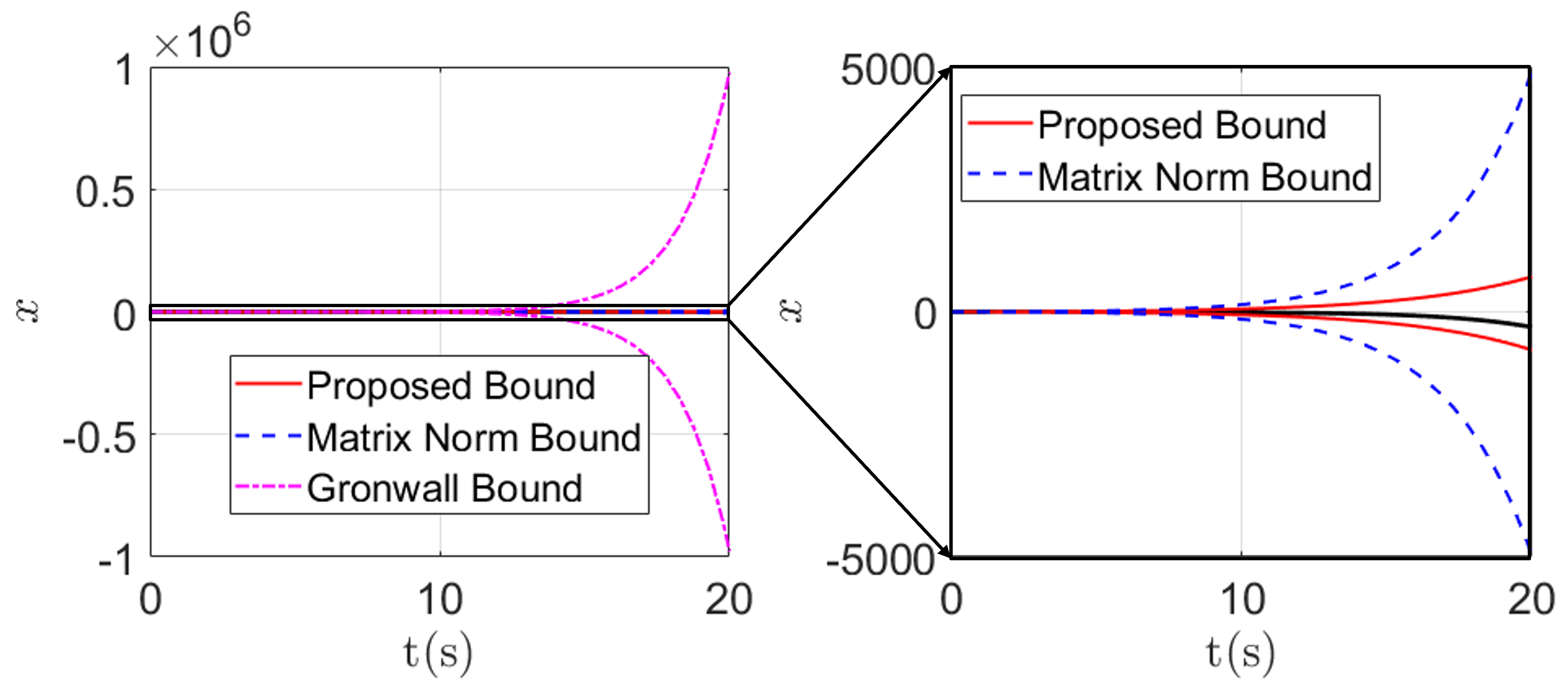
Figure 1: Comparison of bounds obtained using the proposed approach, element-wise absolute-value bounds, and Grönwall-based estimates.
The bounds, d1, encapsulate all possible disturbed trajectories within a Minkowski-summed envelope. Lipschitz continuity of d2 over this envelope enables scenario-based optimization for robust satisfaction checking—transforming the infinite constraint problem into a tractable sampled scenario-based problem, with explicit tightness guarantees.
Scenario Optimization for Computing Resilience
The framework uses scenario optimization to approximate the minimum robustness over the disturbance envelope. By sampling d3 disturbance instances and constructing d4-balls, the paper guarantees specification satisfaction if the worst-case scenario robustness plus the Lipschitz-induced d5 margin remains nonnegative. This method bridges robust optimization and scenario-based solution accuracy, with formal alignment to performance bounds established in previous works.
Extension to Nonlinear Systems
The framework extends to nonlinear systems via local linearization, with the resilience metric corrected for the residual (Hessian) approximation error. The method remains conservative, valid within a compact neighborhood of the equilibrium, and suggests possible extensions via piecewise linearization or global set-based reachability techniques—such as zonotope methods—to mitigate conservatism for more general nonlinear systems.
Case Studies
DC Motor
The DC motor case examines safety and reachability STL constraints, computing resilience for multi-dimensional disturbances. The proposed envelope-based bounds yield maximum admissible disturbances (d6 for safety, d7 for reachability) substantially higher than absolute-value-based methods, which are shown to be overly conservative. Simulation results confirm specification satisfaction for all perturbed trajectories.
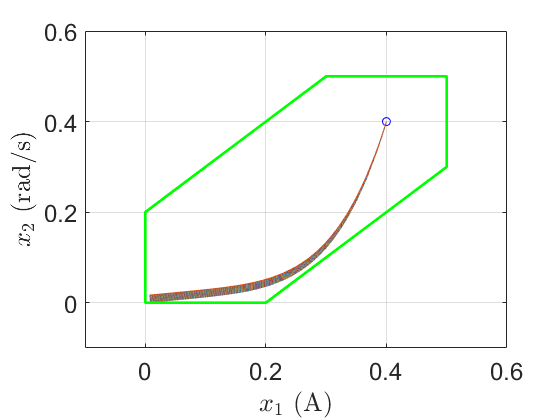
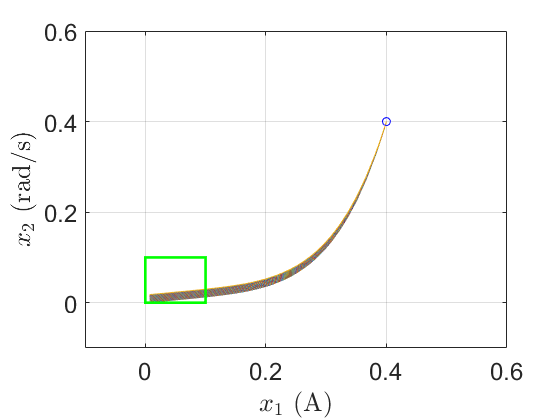
Figure 2: d8 (green boundaries indicate satisfaction of safety specification).
Temperature Regulation
A linear building temperature regulation model is analyzed, with STL constraints on room temperature ranges across time intervals. The computed maximal external disturbance is d9C, validated across 1000 randomly sampled trajectories.
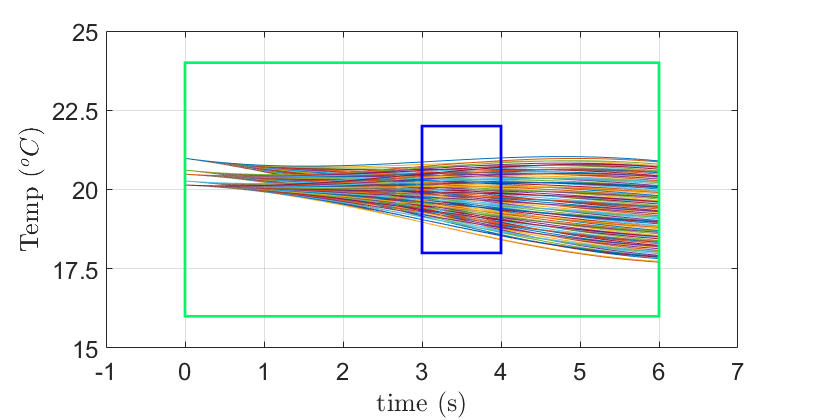
Figure 3: Evolution of perturbed temperature trajectories, satisfying both D=B∞(ε)0 and D=B∞(ε)1 specifications.
Nonlinear Example
A nonlinear damped oscillator system is evaluated, requiring eventual reachability and persistent safety/avoidance. Using the linearization-corrected resilience metric, the maximal disturbance is D=B∞(ε)2, with all sampled perturbed trajectories satisfying the compound STL specification.
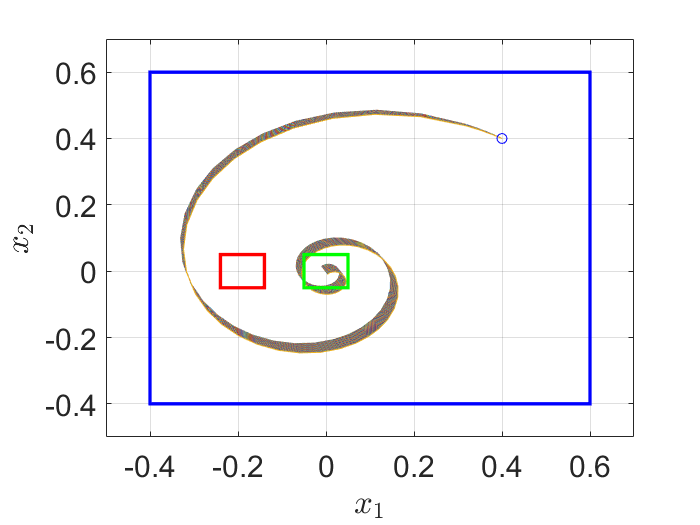
Figure 4: Evolution of 1000 perturbed trajectories starting from D=B∞(ε)3. Boundaries shown for unsafe, target, and safe sets.
Intersection Collision Avoidance
A traffic intersection scenario involving a fire truck and an autonomous vehicle is investigated. The resilience metric computes the maximal velocity disturbance (D=B∞(ε)4 m/s) tolerated by the control system while guaranteeing collision avoidance STL specification. Simulations demonstrate specification satisfaction at the computed resilience threshold, and violation when exceeding this threshold, underscoring the practical relevance of the proposed metric in formal safety assurance.
Implications and Future Directions
The framework rigorously formalizes disturbance-tolerance for continuous-time systems under STL. It enables practical verification for cyber-physical systems in real-world scenarios—where formal safety guarantees must encompass stochastic and worst-case disturbances. The envelope-based bounds and scenario optimization methodology are theoretically robust and computationally scalable, but conservatism remains in global nonlinear settings.
Potential developments include integrating interval-based STL monitoring for robustness within deviation polytopes, extending piecewise and zonotope-based reachability for global nonlinear systems, and refining scenario-based approaches for tighter probabilistic performance guarantees.
Conclusion
This work presents a formal and computational approach to quantifying resilience for continuous-time systems with respect to STL specifications, enabling explicit calculation of maximal disturbance tolerance. The trajectory-envelope methodology, validated across diverse case studies, offers a practical synthesis of formal logic and robust optimization for safety-critical system verification. Future work should address further reduction of conservatism for nonlinear systems and integrate advanced reachability techniques to enhance applicability across broader classes of dynamical systems.