- The paper introduces vibe-driven model-based engineering, a methodology integrating model-driven engineering and LLM-based vibe coding for adaptive software development.
- Its workflow combines traditional modeling, AI-augmented model refinement, and model-guided vibe coding to balance rapid prototyping with reliability.
- It establishes a unified protocol (MCP) and agent skills to enable seamless integration between AI agents and modeling tools, ensuring traceability and auditability.
Vibe-driven Model-based Engineering: Integrating AI and Modeling for Adaptive Software Development
Introduction
Vibe-driven model-based engineering (VD-MBE) is a methodology that systematically integrates model-driven engineering (MDE) and LLM-powered "vibe coding" to address the increasing complexity, heterogeneity, and velocity of modern software development. The premise is that while LLMs and AI-powered agents can accelerate development—especially via natural language specifications—modeling remains indispensable for ensuring software reliability, maintainability, and systematization. VD-MBE advocates for a model-centric workflow, flexibly incorporating deterministic code generation, AI-augmented modeling, and AI-based code synthesis, orchestrated according to scenario requirements, user expertise, and infrastructure constraints.
Background: MDE, Low-Code, and LLMs
Traditional MDE and its offspring, low-code development, advance abstraction by enabling automatic code generation from high-level models. This reduces manual effort for common patterns and enhances reliability when validated templates are used. However, the models themselves have become increasingly intricate due to new domain requirements (e.g., advanced UIs, intelligent system features, sustainability), raising the cost and cognitive barrier for adoption. In parallel, LLM-based approaches have gained traction for translating natural language descriptions into running systems—"vibe coding"—but suffer from issues with predictability, security, traceability, and scalable maintainability.
Despite claims that LLMs may make explicit modeling obsolete, the empirical reality is that high-quality low-code platforms and agentic platforms still rely on models and generative templates beneath their AI-generated façades.
VD-MBE Workflows and Key Concepts
VD-MBE proposes that mainline software models (or analogous specifications/designs) remain central to all development paths, with LLMs and agents integrated as assistants, not replacements. Figure 1 summarizes the conceptual workflow landscape.
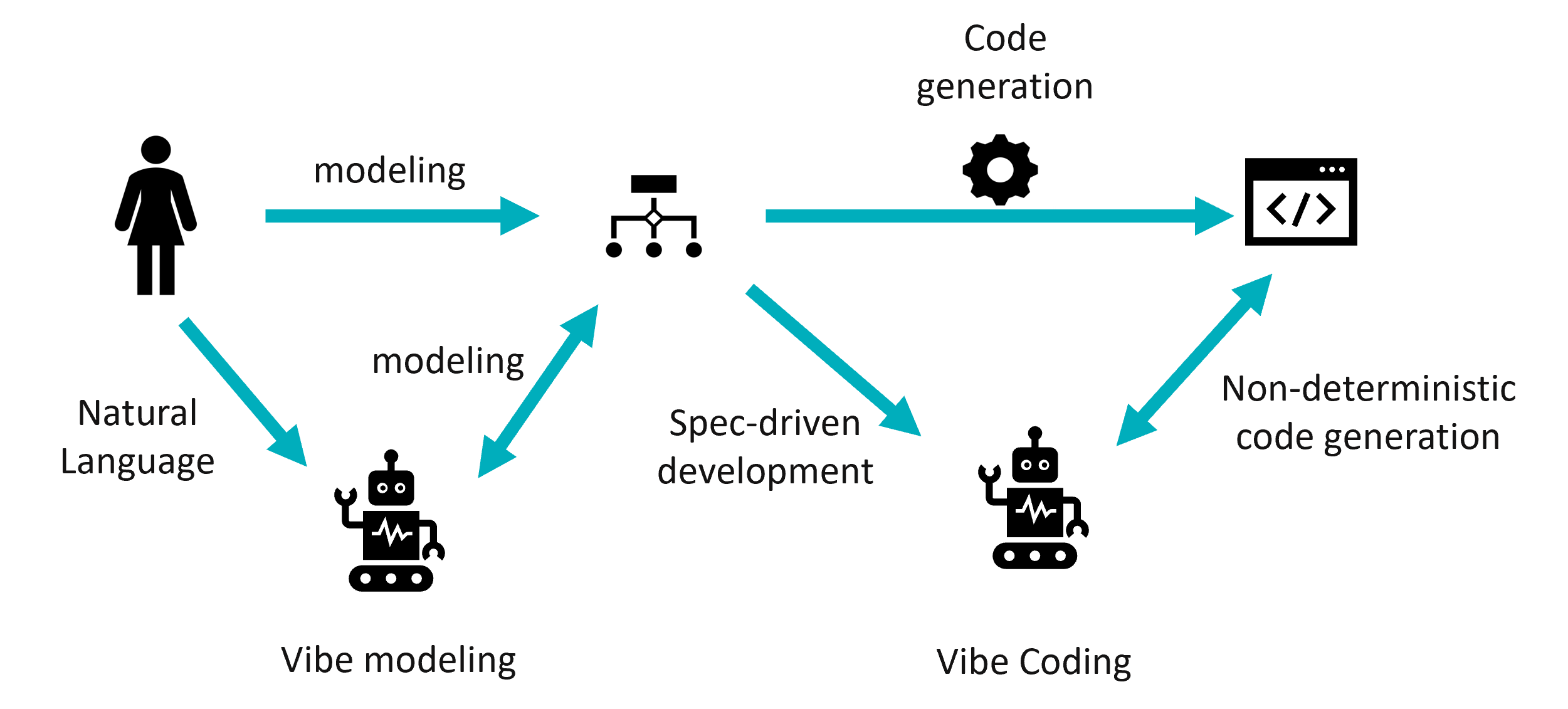
Figure 1: Possible vibe-driven model-based engineering development workflows.
The methodology acknowledges three development workflows:
- Classical Model-based/Low-code Process: Human experts author models, which feed rigorously-tested code generators, yielding deterministic outputs with embodied best practices—removing the need for extensive downstream validation.
- Vibe Modeling Augmentation: Agents or LLMs assist model creation or refinement based on user input, balancing automated generation with human vetting. This leverages AI without sacrificing the reliability guaranteed by model-based generation.
- Model-guided Vibe Coding: Models serve as guides for AI-powered code synthesis, not just as implicit artifacts but as explicit, reviewable, and traceable entities. This mode is essential for domains or UI features not covered by template generators or when extreme flexibility is needed.
Importantly, these three are not mutually exclusive or linear—iterations can transition between them, optimizing for prototyping velocity, production quality, or requirement validation at each project phase.
Infrastructure and Agent Interoperability
A key challenge is enabling seamless interaction between AI agents and modeling tools. VD-MBE identifies two principal integration mechanisms:
- Model Context Protocol (MCP): A standardized protocol allowing agent-driven interaction with external modeling platforms, abstracting away platform-specific APIs. MCP simplifies discovery and invocation of modeling services by exposing them as tools, avoiding the M×N integration problem that would plague agent + tool ecosystems.
- Agent Skills: Workflow-like bundles (documented in manifest artifacts such as SKILL.md), which encapsulate actionable procedures for agents on modeling tools. Skills empower agents with reusable, high-level capabilities and facilitate complex, multi-agent scenarios with explicit governance.
The choice of integration paradigm depends on requirements such as auditable traceability, authentication, skill modularity, and runtime compatibility.
Flexibility and Scenario-Driven Adaptation
VD-MBE is architected for flexibility. It allows project teams to dynamically shift among model-based, AI-augmented, and AI-driven code generation across project iterations, or even within a single system's lifecycle. For instance, robust initial versions can be bootstrapped via deterministic model-based generation and then enhanced via AI-generated UI refinements. Conversely, rapid-prototype iterations could begin with vibe coding, validated through model-based documentation, before converging to a more formalized, model-driven production process.
Theoretical Implications and Challenges
VD-MBE catalyzes a systematic rethinking of how models and LLMs interface in software engineering. Several major open research problems remain:
- Specialized Modeling Agents: Moving past one-shot model inference with LLMs, future advances will require interactive agents capable of dynamic dialogue, disambiguation, and continuous model evolution, possibly coordinated in multi-agent teams. Open questions concern RL protocols for agent training, automatic governance in agent collaboration, and dynamic agent selection pipelines.
- Uncertainty and Traceability: LLM- and agent-generated model artifacts inherently carry uncertainty and provenance metadata. VD-MBE insists on explicit storage of confidence measures and complete traceability for all model evolution—including agent, tool, and human actor attributions.
- Multi-profile Dialogue Adaptation: The methodology must reconcile disparities in stakeholder technical expertise, enabling interaction paradigms ranging from highly abstract (for domain experts) to deeply technical (for software engineers), mirroring the no-code/low-code/MLOps axis.
- Universal Modeling Literacy: Although agent technology can abstract away some technicalities, maximal benefit is realized when human stakeholders possess basic modeling literacy, arguably a core skill for 21st-century interdisciplinary professionals.
Practical Implications
Practically, VD-MBE paves the way for hybridized platforms where modelers, software engineers, domain experts, and AI agents collaborate via a shared, explicit modeling substrate. This enables:
- Enhanced traceability and certification in critical domains (medtech, automotive, etc.) compared to unconstrained LLM code synthesis.
- Faster prototyping with AI assistance without sacrificing reliability and auditability.
- Multi-agent development ecosystems, where specialized agents negotiate, synthesize, and validate models under human supervision.
Conclusion
Vibe-driven model-based engineering articulates a paradigm shift for 2020s-era software development: embracing the acceleration of AI and LLMs, while preserving the foundational role of explicit modeling for reliability, documentation, and communication. By defining rigorous infrastructure standards (MCP, skills), flexible methodological workflows, and a research roadmap addressing agent specialization and traceability, VD-MBE offers a coherent path toward scalable, reliable, and adaptive software engineering in the AI age (2604.10645).