- The paper demonstrates a velocity threshold (v > 2uₚ) where Doppler-shifted spectral overlap activates irreversible cross-decoherence between quantum subsystems.
- It employs a quadratic Gaussian field theory and closed-time-path formalism to separate coherent mediation from noise-driven decoherence effects.
- Experimental projections indicate that superconducting circuits and ultracold atoms can emulate and measure motion-induced correlated decoherence signatures.
Model and Theoretical Framework
The investigated system consists of two spatially separated boundary subsystems (realized as parallel planar interfaces, labeled A and B) immersed in a common, structured bosonic environment. Plate A moves at constant velocity v along the x-direction; Plate B remains static. The inter-plate region is filled with a charged bosonic medium, effectively serving as a shared quantum bath coupled to both boundary modes, ϕA and ϕB (Figure 1).
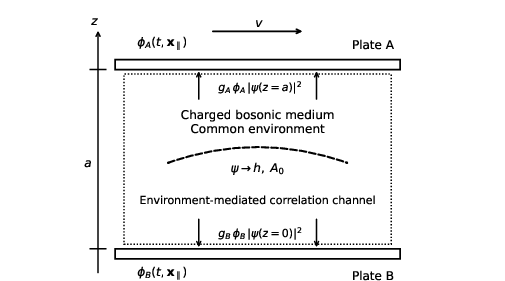
Figure 1: Schematic representation—plate A moves at velocity v, plate B0 is fixed, and the inter-plate medium (with amplitude fluctuation mode B1) acts as a common environment.
The system is modeled by a quadratic (Gaussian) field theory; the boundaries support real scalar surface excitations characterized by a propagation velocity B2 and effective mass B3. The cavity medium is described by a charged complex scalar field coupled to an Abelian B4 gauge field. At low energies, the boundary coupling is dominated by the density response (amplitude fluctuation) of the medium.
Tracing out the environmental degrees of freedom yields a nonlocal (in time and space) influence kernel for the reduced boundary system, decomposed into retarded (coherent mediation) and noise (correlated decoherence) components. Both local and cross-terms in the kernel arise due to the common environment.
Kinematic Threshold for Motion-Activated Cross-Decoherence
A central finding is the emergence of a velocity-controlled kinematic threshold for correlated decoherence. Relative motion modifies the spectra of the boundary modes via Doppler shifts—plate B5's spectral response experiences the shift B6—resulting in the possibility of resonance between excitations on the two plates only if their Doppler-shifted spectral domains overlap. This overlap is realized when
B7
where B8 is the surface excitation velocity.
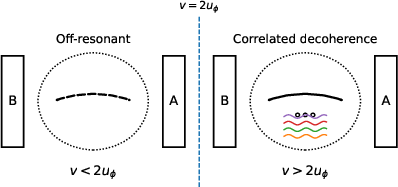
Figure 2: Illustration of the velocity-controlled opening of the correlated decoherence channel, with threshold at B9.
For A0, there is no spectral overlap between the relevant modes (see Figure 3) and thus the dominant resonant, cross-environmental decoherence channel remains closed. When A1 exceeds A2, a finite region in momentum space allows for simultaneous excitation in both boundaries with environmental mediation, activating an irreversible cross-decoherence process.
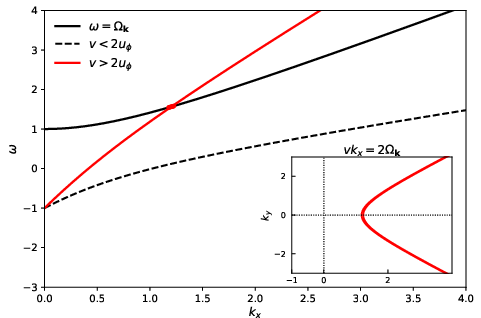
Figure 3: Schematic of the boundary mode spectra. For A3 (dashed), Doppler-shifted and stationary branches do not intersect; for A4 (solid), a resonance shell opens.
Numerically, the leading resonant contribution to the imaginary part of the cross-environmental influence functional is strictly zero for A5 and shows a sharp onset at the threshold (see Figure 4).
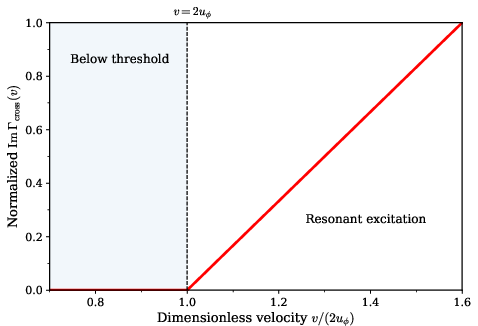
Figure 4: Resonant contribution to the in-out excitation production (A6) as a function of velocity, with abrupt onset at A7.
Environmental Kernel Structure and Decoherence Functional
The influence functional, expressed in closed-time-path (CTP) formalism, yields both retarded and Hadamard (noise) kernels. The off-diagonal elements (cross noise) are directly tied to the spectral properties of the environment evaluated between the plates, encoded in the Hadamard kernel component
A8
where A9 is the symmetrized correlator of the dressed environmental amplitude fluctuation mode.
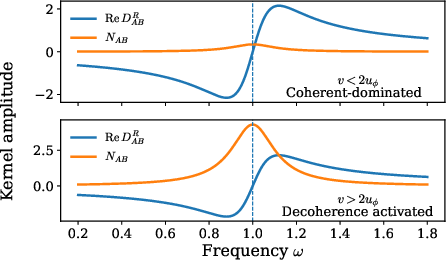
Figure 5: Frequency-resolved retarded (top) and noise (bottom) cross-kernels below and above threshold v0. Coherent mediation persists throughout, but noise is suppressed below threshold.
The cross-noise kernel is highly suppressed below threshold, but above v1, it becomes nonzero with support determined by Doppler-shifted resonance. This leads to pronounced suppression of off-diagonal components of the boundary reduced density matrix, quantified via a coherence factor
v2
with the decay functional v3 scaling with the cross-noise kernel and the system-environment coupling.
Parameter Dependence and Experimental Projections
Finite velocity v4 is the primary control for activating correlated decoherence. The threshold for channel opening, v5, is purely kinematic—independent of separation v6, chemical potential v7, or other bath parameters. Above threshold, the magnitude of cross-decoherence is shaped by the strengths of coupling, environmental spectral weight, and screening, as well as plate separation (which introduces exponential attenuation due to finite environmental correlation length).
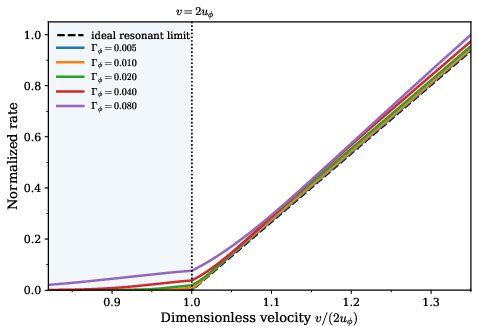
Figure 6: Velocity dependence of the cross-decoherence rate, v8, comparing several linewidths. The threshold is sharpened in the narrow-width limit.
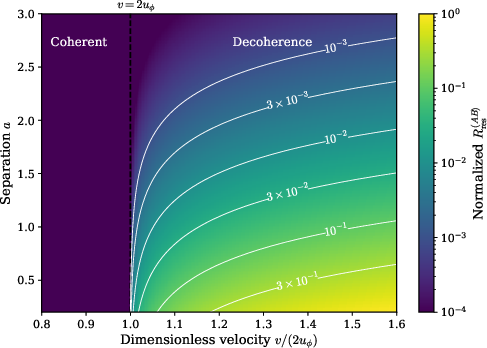
Figure 7: Density plot of resonant cross-decoherence rate vs. velocity and separation. Rate decays exponentially with v9 and shows sharp threshold in x0.
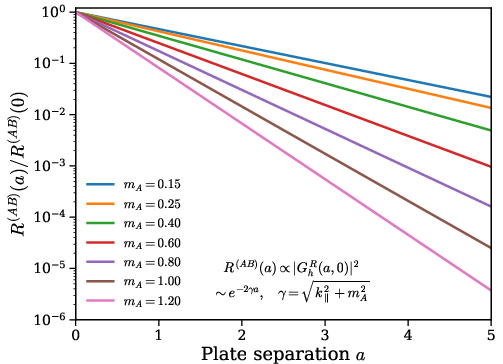
Figure 8: Cross-decoherence rate as a function of x1, for different screening values. Increased screening suppresses correlation length and decoherence.
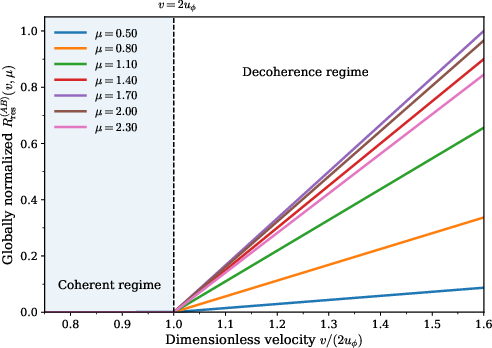
Figure 9: Velocity-dependence of resonant cross-decoherence rate for multiple chemical potentials x2, demonstrating nonmonotonic dependence driven by combined enhancements in coupling and screening effects.
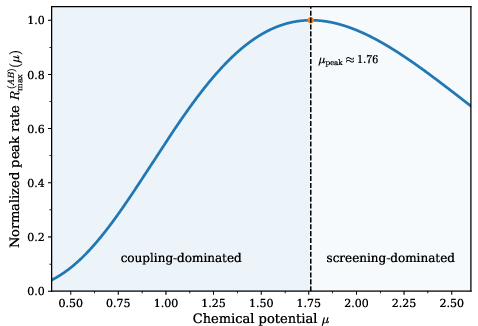
Figure 10: Peak resonant cross-decoherence rate as a function of x3, illustrating maximization at intermediate x4 due to competing system-environment coupling and screening-induced spatial attenuation.
Diverse parameter regimes relevant for ultracold atoms, superconducting circuits, graphene, and plasmonic nanostructures map onto the same dimensionless velocity threshold x5 (see Figure 11).
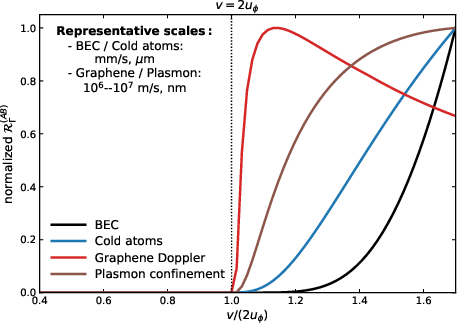
Figure 11: Normalized resonant cross-decoherence rate, x6, vs. x7 across experimental platforms. Universal threshold reflects kinematic origin.
Superconducting circuits with phononic waveguides enable direct emulation of the setup, leveraging synthetic motion (e.g., traveling-wave modulation) to sweep x8 and detect the onset of excess correlated dephasing via joint echo or Ramsey visibility measurements. In ultracold gases, the finding connects to critical velocities for heating and dissipation. In nanophotonic contexts, the results imply sharp onset of nonreciprocal energy transfer or quantum friction.
Implications and Future Outlook
This work introduces a unifying framework showing that the onset of correlated decoherence in spatially separated quantum systems can be tightly controlled by kinematic (Doppler) spectral matching. Below threshold, the common environment mediates predominantly coherent interactions without leading-order irreversible decoherence; above threshold, a resonant cross-noise channel opens, causing rapid loss of coherence between the boundaries. The theoretical connection between in-out excitation rates and the CTP noise functional elucidates the physical mechanism and guides design principles for quantum devices where correlated bath effects are strategically engineered or suppressed.
Extensions to non-Gaussian environments, inclusion of strong-coupling or non-Markovian effects, and generalization to multipartite or extended systems could unlock richer regimes of motion-induced decoherence control. Experimentally, synthetic implementations in circuit QED, nanomechanics, or engineered cold-atom arrays are directly accessible, with thresholded decoherence or noise cross-correlations serving as benchmarks for the framework.
Conclusion
This study establishes a kinematic, velocity-activated threshold for correlated decoherence between spatially separated quantum subsystems sharing a structured environment. The activation occurs only for x9, corresponding to the opening of a Doppler-induced spectral overlap. The identification of this sharp onset and its mapping onto experimentally detectable signatures support its broad significance for quantum information processing, decoherence suppression strategies, and the control of environment-induced correlations in complex quantum devices.
Reference: "Correlated decoherence in a common environment activated by relative motion" (2604.10109)