- The paper shows that the non-Hermitian skin effect persists under both dephasing and amplitude damping, with incoherent processes sometimes enhancing directional transport.
- Experimental quantum walks leveraging polarization and OAM modes enabled a continuous interpolation from coherent to incoherent regimes with precise drift velocity measurements.
- The study reveals order-dependent effects in amplitude damping, highlighting that applying damping after non-Hermitian loss restores and even optimizes the skin effect, informing photonic device design.
Decoherence Resilience of the Non-Hermitian Skin Effect: Experimental and Theoretical Investigation
Introduction
The non-Hermitian skin effect (NHSE) is a nontrivial consequence of non-reciprocal couplings in open quantum systems, manifesting as an extensive localization of bulk eigenstates at system boundaries, thereby inducing strong boundary-sensitive transport. While the NHSE has been well characterized in coherent settings, its dynamical persistence and transformation under decoherence—ubiquitous in realistic, open quantum systems—has remained largely unquantified. This work presents a comprehensive experimental and theoretical study of the NHSE under two canonical decoherence processes—dephasing and amplitude damping—across the full quantum-to-classical crossover in photonic quantum walks (QWs), elucidating unexpected resilience and tunability of non-Hermitian transport under these processes (2604.12739).
The architecture leverages polarization and orbital angular momentum (OAM) degrees of freedom to achieve highly tunable QW protocols with controlled non-Hermitian loss and environmental noise. Photon counting facilitates precise extraction of spatio-temporal probability distributions, enabling direct quantification of drift velocities and skin accumulation.
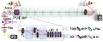
Figure 1: Schematic of the experimental platform for quantum walks with tunable decoherence and non-Hermitian loss, utilizing polarization and OAM modes of heralded single photons.
Experimental Scheme and Implementation
The experimental platform encodes the coin (internal state) in the photon polarization and walker position in OAM modes. Each QW step consists of a polarization coin rotation (half- and quarter-wave plates), a mode-dependent conditional shift (via q-plates), and mode-selective loss (beam displacers and waveplates) to realize tunable non-Hermitian dynamics. Decoherence is induced via probabilistic polarization operations for dephasing, and amplitude damping is realized with tailored waveplate/BBO crystal configurations that implement Kraus operators.
The approach allows a continuous interpolation from fully coherent quantum walks to a classical stochastic regime. A distinguishing feature of this work is the independent tunability and ordering control of decoherence and loss channels for systematic exploration of their interplay with the NHSE.
NHSE Under Dephasing: Persistence and Noise-Enhanced Transport
Dephasing generally destroys quantum coherence without inducing net energy changes. In conventional QWs, this invariably drives a quantum-to-classical transition, erasing ballistic transport in favor of diffusive spreading. In the non-Hermitian regime, the study demonstrates that the NHSE persists robustly under increasing dephasing and, in strong-loss scenarios, is even amplified by incoherence. Quantitatively, the drift velocity of the center of mass first decreases with increasing dephasing at low loss, but then increases monotonically at large loss, reaching its maximum in the fully incoherent regime, which contravenes the expected non-monotonic "Goldilocks" behavior that typically manifests in decoherence-assisted transport optimization.
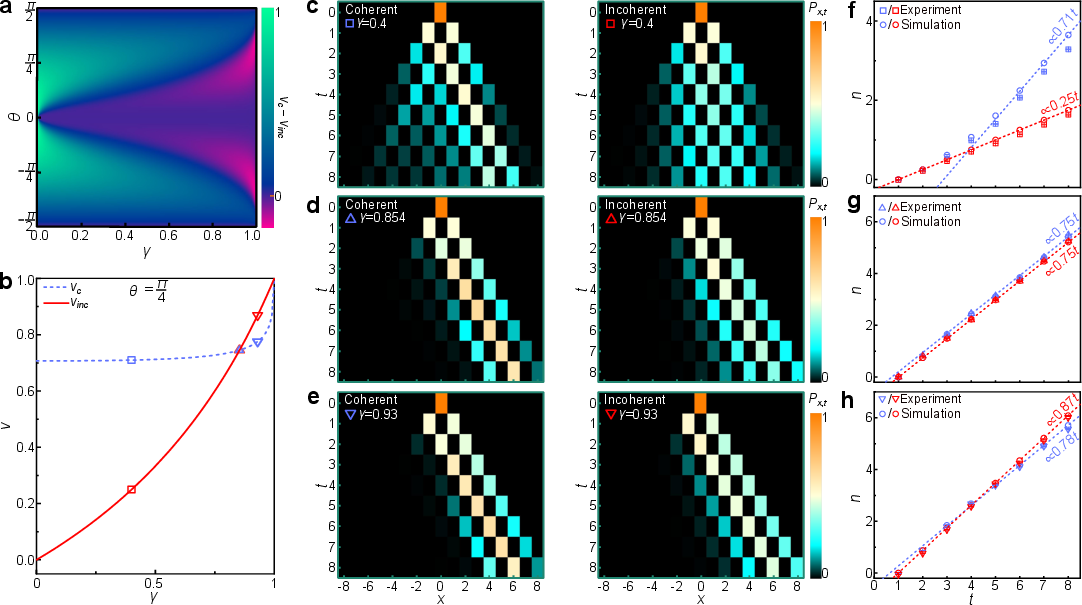
Figure 2: Quantitative measurement of drift velocities and walker probability distributions under dephasing, revealing enhancement at high loss strengths and the persistence of NHSE in fully incoherent dynamics.
At loss strengths γ≳0.85, the observed drift in incoherent quantum walks surpasses the coherent case, producing strong directional transport even when all quantum coherence is destroyed. This establishes that the NHSE is not inherently dependent on quantum coherence and that classical, incoherent processes can amplify non-Hermitian boundary-driven transport.
NHSE Under Amplitude Damping: Order-Dependent Suppression and Restoration
Amplitude damping is an energy-dissipative decoherence channel that irreversibly resets the coin state. Remarkably, the NHSE shows qualitative sensitivity to the ordering between the amplitude-damping channel and the non-Hermitian loss operator. When amplitude damping precedes non-Hermitian loss, the NHSE is strongly suppressed and eventually eliminated as damping strength increases, with walker distributions reverting to classical Gaussian form even in the large-loss regime. In contrast, if amplitude damping is applied after the loss operator, the NHSE persists, and at sufficient loss strengths, decoherence again enhances the drift velocity.
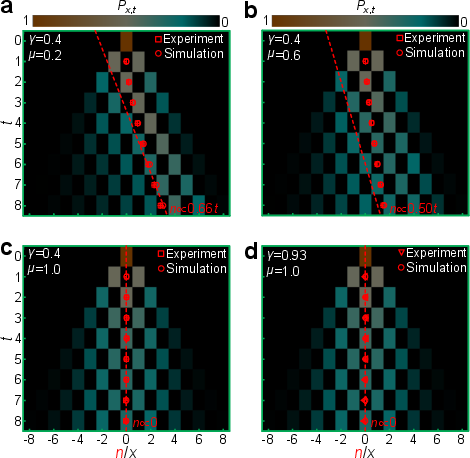
Figure 3: Progressive suppression of the NHSE in quantum walks as amplitude damping strength increases when applied before the non-Hermitian operator; classical Gaussian profiles emerge under full damping.
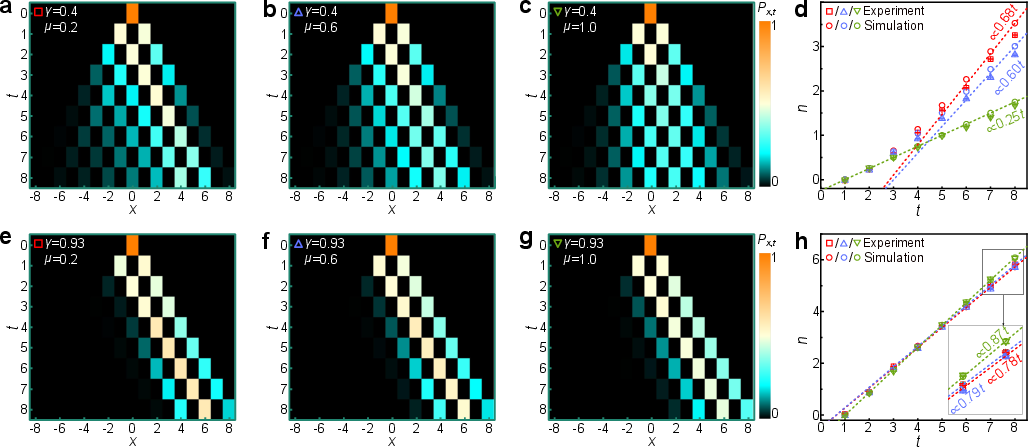
Figure 4: Restoration and even enhancement of NHSE when amplitude damping is applied after the non-Hermitian loss; drift velocities remain finite or increase at high loss and damping.
This order dependence is a direct consequence of the interplay between non-reciprocal dissipative processes and environmental resetting. The NHSE’s resilience is therefore not a trivial property, but rather a consequence of the non-commutativity of noise and system dynamics in non-Hermitian transport.
Numerical Results and Theoretical Framework
Analytical treatment of drift velocities in the strongly non-Hermitian regime aligns with experimental data, confirming the robustness and possible amplification of the NHSE under incoherent conditions. The Markovian reduction of quantum dynamics in the fully incoherent regime preserves the bulk-boundary transport under appropriate noise configurations but can fully suppress it in others, reiterating the non-universality of coherence effects in non-Hermitian transport phenomena.
Results demonstrate that classical dynamics—contrary to intuition from coherent-state preservation requirements—can suffice to generate and even optimize non-Hermitian transport through selective decoherence, depending on the microscopic implementation and process ordering.
Implications and Future Directions
The demonstration that the NHSE can be preserved or enhanced by environmental noise fundamentally reorients the design logic for directional photonic, quantum, and classical devices. Platforms traditionally constrained by unavoidable decoherence can exploit environmental noise as a functional asset for robust transport and programmable flow. Furthermore, the order sensitivity revealed in amplitude damping channels exposes a “noise engineering” dimension for optimizing non-Hermitian functionalities, with ramifications for quantum reservoir computing, active-matter transport, enhanced sensing, and photonic circuitry subjected to environmental fluctuations.
Potential future directions include systematic studies of non-Markovian decoherence, investigation of other non-Hermitian topological phenomena under noise, engineering decoherence-assisted non-reciprocal amplifiers, and harnessing classical stochasticity for transport optimization in high-dimensional and disordered systems.
Conclusion
This work establishes that the non-Hermitian skin effect is not inherently fragile to decoherence but can exhibit remarkable persistence and even enhancement under specific noise channels. The observed order dependence with amplitude damping introduces a new degree of control in the engineering of non-Hermitian transport. These results bridge the quantum-classical divide in open, out-of-equilibrium systems, opening avenues for decoherence-assisted design principles in non-Hermitian and topological materials, photonic devices, and classical simulators.