- The paper establishes that chirp-taper compensation enables sub-femtosecond hard X-ray pulses with bandwidths exceeding 30 eV.
- It employs tailored drive laser shaping and controlled compression to achieve extreme linear energy chirps of up to 350–400 MeV/μm in electron beams.
- The study highlights that these high-intensity, ultrashort pulses can advance pump-probe experiments and coherent control in ultrafast science.
Broadband Hard X-ray Attosecond Pulses from Extremely Chirped Electron Beams
Introduction
The generation of hard X-ray attosecond pulses with broad bandwidth and high intensity remains a pivotal challenge in ultrafast science, especially for site-specific probing of atomic-scale quantum dynamics. This paper presents an experimental demonstration at the Linac Coherent Light Source (LCLS) of sub-femtosecond current spikes in electron beams exhibiting extreme linear energy chirps (up to 350 MeV/μm). Through the application of chirp-taper compensation in undulator magnets, these highly chirped current spikes enable the production of single-spike hard X-ray pulses with bandwidths exceeding 30 eV, a twofold increase over previous single-spike demonstrations. The preserved beam quality at these unprecedented chirp strengths allows efficient free-electron laser (FEL) lasing and further pulse compression, opening new directions in pump-probe attosecond X-ray science and related applications.
Drive Laser Shaping, Collective Effects, and Chirp Generation
Efficient FEL attosecond pulse generation is enabled by forming strong, isolated current spikes in the electron beam. The method relies on drive laser shaping at the photocathode to introduce tailored modulations in the initial electron beam profile. At LCLS, dual-stacked Gaussian pulses generate a quasi-flat-top current profile. A controlled dip is introduced between pulses to seed the microbunching instability, which is amplified through subsequent bunch compression stages and collective effects such as longitudinal space charge.
After acceleration, final compression is achieved in a dogleg section whose R56 is varied to tune the longitudinal phase space of the beam. Strong positive energy chirps, created by space-charge-induced self-fields during compression, result in local energy modulation far surpassing typical FEL tolerances. Measured current spikes at the emission point exhibit more than 100 MeV peak-to-peak energy spread, consistent with a ∼ 350 MeV/μm chirp over tens of nanometers.
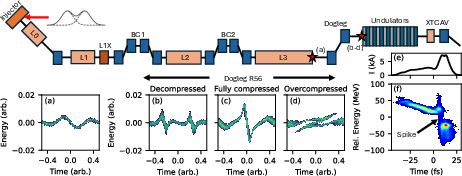
Figure 1: Schematic of the LCLS accelerator complex and illustrations of the electron beam's longitudinal phase space evolution for various compression settings.
Chirp-Taper Compensation and Hard X-ray Pulse Generation
A large linear energy chirp generally degrades the FEL gain process by detuning the electron-radiation resonance. However, this correlated energy spread can be compensated via a tailored positive undulator taper (increase in undulator parameter K along the undulator line), restoring local synchronism between the electrons and the X-ray field.
Experimental scans of R56 reveal that maximal FEL gain (as measured by pulse energy at 9 keV) occurs at dogleg settings where the current spike is both compressed and shows maximal correlated energy spread, provided the undulator taper is matched to the chirp. At the optimal R56, pulse energies and bandwidths are enhanced simultaneously. The chirp magnitude required for optimal compensation, inferred from the taper, is as high as 400 MeV/μm.
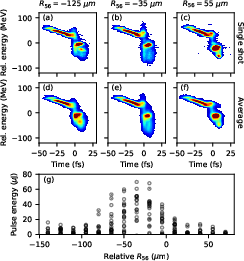
Figure 2: Dogleg R56 scan showing phase space images and matching in-situ X-ray pulse energy, with maximal lasing concurrent with peak chirp-induced energy spread.
Direct scans of the undulator taper at fixed R56 demonstrate distinct peaks in X-ray pulse energy at tapers designed to compensate chirps of R560 MeV/R561m. The application of matched tapers increases the maximum observed X-ray bandwidth to 30 eV—double the bandwidth achieved in prior single-spike hard X-ray FEL experiments, where the limit was R56215 eV. Notably, untapered operation yields lower energy and narrower bandwidth (18 eV), while excessive taper suppresses FEL gain.
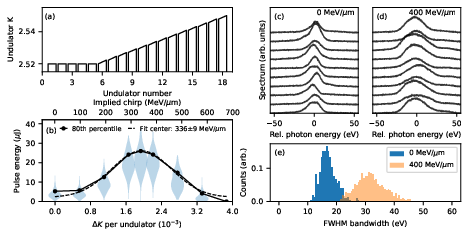
Figure 3: Taper scan results for fixed dogleg R563, revealing pulse energy histograms and broadening of emission bandwidth at optimal taper rates.
Numerical Simulation and Pulse Duration Analysis
To determine whether the experimentally observed bandwidth broadening originates from shorter pulse durations or increased chirp in the emitted X-rays, the authors conduct 3D GENESIS simulations. Isolated Gaussian current spikes with a linear chirp of 350 MeV/R564m are modeled, both with and without ideal undulator taper.
Simulation ensembles confirm that optimal tapering leads to both intensified output power and average pulse durations shortened to R565 200 attoseconds. In contrast, untapered cases produce pulses averaging 300 attoseconds and 10 times less intense. This provides compelling evidence that bandwidth enhancement via chirp-taper compensation leads to genuinely shorter pulses, not merely frequency chirp.
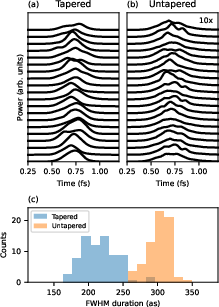
Figure 4: FEL simulations confirm that undulator tapering not only increases output power but also reduces pulse duration relative to the untapered case.
Implications and Future Prospects
The demonstration of hard X-ray attosecond pulses generated from extremely chirped beams has immediate implications for ultrafast X-ray scattering and pump-probe experiments, especially those requiring high energy and temporal localization. The preservation of low emittance and slicewise energy spread at these chirp magnitudes is significant, counter to the prevalent expectation that such extreme chirps would preclude efficient FEL gain.
Moreover, these beams can undergo further post-lasing compression in compact dispersive sections, enabling the direct emission of ultrashort coherent pulses with enhanced field strength. This holds immediate relevance for superradiant emission schemes and for exploiting the strong space-charge fields for direct quantum system excitation on attosecond timescales. The carrier-envelope-phase stability and timing synchronization inherent to such setups are also highly attractive for future developments in coherent control and attosecond metrology.
Comparison with plasma-wakefield-based sources shows that RF linac-based FEL facilities can now match or exceed the capabilities forecasted for next-generation accelerators in key parameters (e.g., chirp amplitude, compression factor), further broadening the practical accessibility of attosecond hard X-ray science.
Conclusion
This work experimentally establishes that broadband, single-spike hard X-ray attosecond pulses (bandwidths R56630 eV) can be reliably produced from RF linac-generated electron beams exhibiting ultra-high correlated energy chirps, with local compensation via undulator taper unlocking efficient FEL gain. The preservation of high slice quality at these extreme chirps and the scalability of the method beyond prior single-spike limits illustrate a robust pathway to next-generation attosecond hard X-ray sources, with broad impact across ultrafast physics, chemistry, and materials science (2604.09969).