- The paper demonstrates that explicit evidence-sensitive supervision, via four distinct evidence categories, improves fact verification in case reasoning.
- It employs a triplet-based approach combining case context, structured claims, and external evidence, achieving AUROC up to 97.43 in radiology tests.
- The findings emphasize that careful supervision design and model architecture are vital for reliable evidence-dependent reasoning and effective transferability.
Case-Grounded Evidence Verification: Methodology, Results, and Implications
Framework and Conceptual Foundations
"Case-Grounded Evidence Verification: A Framework for Constructing Evidence-Sensitive Supervision" (2604.09537) introduces a general methodology designed to enforce evidence-sensitivity in supervised learning, particularly for knowledge-intensive tasks requiring decision grounding in external evidence. The framework formalizes evidence verification as a triplet-based classification problem: the input is a local case context (e.g., clinical report), a structured claim (e.g., binary or multi-state assertion about the case), and external evidence (e.g., sentences from a domain corpus). The model's task is to decide whether the provided evidence supports the claim for that specific case, with the supervision label defined precisely by this relation.
Supervision construction is central: the authors devise a protocol that synthesizes explicit support examples alongside controlled non-support negative samples, including counterfactual wrong-state negatives (where relevant evidence supports an incorrect claim state) and topic-related distractors, all without manual evidence annotation. This construction yields a training distribution where evidence is semantically meaningful, label-defining, and intervention-sensitive, rather than loosely attached or reliant on weak proxies such as retrieval relevance or topical overlap.
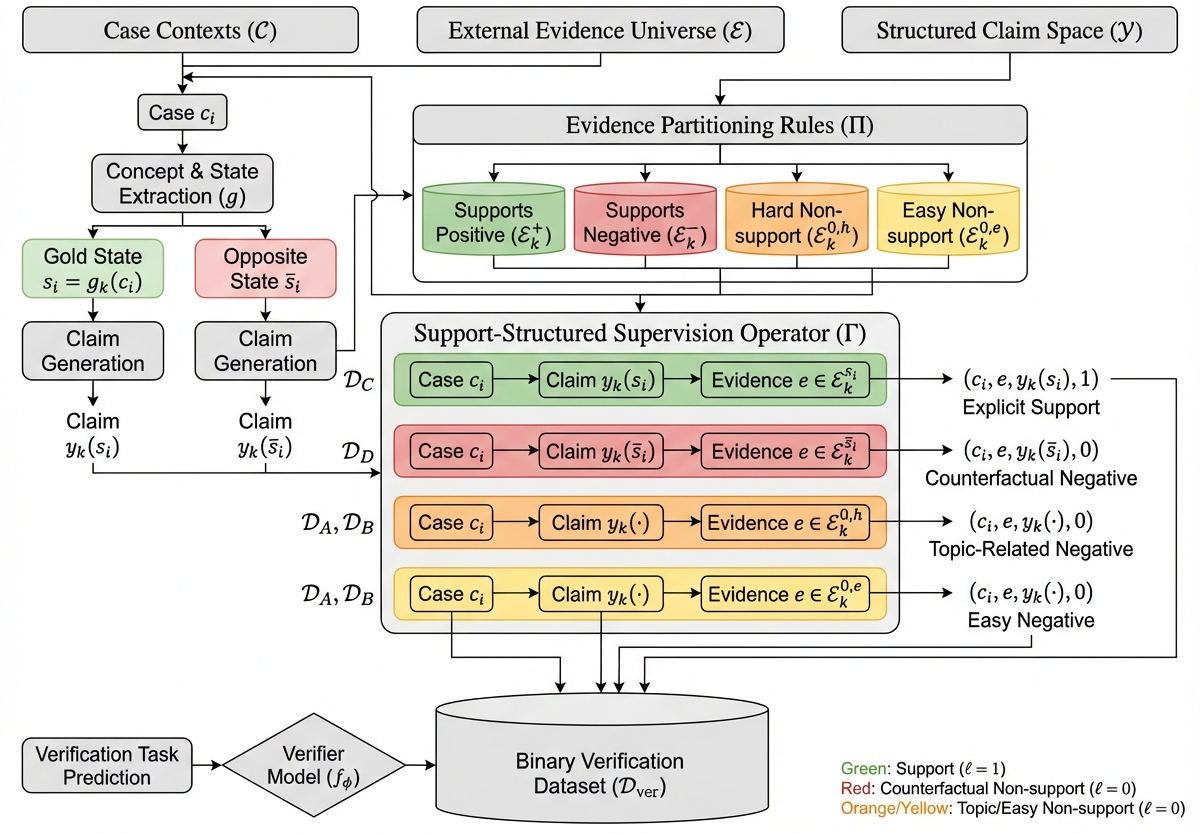
Figure 1: Overview of the framework's input-output and evidence-pool construction, highlighting the explicit separation of support and non-support examples.
Supervision Construction and Semantic Evidence Pooling
The core supervision operator partitions evidence into semantically distinct pools for each concept claim: support-present, support-absent, hard non-support (topic-related but unsupportive), and easy non-support (generic irrelevant). For each instance, the protocol generates four supervision categories:
- Positive (support): Evidence supports claim for the actual case state.
- Counterfactual negative: Evidence supports the opposite claim state.
- Topic-related non-support: Evidence is related but does not support either polarity.
- Easy non-support: Evidence is clearly irrelevant.
This allows the model to learn fine-grained distinctions, including separating near-positives from true support, ultimately making the label depend causally on evidence identity. Training proceeds with binary cross-entropy over the constructed examples, weighted for class imbalance (positives are a minority).
Empirical Evaluation and Core Results
The authors instantiate the framework in radiology, pairing MIMIC-CXR cases and concept claims with sentence-level evidence units from a frozen Radiopaedia corpus. The evaluation includes three baselines:
- S1: Case-only (no evidence)
- S2: Evidence-only (no case context)
- S3: Full case+evidence (the proposed method)
Results on MIMIC-CXR reveal substantial performance gaps:
- S1 (case-only): AUROC 59.90, AUPRC 26.23, F1 32.21
- S2 (evidence-only): AUROC 82.63, AUPRC 35.11, F1 62.79
- S3 (case+evidence): AUROC 97.43, AUPRC 87.78, F1 78.72, Brier 0.060
The task is not solvable from the case context or evidence alone; performance saturates only when the two are jointly modeled. Crucially, the verifier trained under this supervision remains strong under correct evidence but collapses when the evidence is removed or swapped, indicating genuine evidence dependence rather than superficial memorization or shortcut exploitation.
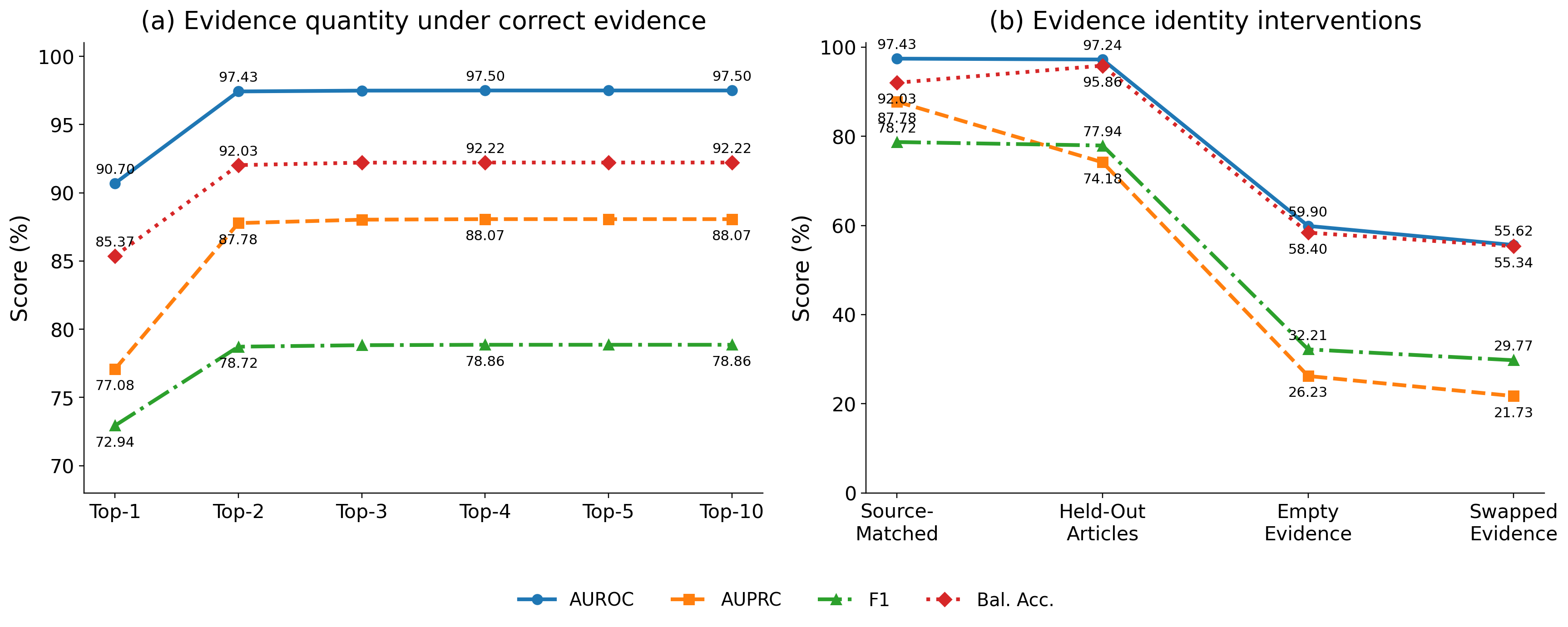
Figure 2: Intervention profile on MIMIC-CXR showing rapid score saturation with additional evidence, and sharp degradation under evidence removal or misalignment.
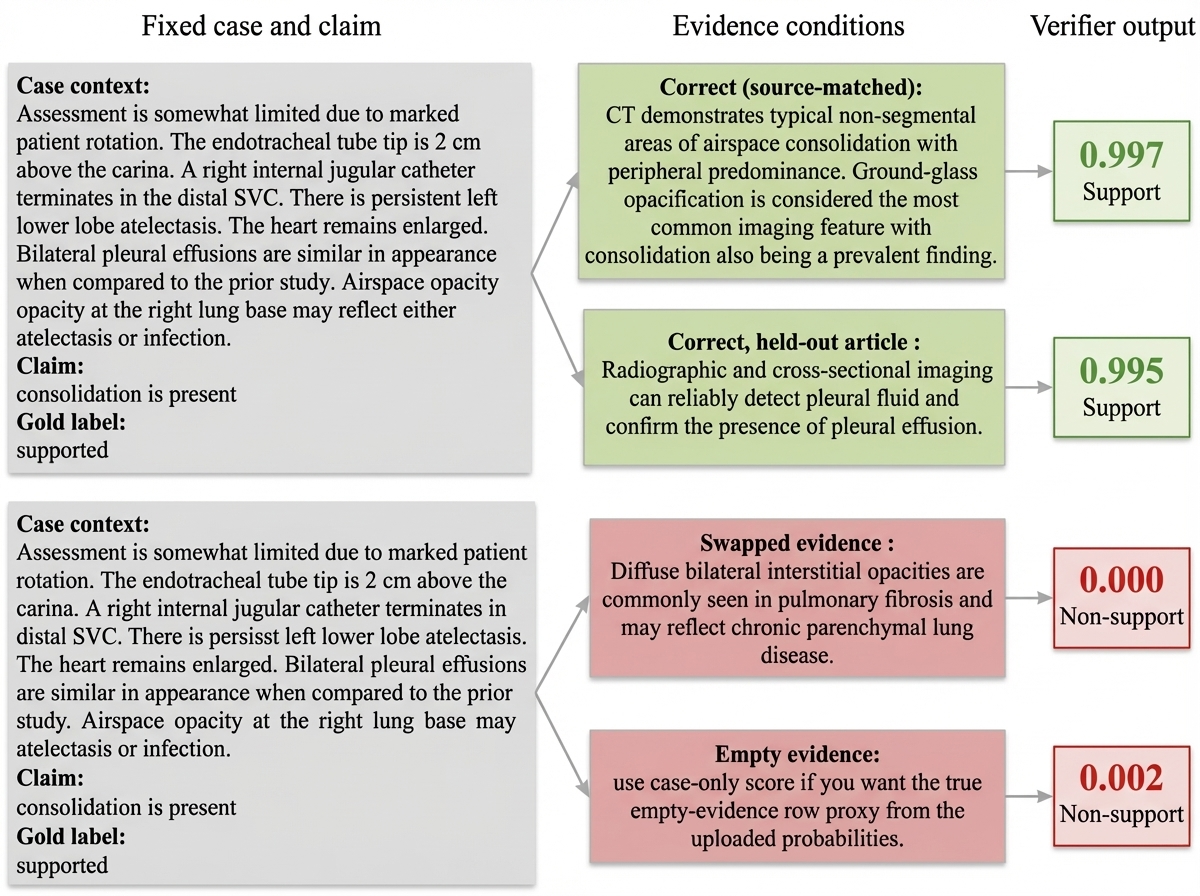
Figure 3: Example demonstrating high support under correct evidence, low support when evidence is swapped or removed.
Quantitative ablation demonstrates performance saturation with two supportive evidence sentences and marginal gains for larger evidence packages, consistent with the evidence budget used during training. When supportive evidence is swapped or removed, AUROC drops by more than 40 points, and AUPRC by more than 65 points, reinforcing the learned dependence on evidence identity.
Transferability, Generalization, and Backbone Effects
External transfer is evaluated by applying the MIMIC-CXR-trained verifier to CheXpert-Plus cases. Supportive evidence from source-matched articles generalizes adequately: AUROC 93.46, AUPRC 78.09, F1 75.15. When evidence is drawn from held-out Radiopaedia articles, AUPRC drops (61.23), and calibration degrades, indicating sensitivity to evidence-source shift.
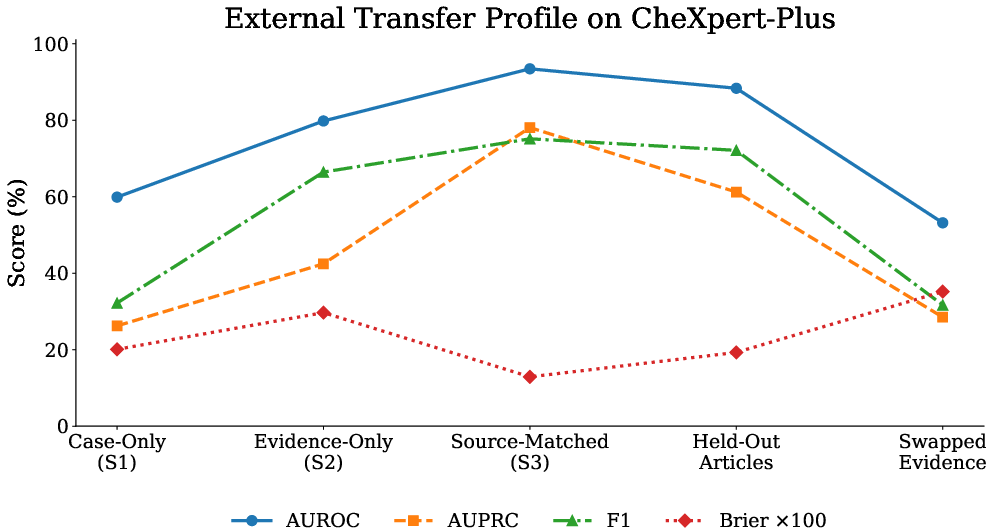
Figure 4: External transfer profile on CheXpert-Plus showing baseline comparison and degradation under evidence interventions.
Backbone ablation shows that in-domain fitting is robust across several architectures (ModernBERT-large, Flan-T5-large, RoBERTa-large), but generalization under evidence-source shift is highly backbone-dependent. ModernBERT-large exhibits best overall performance and stability under held-out evidence; weaker models deteriorate sharply, suggesting that model selection remains critical for deployment in evidence-variant domains.
Practical and Theoretical Implications
The study provides clear evidence that evidence-grounded reasoning bottlenecks arise not only from retrieval quality or model capacity, but primarily from supervision design. Weak proxies and loosely attached evidence enable shortcut exploitation and fail to encode causal evidence-claim relationships. By constructing supervision where evidence is necessary and intervention-sensitive, authentic evidence dependence can be enforced and measured directly.
For practical AI systems, the framework suggests a modular approach: train verifiers on explicitly constructed support relations, integrate them as evaluators within larger retrieval-augmented pipelines, and use their evidence-sensitive scores for abstention, reranking, or calibration. The methodology is domain-agnostic, applicable to clinical NLP, scientific claim verification, legal reasoning, and enterprise knowledge systems, provided case context, structured claims, and external evidence are available.
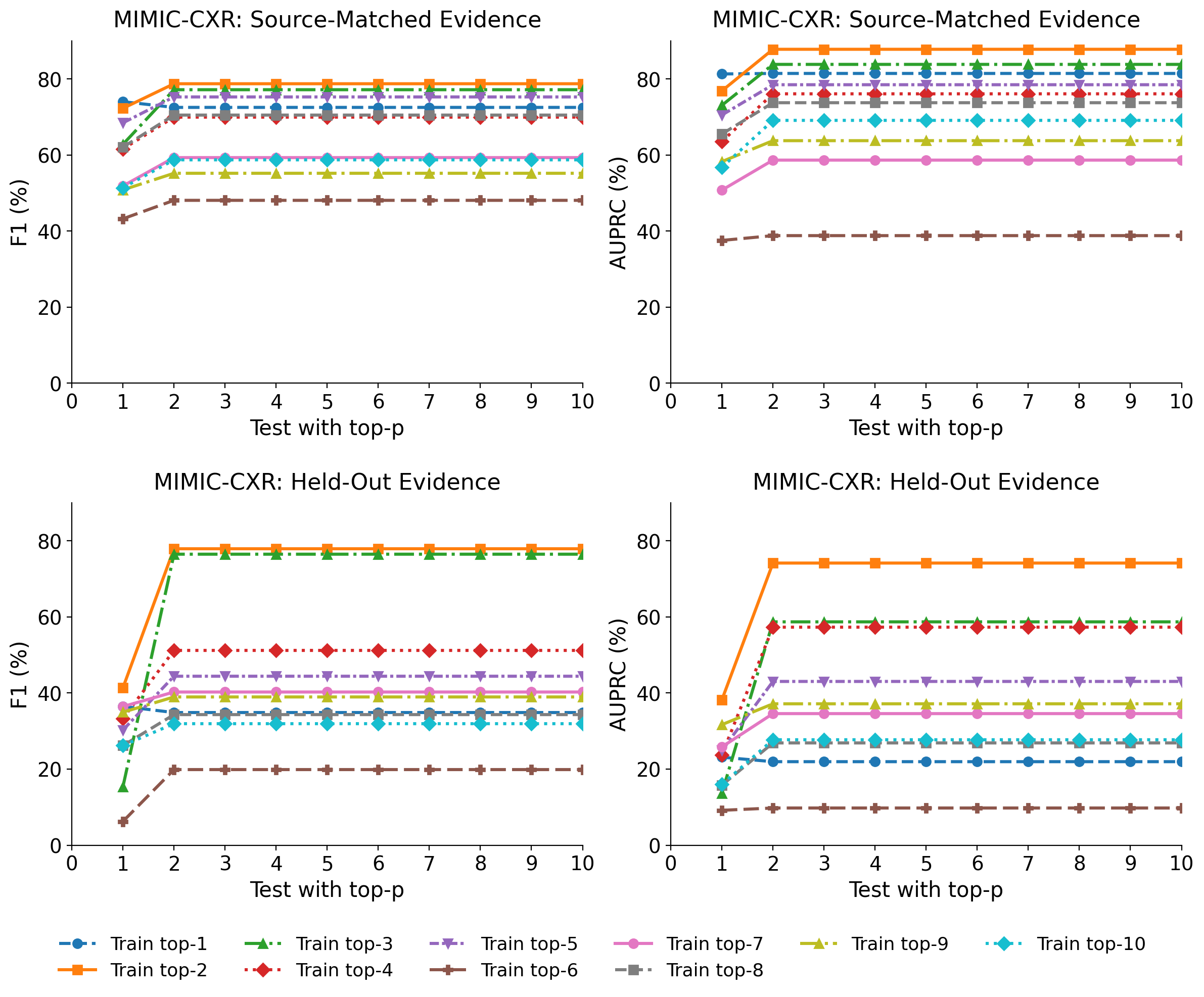
Figure 5: Evidence-quantity ablation confirms performance saturation after top-2 evidence; larger evidence lists yield marginal additional benefit under current retrieval regime.
Future Directions
Key limitations identified include degradation under evidence-source shift and backbone sensitivity. Future work should address richer multi-state claim spaces, end-to-end retrieval with controlled retrieval noise, robust evidence selection under source variability, and applications in domains with distributed or noisy evidence. Further theoretical development may include causal identification in evidence supervision and generalization guarantees under domain shift.
Conclusion
This paper establishes a reproducible, intervention-sensitive framework for evidence-grounded supervision, demonstrating that label-defining, causally explicit evidence construction is essential for genuine evidence-dependent reasoning. Empirical results are robust under correct evidence, transfer well to new case distributions, and are sensitive to both evidence identity and model architecture. The methodology and empirical findings point toward supervision design as the central lever for evidence-grounded learning, with significant implications for the development and deployment of faithful, explainable, and reliable AI in knowledge-intensive applications.