- The paper presents a complete analytical characterization of Pareto sets in constrained multiobjective problems using convex-quadratic functions and scalarization.
- It extends the analysis to complex multimodal and disconnected feasible regions, enabling precise benchmarking of derivative-free optimization methods.
- COBI, the proposed problem generator, allows systematic control of problem difficulties such as non-convexity and ill-conditioning for robust algorithm assessment.
Characterization of Pareto Sets in Constrained Multiobjective Optimization and the COBI Generator
This paper delivers a comprehensive theoretical framework for analyzing Pareto sets in constrained multiobjective optimization (CMO) and introduces COBI, a scalable problem generator for benchmarking derivative-free bi-objective constrained optimization methods. By leveraging convex-quadratic and multipeak problem structures, the work bridges the gap between tractable formal analysis and real-world problem difficulty, enabling systematic algorithm assessment under analytically understood conditions.
Analytical Characterization of Pareto Sets
A central contribution of the paper is the complete analytical description of Pareto sets in constrained CMO problems built from strictly convex-quadratic functions, with extensions to the more complex multimodal (multipeak) and disconnected-feasible-region scenarios. The authors prove that for m strictly convex-quadratic objectives and convex constraints, every Pareto-optimal solution coincides with the unique optimum of a scalarized function formed by a convex combination of objectives. This yields a parametric description of the Pareto set:
Given objectives fi(x)=21(x−ci)⊤Hi(x−ci)+vi with Hi≻0, the unconstrained Pareto set is
P={Hθ−1(i∑θiHici)∣θ∈S}
where Hθ=∑iθiHi, and S is the unit simplex.
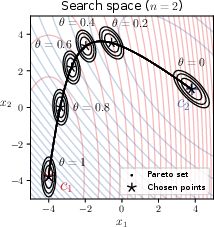
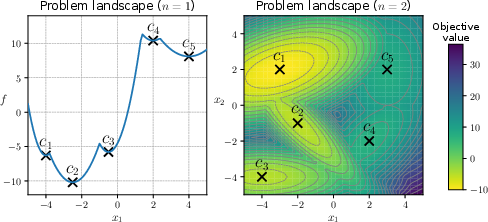
Figure 1: Level sets for scalarized and individual objectives, with the Pareto set as the locus of optima for all scalarizations; effect of non-isotropic Hessians on solution distribution; examples of multimodal landscapes.
When constraints are present, the Pareto set is the projection (with respect to the Hθ-induced norm) of the unconstrained Pareto set onto the feasible region. This projection property extends previous findings, yielding a geometry-informed method for locating optimal trade-off solutions under constraints.
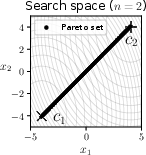
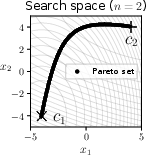
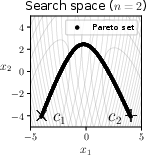
Figure 2: Illustration of how the Pareto set's shape depends critically on the relative positions and Hessian structures of the objective functions; extension to three objectives.
This explicit geometric and algebraic form enables both theoretical reasoning and practical Pareto set computation in benchmark construction.
Extensions to Multipeak and Disconnected Feasibility Problems
The analysis is rigorously generalized to settings where each objective (and constraint) is itself a minimum over several convex-quadratic components—the multipeak construction. This introduces both multimodality (multiple attraction basins) and disconnected feasible sets, reflecting complex real-world optimization challenges while preserving analytical tractability.
Key results include:
- The Pareto set of a multipeak bi-objective problem is comprised of non-dominated points from the union of the Pareto sets corresponding to all pairs of peaks (fai,fbj).
- For feasible sets described by unions (e.g., sublevel sets of multipeak constraints), Pareto sets are subsets of the union of individual-region Pareto sets, with non-dominated sorting yielding the global set.
The theoretical framework further covers invariance of the Pareto set under:
- Strictly increasing transformations of objectives,
- Sign-preserving (zero-only-at-zero) transformations of (in)equality constraints.
This broadens the tractable problem class while facilitating benchmarking scenarios with varied front shapes and constraint types.
The COBI Problem Generator
Based on these analytical insights, the authors formalize COBI, a parametric generator of bi-objective constrained test problems for derivative-free optimization. COBI features:
- Multimodal (multipeak) objectives synthesized from convex-quadratic minima, allowing explicit control over non-convexity and ill-conditioning.
- Constraints comprising linear, convex-quadratic, or multipeak forms, yielding nonseparable and disconnected feasible domains.
- Tunable transformations on objectives and constraints to reflect real-world properties (e.g., non-linearity, discontinuity at the boundary).
Benchmark problems can thus be instantiated across a spectrum of complexities, with the Pareto set analytically known or precisely approximable via efficient convex optimization procedures.
Numerical Methods for Pareto Set Approximation
The paper describes and implements (reference Python code provided) efficient methods for approximating Pareto sets:
- For problems with convex-quadratic objectives and convex constraints, a grid of scalarization weights (θ) provokes the generation of candidate Pareto points, projected onto the feasible set.
- For multipeak objectives or constraints, the union of Pareto sets for each subproblem (peak pair or feasible region) is constructed; Pareto dominance filtering produces the non-dominated set.
- For high-precision approximation, ϵ-distance control is imposed in parameter space and/or objective space.
The approach is scalable: the computational bottleneck reduces to repeated resolution of convex quadratic or conic subproblems.
Visualization and Classification of Benchmark Properties
Extensive visual analysis categorizes the rich variety of problem landscapes and Pareto front geometries achievable with COBI:
- The generator encompasses all classic constraint effect types (classification of [ma2019evolutionary]).
- Both objectives and constraints can be made highly multimodal, ill-conditioned, or non-separable.
- Transformation-induced effects (e.g., front shape morphological changes under strictly increasing monotonizations) are demonstrated.
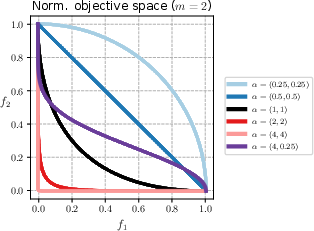
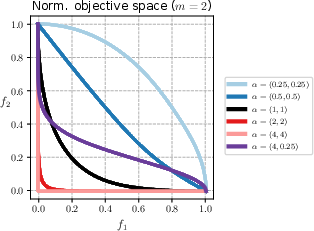
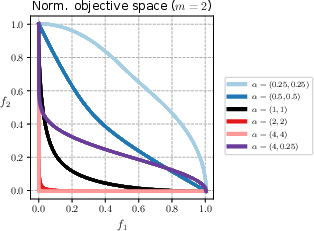
Figure 3: Achievable Pareto front shapes with the proposed generator; convex, concave, highly curved, and non-convex fronts can be induced by parameterized transformations.
The geometric interpretation is further confirmed by juxtaposing unconstrained and constrained Pareto sets—validating the theoretical projection property and elucidating the impact of various constraint types.
The main practical implication is the availability of a benchmark suite where difficulties such as non-separability, ill-conditioning, multi-modality, disconnected feasible regions, and non-trivial front geometries are systematically parameterizable and analytically characterized. This permits:
- Detailed, rigorous performance assessment of derivative-free and evolutionary multiobjective optimizers.
- Direct computation (not estimation) of hypervolume or other front-based metrics due to Pareto set availability.
- Systematic study of algorithmic weaknesses tied to problem geometry.
Empirical results show, for instance, that increasing decision space dimension impairs standard evolutionary methods' ability to recover full Pareto sets, especially at the extremes—insights made possible by the fine-grained analytical knowledge of optimal sets.
Theoretical and Practical Impacts, and Future Outlook
The explicit, constructive theory underlying COBI enhances both practical benchmark design and foundational understanding of Pareto set geometry in a broad class of analytically tractable, yet challenging, CMO problems. The generalization to arbitrary transformations and union/intersection-structured constraints broadens real-world applicability, especially for algorithm diagnostics and ablation studies.
Possible future developments include:
- Extending beyond bi-objective settings, leveraging similar algebraic-geometric structures for higher objective counts.
- Further automated calibration of generator parameters to mimic specific industrial problems.
- Deeper exploration of the interaction between front geometry, problem multimodality, and algorithmic convergence barriers in high-dimension spaces.
Conclusion
This paper furnishes a unified characterization of Pareto sets for a large, analytically tractable class of constrained multiobjective problems, and operationalizes these findings in the robust COBI test problem generator. The results decisively advance the methodological foundations for benchmarking optimization algorithms under realistic and formally understood difficulty, and pave the way for systematic studies of multiobjective optimization under complex, application-inspired constraints and objectives (2604.09131).

