- The paper demonstrates that proactive, context-sensitive AI assistance significantly improves the actionability and relevance of research suggestions compared to traditional systems.
- The paper employs continuous analysis of project documents combined with LLM-based inference to generate targeted questions and literature-backed suggestions tailored to evolving research stages.
- Experimental evaluations indicate that the Omakase system enhances decision making by delivering timely, prioritized suggestions with lower cognitive load for researchers.
Proactive Literature-Grounded Research Assistance via Omakase
Introduction and Motivation
The interaction dynamics between researchers and AI assistants remain dominated by explicit, user-initiated, query-response protocols, despite significant progress in agentic capabilities across domains such as software engineering and scientific discovery. Existing paradigms in literature support—either deep research systems, which require manual query specification and return comprehensive but hard-to-action reports, or recommender engines, which push paper lists derived from static interest profiles—fail to deliver contextually relevant, actionable information aligned with evolving research workflows. “Omakase: proactive assistance with actionable suggestions for evolving scientific research projects” (2604.08898) advances the concept of long-horizon, proactive agentic support, leveraging sustained monitoring of project artifacts to distill actionable, literature-backed suggestions that align dynamically with research project context.
System Architecture and Core Pipeline
Omakase is implemented as a web-based research assistant. Its architectural centerpiece is continuous, minimally intrusive ingestion and analysis of project documents (e.g., Google Docs, slides, notes) which form the persistent, living context for a research project. The system operates by:
- Document Parsing and Paper Extraction: Automated retrieval and parsing of project artifacts, with identification and deduplication of referenced literature.
- Project State Inference: LLM-based inference to assign project stage(s) (ideation, experimental design, data collection, etc.) through contextual document analysis, leveraging recency heuristics where available.
- Proactive Question Generation: Contextual synthesis of specific, literature-facing queries—distinct from generic keyword search—directly addressing probable information gaps, methodological ambiguities, or potential pitfalls germane to the project’s inferred phase.
- Deep Research System Interfacing: Submission of generated queries to a RAG+LLM-powered deep research system, returning attributed, multi-document syntheses tailored for scientific review.
- Suggestion Extraction and Prioritization: Automated distillation of returned literature syntheses into task- and context-specific actionable suggestions, ranked for timeliness, relevance, diversity, and actionability. Redundancy elimination and prior-seen suggestion filtering are explicitly incorporated.
- Anchoring and Visualization: Suggestions are anchored to precise document sentences or sections and surfaced in both suggestion-centric and document-centric interfaces for rapid triage and integration into workflow.
- User Steerability and Control: Adjustable delivery cadence, manual rerunning, and selective query tracking (e.g., periodic literature re-sweep for targeted questions) all facilitate user autonomy without imposing recurrent context curation burdens.
Iterative Design and Evaluation
Omakase’s development followed a multi-phase, user-driven, iterative methodology:
Initial deployments revealed:
- High cognitive and temporal cost for manual context curation in static “interest documents.”
- User demand for actionable, project-phase-specific suggestions over non-specific paper recommendations.
- The impracticality, for most users, of maintaining curated interest profiles solely for AI-system benefit.
- Rich opportunity for context/initiation extraction from pre-existing, organically evolving project documents.
These insights converged into three central design goals: maximize project-specificity in literature discovery, prioritize actionable suggestion delivery, and eliminate the need for manual context curation.
Pipeline Refinement
Two pipeline iterations were rigorously evaluated:
- Early-stage suggestions, while favorably received, suffered from issues of redundant/uncontextualized output, stale information, insufficient pruning, and occasional temporal misalignment.
- Successive improvements—robust date-handling, model upgrade, explicit sub-question decomposition, enhanced selection and deduplication, and user feedback integration—addressed these deficits, yielding improved specificity and reduced overload.
Controlled Comparative Study
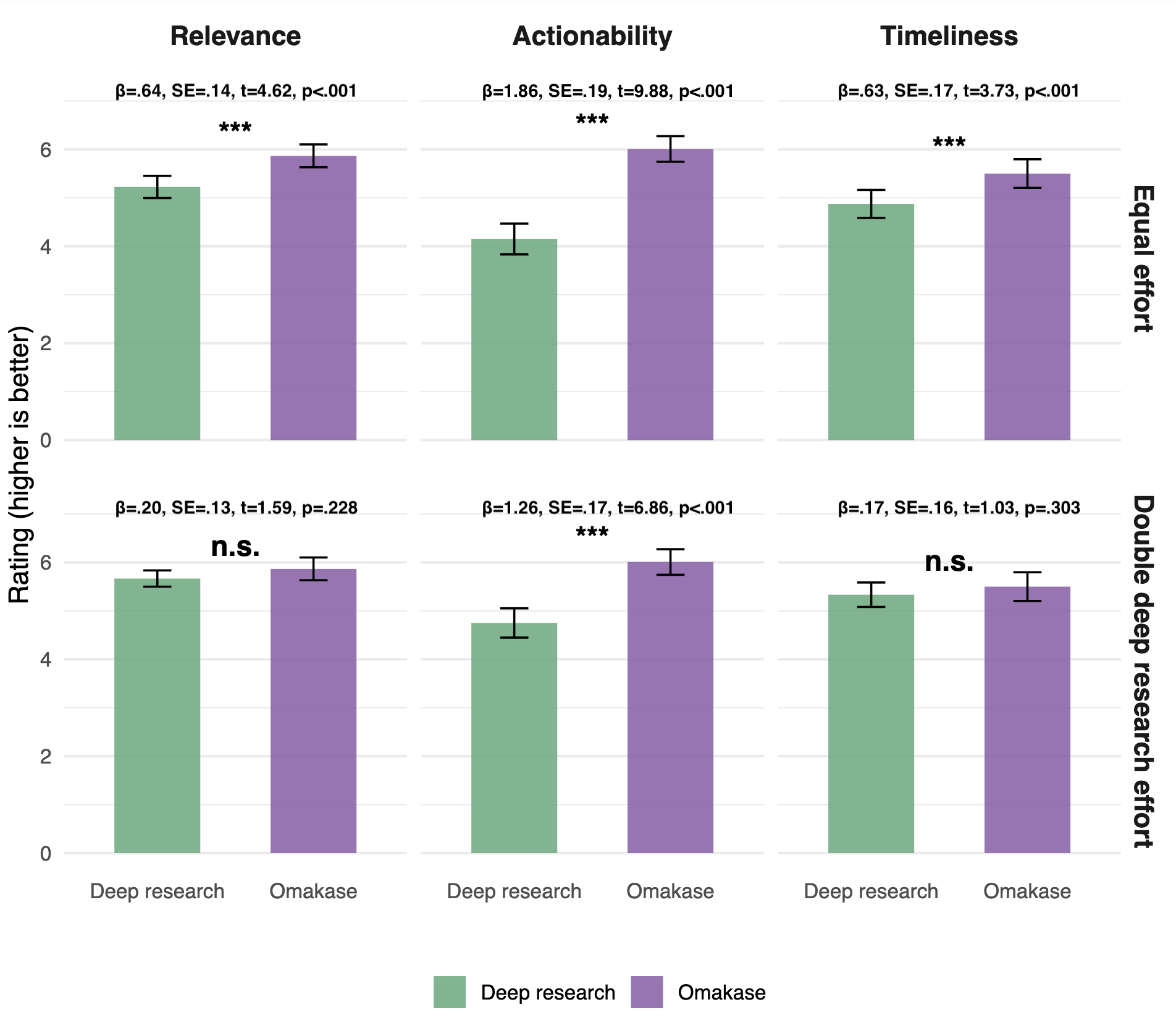
A controlled experiment (N=11) compared Omakase’s actionable suggestions against baseline deep research output—where participants selected and read either a single or two “most relevant” sections of a traditional literature synthesis per question, reflecting equal/double cognitive effort.
The data, assessed via linear mixed-effects modeling, show that Omakase:
Omakase’s suggestions also demonstrated superior triageability: participants found it straightforward to rapidly assess suggestion utility, unlike long-form narrative research reports.
User Experience
The user workflow is non-intrusive, focusing on minimal effort for maximum insight. Upon document addition or update, Omakase provides dashboards summarizing actionable literature-derived suggestions, allowing navigation between a suggestion-centric view and document-anchored highlights.

Figure 3: Question interface: users review, subscribe to, and customize literature queries; rationale and full answers from the deep research system are inspectable.
Control over suggestion timing, question subscription, and project state adjustment supports both default automation and fine-grained user steering. Integration with project document artifacts obviates the need for explicit query crafting or dedicated context curation.
Empirical Findings and Strong Claims
Empirical studies reported:
- Significantly higher scores in actionability, relevance, and timeliness for Omakase’s output versus manual deep research reading.
- Omakase’s queries and suggestions consistently aligned more with the actual stage and priorities of participants’ evolving projects, contrasting with generic or stale outputs from recommenders.
- Omakase surfaces productive information needs and experimental directions not previously considered by the user, demonstrating a non-overlapping coverage with manually generated queries.
- The triage cost for Omakase suggestions is low; users rapidly filter, dismiss, or amplify actions, accelerating decision-making and research progress.
- Users value both suggestion and full-answer modalities, preferring actionable prompts for design and writing phases, while retaining the ability to deep dive when desired.
Implications for Proactive Agentic Systems
Omakase substantively advances the design space for proactive AI research assistants:
- It demonstrates the feasibility of long-horizon, asynchronicity-aware, project-level context maintenance for proactive assistance, in contrast to prior work focused on synchronous, short-horizon, or conversation-bound interactions.
- By grounding interventions in live project artifacts rather than static interest lists or interaction traces, Omakase achieves superior adaptability and information gain, circumventing cold-start, staleness, and context-mismatch problems endemic in recommender systems.
- Success highlights the criticality of integrating agentic autonomy (background document monitoring, question generation, report distillation) with user steerability (tunable cadence, manual query input, context override).
- The architecture is robust to the evolving, multimodal nature of scientific project artifacts and does not require bespoke, curated artifacts.
Limitations and Future Research Directions
The current evaluation, while robust in comparative and short-horizon settings, does not longitudinally assess impacts on actual research outcomes over complete project lifecycles. Privacy, security, and artifact access control remain open challenges, especially in sensitive or multi-collaborator settings. Furthermore, multi-document, multi-modal context fusion, dynamic adaptation to shifting priorities, and advanced feedback incorporation are promising avenues for future research. Expanding Omakase to directly interface and act within documents (e.g., inline comment insertion, automated suggestion merging) warrants careful study regarding user acceptance, trust, and unintended automation side effects.
Conclusion
Omakase operationalizes the paradigm of proactive, literature-grounded, suggestion-centric assistance for research projects by continuously observing, reasoning about, and intervening based on live project artifacts. Experimental evidence demonstrates that its suggestions are significantly more actionable, relevant, and timely than those derived from baseline deep research systems—even with increased user effort on the latter. The approach validates the extraction of living context from natural project workflows and establishes a platform for future agentic AI research, where scientific assistance is tightly coupled to the true state and needs of ongoing projects (2604.08898).