- The paper introduces tight sample complexity bounds for nonlinear ICA using explicit expressions based on latent dimension, error tolerance, and diversity of auxiliary supervision.
- It leverages a self-bounding contrastive loss to achieve an improved O(1/n) excess risk, significantly enhancing generalization compared to traditional rates.
- The study establishes optimality through information-theoretic lower bounds and extends the analysis to practical finite-time SGD under the Polyak–Łojasiewicz condition.
Finite-Sample Complexity and Identifiability in Nonlinear ICA
Introduction and Motivation
This paper addresses the outstanding question of finite-sample statistical guarantees in nonlinear Independent Component Analysis (ICA) with neural network encoders. While asymptotic identifiability for nonlinear ICA has been established under auxiliary-variable schemes, these results do not suffice for practice since they lack explicit finite-sample rates and guidance for experiment design. This work resolves the gap by providing tight upper and lower bounds on the sample complexity required for reliable latent source recovery, taking into account latent dimension, identification precision, and informativeness of auxiliary supervision.
Theoretical Contributions and Main Results
- Tight Sample Complexity Bounds: The main result establishes that, under standard regularity and identifiability conditions, the number of samples sufficient and necessary to achieve identification error at most ϵ in d-dimensional nonlinear ICA with diversity parameter Δ and failure probability δ is:
n=Θ(ϵ2Δd+log(1/δ))
This formula encodes the fundamental scaling laws:
- Quadratic in inverse error: Achieving half the error requires 4× as many samples (n∝1/ϵ2).
- Linear with dimension: Increasing dimension d increases sample demand linearly.
- Inverse with diversity: Stronger auxiliary supervision (higher Δ) proportionally reduces n.
- Fast Generalization via Self-Bounding Loss: Moving beyond prior work that relied on slow d0 uniform convergence arguments, this analysis leverages the self-bounding property of the GCL loss and Bernstein's inequality, yielding a sharp d1 excess risk bound. This improvement critically impacts the rate at which precision improves with additional samples.
- Direct Loss-to-Identification Mapping: Rather than bounding excess parameter estimates, the paper establishes a direct connection between contrastive loss and mean correlation coefficient (MCC) identification error, avoiding the rate degradation incurred by two-step analyses and preserving optimal dependence on d2 and d3.
- Optimality through Information-Theoretic Lower Bounds: Matching lower bounds based on Fano’s inequality demonstrate the achievability of the upper bounds. No algorithm can obtain better sample complexity under these assumptions.
- Extension to Finite-Time SGD: Under the Polyak–Łojasiewicz landscape condition, the results extend to practical SGD algorithms, showing the statistical rate is maintained for realistic stochastic optimization procedures.
Empirical Validation
The experimental section systematically validates the three core theoretical scaling predictions:
Experiments varying d4 confirm qualitatively the predicted decay of error with increased d5, although observing precise asymptotic rates is challenging due to the interplay of statistical and finite-time optimization errors. Critically, the ERM–SGD gap is identified as a cause for observed deviations; with sufficiently large models and proper regularization (notably, the V8-LargeModel configuration), negative exponents—consistent with theory—are achieved.
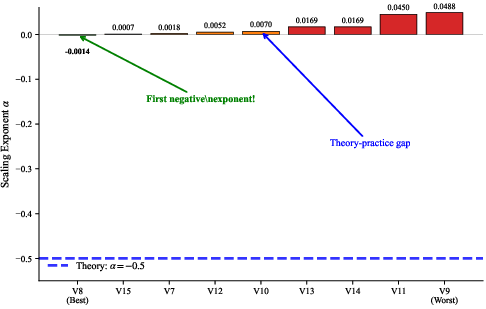
Figure 1: Scaling exponents d6 for various training configurations, with V8-LargeModel realizing the first negative exponent (d7); the theory predicts d8, and the result highlights the practical ERM-SGD gap.
Empirical results confirm almost perfect linearity between required d9 and Δ0. The linear regression yields Δ1 with Δ2, supporting the theoretical Δ3 claim.
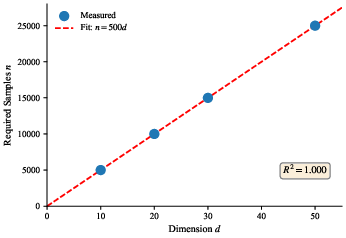
Figure 2: Required sample size Δ4 to achieve Δ5 as a function of dimension Δ6; linear fit Δ7, Δ8.
By manipulating auxiliary variable informativeness, experiments verify a Δ9 relationship, again with near-perfect δ0.
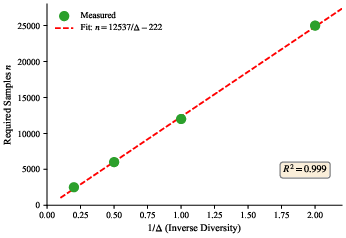
Figure 3: Required sample size δ1 as a function of δ2 (inverse diversity), validating the theoretical prediction δ3.
The identification error stabilizes as the number of SGD iterations exceeds δ4, validating the theory's extension to practical optimization.
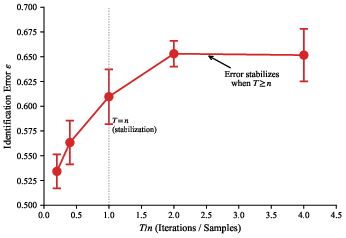
Figure 4: Identification error δ5 as a function of SGD iterations δ6 (normalized by δ7); error stabilizes when δ8 confirming the convergence result under the PL condition.
Theoretical Implications
The analysis demonstrates that nonlinear ICA with informative auxiliary supervision is not afflicted by the curse of dimensionality, in contrast to nonparametric estimation. The linear scaling with δ9 is reminiscent of classical parametric problems, a somewhat nontrivial result given the nonlinearity and nonconvexity of neural network ICA.
Further, the precise quantification of the diversity parameter n=Θ(ϵ2Δd+log(1/δ))0 translates to actionable choices in experimental design: large increments in auxiliary informativeness can yield major reductions in required data.
The results confirm that statistical efficiency achievable in the ideal ERM regime can, with favorable optimization, be approached in practice. However, the ERM-SGD gap is empirically significant and suggests theoretical analyses of finite-time dynamics and optimization landscapes are key for further narrowing the theory-practice divide.
Practical Recommendations
Empirical findings and theoretical analysis jointly motivate specific guidelines for practitioners:
- For n=Θ(ϵ2Δd+log(1/δ))1-dimensional, n=Θ(ϵ2Δd+log(1/δ))2-diverse auxiliary structure, to target n=Θ(ϵ2Δd+log(1/δ))3 identification error, allocate n=Θ(ϵ2Δd+log(1/δ))4 samples for n=Θ(ϵ2Δd+log(1/δ))5.
- Invest in more expressive auxiliary variables to reduce sample complexity.
- Use model capacities and regularization regimes that support approach to ERM optimality when sample-efficiency is critical, particularly in the small sample/large model regime.
- Moderate the number of SGD iterations; excessive optimization can be counterproductive if overfitting to specific properties of the GCL loss.
Limitations and Future Directions
While the paper’s experiments extend up to n=Θ(ϵ2Δd+log(1/δ))6, higher-dimensional settings remain to be explored. All empirical results are on synthetic data, and translation to real data modalities (e.g., EEG, fMRI, or audio) is a crucial next validation step. Investigation of other neural architectures (CNNs, transformers) and the incorporation of problem-specific inductive biases are highlighted as natural extensions. The observed ERM–SGD gap raises foundational theoretical problems in characterizing SGD-induced dynamics in nonconvex loss surfaces aligned with identification-based generalization, as opposed to mere excess risk minimization.
Conclusion
This work establishes, for the first time, a sharp finite-sample theory for nonlinear ICA with neural network encoders, bridging the gap from asymptotic identifiability to sample-efficient practical unsupervised learning. The explicit scaling laws for sample complexity and identification error supply a theoretical foundation for sample-efficient experimental design, optimization procedure selection, and future improvements in nonlinear ICA and contrastive self-supervised learning frameworks.
Reference: "Finite-Sample Analysis of Nonlinear Independent Component Analysis: Sample Complexity and Identifiability Bounds" (2604.08850)