- The paper presents a novel tournament-based framework that redefines document ranking with explicit competitive elimination.
- It employs adaptive grouping and reasoning-enhanced prompts to justify ranking decisions, achieving notable nDCG improvements across benchmarks.
- The framework offers lower computational complexity and robust multi-step inference, making it practical for scalable, real-world deployments.
BracketRank: Reasoning-Driven Competitive Elimination for LLM-Based Document Ranking
Introduction and Motivation
The challenge of ranking documents in information retrieval is amplified in reasoning-intensive scenarios, where deep semantic inference and multi-step rationalization are essential. Existing LLM-based rerankers using pointwise, pairwise, or listwise paradigms inadequately address the context limitations, sequential bottlenecks, and order sensitivities that arise in such tasks. The "BracketRank: LLM Document Ranking via Reasoning-based Competitive Elimination" (2604.08834) paper presents a systematic framework that reconceptualizes reranking as a structured, reasoning-intensive tournament, mitigating these core deficiencies.
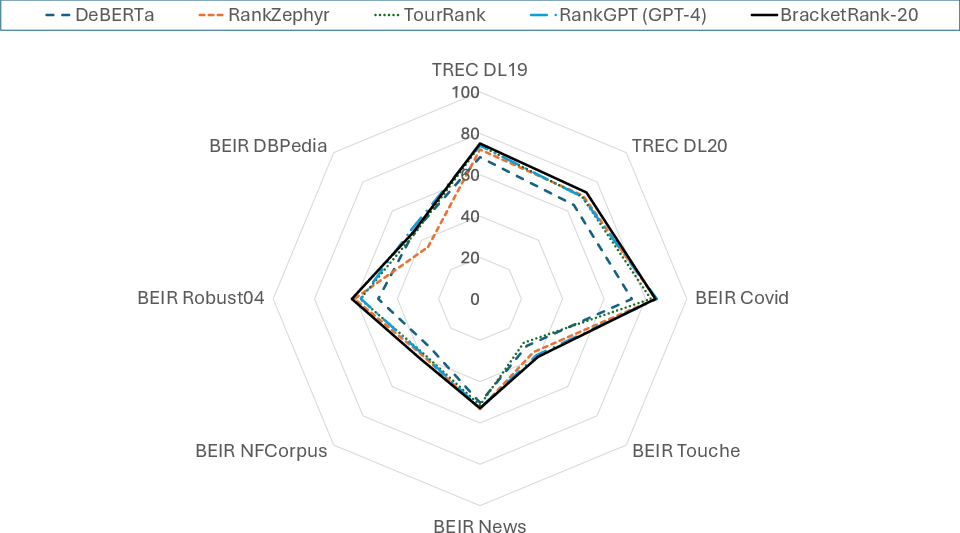
Figure 1: Radar chart comparing nDCG@5 performance of top reranking methods, including DeBERTa, RankZephyr, RankGPT (GPT-4), and -20 (GPT-4), across TREC DL20, TREC DL19, and BEIR datasets.
Framework Overview
BracketRank operates in five algorithmic phases:
- Adaptive Grouping: Documents are partitioned into groups, with group sizes determined by LLM context constraints, maximizing per-prompt utilization without exceeding token limits.
- Intra-Group Reasoning-Enhanced Ranking: Each group is independently ranked via prompts that require explicit, step-by-step relevance explanations, compelling the LLM to justify its ranking decisions in detail.
- Winner/Loser Bracket Splitting: Groups are split into top (winner) and bottom (loser) subsets, initializing dual tracks for subsequent elimination.
- Bracket-Style Competitive Elimination: Documents advance via head-to-head matches in single-elimination tournaments within their brackets, enabling parallelization across rounds and robust, order-invariant relevance evaluation.
- Final Ranking Assembly: The global ranking is produced by concatenating the winner and loser bracket outputs, ensuring that highly ranked documents have repeatedly survived structured, reasoned competitions.
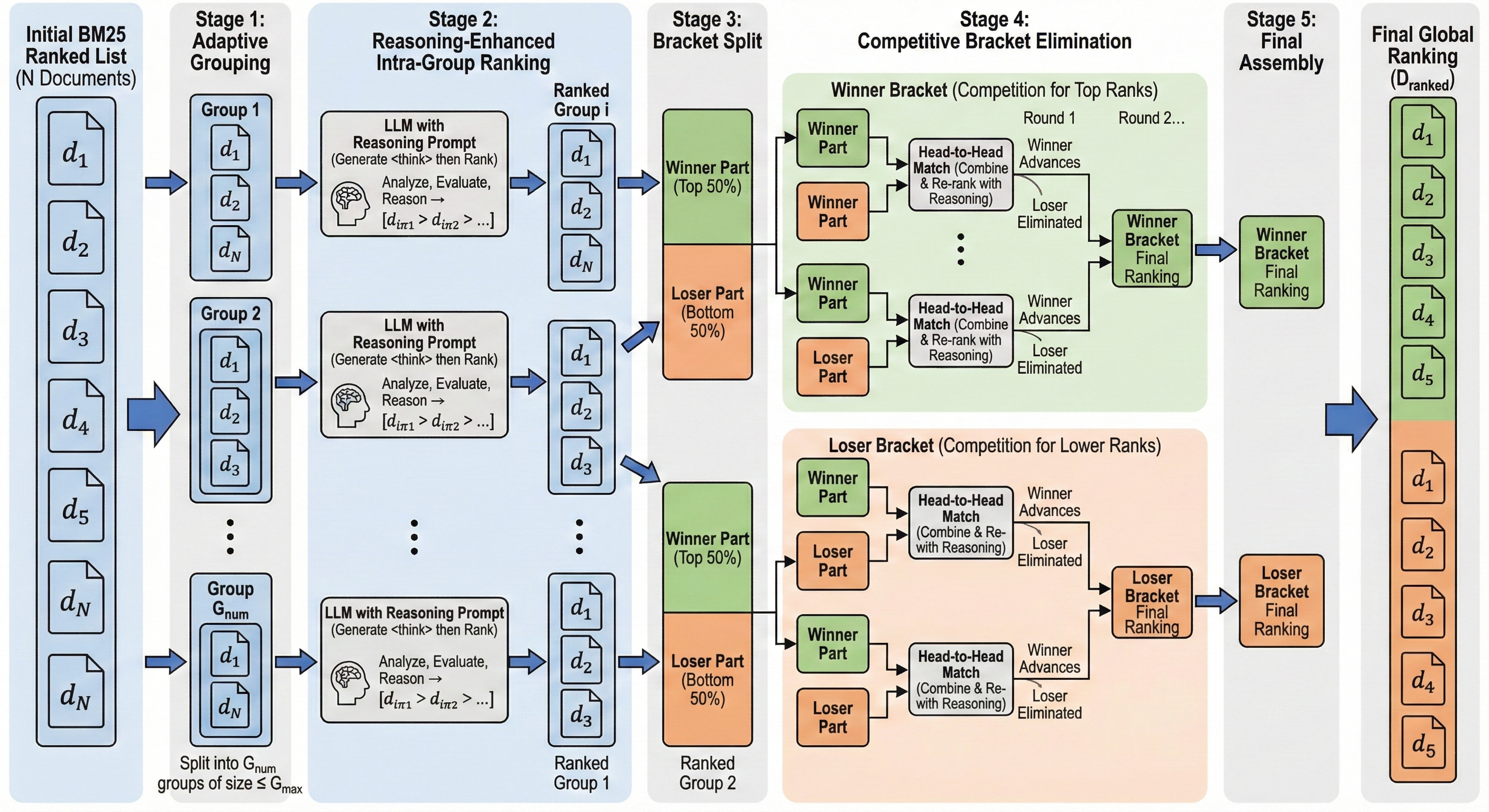
Figure 2: Overview of the BracketRank framework, illustrating adaptive grouping, intra-group ranking with reasoning, bracket splitting, multi-stage elimination, and final ranking synthesis.
Methodological Novelty
The core innovation is embedding explicit comparative reasoning into every stage of document selection within a bracketed elimination structure. This approach stabilizes ranking despite context limitations and initial ordering, as each document can be exposed to diverse competitive contexts; significant documents can recover from early placement disadvantages via the loser bracket.
The reasoning-augmented prompts enforce an architectural inductive bias toward deliberative, interpretable comparison rather than shallow, surface-level matching. The adaptive grouping ensures maximal computational efficiency by saturating the LLM’s context window without superfluous overhead.
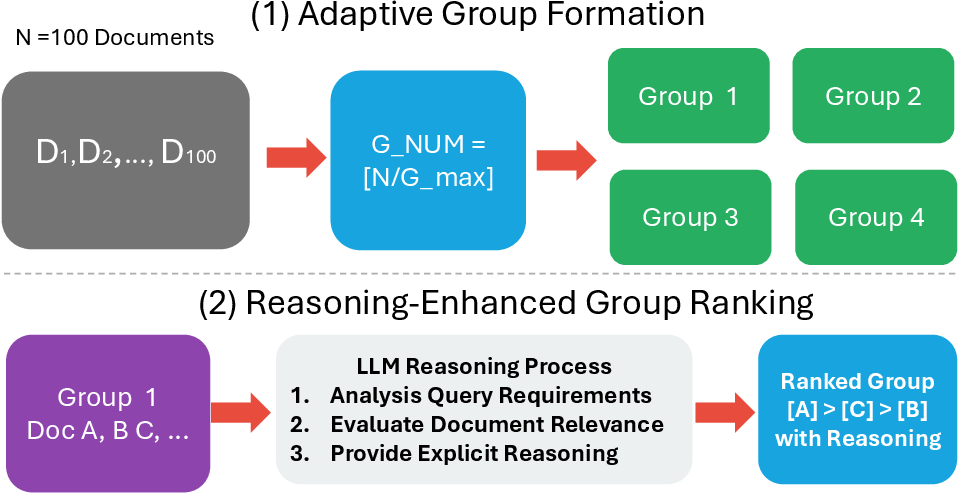
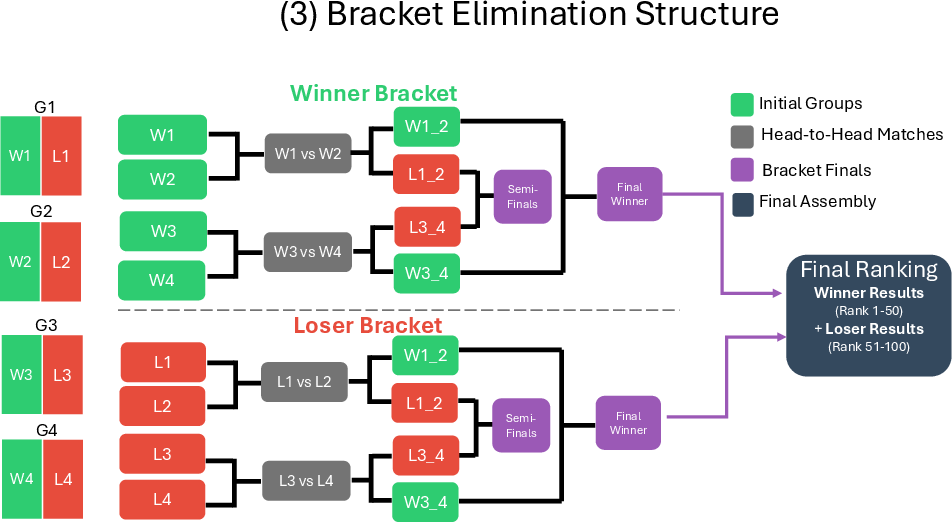
Figure 3: Visualization of adaptive group formation and intra-group reasoning-enhanced ranking.
Empirical Results
Benchmarking demonstrates consistent, statistically significant superiority over prevailing rerankers:
- On BRIGHT (reasoning-intensive benchmark): BracketRank achieves 26.6 nDCG@10 (avg), surpassing the strongest baselines (RankGPT-4: 17.0 and Rank-R1-14B: 20.5). Improvements are most pronounced in scientific domains (e.g., +7.0 nDCG in Biology over Rank-R1-14B) and coding.
- On TREC DL 19/20: 77.90/75.85 nDCG@5, outperforming both leading zero-shot (RankGPT-4: 75.98/72.32) and supervised models (monoT5-3B: 73.74/72.32), with p<0.001.
- On BEIR (heterogeneous zero-shot): BracketRank attains 54.66 nDCG@10 avg, leading over RankGPT-4 (53.68) and monoT5-3B (51.36).
- On NovelEval-2306 (post-training data): 88.76 nDCG (avg), indicating generalization to truly novel content.
Ablation results show that explicit reasoning requirements yield consistent nDCG gains (e.g., +1.76 NDCG@5 on TREC DL19).
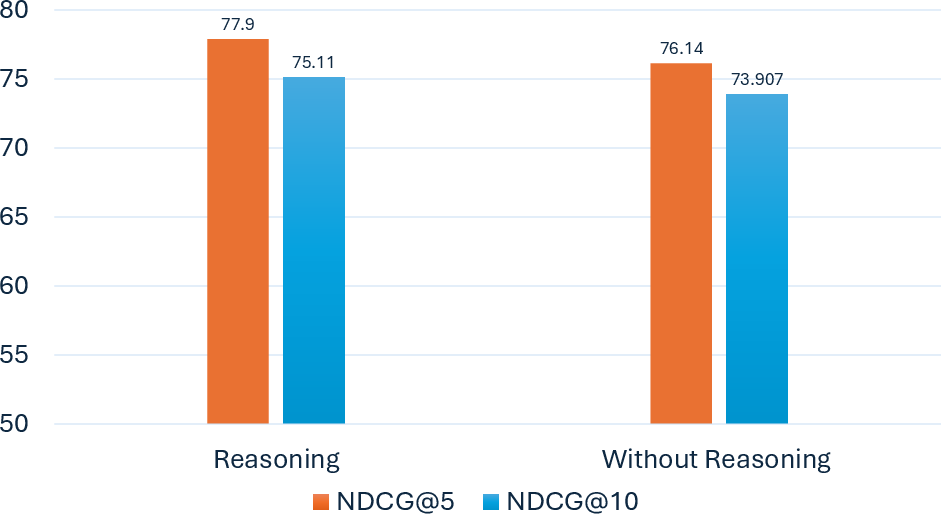
Figure 4: Ablation study on TREC DL19; reasoning-enhanced prompts consistently improve both NDCG@5 and NDCG@10.
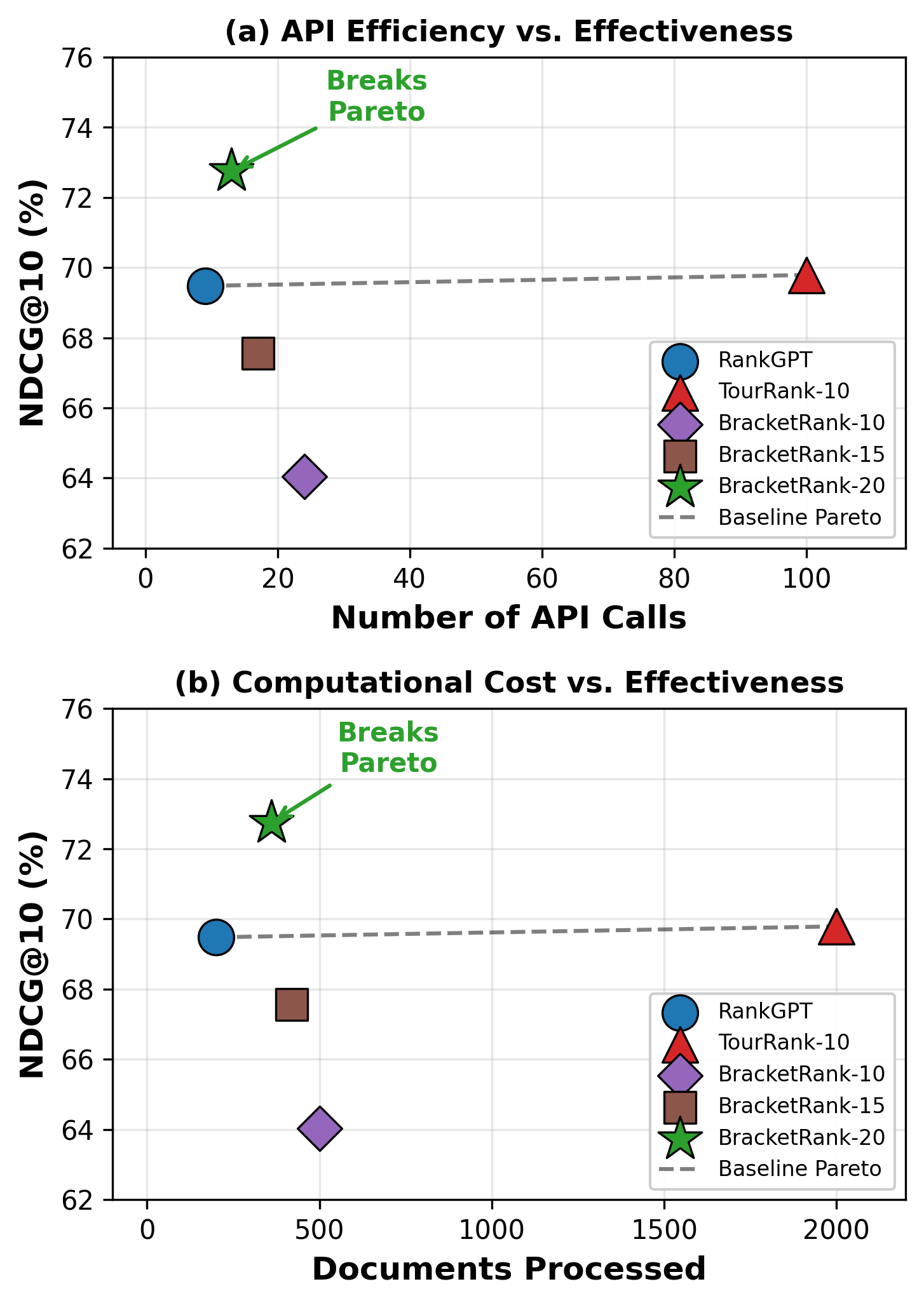
Figure 5: Efficiency-effectiveness Pareto analysis, demonstrating that BracketRank-20 dominates the previous trade-off frontier.
Efficiency-Effectiveness Analysis
BracketRank demonstrates a logarithmic (O(logGnum)) complexity in the elimination phase. For 100 candidate documents and Gmax=20, only 13 API calls and 360 document evaluations per query suffice—orders of magnitude lower than pairwise or round-robin tournaments, while outperforming or matching methods that require substantially more compute.
Adaptive grouping not only optimizes prompt utilization but, counterintuitively, larger group sizes yield both higher quality (8.7 NDCG@10 gain from group size 10 to 20) and lower latency (45.7% runtime reduction), due to a reduction in the number of tournament rounds.
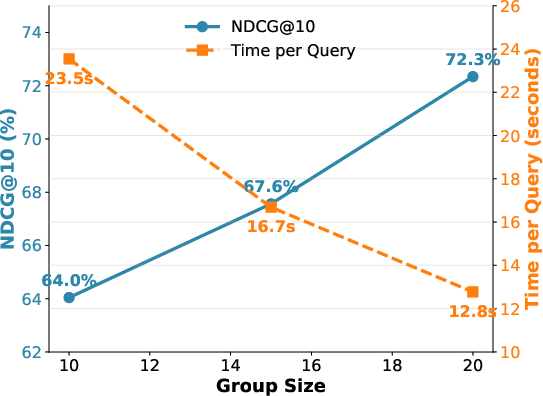
Figure 6: Group size impact on per-query performance and computational efficiency.
Analysis of Design Choices
Single-elimination brackets offer the best balance of effectiveness and compute. Double elimination achieves marginally higher NDCG@1 but is inferior at higher cutoffs. Round robin, while exhaustive, introduces ranking noise and quadratic overhead without measurable quality gain.
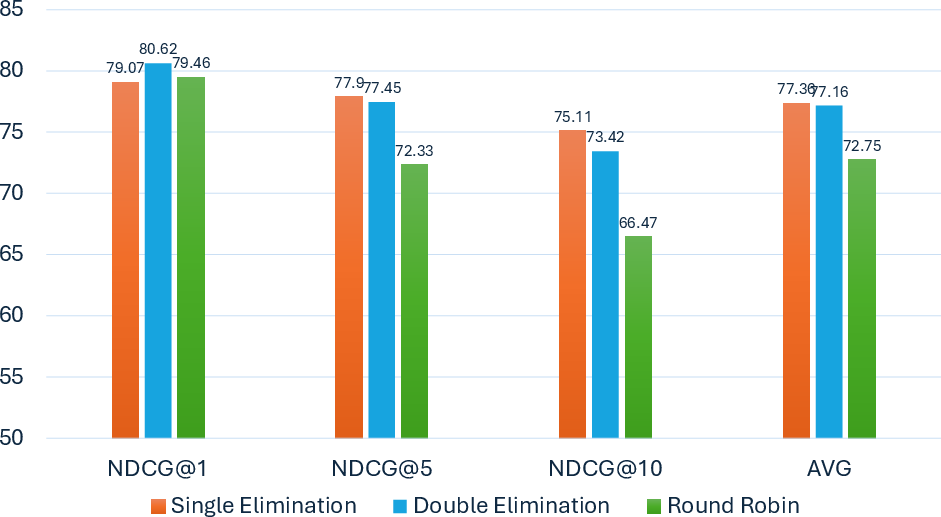
Figure 7: Comparison of bracket elimination structures; single elimination is optimal for nDCG performance and efficiency.
Robustness and Generality
BracketRank is agnostic to the choice of LLM, maintaining strong gains with both proprietary (GPT-4) and open-source (Qwen2.5-7B, Llama-3.1-8B) models. The bracketed competition’s inductive bias for comparative reasoning persists across architectures and retrievers (BM25, Contriever). Performance gains are consistent, particularly on multi-step inference tasks, as detailed in BRIGHT analysis.
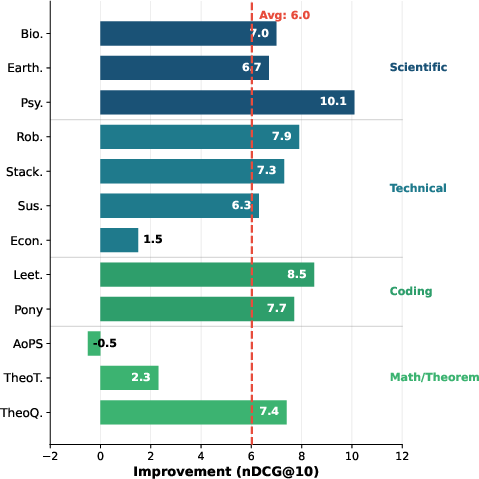
Figure 8: Explicit reasoning benefits are especially pronounced on BRIGHT domains demanding multi-step inference.
Implications and Future Directions
BracketRank substantiates that explicit, prompt-driven comparative reasoning—integrated into a systematic elimination structure—addresses ranking volatility induced by LLM context window limitations and order sensitivity. This paradigm is well-suited for scaling to large candidate sets, mitigating the combinatorial explosion faced by pairwise schemes.
Practically, the improved efficiency-effectiveness frontier makes high-accuracy LLM reranking more viable for real-world, cost-sensitive deployments, especially in scientific and technical QA systems demanding robust multi-hop reasoning. Theoretically, BracketRank’s modular approach invites further work on distilling bracket reasoning into instruction-tuned, smaller student models, or extending the framework to multimodal or conversational contexts.
Conclusion
BracketRank introduces a reasoning-based competitive elimination framework for LLM reranking that decisively improves state-of-the-art performance on both standard and reasoning-intensive retrieval tasks. By fusing context-aware adaptive grouping, explicit stepwise reasoning prompts, and a parallelizable, single-elimination tournament structure, the paradigm delivers superior robustness, efficiency, and ranking fidelity, reestablishing the efficiency-effectiveness Pareto front in LLM-based IR systems.
(2604.08834)