- The paper demonstrates that hyperscale-driven modifications in state-space models, especially in Mamba-3, lead to a significant 22% throughput loss and increased latency in edge deployments.
- Empirical evaluations using roofline models and GPU baselines reveal a 2× increase in per-token energy and computation for single-batch (B=1) scenarios.
- The study advocates decoupling cloud-optimized designs from deployment-specific enhancements to maintain both real-time edge performance and high throughput in hyperscale settings.
Architectural Trade-offs in State-Space Models: The Hyperscale Lottery and Edge Efficiency
Introduction
The paper "The Hyperscale Lottery: How State-Space Models Have Sacrificed Edge Efficiency" (2604.07935) critically examines the impact of hyperscale-driven architectural evolution within the State-Space Model (SSM) lineage, notably Mamba-1 through Mamba-3. While SSMs attained prominence due to their linear computational complexity and constant memory footprint—attributes theoretically favorable for edge intelligence—the progression toward cloud-first deployment and architectural saturation has systematically degraded their single-batch, real-time efficiency. This essay distills the strong empirical results and structural claims underpinning the paper, analyzes architectural mutations within Mamba, and evaluates the practical and theoretical implications for hardware-algorithm co-design.
SSMs: Paradigm Shift and Edge Promise
SSMs offer O(L) complexity for sequence modeling, fundamentally outperforming attention mechanisms (O(L2)) as sequence lengths and embedding dimensions scale. The fixed, recurrent state in SSMs assures constant memory usage—vital for edge accelerators with severe constraints on dynamic allocation and bandwidth. Empirical deployment in CV, physical AI, and small-scale LMs demonstrates the viability of SSMs for real-time, resource-constrained environments. Despite Mamba's initial framing as an LLM backbone, variant adoption in edge-centric domains, such as AR/VR and privacy-preserving inference, affirms its cross-modal flexibility.
Mamba Architectural Evolution: Hyperscale Optimization vs. Edge Suitability
The transition from Mamba-1 to Mamba-3 is characterized by explicit architectural pivots favoring hyperscale throughput. Mamba-1 leverages sequential or parallel scan mechanisms, maintainable via deployment-time optimizations without sacrificing edge efficiency.
Mamba-2 introduces Structured State Space Duality (SSD) via simplification of the state transition matrix and a head dimension for Tensor Parallelism. These changes reduce per-channel temporal expressivity and facilitate multi-GPU synchronization, aligning the architecture with transformer inference stacks prevalent in hyperscale environments.
Mamba-3 amplifies the hyperscale penalty by embedding a rank dimension (R=4) in state expansion, shifting state update operations from vector-based to matrix-matrix multiplications. The operational intensity is increased by R×, theoretically improving utilization in memory-bound, high-batch scenarios. However, in the edge regime (B=1), this induces a 2× increase in computation and energy per token, resulting in a severe regression in prefill and single-batch performance.
Empirical Evaluation: Throughput and Latency Analysis
Quantitative analysis across GPU baselines, analytical Stream modeling, and roofline estimation establishes that sequential SSM formulations remain optimal for edge ASICs. The architecture optimizations for cloud throughput forcibly degrade per-token latency and energy, especially during prefill phases in low-batch deployments.
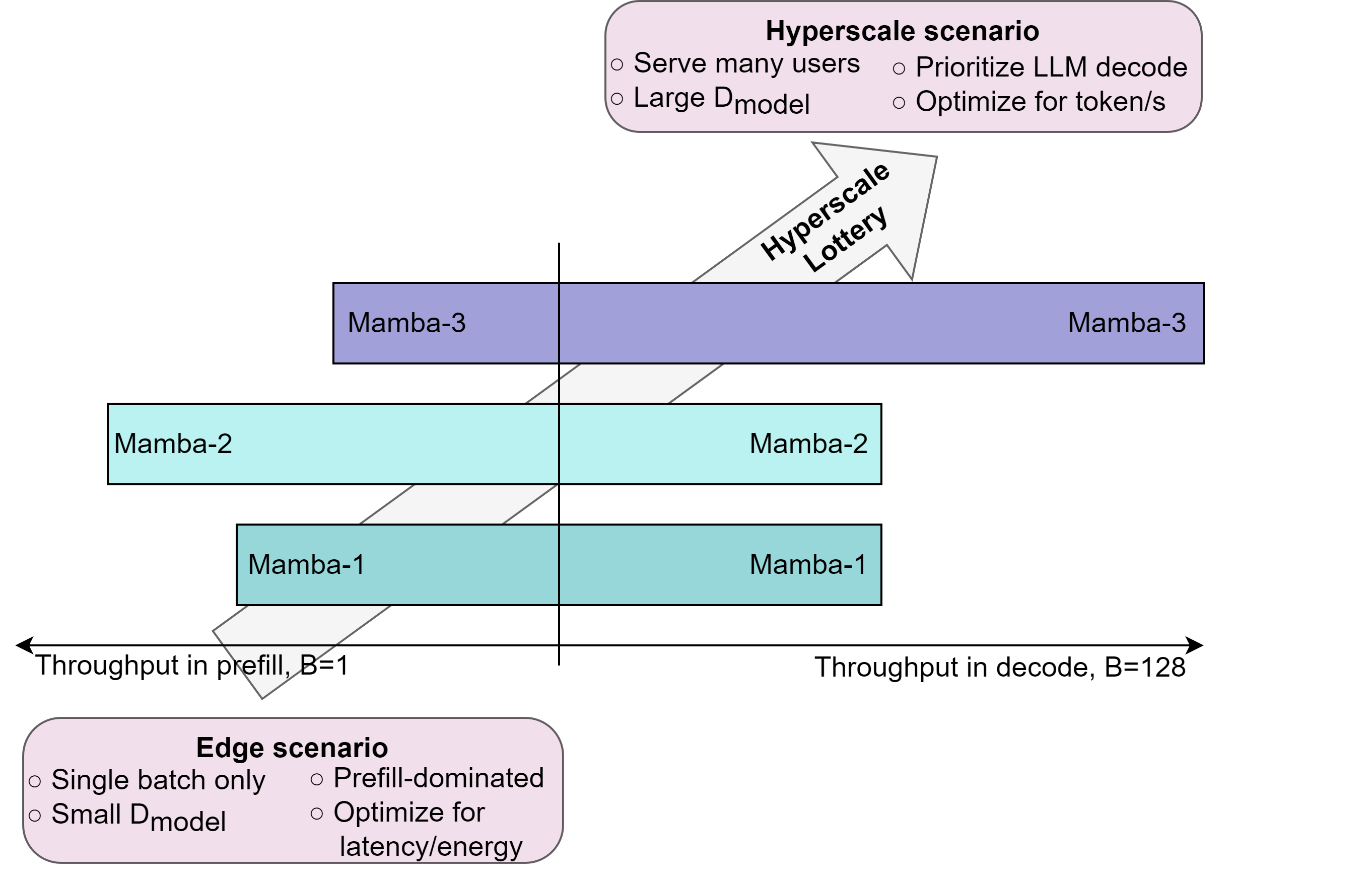
Figure 1: Normalized throughput of the state-update block across Mamba variants, contrasting edge (B=1, prefill) and hyperscale (B≫1, decode) scenarios.
Edge-focused throughput deteriorates with each architectural mutation: Mamba-3 incurs a −22% throughput (+28% latency) penalty relative to Mamba-2 at 880M parameters. For smaller models (15M parameters), the latency penalty escalates to +48% due to the quadratic scaling of projection operations versus the linear scaling of state updates.
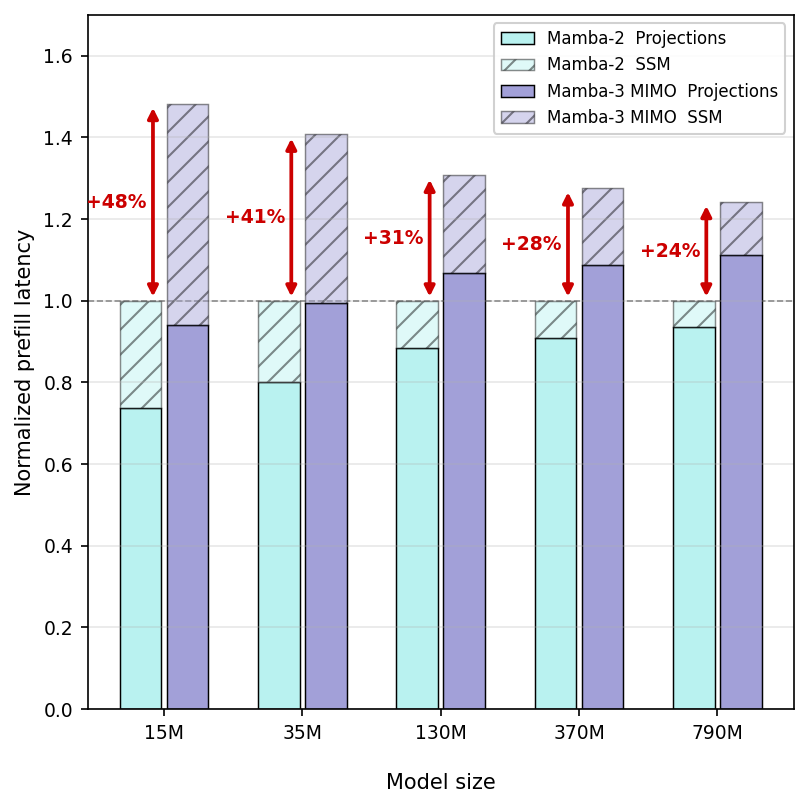
Figure 2: Normalized latency trends with increasing and decreasing model sizes across Mamba variants, estimated via roofline models.
These results starkly illustrate the divergence: architectural elements benefiting hyperscale (decode phase, large batch) are actively detrimental to edge-native efficiency (prefill, small batch).
Theoretical and Practical Implications
The architectural evolution driven by hyperscale economic imperatives epitomizes the Hyperscale Lottery: model design is dominated by cloud deployment and throughput, leading to embedded batch-size-dependent optimizations incompatible with single-user, real-time edge operation. This structural shift risks monoculturing cloud-exclusive AI architectures and undermines the theoretical Pareto optimality between accuracy and raw computational efficiency.
For future hardware-algorithm co-design, the paper advocates decoupling deployment-dependent optimizations from core architectural design. Batch-size-specific enhancements should be left to deployment-time transformations, not embedded as architectural constraints. Further, evaluation metrics must incorporate edge benchmarks, explicitly targeting latency, memory, and energy limitations.
Future Directions
Research trajectories should prioritize architectural flexibility, parameterizing operational intensity and state expansion to allow dynamic adaptation between edge and cloud regimes. Model compression, fine-grained fusion, and hardware-aware optimization strategies are relevant avenues to restore deployment agnosticism. Additionally, explicit architectural branching and modularity may enable scalable tensor parallelism without imposing penalties on single-batch inference.
Conclusion
The paper demonstrates, with precise numerical evaluations, that architectural modifications in Mamba—from SSD in Mamba-2 to MIMO state expansion in Mamba-3—systematically erode the edge-native efficiency that originally distinguished SSMs over transformers. The Hyperscale Lottery defines a critical axis of tension in AI model research and deployment: hyperscale optimization must not preclude low-latency, energy-efficient edge intelligence. Architectural decoupling and dual-benchmark evaluation are imperative to preserve flexibility and viability across heterogeneous deployment scenarios.

