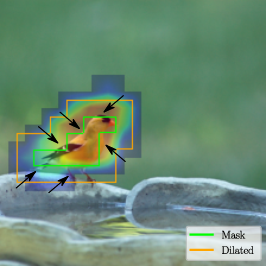
- The paper proposes DINO-QPM, a lightweight adapter that transforms frozen DINOv2 features into globally interpretable representations using strict sparsity and quantised patch embeddings.
- It employs a structured pipeline with average pooling, a trainable MLP, and a sparse BLDD layer to ensure spatially localized and contrastive class features.
- Experimental results on datasets like CUB-200 and Stanford Cars show improved accuracy (88.3%) and interpretability, making decision processes more transparent.
DINO-QPM: Globally Interpretable Image Classification with Frozen Visual Foundation Models
Introduction and Motivation
The paper "DINO-QPM: Adapting Visual Foundation Models for Globally Interpretable Image Classification" (2604.07166) addresses the critical challenge of global interpretability in state-of-the-art visual foundation models (VFMs), particularly self-supervised models such as DINOv2. While VFMs demonstrate impressive feature extraction capabilities, their high-dimensional latent spaces and reliance on complex aggregation tokens (e.g., CLS tokens in Vision Transformers) severely hinder both local and global interpretability—an essential requirement for real-world, high-stakes domains.
To resolve this, the work presents DINO-QPM, a lightweight interpretability adapter leveraging strict sparsity, class-independent features, and average-pooled patch representations. Rather than requiring prohibitively expensive end-to-end retraining or external supervision (e.g., language-based concept banks), DINO-QPM operates entirely on frozen foundation backbones. By structurally coupling the final features to spatially local input evidence and enforcing quantised, compact, and globally contrastive representations, DINO-QPM provides faithful, human-interpretable explanations—both locally for individual predictions and globally for the entire class structure—while achieving strong accuracy.
Methodology: Sparse, Quantised, and Localised Interpretability
The paper adapts the Quadratic Programming Enhanced Model (QPM) framework (Norrenbrock et al., 27 Feb 2025) to transform the entangled representations of the frozen DINOv2 backbone into interpretable, spatially localised features via a specialized adapter:
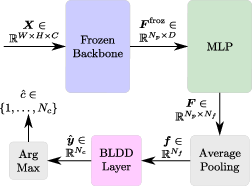
Figure 1: The DINO-QPM architecture: frozen DINOv2 patch embeddings feed a trainable MLP, followed by a sparse BLDD layer for compact, interpretable image classification.
Pipeline Overview:
Novelty: In contrast to prior approaches that either use dense linear probes or prototype-based heads (which lack true global interpretability or require fine-tuning), DINO-QPM’s architectural choices—particularly the average pooling on patch features and strict sparsity at the decision layer—enable both high accuracy and a transparent, globally consistent semantic decomposition of class evidence.
Quantitative and Qualitative Results
The model is validated on fine-grained benchmarks (CUB-200-2011, Stanford Cars) using a broad suite of interpretability metrics: Plausibility, SID@5 (feature spatial diversity), Class-Independence, Contrastiveness, and standard accuracy.
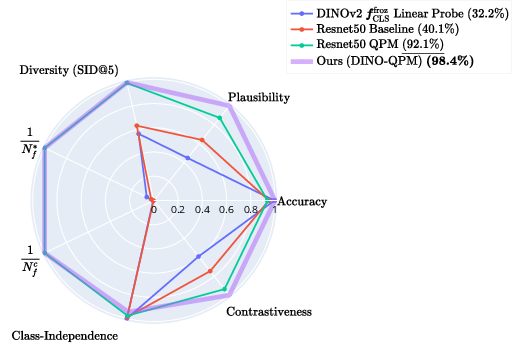
Figure 3: DINO-QPM surpasses both the non-frozen QPM and baselines in accuracy and all interpretability dimensions, achieving over 98% of the achievable aggregate score.
Key Results:
Qualitative Interpretability
The model produces global and local explanations enabling transparent dissection of decision rules. For visually similar classes, DINO-QPM’s features consistently localise on semantically meaningful parts directly tied to human-recognizable distinctions.
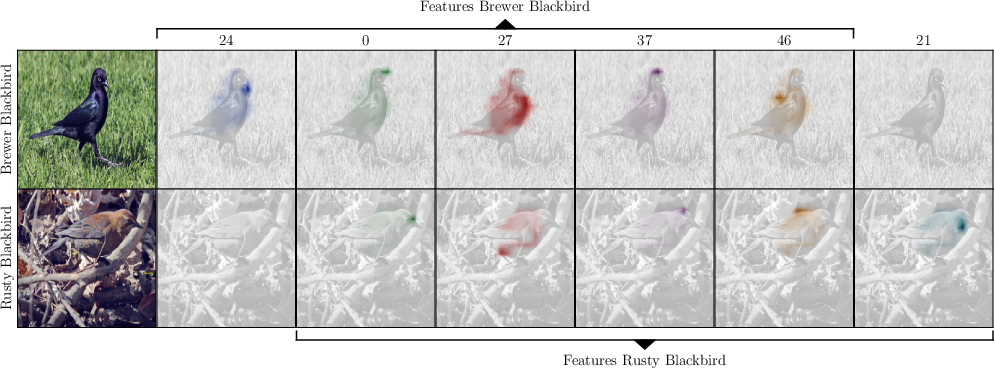
Figure 5: Two visually similar blackbird species are differentiated by the DINO-QPM feature corresponding to beak morphology, reflecting ornithological expertise.
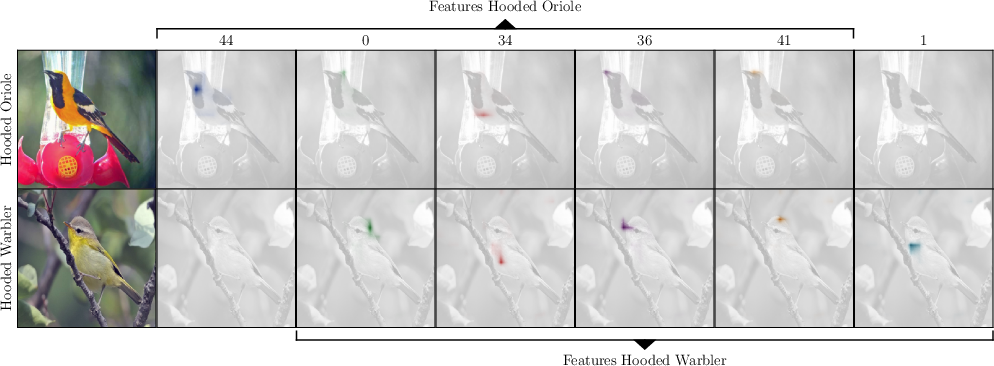
Figure 6: DINO-QPM autonomously discovers the five features distinguishing Hooded Oriole and Hooded Warbler, highlighting throat region differences—no external supervision required.
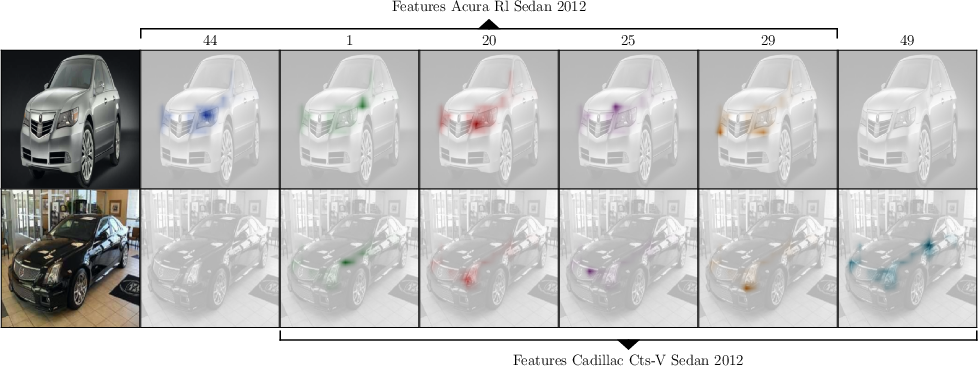
Figure 7: For Stanford Cars, DINO-QPM localises distinctive headlights, enabling class differentiation through explicit, part-level feature discovery.
Additionally, model ablations demonstrate the critical role of using patch embeddings and structured sparsity for both accuracy and faithfulness, and that the adapter generalizes across different DINOv2 backbone variants.
Comparison to Existing Interpretable and Post-Hoc Methods
While post-hoc methods such as GradCAM, ViT-Shapley, or CBMs can offer superficial attribution maps and partial semantic bottlenecks, they either operate on dense, entangled feature spaces or require external concept supervision and re-training. DINO-QPM uniquely enables:
- End-to-end spatial grounding of globally defined features—each class is represented by exactly the same fixed, low-dimensional, and non-overlapping feature subset across the dataset.
- Full compatibility with frozen large-scale self-supervised backbones, drastically reducing computational overhead.
- Interpretability not just at the level of individual predictions (local), but globally across the learned class structure.
Implications and Future Directions
Practical Implications: DINO-QPM makes inherently faithful, globally interpretable image classification accessible for foundation model pipelines without expensive fine-tuning or domain-specific supervision. The clear structure, compact explanations, and high Plausibility enable robust auditability and trust, especially in safety-critical or regulated settings.
Theoretical Insights: The work highlights the efficacy of explicit discrete optimization for feature selection in neural networks—outperforming more heuristic prototype selection or post-hoc attribution—and provides quantitative evidence that direct patch-feature coupling in ViT backbones is essential for robust local grounding.
Future Work: Directions include:
- Extending the structurally sparse interpretability paradigms to segmentation, detection, or video classification (where global explanations over spatiotemporal features are needed).
- Integrating DINO-QPM-like adapters with multimodal or text-image aligned VFMs for transparent cross-modal reasoning.
- Exploring differentiable relaxations of the BLDD layer for gradient-based neural architecture search.
Conclusion
DINO-QPM demonstrates that interpretable global classification is achievable in large-scale, frozen VFMs by structurally decoupling decision features from entangled token representations and enforcing sparse, global, and localizable features via QPM optimization. The model substantially advances both accuracy and interpretability, establishing a rigorous foundation for future research into faithful, efficient, and globally transparent AI vision systems.