- The paper demonstrates that passive clusters acquire persistent rotation via net chiral torque and anisotropic structure in a chiral active bath.
- Numerical simulations show that optimal rotation occurs at intermediate size ratios with moderate active fractions, evidenced by superdiffusive angular dynamics.
- Increasing chirality disorder suppresses rotational coherence, underscoring the importance of homogeneous torque for sustaining collective motion.
Emergent Rotation of Passive Clusters in a Chiral Active Bath
Introduction and Background
This work presents a systematic numerical study of passive particle clusters immersed in a bath of chiral active Brownian particles (cABPs) with inherent chirality, focusing on the emergence of collective rotation. The system is designed to probe the parameter regimes of size ratio and active particle density under which passive clusters not only assemble but exhibit persistent, coherent rotational motion. This rotational state emerges as a consequence of the interplay between geometrical anisotropy, structural order, net chiral torque from the surrounding bath, and the distribution of chirality among cABPs. The theoretical framework aligns with recent advances in active matter, extending the role of active depletion and non-equilibrium assembly to include chirality-induced rotational phenomena previously underexplored in active–passive mixtures.
Model Description
The model implements a binary mixture in two dimensions: Np large, passive disks in a bath of Na≫Np cABPs (with a2>a1). Interactions are primarily soft repulsive for all pairs, augmented by a weak, tunable attraction between the passive particles to stabilize clusters against active driving (see force law details). The cABPs experience both self-propulsion and a torque determined by intrinsic chirality Ωi sampled from a log-normal distribution with tunable variance σ, capturing natural population heterogeneity. The principal control parameters are the size ratio S=a2/a1 and active area fraction ϕa. Simulations employ overdamped Langevin dynamics, proceeding to steady state post-initial thermalization, with observables averaged over many independent realizations.
The system evolution from a homogeneously mixed state to the late-time clustered and rotationally active configuration is illustrated below.
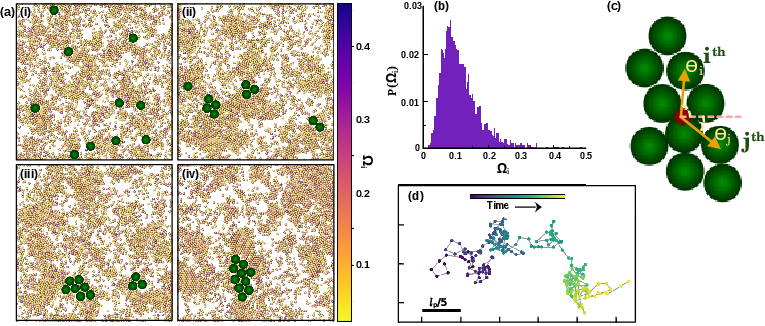
Figure 1: (a) Temporal sequence from initial mixing to late-time clustering, (b) active particle chirality distribution, (c) passive cluster snapshot and (d) cluster COM trajectory highlighting rotational and translational dynamics.
Structural Properties and Parameter Regimes for Rotation
The paper demonstrates that cluster formation alone is insufficient for rotation; specific morphological and dynamical signatures are required. The internal structure is quantified through the passive–passive radial distribution function, gyration tensor, and cluster asphericity.
Within intermediate size ratios (S=3–$4$), passive clusters exhibit pronounced hexagonal order, significant asphericity, and enhanced net torque induced by the bath. These features are strongly correlated with persistent, coherent rotation. Notably, structural order persists in the rotational regime, whereas order is lost as clusters become either too small (comparable to actives) or too large (where internal reshuffling dominates).
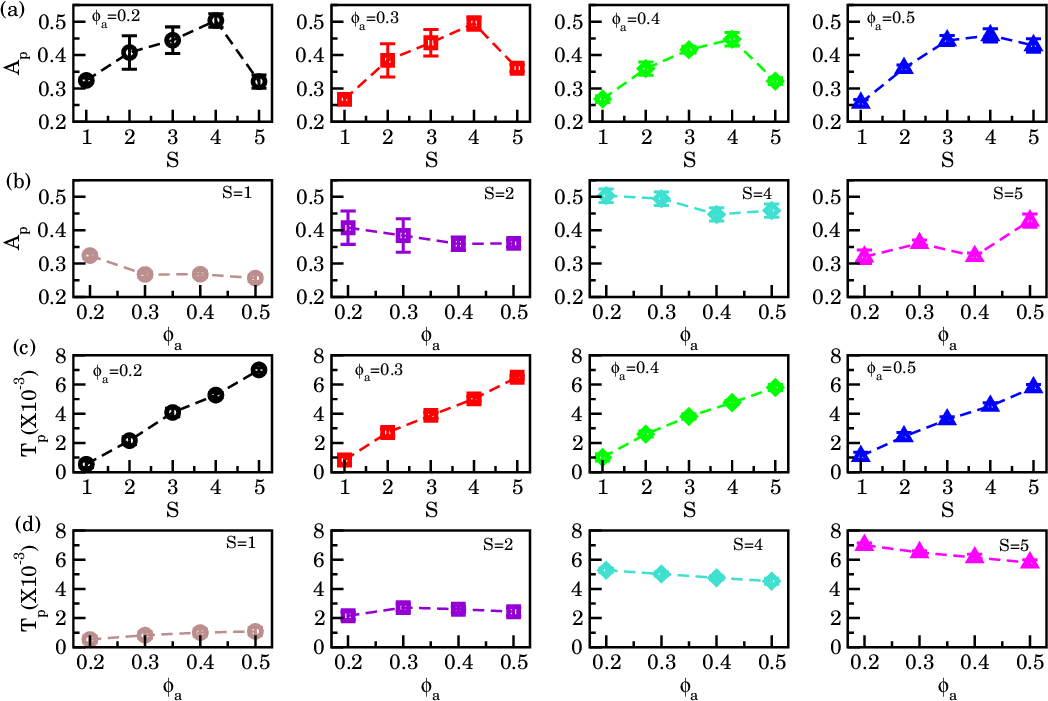
Figure 2: (a,b) Asphericity as functions of size ratio and packing fraction and (c,d) mean net torque as functions of the same, demonstrating the mechanistic link between cluster morphology and mechanical stimuli from the active bath.
The passive cluster’s asphericity (Ap) shows a non-monotonic dependence on Na≫Np0: it is maximal for intermediate sizes and low in both limits of small and large clusters. The mean net torque (Na≫Np1) increases with Na≫Np2, but the rotational response saturates and diminishes at large Na≫Np3 due to enhanced internal rearrangements and loss of rigid body coherence.
Angular and Translational Dynamics
The transition from diffusive to superdiffusive rotational dynamics is quantified via the angular autocorrelation function Na≫Np4 and the mean-squared angular displacement (MSAD). Persistent rotation only manifests in an optimal window of intermediate cluster size (Na≫Np5) and moderate active fraction (Na≫Np6). In this regime, Na≫Np7 shows long-lived oscillations, while the MSAD exhibits a power-law growth with a strong superdiffusive exponent (Na≫Np8), peaking at Na≫Np9. Outside this regime, angular dynamics return to near-diffusive (a2>a10) and rotational coherence vanishes.
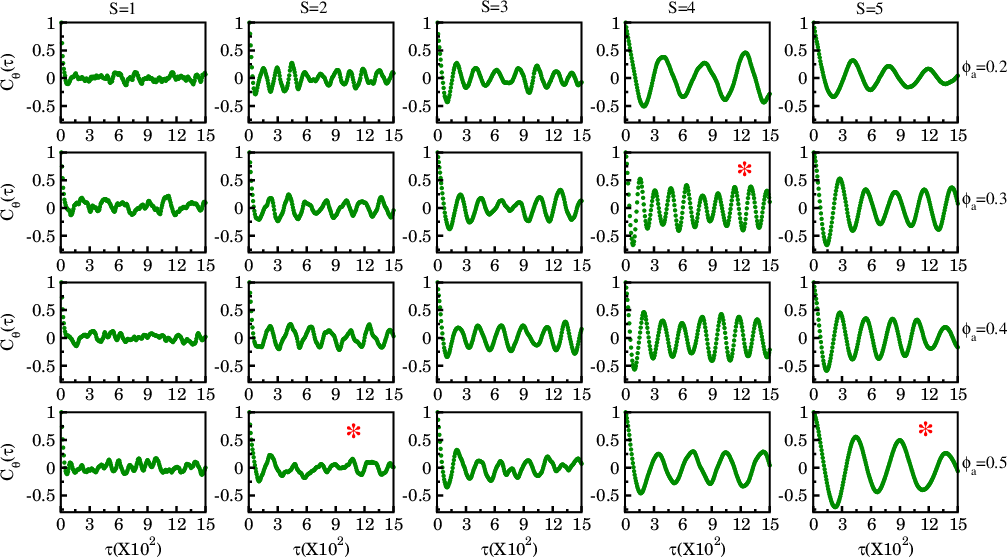
Figure 3: Angular autocorrelation a2>a11 for varying a2>a12 and a2>a13; persistent oscillations highlight regimes of sustained rotation.
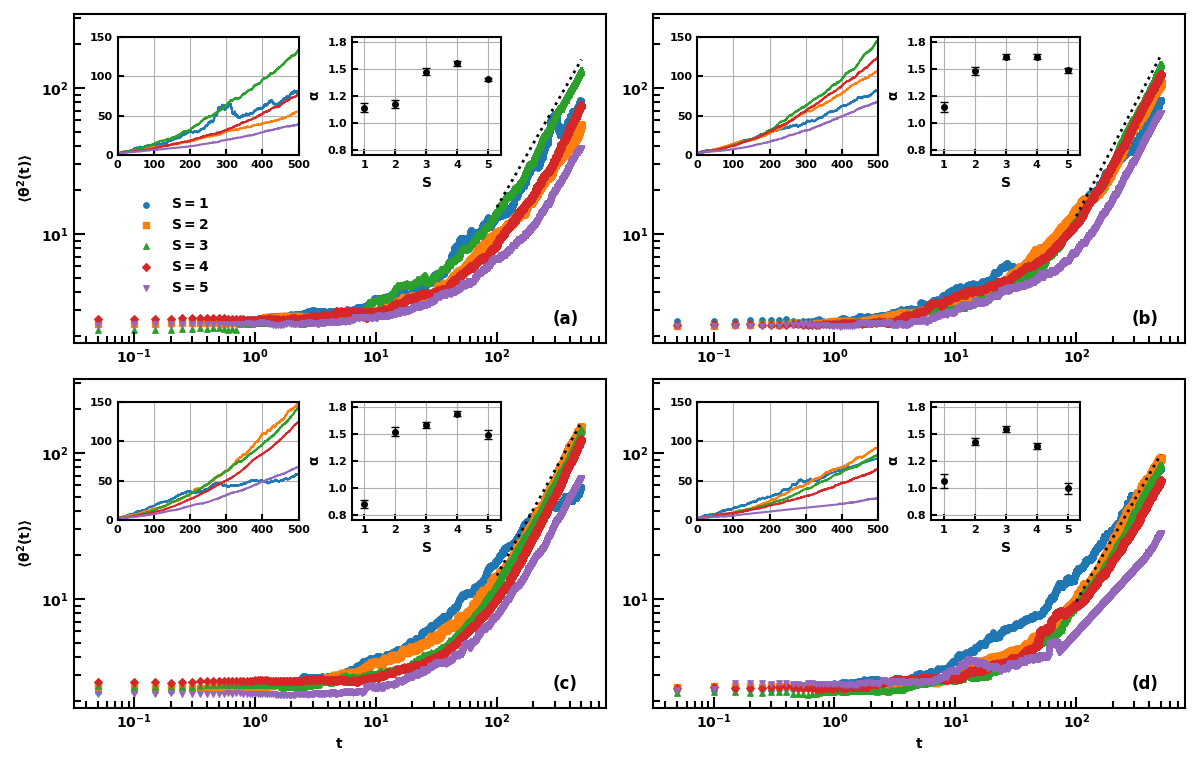
Figure 4: MSAD for different a2>a14 and a2>a15; power-law exponents quantify the emergence of superdiffusion in the rotational regime.
Translational mobility, characterized by the center of mass mean-squared displacement (MSD), is maximal for slightly smaller clusters (a2>a16), and is not optimized in the same parameter space as rotation. The translational mode is primarily diffusive at long times, and enhanced cluster size or crowding suppresses COM diffusion.
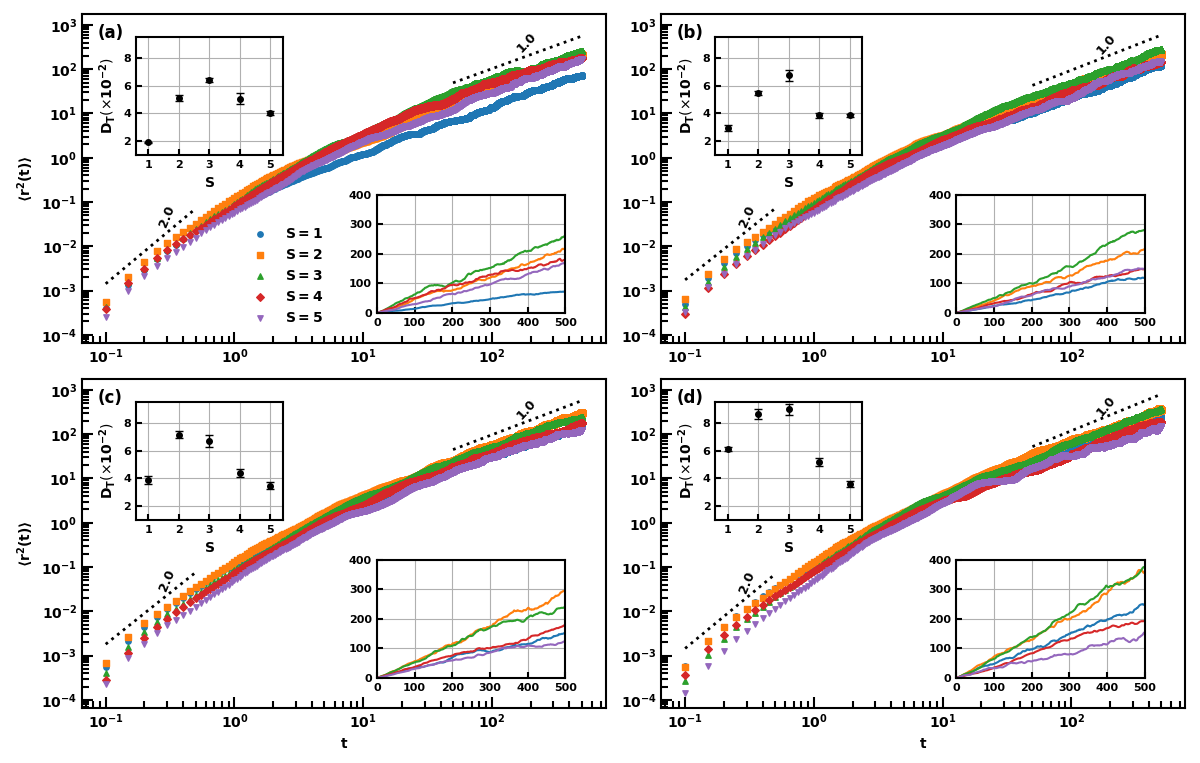
Figure 5: Mean-squared displacement of the passive cluster illustrates ballistic-to-diffusive crossover and distinct parameter dependence from angular dynamics.
Effects of Chirality Disorder
Chirality heterogeneity in the active bath (quantified by the variance a2>a17 of the log-normal a2>a18 distribution) substantially suppresses the rotational persistence of passive clusters. With uniform chirality (a2>a19), clusters experience coherent net torque, leading to nearly ballistic angular transport. Increasing Ωi0 introduces geometric frustration that degrades orientational coupling and suppresses superdiffusive rotation (Ωi1 trends towards Ωi2), a result robust across the investigated Ωi3.
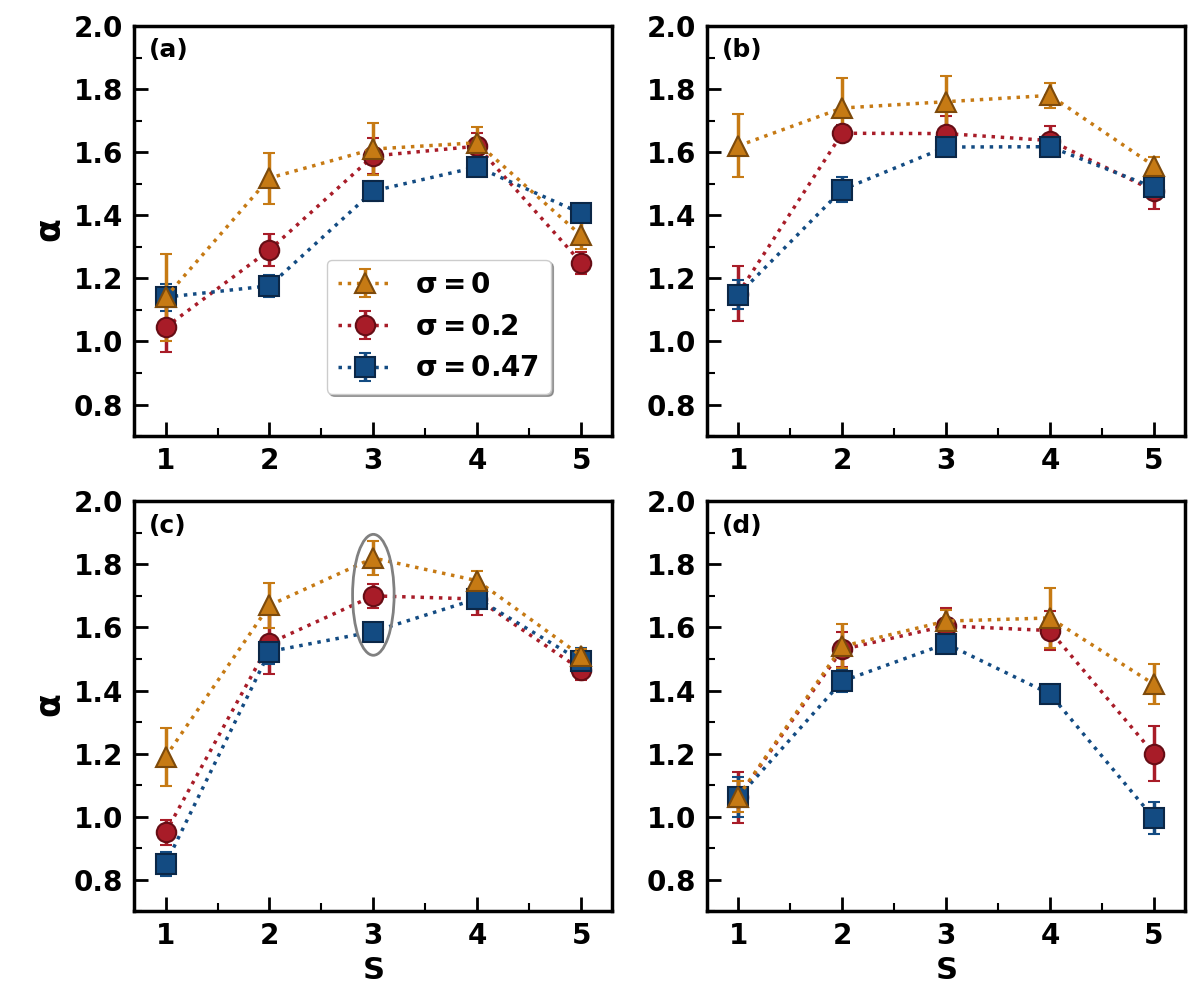
Figure 6: MSAD exponent Ωi4 as a function of Ωi5 and Ωi6, showing maximal rotational coherence for uniform chirality baths and systematic suppression with increasing chirality variance.
Oscillatory features of Ωi7 are likewise damped under chirality disorder, providing a direct dynamical signature of the loss of rotational coherence.
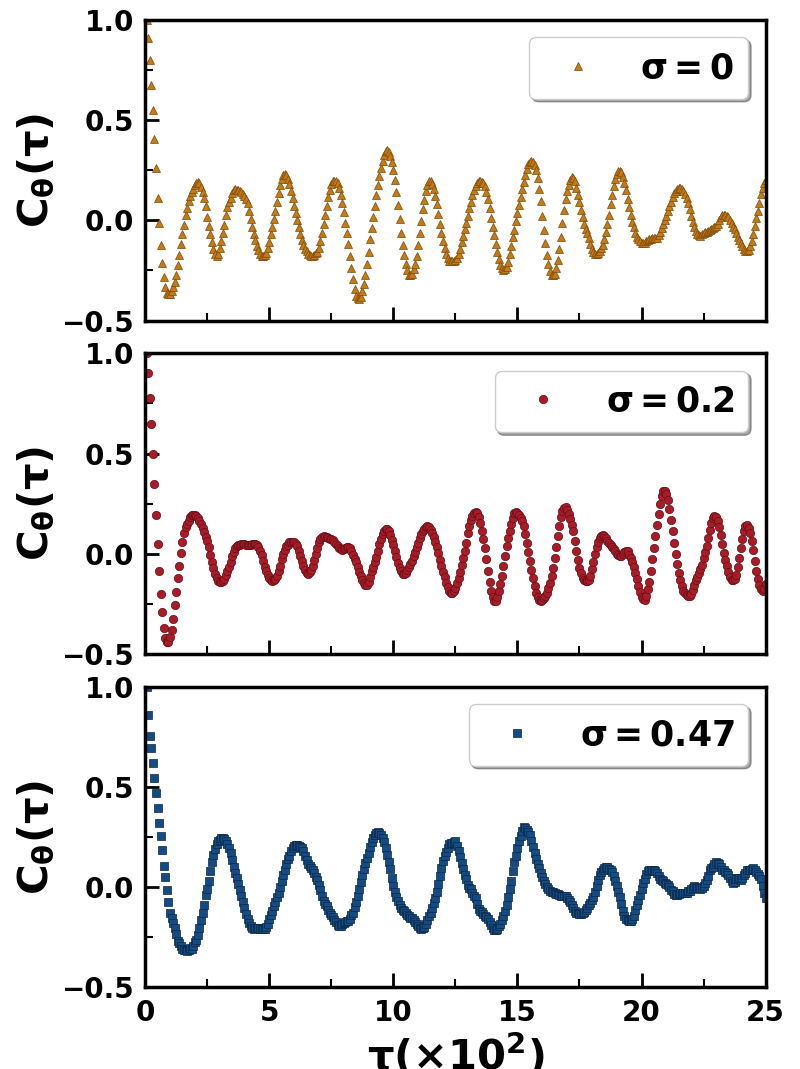
Figure 7: Angular autocorrelation at fixed Ωi8 and Ωi9 under varying chirality variance, confirming damped rotational dynamics with stronger disorder.
Discussion and Implications
The numerical results firmly establish that emergent collective rotation of passive clusters in a chiral active bath is confined to a sharply defined region in parameter space. This regime is characterized by the coexistence of structural order, geometric anisotropy, and mechanical torque from a chirally homogeneous, sufficiently dense active bath. Neither cluster size nor bath activity alone suffice—the effect is inherently collective and contingent on structural and mechanical coherence.
From a theoretical perspective, the findings highlight the non-trivial role that chirality and its spatial disorder play in the global dynamics of active–passive mixtures. The results emphasize that even simple passive inclusions can exhibit nontrivial transport phenomena (persistent rotation) resulting from nonequilibrium energy transfer, with collective effects overcoming single-particle intuition.
Practical implications pertain to the design and control of micro- and nanoscale devices in active environments. By tuning size ratio, bath activity, and chirality distribution, it is feasible to control not only cluster assembly but the persistent orientation dynamics, relevant to the engineering of micro-rotors, microrobots, and synthetic gears extracting work from non-equilibrium backgrounds. The results also suggest future exploration along several directions, including the explicit role of hydrodynamic interactions, extension to anisotropic cluster geometries, or extension to higher dimensions.
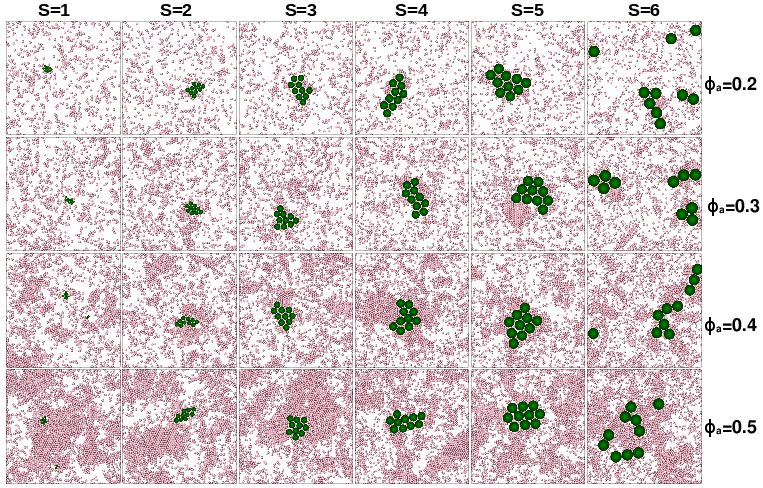
Figure 8: Steady-state snapshots for different σ0 and σ1, demonstrating morphological diversity and the parameter-dependent emergence of ordered rotating clusters.
Conclusion
This work quantitatively delineates the structural and dynamical criteria for the appearance of persistent, collective rotation in passive clusters immersed in a chiral active bath. Strong numerical evidence demonstrates that optimal rotational coherence arises from a synergistic confluence of cluster asphericity, net chiral torque, and homogeneous activity, and is sharply degraded by either geometric mismatch or disorder in chirality. These conclusions refine the understanding of collective effects in active–passive systems, informing both the statistical mechanics of nonequilibrium assembly and the practical realization of functional micro-scale machines powered by active matter.