- The paper presents a novel bidirectional model of trust, highlighting reciprocal evaluation of both human and AI reliability.
- It employs counterfactual scenarios and empirical illustrations to examine automation bias and algorithm aversion.
- The study proposes adaptive regulatory frameworks that align AI autonomy with the catastrophic potential of false negatives or positives.
Reciprocal Trust and Distrust in AI Systems: The Hard Problem of Regulation
Introduction
The paper "Reciprocal Trust and Distrust in Artificial Intelligence Systems: The Hard Problem of Regulation" (2604.05826) provides a comprehensive and conceptually rigorous analysis of trust and distrust dynamics between humans and AI systems, with special focus on their regulatory implications in high-stakes contexts. Emphasizing that trustworthiness is inherently relational, the author advances current discourse by moving beyond a unidirectional framing of "can we trust AI?" to a more nuanced, bidirectional model: not only should humans evaluate and calibrate trust in AI, but AI systems themselves operationally exercise agency-like behaviors that mirror trust and distrust towards their users, data sources, and regulators. This approach illuminates novel regulatory dilemmas, especially as the degree of AI autonomy rises in critical applications.
Theoretical Framework: Trust as a Relational and Operational Construct
Rather than treating trust as a static property, the analysis situates it as a dynamic relation co-produced through interaction. Drawing on contemporary organizational studies and AI ethics frameworks, the paper distinguishes between attributes such as competence, robustness, and integrity in both AI and human actors, and highlights the critical notion of "watchful trust" over blind trust. Importantly, the discussion points out that existing AI systems operationalize trust in a highly qualified, functional sense—eschewing subjective experience, and instead modeling trust as the reliable weighting and calibration of human-provided inputs. This "calculus-based trust" aligns with incentive-driven, rational behavior rather than affective disposition.
The paper identifies symmetric and asymmetric failure modes: humans can deploy unwarranted trust or distrust toward AI, leading to phenomena such as automation bias or algorithm aversion; similarly, AI systems can be seen as functionally over-trusting flawed human data/instructions, or unwarrantedly distrusting valuable human interventions. Both axes of (mis)trust create measurable regulatory failures.
Misalignments of Trust: Empirical and Counterfactual Illustrations
The functional reciprocity of trust in human–AI relations is articulated through four archetypal interactional modes: warranted trust, warranted distrust, unwarranted trust, and unwarranted distrust. Empirically, automation bias and algorithm aversion illustrate misalignments from the human perspective, undermining effectiveness or safety. Experiments show that public trust in AI is highly context-dependent, and that procedural transparency, participatory governance, and adequate human oversight modulate these relationships.
To operationalize the regulatory consequences of misaligned trust, the author employs two well-constructed counterfactual scenarios derived from catastrophic 20th-century events: the 1983 nuclear false alarm at Serpukhov-15 and the 1986 Chernobyl disaster. These cases are leveraged to clarify the risks associated with both excessive AI autonomy (escalation triggered by unwarranted trust in faulty sensors and unwarranted distrust of legitimate human skepticism), and insufficient AI autonomy (catastrophic consequences when AI lacks authority to override untrustworthy human behaviors in safety-critical contexts).
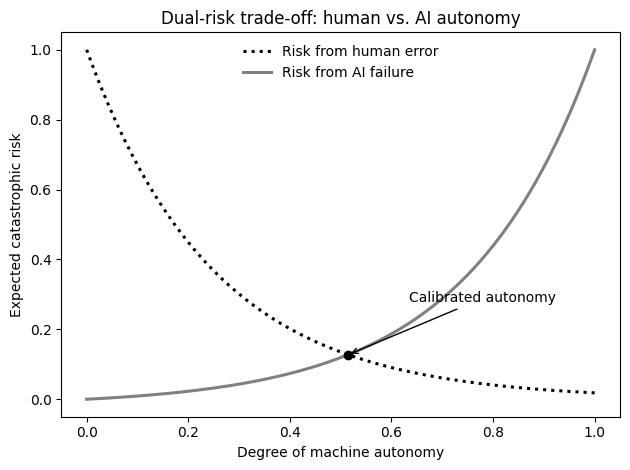
Figure 1: Calibrated AI autonomy is conceptualized as a continuum structured by costlier errors, aligning final authority and override mechanisms to context-sensitive risk evaluations.
Regulatory Tensions and the Calibration of Autonomy
The paper identifies a fundamental regulatory paradox: allocating autonomy and authority in human–AI hybrids requires regulators to determine whose errors—false positives or false negatives—are more catastrophic in a given domain, and to structure control accordingly. In strategic defense and nuclear warning, the cost of accidental escalation mandates final human authority and stringent redundancy. In infrastructures such as energy, aviation, and chemical process control, regulatory logic may favor hard safety interlocks and privileged AI override to prevent catastrophic false negatives. The logic of "allocate autonomy to the costlier error" is developed in detail and mapped to practical regulatory instruments (e.g., dual-key overrides, regulator-audited firmware, non-overridable logic).
The paper further underscores the ongoing evolution of regulatory institutions, noting the emergence of specialized AI oversight agencies and adaptive standardization processes, as well as the need for distributed accountability and continuous trust audit mechanisms. In all cases, reflexive, multi-actor and polycentric governance is presented as essential for sustaining the calibration of trust and distrust across dynamic technological and institutional landscapes.
Implications for AI Governance
Theoretically, these arguments strongly challenge reductionist or techno-solutionist paradigms, positing AI regulation as an inherently political task rather than a purely technical design problem. The calibration of authority, responsibility, and control must remain adaptive, context-sensitive, and subject to ongoing democratic and stakeholder deliberation. Practically, the findings signal that static regulatory templates—such as blanket calls for "human-in-the-loop" or unrestricted automation—are systematically inadequate. Instead, safety, legitimacy, and accountability hinge on aligning trust relationships dynamically, re-assessing the balance of control as AI capabilities and sociotechnical arrangements evolve.
Conclusion
This paper makes a substantive contribution to the theory and practice of AI regulation by reconceptualizing trust and distrust as bidirectional, operational, and inherently relational phenomena. The analysis is technically and philosophically rigorous, leverages both theoretical constructs and realistic counterfactual scenarios, and translates these into concrete regulatory heuristics for the allocation of autonomy. However, it foregrounds an enduring dilemma: no fixed distribution of authority can fully resolve the risks introduced by advanced AI; instead, legitimacy and effectiveness demand continuous governance innovation, adaptive checks, and recalibration of reciprocal trust relationships between humans, AI systems, and regulators.
The challenges illuminated here are salient for any future development of AI in high-stakes domains—whether safety automation, critical infrastructure, or defense. Open technical and political questions remain about the feasibility and implementation of multi-actor regulatory architectures capable of keeping pace with rapid AI advances. Nevertheless, the proposed framework establishes a principled foundation for future scholarship and policy on the relational and institutional dynamics of AI trust, autonomy, and accountability.

