- The paper demonstrates that manipulating pulse-front curvature (PFC) in a flying-focus LWFA extends electron acceleration by mitigating dephasing limits.
- Experiments employing a 100 TW-class Ti:Sapphire laser with axiparabola focusing achieved systematic wakefield velocity tuning, corroborated by PIC simulations.
- Analytical and experimental results show up to a 50 MeV increase in electron cutoff energy, suggesting a pathway to compact GeV-class accelerators.
Electron Acceleration in a Flying-Focus Laser Wakefield Accelerator
Introduction
This work presents a clear, experimentally validated demonstration of electron acceleration to relativistic energies within a laser-wakefield accelerator (LWFA) employing a flying-focus driver. Through simultaneous use of spatio-temporal couplings and axiparabola focusing, the system produces a quasi-Bessel beam with precisely tunable on-axis group velocity. The principal objective is to address the long-standing dephasing limitation inherent to conventional LWFAs, which restricts maximum achievable energy by causing electrons to outrun the accelerating phase of the plasma wake. The results provide empirical evidence that altering the wakefield velocity via pulse-front curvature (PFC) manipulation directly impacts the final energy distribution of the accelerated electron bunches, which is corroborated by supporting PIC simulations and a supporting analytical model.
Experimental Design: Flying-Focus LWFA Implementation
The experimental configuration leverages the HIGGINS 100 TW-class Ti:Sapphire system, delivering 1.5 J, 27 fs pulses, focused by a high numerical aperture axiparabola element to an extended line focus over several millimeters. Manipulation of the beam’s spatio-temporal structure is achieved with a variable PFC using a custom doublet in the expansion telescope, enabling reversible and precisely calibrated modifications to the group velocity of the intensity peak along the focal axis. Optical metrology (beamlet cross-correlation) confirms that varying PFC does not introduce confounding aberrations beyond a calibrated longitudinal shift.
The plasma target is formed by a He:N2 mixture delivered via a supersonic slit nozzle. The gas flow and plasma density profile are validated via high-resolution Ansys Fluent CFD and interferometry for precise input into simulations.
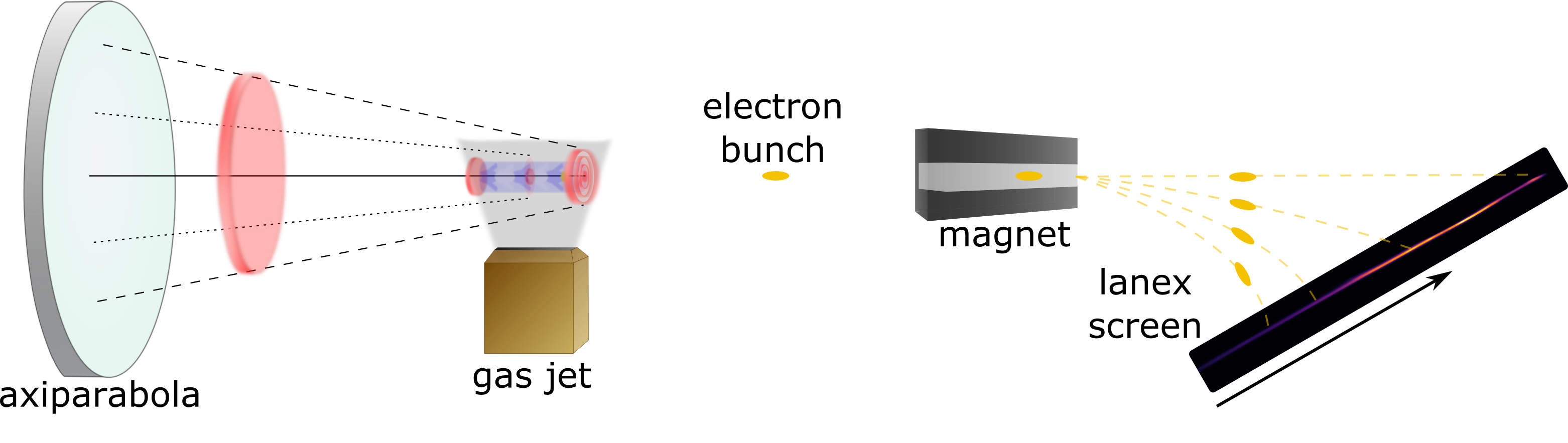
Figure 1: Schematic of the experiment highlighting the flying-focus generation, relativistic electron acceleration, and post-plasma energy-dispersive detection.
Detailed measurements and simulations of the focal structure confirm high fidelity between modeled and experimental focal field distributions across all PFC settings, ensuring systematic reproducibility and minimizing parameter degeneracy.
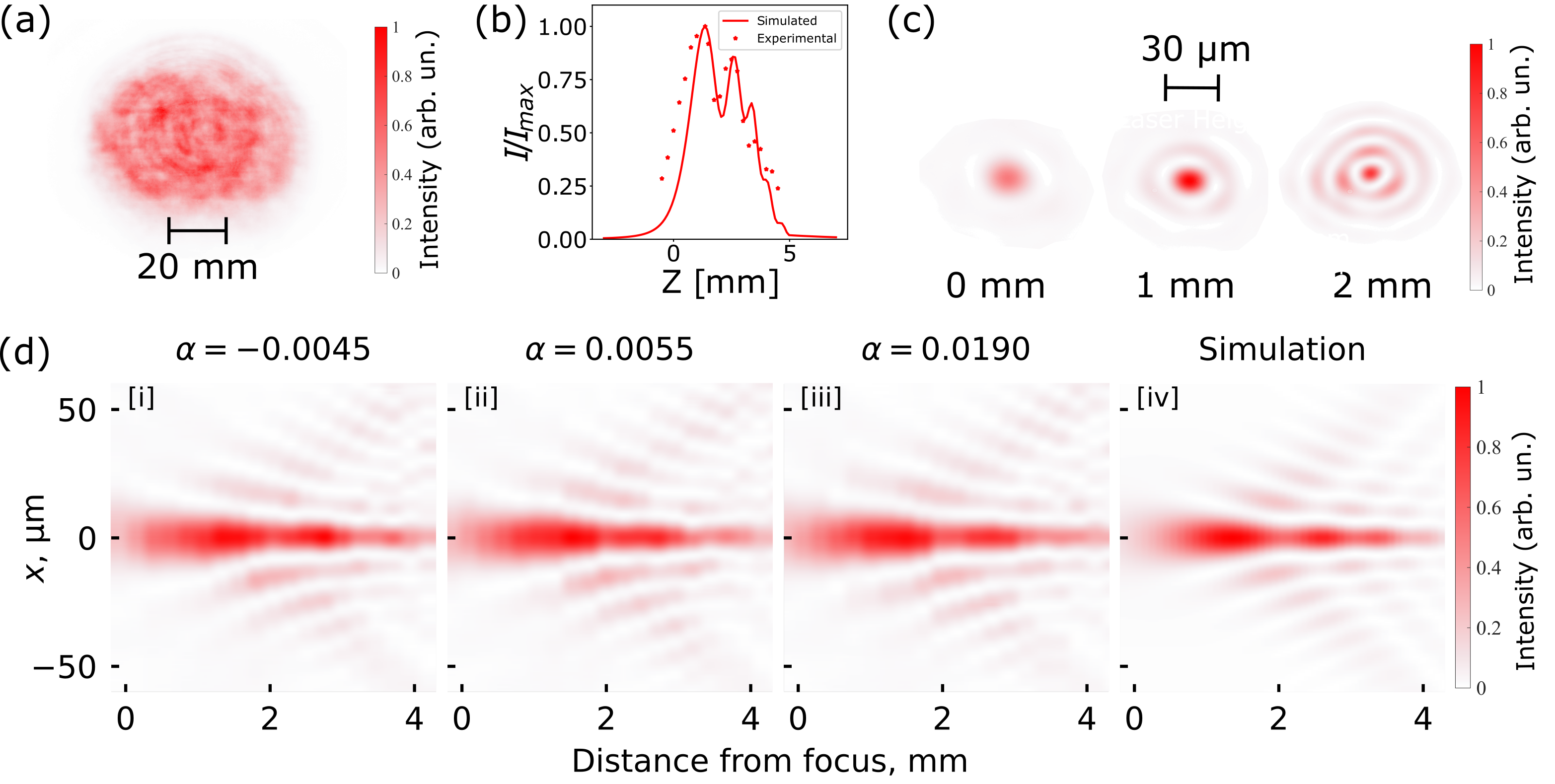
Figure 2: Experimental validation of the laser’s focal structure and spatio-temporal intensity distribution over the focal depth for different PFCs.
Wakefield Velocity Control and Measurement
The group velocity of the intensity maximum, vz, is analytically governed by the interplay of axiparabola geometry and a quadratic-in-radius, linear-in-frequency phase (PFC, parameterized by α). Experimentally, vz/c is measured for α=−0.0045, $0.0055$, and $0.0190$ fs/mm2 (superluminal to subluminal regimes in vacuum), confirming continuous and reversible tunability.
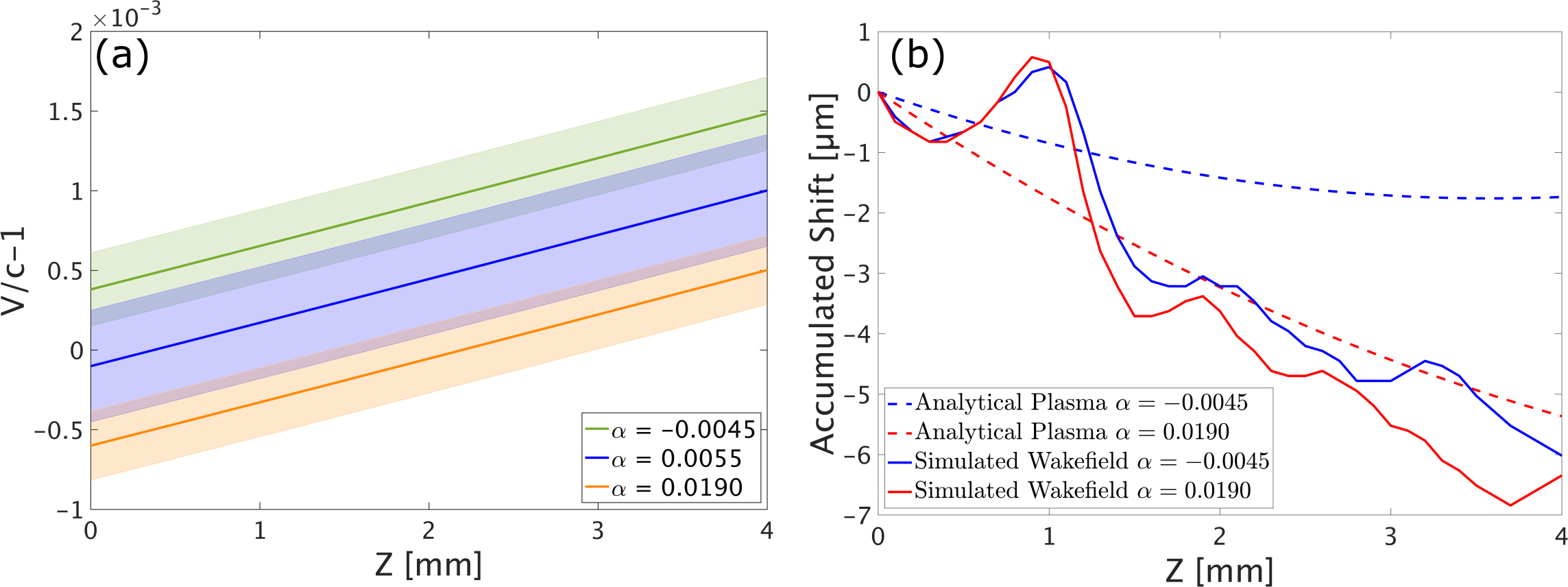
Figure 4: Experimentally measured and simulated deviation of intensity peak velocity from c for different PFCs; accumulated longitudinal shift in plasma versus vacuum.
In plasma, plasma dispersion and ionization injection processes modulate the group velocity further, resulting in a more complex deviation from the vacuum case. However, simulations confirm a persistent ordering between wakefield phase velocity and PFC: more negative α yields systematically higher wakefield velocity throughout the acceleration region.
Relativistic Electron Production and Spectral Diagnostics
For each PFC value, a statistical ensemble of 20 shots verifies the repeatability and robust sensitivity of the accelerated electron spectrum to the wakefield velocity. Spectrally dispersed Lanex scintillator images reveal a clear, systematic increase in the high-energy cutoff of the electron distribution for the fastest (most negative vz0) PFC setting.
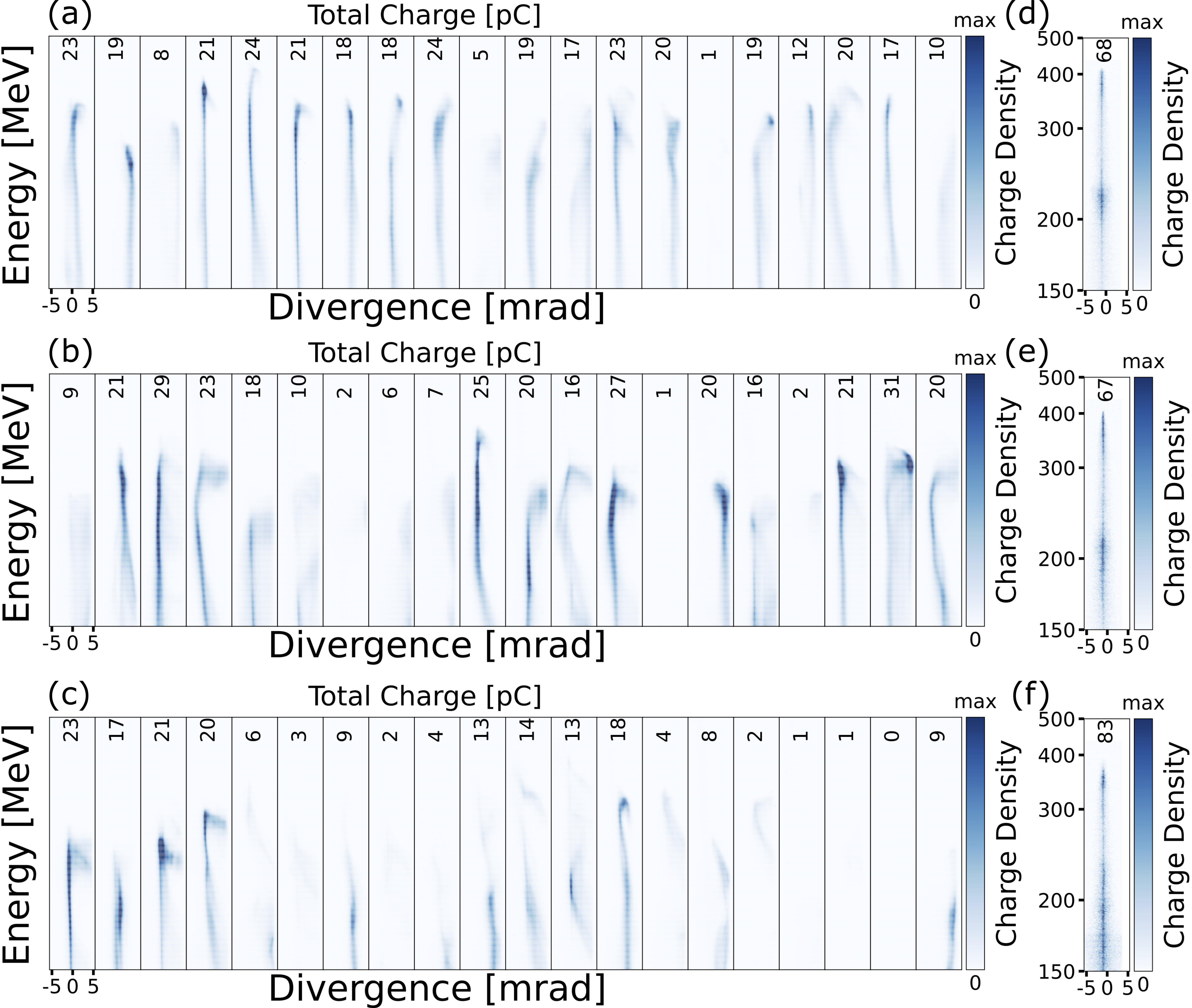
Figure 3: Representative Lanex scintillator images for different PFC values, showing divergence and energy spread for 20-shot datasets and corresponding PIC simulation outputs.
Quantitative analysis of the integrated charge above 150 MeV and the cutoff energy demonstrates that faster wakefields (more negative PFC) do not merely increase final energy but also enhance shot-to-shot stability, evidenced by reduced occurrence of non-accelerating (“failed”) shots. The experimentally observed maximal energy shift between extremal PFCs is vz150 MeV; simulations reproduce this magnitude and ordering despite modest absolute discrepancies due to idealized input conditions.
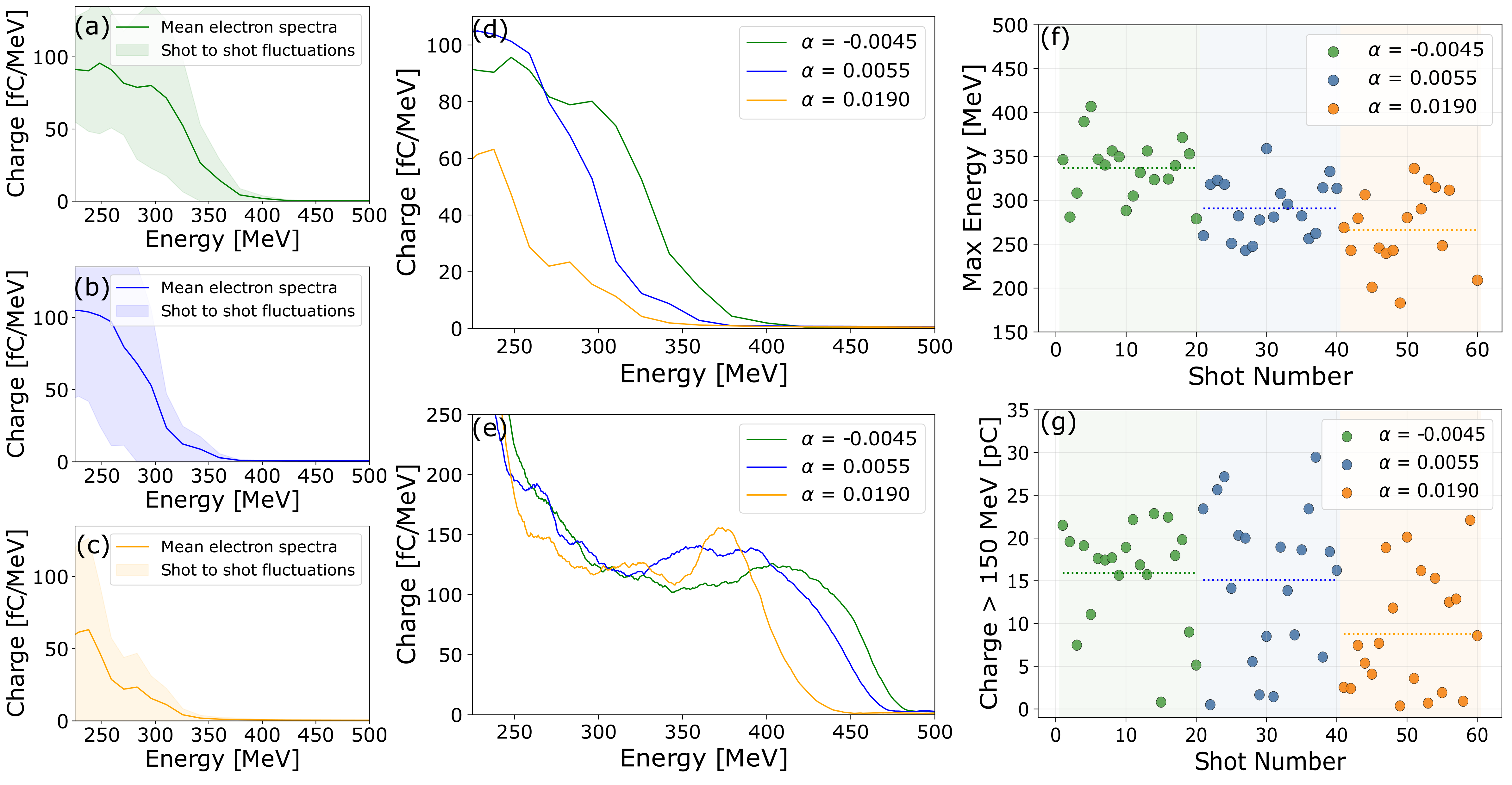
Figure 5: Averaged electron spectra and fluctuations for all three PFC regimes, comparing experiment and PIC simulation; discrete shot-by-shot distributions for maximum energy and accelerated charge.
The charge above threshold does not exhibit a comparable dependence on wakefield velocity, eliminating interpretation in terms of beam loading and reinforcing a causal link to phase velocity modulation.
Mechanistic Validation via Simulation
Direct PIC simulation snapshots of the accelerating fields provide unambiguous evidence that the microstructure of the plasma wake—for fixed input conditions but varied PFC—exhibits a longitudinal displacement consistent with the group velocity shift. Electrons remain closer to the optimal accelerating phase throughout the interaction for the fastest wakefield, with the resulting separation from the dephasing point visible in spatial electron density and electric field plots.
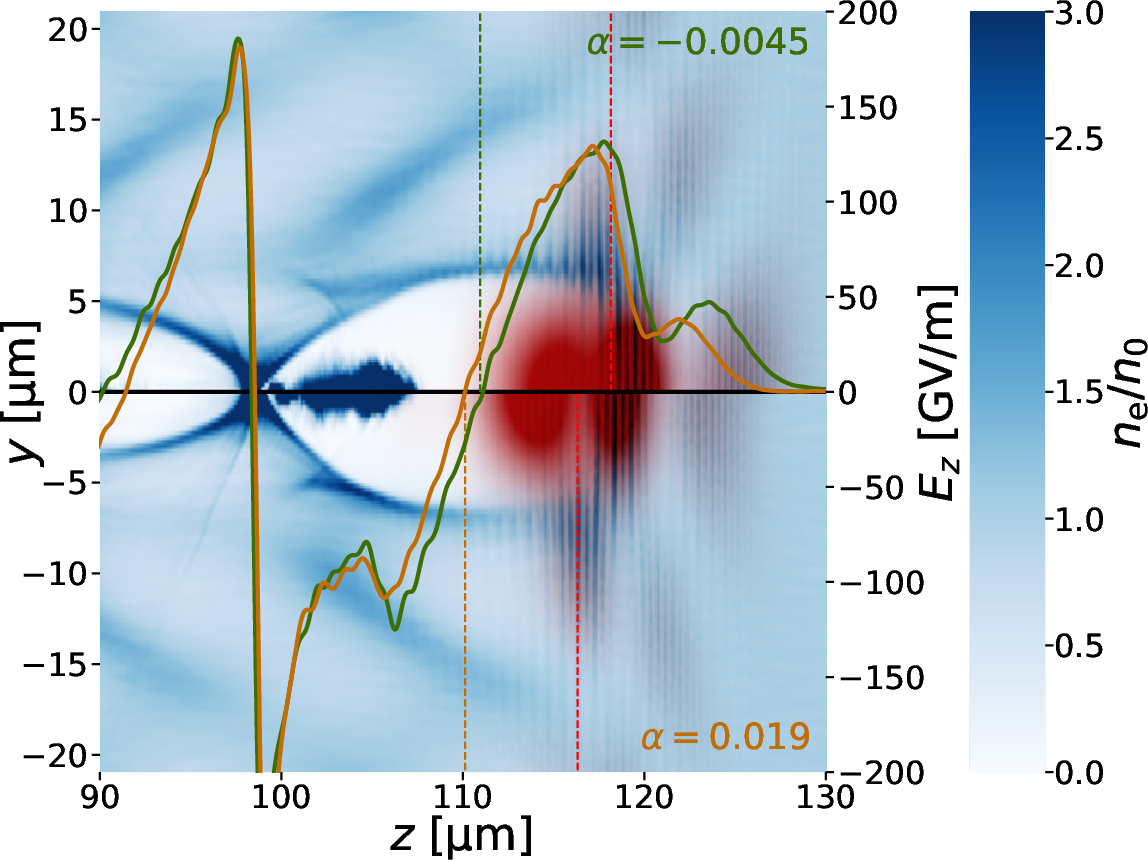
Figure 6: Simulated wakefields comparing vz2 and vz3 for fastest and slowest wakefield cases, illustrating the relative shift of the accelerating structure in coordinate space.
Analytical Model for Cutoff Energy Dependence
A supporting analytic trajectory calculation in the bubble regime, parameterized by the measured/simulated wakefield phase velocities, confirms that electron energy cutoff increases monotonically with increasing phase velocity for fixed plasma density. The calculated energy shift between extremal PFC cases is consistent in order-of-magnitude with both experiment and simulation. The model, while simplified, captures the essential physics (ultrarelativistic electron velocity, linear vz4–vz5 dependence, group velocity shift from plasma dispersion and PFC), rendering extraneous an explanation based on injection or beam loading variations.
Implications and Outlook
This demonstration constitutes the first clear empirical validation that flying-focus wakefields, generated by precise spatio-temporal pulse shaping and axiparabola focusing, can both produce relativistic electron beams and exhibit continuous, predictable sensitivity of cutoff energy to the group velocity of the intensity maximum. The evidence for partial dephasing mitigation—electrons maintaining phase-locked acceleration for longer distances—suggests that further refinements in spatio-temporal control and in-situ velocity characterization could enable operation asymptotically close to the dephasingless acceleration regime.
Practical applications of such LWFAs span compact GeV-class accelerators for high-energy physics, tabletop XFELs, and ultrafast electron radiotherapy, with the extension to ion acceleration (by analogous dynamic focusing mechanisms) being plausible. Realization of single-stage, multi-10 GeV or even TeV-class LWFAs is contingent upon advances in high-damage-threshold, programmable meta-optics and single-shot spatio-temporal metrology, many of which are in active development [see e.g., (Grzesik et al., 2020, Shen et al., 2020), and references therein].
Conclusion
This work empirically establishes the feasibility of structured-light-driven, velocity-tunable LWFAs that realize a measurable, statistically robust elevation in electron energy cutoff through precise manipulation of wakefield phase velocity. The combined experimental, numerical, and analytical evidence supports the central claim that flying-focus LWFAs are a valid pathway to overcoming the canonical dephasing constraint in plasma-based electron accelerators. Future research will focus on optimizing the in-plasma group velocity, refining spatio-temporal control, and scaling the concept to larger acceleration lengths and higher energies.
Reference: "Electron Acceleration in a Flying-Focus Laser Wakefield Accelerator" (2604.05771)