- The paper introduces a novel quantum algorithm leveraging density matrix exponentiation and IQPE to accurately estimate trace distance between arbitrary quantum states.
- The method bypasses full state tomography, reducing computational overhead while maintaining robust performance validated by simulations and IBM hardware.
- The approach employs parallelizable subroutines and achieves polynomial scaling (O(N^8)), making it practical for high-dimensional quantum systems.
Quantum Algorithm for Estimating Trace Distance Between Arbitrary Quantum States
Introduction and Motivation
Trace distance serves as a fundamental metric quantifying the distinguishability of quantum states, with applications spanning quantum state discrimination, benchmarking quantum devices, detecting non-Markovianity, quantum networking, and assessing coherence. Despite the operational significance of this metric, efficient estimation for general quantum states, particularly when both are arbitrary mixed states, remains computationally challenging due to the exponential complexity of quantum state tomography and eigenvalue decomposition.
This work introduces a quantum algorithm for estimating the trace distance between two arbitrary quantum states, ρ and ρ′, without explicit state reconstruction. The approach leverages density matrix exponentiation via the Lloyd-Mohseni-Rebentrost (LMR) protocol and improved quantum phase estimation (IQPE), thus providing a scalable route for characterizing high-dimensional quantum systems.
Principles and Algorithmic Framework
The trace distance between two N-qubit states is defined as D(ρ,ρ′)=21∥ρ−ρ′∥1, which, given Hermiticity, reduces to half the sum of absolute eigenvalues of Δ=ρ−ρ′. Direct computation demands full diagonalization, which is infeasible for large N, motivating quantum approaches.
The algorithm proceeds through the following core steps:
- Encoding the Difference Structure: The two density operators are block-embedded in an extended Hilbert space using
ϑ:=21(1⊗ρ),ϑ′:=21(1⊗ρ′)
and their difference encoded as
2Ω=(21(ρ−ρ′)0 021(−ρ+ρ′)).
This ensures eigenvalues of ρ−ρ′ appear in positive/negative pairs, simplifying subsequent analysis.
- Density Matrix Exponentiation: Using the LMR protocol, Ω/2 (and other relevant operators) are exponentiated efficiently by applying SWAP networks and ancilla registers, producing unitaries required for eigenphase estimation.
- Improved Quantum Phase Estimation (IQPE): The eigenvalues of ρ′0 are estimated without full knowledge of the state, using IQPE. The process initializes registers in suitable states, applies conditional unitaries, controlled rotations (as in the HHL algorithm), ancillary CNOT operations, and uncomputation to extract distributions encoding the eigenvalue spectrum.
- Aggregation of Measurement Results: The estimated probabilities from ancillary register measurements yield three aggregate quantities, ρ′1, ρ′2, and ρ′3:
- ρ′4: Encodes contributions from eigenvalues of ρ′5;
- ρ′6: Encodes those arising from a shifted spectrum (ρ′7);
- ρ′8: Estimates the number of zero eigenvalues.
The final trace distance is extracted by combining these quantities according to
ρ′9
with the result converging to the exact value as the number of clock qubits in the QPE increases.
Numerical and Hardware Results
Extensive simulations and hardware implementations were performed to validate the theoretical algorithm:
- Simulated QPE: For instances such as N0 and N1, the trace distance estimates converge to the ideal values as the number of clock qubits is increased.
- Comparison to IBM Quantum Hardware: The algorithm was realized on the IBM Brisbane quantum processor. Results remain robust for few qubit systems, with percentage differences of less than 2% for orthogonal pure states and deviations primarily arising for near-parallel pure states or identical states, where the method is highly sensitive to the estimation of N2.
The characteristic oscillatory convergence of QPE-based estimation is evident, and discrepancies exceeding unity can occur due to under/overestimation across the multiple measured quantities, a phenomenon suppressed as precision improves.
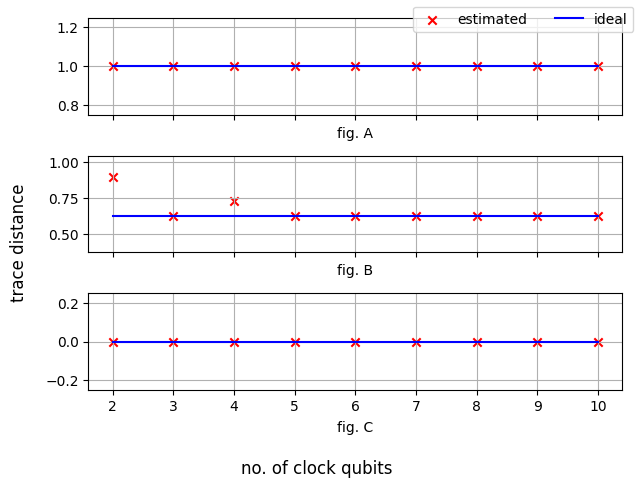
Figure 1: Plotting the software simulated trace distance value estimated by the algorithm, containing only the precision error from the first QPE, and comparing it with the ideal trace distance value.
Complexity Analysis
The dominant resource overhead in this method arises from density matrix exponentiation. For N3-qubit states, the end-to-end gate complexity is N4 under reasonable assumptions about error aggregation across QPEs and exponentiations. All measurements and simulation errors (Trotter, finite clock qubit, and hardware noise) need not be exponentially suppressed; polynomial scaling suffices for bounded overall error.
Parallelization is feasible for the subroutines computing N5 and N6, making the method adaptable to near-term quantum devices given available ancilla and control infrastructure.
Extensions and Discussion
The core protocol admits generalization for (a) efficient state distinguishability checks prior to full trace distance estimation, (b) comparison with the SWAP-test (which is less general for mixed states and exhibits higher sample complexity for small overlaps), and (c) direct applicability to benchmarking, device certification, and quantum channel analysis.
Error sources are well-modeled and understood: Trotterization (from non-commuting exponentiations), QPE finite precision, and hardware noise. The method retains polynomial complexity (N7) for all sources, provided cumulative error rate stays below a constant threshold, e.g., N8.
Conclusion
This work presents a comprehensive quantum algorithm for estimating the trace distance between arbitrary quantum states—pure or mixed—without recourse to full quantum state tomography. By integrating LMR-based density matrix exponentiation and IQPE, the algorithm achieves scalable, efficiently parallelizable estimation procedures with proven numerical and hardware validity. The protocol promises practical relevance to quantum benchmarking, metrology, and future scalable quantum information processing platforms, as well as theoretical impacts on the analysis of quantum state distinguishability and quantum complexity.