- The paper introduces a Grassmann-valued tensor network with a CTMRG approach, enabling efficient contraction of 1D fermionic partition functions.
- It accurately benchmarks the method on the Hubbard model by reproducing ground-state order parameters and phase boundaries in line with exact Bethe Ansatz results.
- The approach overcomes challenges related to sign problems and path-integral representations, providing numerical stability and potential extensions to more complex systems.
Grassmann Corner Transfer-Matrix Renormalization Group Approach for 1D Fermionic Models
Introduction
Accurately simulating strongly correlated fermionic systems remains a central yet formidable challenge in condensed matter and lattice field theory due to complications such as the exponential growth of Hilbert spaces, the sign problem in quantum Monte Carlo simulations, and limitations of weak-coupling or mean-field methods. Recent progress in tensor network algorithms has been instrumental for systems with moderate entanglement, particularly employing matrix product states (MPS), projected entangled pair states (PEPS), and their fermionic generalizations. However, existing approaches, such as swap-gate-based fermionic tensor networks, encounter significant difficulties for path-integral representations, finite-temperature calculations, and complex lattice geometries, motivating further algorithmic developments.
This work introduces a Grassmann-valued tensor network formalism for interacting one-dimensional (1D) fermionic models, specifically the Hubbard model under a magnetic field, and develops a Grassmann-adapted corner transfer-matrix renormalization group (GCTMRG) approach for efficient contraction. The Grassmann CTMRG is systematically benchmarked, establishing its accuracy and computational advantages in the investigation of the 1D Hubbard model's ground-state phase diagram and observables. The method leverages coherent-state path-integral representations to naturally encode Fermi-Dirac statistics and facilitates systematic contraction strategies analogous to classical statistical models but generalized to non-commuting Grassmann variables.
Grassmann Tensor Network Representation
The central construction begins with the path-integral formulation of the 1D Hubbard model. Via a coherent-state Grassmann formalism, the partition function is mapped into a (1+1)-dimensional anisotropic tensor network, where the local tensors are functions over multi-component Grassmann variables. The contraction over these tensors, denoted as gTr, replaces conventional traces or integrals with Grassmann integrations, carefully tracking fermion parity and sign conventions.
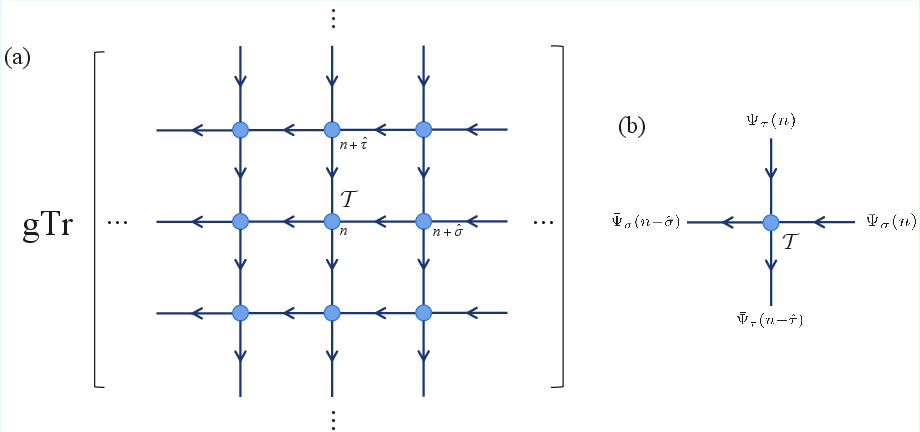
Figure 1: Schematic: (a) Partition function of the 1D Hubbard model as a Grassmann tensor network; (b) Local Grassmann tensor structure at site n.
The explicit tensor network representation provides immediate access to both thermodynamic and correlation functions via impurity insertion techniques (replacing local tensors with observable-specific variants), enabling not only ground-state but also finite-temperature and arbitrary operator expectation values, provided efficient contraction is feasible.
Grassmann CTMRG Algorithm
To perform contractions in the thermodynamic limit, the work generalizes the CTMRG—historically successful for classical spin and bosonic tensor networks—by systematically adapting all core steps (corner and edge tensor update, environment construction, isometry insertion, and truncation) to the Grassmann setting. This requires precise management of variable orderings and parity-induced sign factors in each Grassmann contraction, which is algorithmically realized and automated.
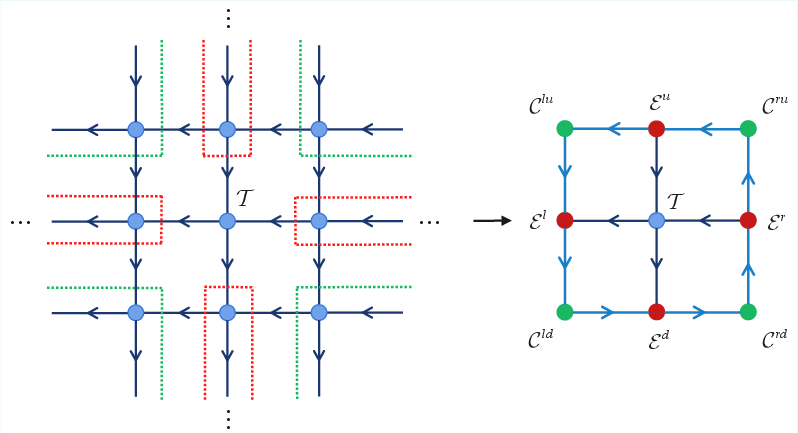
Figure 2: A 2D Grassmann tensor network on a square lattice approximated by a finite cluster with four corner matrices and four edge tensors, forming the effective environment for bulk tensors.
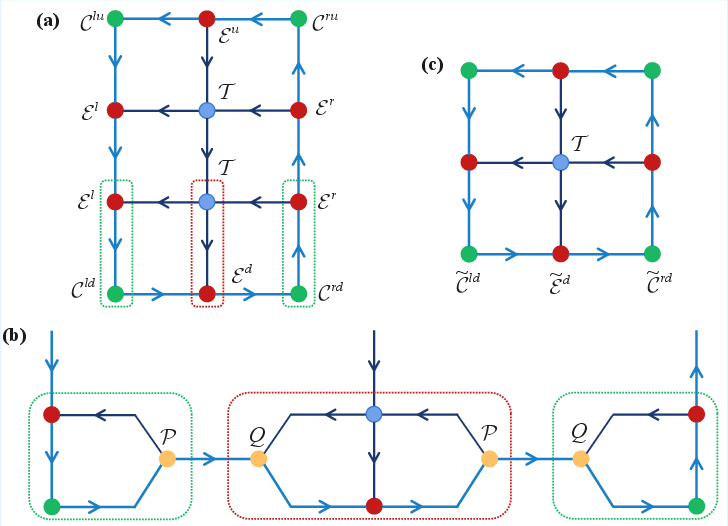
Figure 3: Downward move in the Grassmann CTMRG showing the update process and truncation via Grassmann isometries.
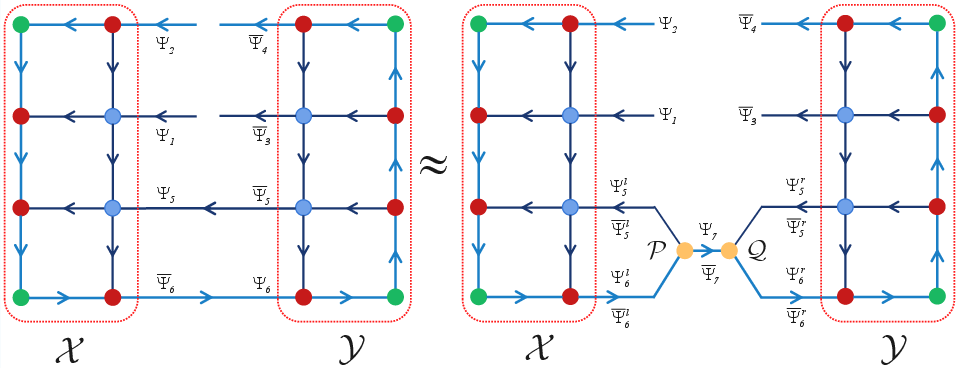
Figure 4: Construction and algebraic relations for Grassmann isometries used in truncating enlarged bonds during environment updates.
To further accelerate convergence and minimize Trotter and anisotropy errors, a preprocessing stage employing the Grassmann version of HOTRG (G-HOTRG) is introduced. The composite technique (GCTMRG*) provides both high accuracy and numerical stability in the zero-temperature (large β) limit.
Benchmarks: The One-Dimensional Hubbard Model
Phase Diagram and Observable Computation
The algorithm is validated on the 1D Hubbard model with a magnetic field, a paradigm of strongly correlated electrons featuring nontrivial magnetic and Mott transitions. The method systematically probes the parameter space (μ,B) and computes ground-state order parameters—particle density p, magnetization m, and double occupancy d. All quantities are evaluated via impurity tensors using the converged environments from GCTMRG*.
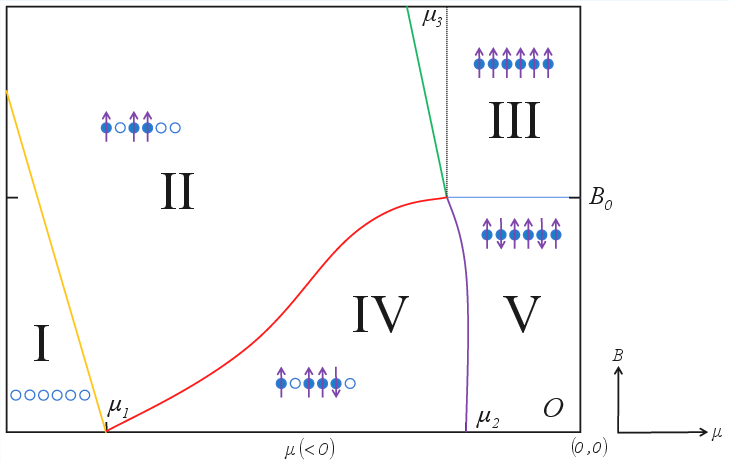
Figure 5: Ground-state phase diagram of 1D Hubbard model in the (μ,B) plane (adapted from Bethe Ansatz results), demarcating metallic, insulating, and polarized phases.
The numerical performance is benchmarked using exact results from the Bethe Ansatz for d, p, and n0.
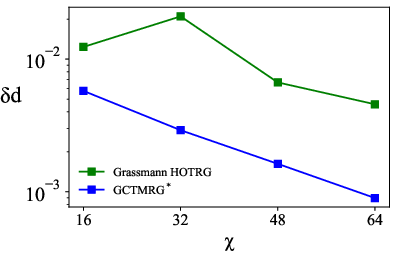
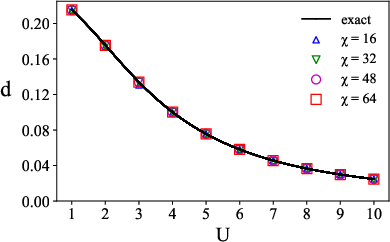
Figure 6: Double occupancy n1 at n2: (a) Relative error n3 at n4 for G-HOTRG and GCTMRG
, (b)
n5 versus
n6 compared against exact solutions.*
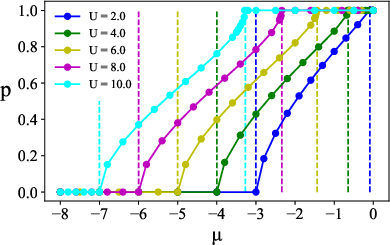
Figure 7: Particle number n7 as a function of n8 at n9 for several β0, together with analytically determined critical β1's.
Results demonstrate that GCTMRG* achieves high precision, with convergence in both order parameters and phase transition points within negligible error margins compared to exact theory. The method also outperforms state-of-the-art G-HOTRG in both accuracy and computational efficiency for 1D fermionic systems.
Discussion and Implications
The GCTMRG* formalism generalizes traditional CTMRG to Grassmann-valued tensor networks, providing a systematic and automatable approach for simulating 1D interacting fermionic models directly in the partition function framework. This enables:
- Thermodynamic limit calculations at zero and finite temperatures: Direct evaluation of physical properties without sampling or variational ansätze, overcoming the sign problem.
- Computation of arbitrary local observables and correlation functions: Analytic control enabled by the tensor network impurity framework.
- Extension to higher dimensions and complex lattice geometries: The categorical tensor structure and flexibility of the algorithmic pipeline are preserved for larger system classes.
Potential directions for future research include extending GCTMRG* to compute finite-temperature observables (requiring a Grassmann TEBD), comparison with other fermionic tensor network frameworks (e.g., variational PEPS/GMERA), investigation of 2D fermionic lattice models (where the sign structure is more severe), and exploration of further optimization in isometry construction and truncation. The algorithm’s generality makes it a promising candidate for addressing both model Hamiltonians in condensed matter and lattice regularizations of quantum field theories.
Conclusion
This work provides a rigorous and efficient tensor network method for contracting Grassmann-valued partition functions in 1D interacting fermionic systems, overcoming previous limitations associated with sign structures and path-integral representations. Validation on the Hubbard model demonstrates fidelity with exact solutions and robust phase boundary determination across the whole β2 phase diagram. The GCTMRG* approach represents a substantive advancement in tensor network numerical technology for fermionic many-body systems and is positioned for further application and generalization in quantum simulation.