- The paper introduces OpenCEM, a novel simulator that integrates natural language context with physical microgrid data for adaptive prediction and control.
- It employs a modular, hardware-in-loop architecture with synchronized time-series and event logs, enabling dynamic load forecasting and optimal MPC strategies.
- Empirical results demonstrate significant RMSE reductions and cost savings, validating LLM-driven semantic interpretation in enhancing microgrid control.
Bridging Natural Language and Microgrid Dynamics: An Expert Review of the OpenCEM Simulator and Dataset
Motivation and Positioning
The paper "Bridging Natural Language and Microgrid Dynamics: A Context-Aware Simulator and Dataset" (2604.05429) introduces OpenCEM, an open-source platform that addresses a critical deficiency in existing power system research: the failure to harness rich, unstructured human context for microgrid control and forecasting. Classic microgrid datasets and simulators are strictly numerical, limiting their utility for modern ML and LLM-powered approaches that require multi-modal, language-rich data to enable in-context reasoning and truly adaptive control policies.
OpenCEM explicitly targets this gap by integrating natural language events—e.g., user schedules, system logs, operational intent—with synchronized physical measurements from a production PV-and-battery microgrid. This establishes a new experimental paradigm, where context is a first-class feature for both prediction and online control, not merely a post-hoc annotation.
System Architecture and Physical Testbed
OpenCEM is built on a digital twin paradigm, merging hardware-in-the-loop fidelity with modular simulation. The physical layer is realized as a campus microgrid, partitioned into two independent PV+storage subsystems, each powering critical and variable loads—a research-oriented workstation and an HVAC system.
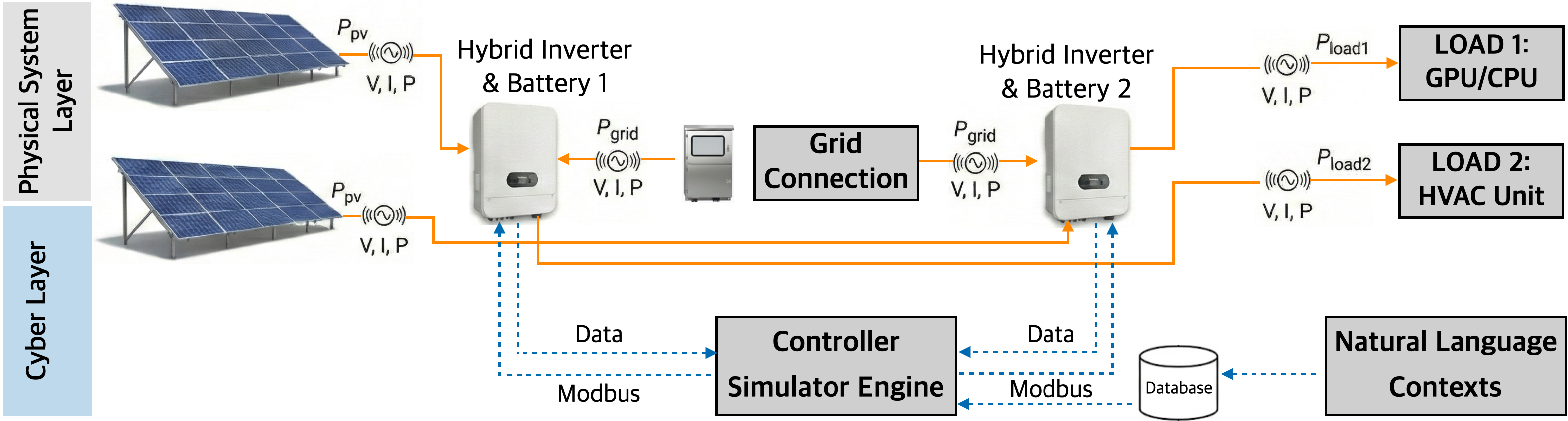
Figure 1: High-level architecture of the OpenCEM platform, delineating the physical microgrid and the cyber layer that interfaces with hardware, synchronizes measurements, and ingests multi-modal contextual data.
Key innovations are:
- Hardware-Cyber Integration: All energy data is collected using industrial Modbus protocols, ensuring precise synchronization between sensors, actuators, and logged context.
- Natural Language Context Logging: Contextual events (e.g. job schedules, unexpected reboots, user interventions) are sourced through direct user input, system logs, and external APIs, and time-stamped alongside physical state.


Figure 2: Implementation detail of the physical layer, highlighting the dual PV arrays and hybrid inverters with battery storage.
The database spans July 2025 through January 2026, with two-minute resolution and extensible context fields.
Simulator Design: Modular APIs and Context as Control
The OpenCEM simulator implements a fully object-oriented, component-based API, where each system part (battery, PV, load, grid, inverter) and the context stream are first-class, swappable modules. Abstract base classes enforce interface compatibility and encapsulate time-stepped evolution, with all interactions mediated by a central clock for reproducibility.
This architecture critically allows:
- Swap-in of synthetic, physics-based, or black-box ML models for any subsystem.
- Hybrid operation modes (e.g., real data replay vs. closed-loop control).
- Native unstructured context injection via a dedicated Context API.
Simulator extensibility enables the integration of price schedules, RL agents, and differentiable surrogate models without re-engineering the control loop. Notably, context is not an external annotation, but an actionable signal accessible to controllers at each simulation step.
Dataset Semantics: Synchronized Events and Power Dynamics
The dataset fuses dense electrical time series with event timelines, thus permitting causal inference between context (e.g. "CPU-intensive robustness test for 24h") and observed demand/supply fluctuations.
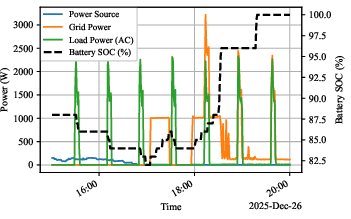
Figure 3: Example time series illustrating grid power draw, PV generation, battery SOC, and load for a representative operational interval.
Complex event cascades—such as scheduled compute-intensive jobs, subsequent system reboots, and user-initiated extensions or load shifting—are reflected both in log data and consumption curves. This granular cross-domain alignment is key for next-generation ML or LLM models tasked with grounding language in physical outcomes.
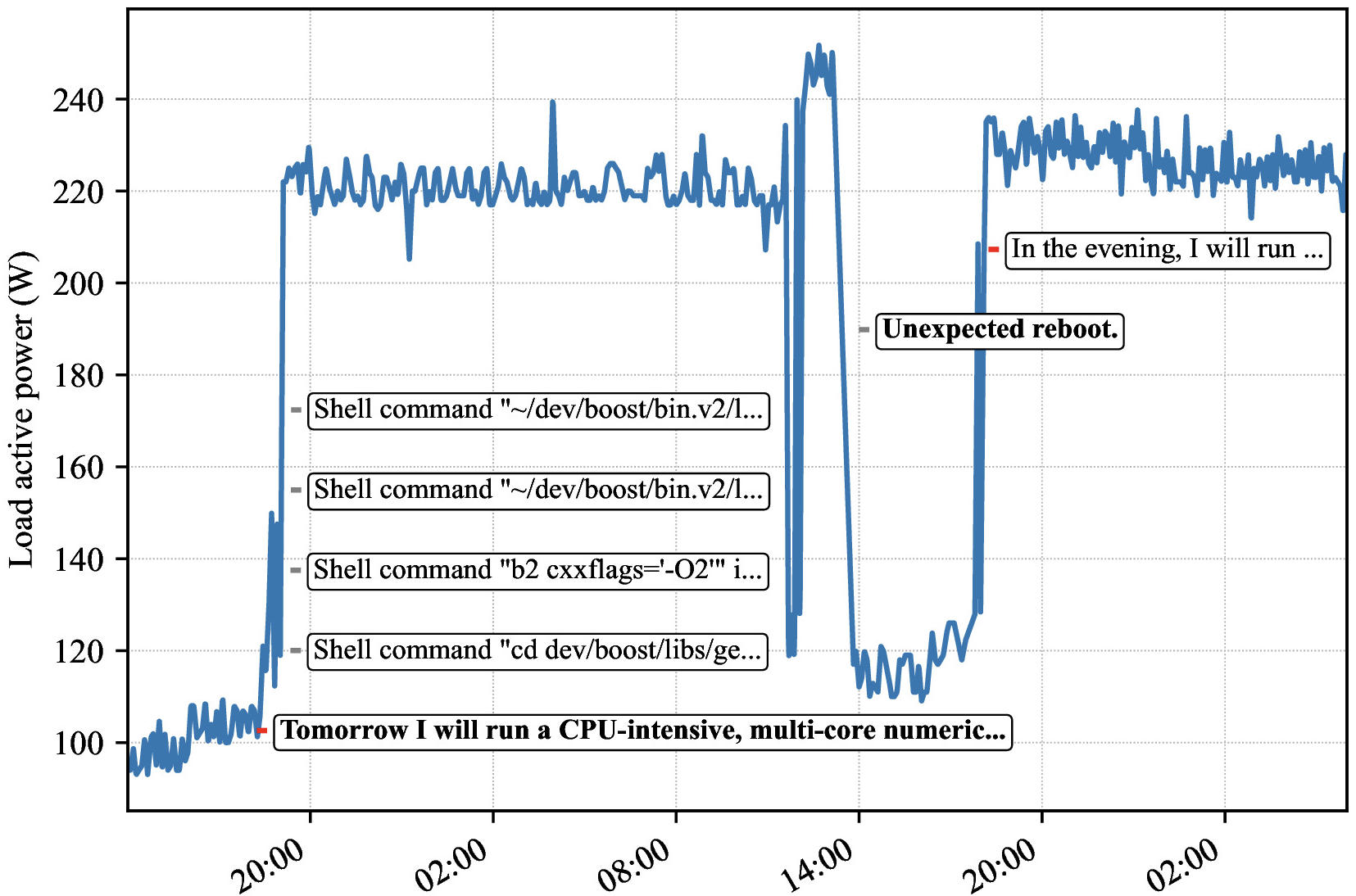
Figure 4: Overlay of time series load data with context events, demonstrating demand forecast adjustments in response to real-time event annotation.
Numerical Results: Quantitative Impact of Context-Aware Prediction
The paper provides direct empirical evidence of the predictive power unlocked by natural language context. Various demand forecasting models are evaluated:
- Baselines without context
- Models using only structured numerical context (e.g., CPU core counts)
- Models transforming natural language context into quantitative workload features using an advanced LLM
- Combined multi-modal context models
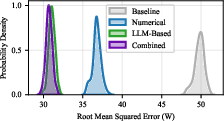
Figure 5: Distribution of RMSE across context-aware forecasting models, demonstrating substantial error reduction when using LLM-extracted context.
The dominant reduction in prediction error is attributed to linguistic event descriptions interpreted by LLMs. Numerical features alone add negligible incremental information, indicating a high degree of redundancy or insufficient expressiveness compared to structured language-derived embeddings.
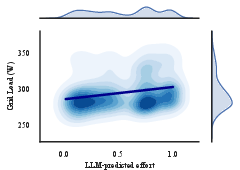
Figure 6: Joint distribution of measured power demand and LLM-predicted workload effort for CPU-bound tasks, evidencing direct semantic-to-physical mapping.
Application: Context-Driven Optimal Control and Cost Savings
A Model Predictive Control (MPC) setup is instantiated, where battery charging actions are optimized in anticipation of both dynamic load forecasts and time-varying electricity prices. The context-aware load prediction loop is tightly coupled: the system parses natural language events in real time, updates demand forecasts, and computes near-optimal charge/discharge plans online.
Reproducible results indicate that using LLM-extracted context for forecasting yields final operational costs within the Pareto frontier of perfect (oracle) prediction—substantially outperforming both context-blind and simple trailing-average baselines.
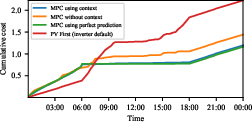
Figure 7: Comparative running cost time series for various control policies, demonstrating near-optimality of context-informed strategies against oracle and default methods.
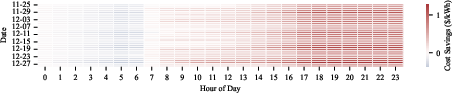
Figure 8: Hourly cost savings aggregated over multiple days, showing robust improvement from context-aware MPC.
This demonstrates both practical and theoretical advances:
- Practical: Direct cost minimization, with the possibility to avoid expensive real-time purchases by leveraging anticipated demand from context.
- Theoretical: Validation that LLM-mediated semantic understanding meaningfully enhances model-predictive control, justifying further research into joint language/dynamics model co-training.
Implications and Future Directions
OpenCEM establishes a new research testbed paradigm for context integration in power systems. Its open-source status, code-level modularity, and unique dataset lower the barrier for developing and benchmarking LLM-powered, context-driven agents across multiple research domains—energy management, RL, in-context learning, and human-in-the-loop control.
Immediate next steps proposed are:
- Dataset expansion with more diverse operational histories and event types
- Augmentation of surrogate physics models to capture nonlinearities and device degradation
- Integration with RL suites for policy learning under partial observability and event-driven regimes.
These directions portend a fundamental shift in microgrid research and sustainable grid automation: from time-series-centric engineering toward multi-modal, language-and-dynamics co-optimization.
Conclusion
OpenCEM marks the first comprehensive public platform coupling physical microgrid simulation with granular, time-aligned natural language context, providing both the dataset and modular infrastructure needed for the next generation of intelligent power system controllers (2604.05429). The empirical evidence establishes that integrating LLM-driven context understanding into both prediction and control loops confers substantial practical benefits. This paves the way for advanced research in context-aware RL, interpretable energy analytics, and robust, adaptive management of distributed renewables.
The OpenCEM platform is likely to serve as a reference implementation and benchmarking environment for future hybrid AI+control architectures in sustainable energy domains.