- The paper presents a self-calibrating digital twin that integrates live telemetry with discrete-event simulation for optimal datacenter management.
- It employs a pipelined recalibration strategy that reduces error, improving MAPE from 7.86% to 4.39% in performance prediction.
- The platform combines human-in-the-loop oversight with scalable simulation, paving the way for AI-driven sustainable datacenter operations.
Motivation and Context
The increasing digitalization of society imposes stringent operational and sustainability requirements on datacenter infrastructure. While digital twins have enabled close integration of simulation and real-time telemetry for operational optimization in domains such as aviation and automotive control, their role in datacenter management remains nascent, with a lack of open platforms capable of closed-loop, self-calibrating digital twinning. "OpenDT: Exploring Datacenter Performance and Sustainability with a Self-Calibrating Digital Twin" (2604.11445) addresses this gap by proposing and validating OpenDT, an open-source platform designed for continuous, SLO-aware monitoring, analysis, and (potentially) steering of datacenters, with substantial focus on real-time calibration for improved predictive fidelity.
System Architecture and Design Principles
OpenDT is architected as an orchestrator-centric, microservice platform Figure 1, integrating:
- Live Telemetry Ingestion: Streaming of multi-modal metrics from the physical ICT infrastructure, pre-processed and ingested for simulation.
- Discrete-Event Simulation via OpenDC: High-fidelity simulation, continuously updated and parameterized with live telemetry.
- Self-Calibration Loop: An online calibration process, running in parallel with the simulator, dynamically correcting predictive model parameters to minimize deviation from observed ground truth.
- Human-in-the-Loop Oversight: All simulation-driven recommendations for physical infrastructure adjustments are reviewed and actioned by operators, with flexibility to integrate increasingly automated closed-loop control in future versions.
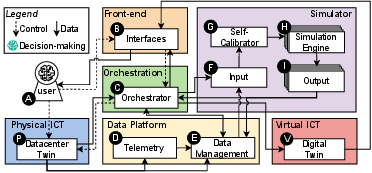
Figure 1: High-level overview of OpenDT, depicting the orchestrator-centric architecture and continuous simulation-calibration processes.
The architecture supports configurable operational windows, accommodating multiple simulation acceleration modes, from real-time to trace-driven, maximizing practical applicability across both live and retrospective analysis.
Online Calibration Strategy
A notable innovation in OpenDT is its explicit decoupling of the simulation engine and calibrator Figure 2. The calibrator continuously evaluates parameter spaces, employing grid search techniques to optimize the error profile (MAPE), and transmits optimal parameters to the simulator in a pipelined manner. This approach avoids the latency of blocking synchronization, supports frequent recalibration, and actively compensates for hardware aging, workload drift, and configuration dynamics that static simulators cannot address.
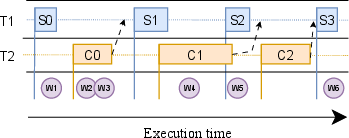
Figure 2: Synchronization logic between simulator and calibrator, demonstrating pipelined recalibration and real-time feedback integration.
Experimental Validation
OpenDT is validated on production traces from the SURF-SARA scientific computing center, focusing on two primary experimental axes: (1) reproducibility and extension of peer-reviewed datacenter energy modeling, and (2) quantification of calibration impact on predictive accuracy and error bias.
Experiment 1: Benchmarking Against Peer-Reviewed Simulation
OpenDT reproducibly emulates the operational conditions and topology explored in the FootPrinter experiment, a state-of-the-art datacenter CO₂ footprint simulator. The results show a strong reduction in MAPE: OpenDT without recalibration achieves 5.13% MAPE, outperforming FootPrinter’s 7.86%. This is achieved with a generic, continuously updating predictive model, avoiding trace-specific overfitting.
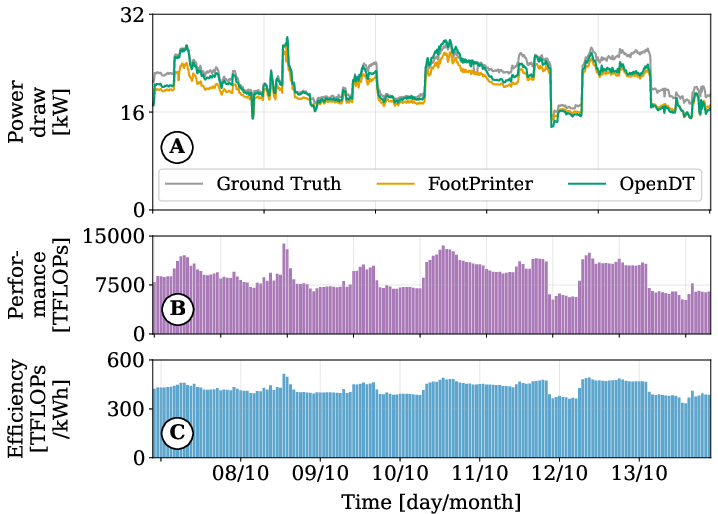
Figure 3: Overlay of simulated power draw and measured reality, live TFLOPs, and TFLOPs/kWh metrics, demonstrating high-fidelity replication and multi-metric analysis.
OpenDT extends analysis to cluster-level efficiency (TFLOPs/kWh) and utilization, uncovering that under 30% of available compute power is actively used in the monitored period. This enables finer-grained operational insights for energy-performance trade-off optimization.
Experiment 2: Impact of Online Calibration
With real-time recalibration enabled, OpenDT further reduces the cluster-wide MAPE to 4.39%, with 92% of predictions falling below the 10% community-accepted error threshold. Importantly, calibration alleviates the simulator’s underestimation bias—uncalibrated predictions underestimated in 85% of samples, reduced to 66% with active calibration.
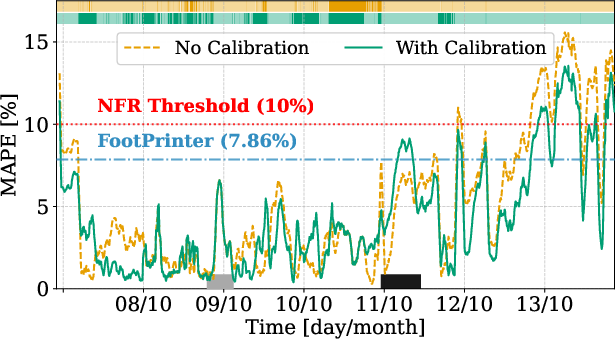
Figure 4: MAPE evolution for power-draw prediction, highlighting reduced error and bias in OpenDT with calibration compared to both uncalibrated and prior models.
The analysis also acknowledges that over certain operational intervals, the simplistic calibration approach can be outperformed by static simulation, suggesting that while beneficial overall, further sophistication in calibration methodology is warranted.
Practical Implications and Future Directions
OpenDT sets a foundation for reproducible, FAIR, and open digital twinning in datacenter research, with a well-engineered architecture suitable for operational deployment and integration with educational curricula. From a practical standpoint, OpenDT demonstrates the ability to process seven days of high-granularity telemetry data and simulation in under an hour on commodity hardware, directly enabling live decision support scenarios instead of traditional post-hoc analyses.
On the theoretical side, OpenDT’s architecture advances the case for continuous, self-correcting simulation in cyber-physical systems, bridging the gap between static modeling platforms and the needs of large-scale, dynamic digital infrastructures.
Theoretical and AI-Relevant Implications
Integrating open, self-calibrating digital twins enables AI-driven infrastructure management and experimentation at unprecedented fidelity and scale. OpenDT creates a substrate for future research in automated, closed-loop orchestration of datacenters, a requisite for scalable ML deployment (inference scheduling, adaptive cooling, and resource-disaggregation strategies). The human-in-the-loop paradigm supports safe adoption, but its design anticipates integration with reinforcement learning and AI-based control agents. The demonstrated architecture directly supports trace-driven simulation for LLM workloads, enabling experimentation and development of sustainable AI at infrastructure scale.
Conclusion
OpenDT (2604.11445) defines and demonstrates the first open-source, self-calibrating digital twin for datacenter operation. Experimental evidence demonstrates high simulation accuracy (MAPE as low as 4.39% with calibration), efficient processing, and flexible support for energy, performance, and utilization metrics in production clusters. The architectural decoupling of simulation and calibration, with continuous telemetry integration, provides a robust platform for reproducible operational studies, AI-driven infrastructure research, and educational use. OpenDT’s public release paves the way for continued advancement in both theory and practice of sustainable, explainable, and automated datacenter management.

