- The paper demonstrates that hard MaxSim pooling yields high patch-level gradient concentration (Gini ~0.78) compared to Top-k and softmax pooling.
- It reveals that this concentrated gradient flow causes brittleness in retrieval performance as document lengths increase and under adversarial spike conditions.
- The study validates these findings on biomedical benchmarks, emphasizing the need for smoother pooling strategies for robust multi-vector retrieval.
Spike Hijacking and Gradient Routing in Late-Interaction Retrieval
Overview and Motivation
This work systematically investigates the robustness and training dynamics of late-interaction retrieval models employing the hard maximum similarity (MaxSim) pooling operator. These models, in contrast to single-vector embedding approaches, aggregate token-level or patch-level similarities using pooling strategies such as MaxSim, Top-k averaging, or softmax. The primary focus is a mechanistic characterization of how MaxSim structurally biases gradient flow during contrastive learning and induces a tradeoff between sparsity and robustness, particularly as document length increases.
Structural Implications of MaxSim Pooling
Late-interaction architectures leverage higher-resolution token--patch interactions for effective retrieval, but the hard MaxSim operator imposes a highly non-smooth winner-take-all aggregation at each query token. The study introduces patch-level gradient concentration, quantified by the Gini coefficient over patch gradient norms, to probe the consequences of this pooling-induced sparsity.
Analyses in a controlled synthetic setting demonstrate that MaxSim consistently produces the highest gradient concentration across training epochs (Gini ∼0.78), compared to Top-k pooling (Gini ∼0.45) and softmax pooling (Gini ∼0.18). This disparity is stable and intrinsic to the pooling function, not a transient effect of optimization, implying that MaxSim routes the majority of the learning signal onto a small subset of document patches.
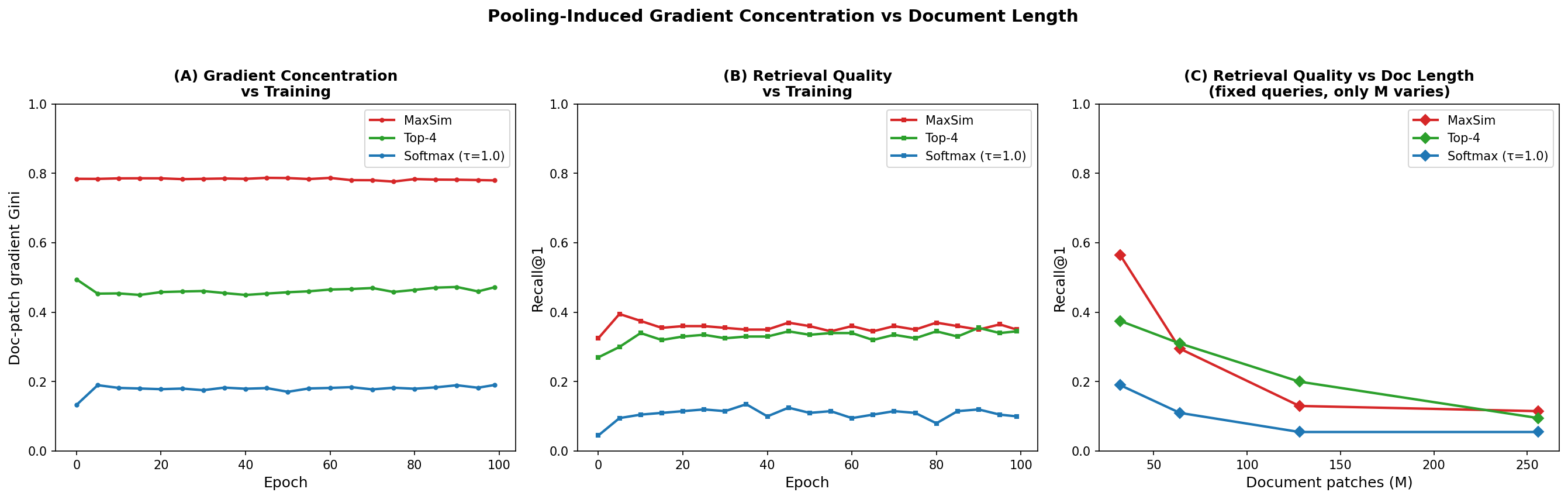
Figure 1: Patch-level gradient concentration, retrieval quality during training, and the impact of increasing document length under different pooling operators.
Robustness to Document Length and Spike Injection
The winner-take-all routing of learning signals offers strong early discrimination, reflected in retrieval performance (Recall@1 ∼0.33-0.38 for both MaxSim and Top-k), yet the same property underpins a sharp loss in robustness as document length grows. Controlled sweeps over document lengths reveal that as M increases, MaxSim's retrieval quality degrades more abruptly compared to smoothed alternatives, with Top-k demonstrating a more gradual decline and consistently outperforming MaxSim at larger M.
Furthermore, the study designs an adversarial regime—"spike hijacking"—where negative documents are injected with synthetic "spike" patches that may attract the MaxSim aggregator. Empirically, token-wise maxima are redirected to these synthetic spikes, resulting in catastrophic hijacking of retrieval performance, with Recall@1 collapsing under extreme but plausible adversarial settings.
Real-World Validation in Biomedical Retrieval
The above findings are validated on real-world multi-vector benchmarks using ColQwen2.5 models on the ViDoRe biomedical dataset. Without retraining, patch-level gradient Gini values mirror the synthetic results: MaxSim (0.983) ∼0 Top-5 (0.951) ∼1 Softmax (0.883). Document-length sweeps confirm that MaxSim-trained models remain acutely sensitive to the presence of high-similarity (semantically meaningful) distractor patches: at ∼2 distractor tokens, retained recall for MaxSim and Top-∼3 plummets to approximately 28%, while Softmax preserves 68%. Increasing ∼4 fails to mitigate this brittleness—the utilization of rigid selection strategies is fundamentally susceptible to semantic spikes.
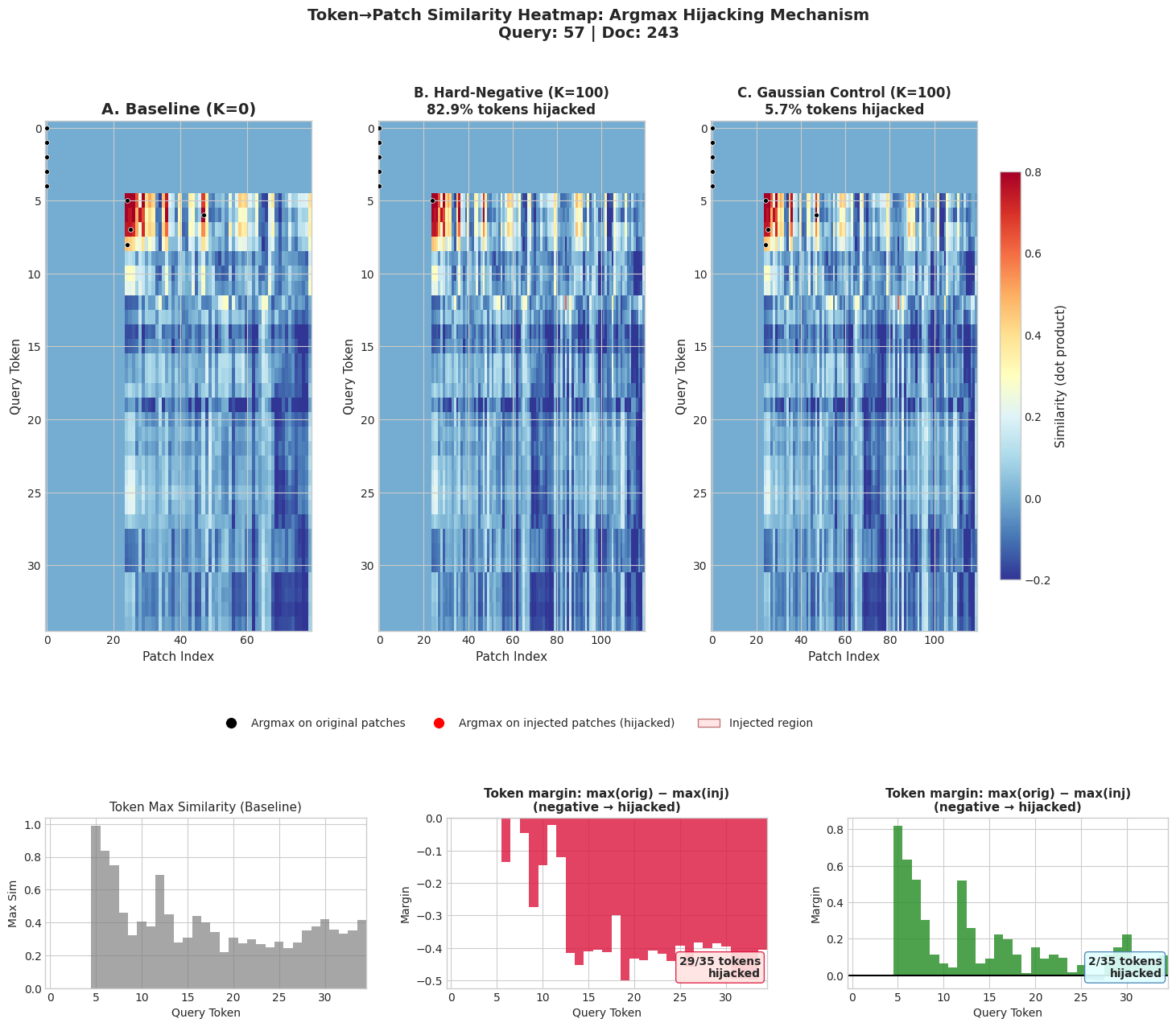
Figure 2: Token--patch similarity heatmaps demonstrate that hard-negative spike injection causes widespread hijack of token maxima, while random (Gaussian) distractors yield minimal disruption.
The mechanism is visualized through token--patch similarity heatmaps, revealing that more than 80% of token maxima are rerouted to the adversarial region after spike injection, while a Gaussian noise control does not trigger this effect.
Theoretical and Practical Implications
The results isolate gradient concentration, induced structurally by the pooling operator, as a primary determinant of both discriminative power and vulnerability. Hard max-based pooling achieves peak selectivity but induces brittleness in the face of document expansion or targeted semantic distractors. Importantly, softer alternatives (e.g., Top-∼5 or softmax) demonstrate a more balanced robustness/sparsity profile without catastrophic loss of retrieval accuracy for reasonable ∼6.
The implications extend to adversarial robustness and retrieval-augmented applications, where document length and adversarial content cannot be controlled. The spike hijacking vulnerability identified is not mitigated by naive aggregation over larger subsets (increasing ∼7), and alternative pooling formulations are required to achieve length-robust retrieval. Furthermore, these results challenge the consensus in the field regarding the indispensability of hard MaxSim in late-interaction systems and motivate end-to-end retraining and investigation of smoother pooling regimes.
Conclusion
This study provides a comprehensive analysis of the interplay between pooling strategy, gradient routing, and robustness in late-interaction retrieval. Hard MaxSim pooling, while effective for short documents, induces high patch-level gradient concentration and is structurally brittle under document-length expansion and adversarial spike injection. The observed sparsity--robustness tradeoff calls for principled innovation in pooling operators to achieve robust, high-quality multi-vector retrieval in practical, variable-length document regimes (2604.05253).

