- The paper demonstrates that JWST/NIRISS/SOSS data refines transit parameters with improvements up to 5–20× in orbital period precision.
- It establishes upper detection limits, showing that only satellites larger than Ganymede (R > 0.41 R⊕) are consistently detectable given the observed noise floor.
- The study identifies a dominant 16-minute correlated noise, likely from M-dwarf granulation, challenging existing models and impacting high-precision transit analyses.
JWST Constraints on Exomoons: Limits and Refined Transit Parameters for TOI 700 d and e
Scientific Context and Motivation
The presence of exomoons, particularly terrestrial-planets hosting large moons analogous to the Earth–Luna system, has substantial implications for planetary system architectures, planetary evolution, and habitability. Current planet formation models predict that satellite formation is a robust outcome of high-energy planet-scale collisions, yet no unequivocal detection of an exomoon in the terrestrial regime exists. The transit depth induced by such a body (e.g., Luna) is extremely small for Sun-like stars, but more easily observable for transits around M dwarfs, given the smaller host radius and favorable contrast. This work uses the JWST's NIRISS/SOSS instrument to scrutinize the transiting rocky exoplanets TOI 700 d and e, two habitable-zone, Earth-sized planets around a mid-M dwarf, with the objective of either detecting or placing strict upper limits on the presence of close-in large exomoons.
Target Selection and Dynamical Suitability
Candidate systems must be dynamically stable for moons in orbits beyond the planet’s Roche limit and below a critical fraction of the Hill radius for a prograde satellite. The paper presents the relevant stability criterion and applies it to TOI 700 d and e. The phase-space for stable satellite orbits is strongly dependent on the host star and planetary mass/radius, and orbital separation. For both TOI 700 d and e, the regime for stable Luna-like satellites between the Roche and Hill radii is quantitatively favorable.
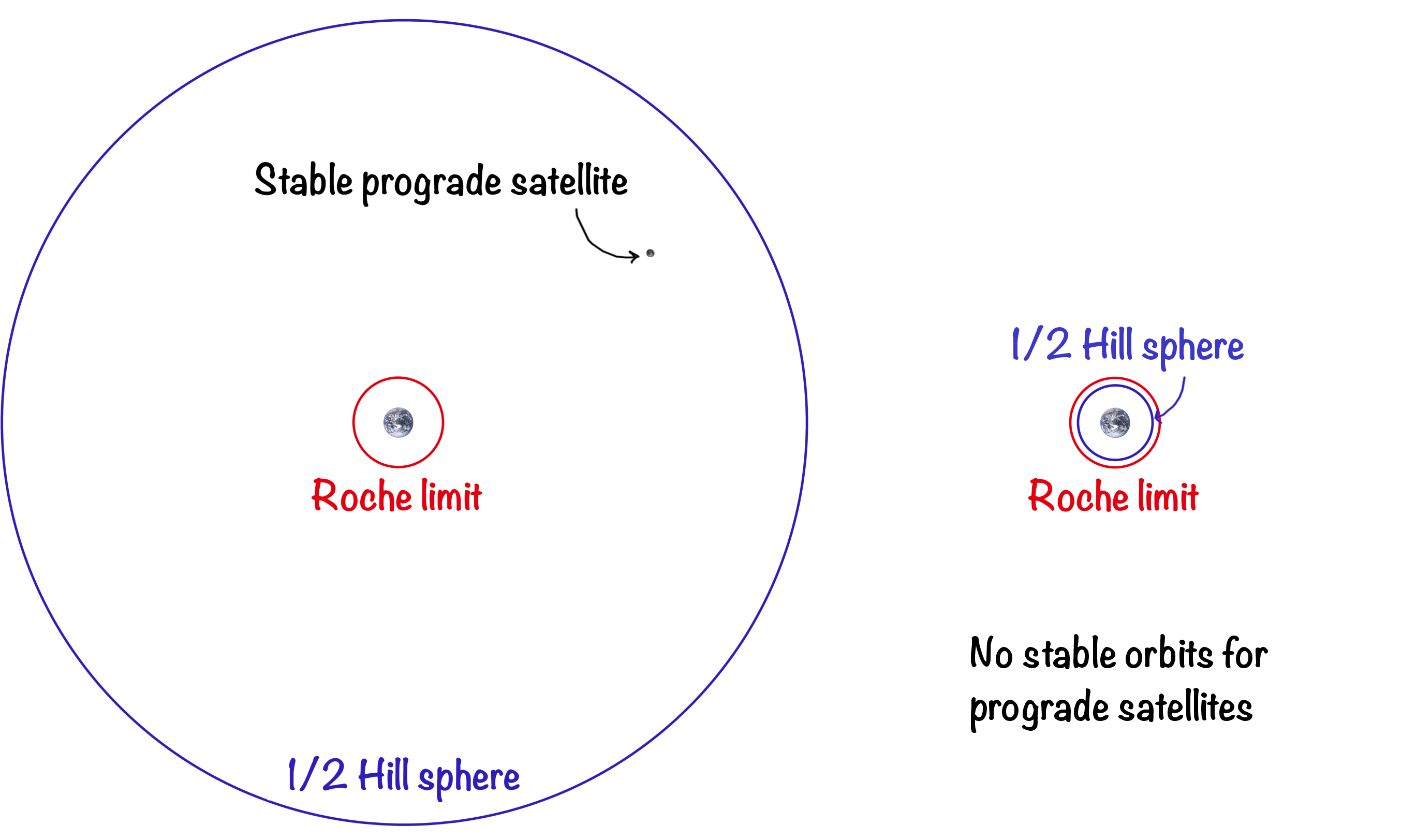
Figure 1: Stable orbits for satellite systems are constrained between the planetary Roche limit and half the Hill radius, illustrated specifically for Luna-sized exomoons around TOI 700 d.
Observational Strategies and Data Reduction
A single full transit of each planet was obtained with JWST/NIRISS/SOSS, sampled at high cadence with broad out-of-transit baselines to ensure sensitivity to wide-separation moons. Data reduction utilized the exoTEDRF pipeline with custom modifications to optimize noise minimization in the white-light curve. The analysis incorporated PCA-based corrections for changes in the spectrograph trace morphology (y-position and FWHM), but instrumental systematics alone could not explain the excess correlated noise.
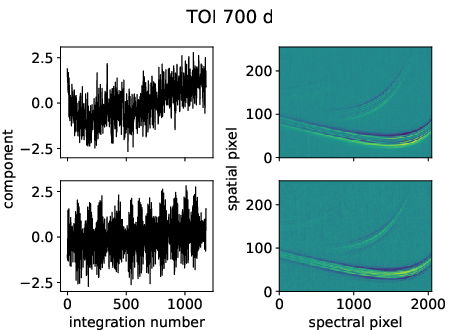
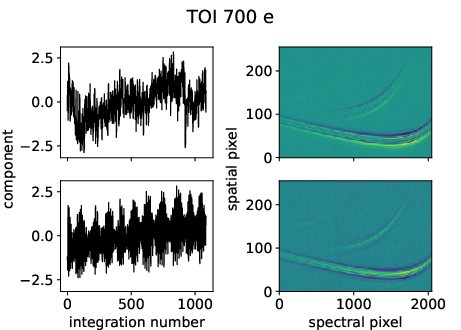
Figure 2: Principal component analysis (PCA) reveals morphological trace changes in both the y-position and FWHM of the spectral trace during NIRISS/SOSS observations.
Light curve fitting was performed using exoplanet, with informed priors on limb darkening and stellar parameters, and included explicit modeling of correlated noise using a celerite-2-based Gaussian process (GP) to account for time-correlated noise beyond Poisson expectations.
Characterization of Noise and Systematics
Analysis of the transit residuals identifies a strong time-correlated noise with a characteristic timescale of 16±4 min and an amplitude of 46±4 ppm in both targets, consistent with but longer than expectations from granulation noise scaling relations extrapolated to mid-M dwarfs. The noise is largely achromatic over 0.6–2.8 μm, distinguishing it from both canonical instrumental systematics and predictions for M dwarf granulation in the NIR.
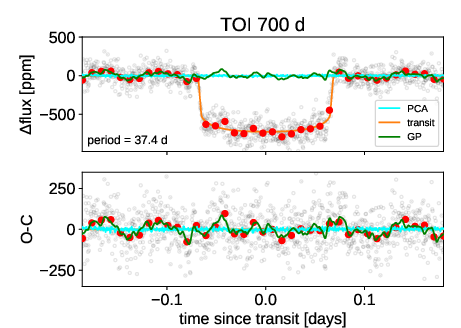
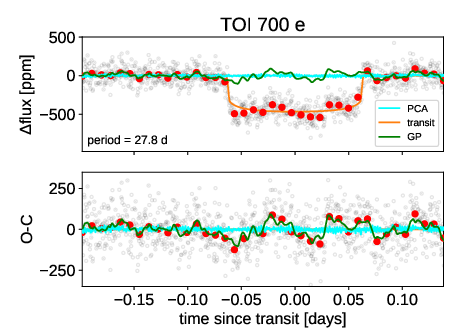
Figure 3: Transit light curves and residuals for TOI 700 d and e, with GP quantification of the excess, achromatic, correlated noise dominating the error budget.
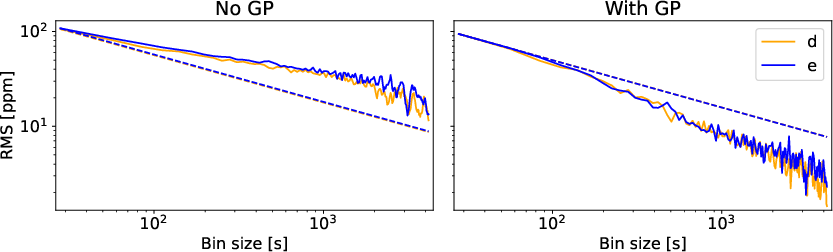
Figure 4: RMS of light curve residuals as a function of binning, demonstrating that correlated noise precludes achievement of the photon-limited precision even after aggressive temporal binning.
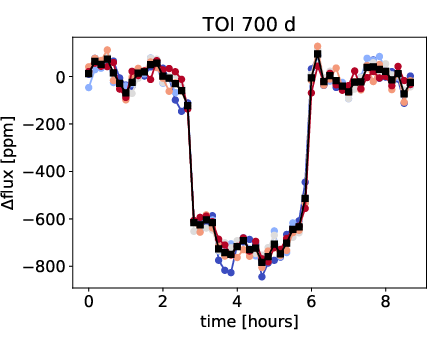
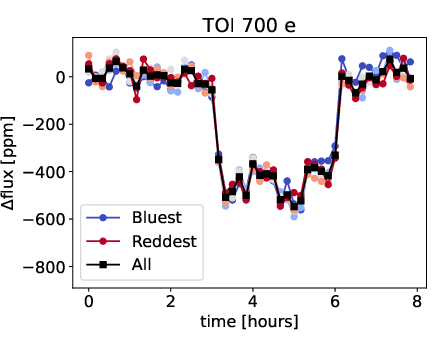
Figure 5: Chromatic analysis of the light curve residuals across five wavelength bins reveals weak wavelength-dependence, especially at bluer bins, but confirms essentially achromatic correlated noise.
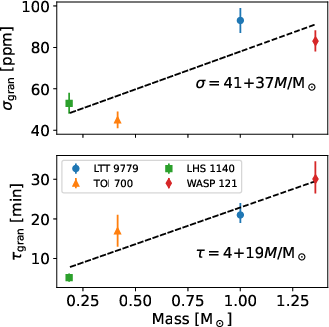
Figure 6: Empirical comparison of NIRISS/SOSS-derived granulation amplitudes and timescales across different stellar hosts, with TOI 700 results suggesting a trend versus stellar mass but inconsistent timescales with canonical models.
Joint Multi-Instrument Transit Modeling
By combining JWST, TESS, and Spitzer time-series photometry, the authors refine the planetary and orbital parameters of TOI 700 d and e, achieving a factor of 2–3 improvement in planetary radii and a factor of 5–20 improvement in period precision. Transit durations, ingress/egress, and impact parameters are also significantly improved. Eccentricity constraints for both planets are consistent with e<0.1 at 95% confidence, with no significant deviation from circularity.
Exomoon Search Methodology and Sensitivity
A comprehensive photodynamical modeling campaign was conducted using the pandora analytical light curve tool, modeling both planet-only and planet+moon hypotheses with nested sampling and Bayesian evidence comparisons.
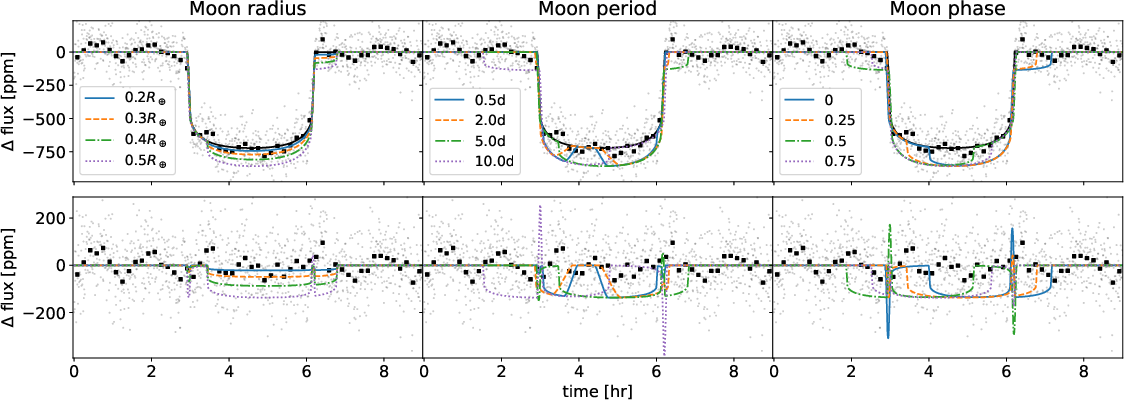
Figure 7: Simulated light curves highlighting the effect of varying moon radius, period, and phase; only in certain configurations do moon-induced deviations surpass the systematic noise floor.
For both systems, the planet+moon models never achieve Bayesian evidence ratios that meaningfully favor the moon scenario, with Δlog(Z)=0.14 for TOI 700 e (1.15:1 odds), far below a robust detection threshold.
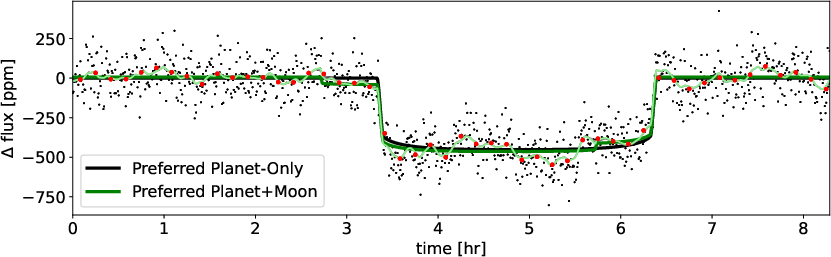
Figure 8: For TOI 700 e, the best-fit planet-only and planet+moon models (with and without GP noise) are virtually indistinguishable, and Bayesian evidence fails to support a moon signal.
A comprehensive injection-recovery analysis was performed across a grid of moon periods (0.5–10 d) and radii (0.25–0.6 R⊕), with 100 random phase draws per configuration, quantifying the detection probability as a function of moon properties.
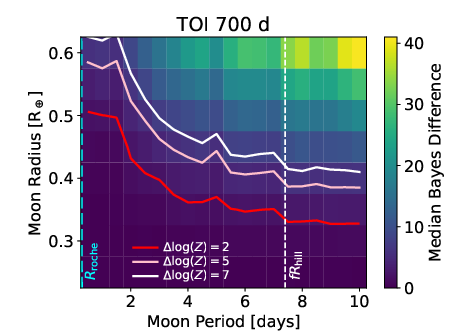
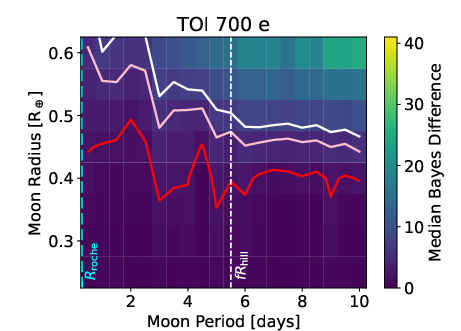
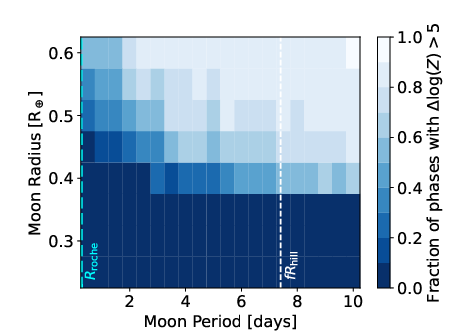
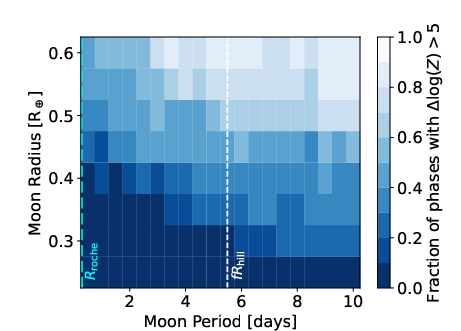
Figure 9: Injection–recovery maps of detection significance as a function of moon size and period, for TOI 700 d and e; red, pink, and white contours enclose regions of increasing exomoon detectability.
The results demonstrate that correlated noise with a 16-min coherence timescale severely limits sensitivity: only satellites larger than Ganymede (R>0.41 R⊕) on periods >2 d are consistently detectable at high confidence. Moons analogous to Luna (∼0.27 R⊕) would be undetectable with current data unless the correlated noise can be suppressed.
A hypothetical, photon-limited scenario (GP component removed) would have been sufficient to robustly detect or rule out Luna analogs with these data.
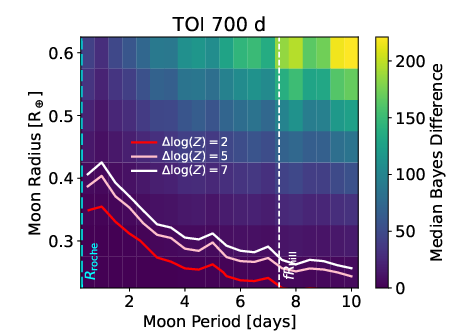
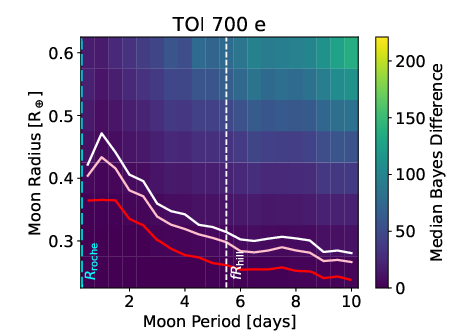
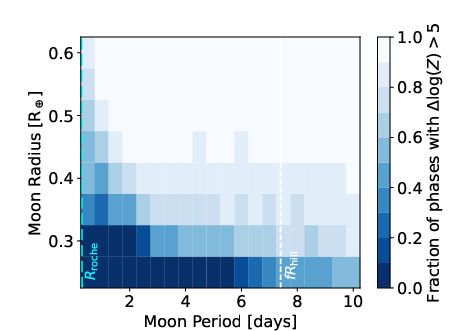
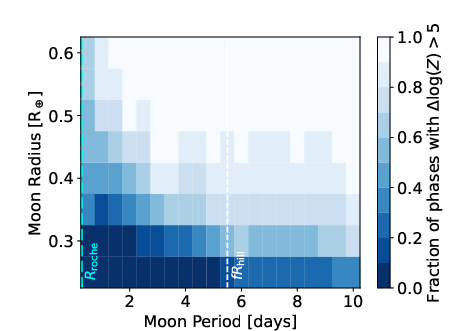
Figure 10: Theoretical injection–recovery sensitivity excluding correlated noise, demonstrating the frozen noise floor as the dominant factor limiting the true scientific reach of the dataset.
Theoretical and Practical Implications
Strong result: The dominant noise floor that precludes the detection of Luna-sized moons is an unexpected, photometrically stable, non-Poisson-correlated component likely related to M-dwarf stellar granulation, contrary to prior theoretical predictions that this effect would not dominate the NIR. This challenges prevailing models of both stellar granulation in mid-M dwarfs and the systematics floor in NIRISS/SOSS time-series.
Dynamical restrictions on stable satellite orbits are quantified and validated, and no viable moon signals are detected; upper limits are directly relevant for planet formation models that predict Earth–Moon-like satellite occurrence and stability.
Ephemeris refinement by an order of magnitude will improve transit precision timing, vital for TTV analyses, atmospheric follow-up, and future exomoon searches.
Future Directions
Enhanced multi-wavelength and multi-instrument approaches, improved stellar noise modeling, and acquisition of additional transit epochs will be necessary to advance the exomoon detection frontier into the terrestrial planet regime. Advances in temporal and spectral characterization of low-mass stellar granulation (empirical or theoretical) are specifically identified as a primary bottleneck for JWST transit science at the ∼10 ppm level. Future work addressing the achromatic noise nature—either astrophysical, instrumental, or both—will have far-reaching impact beyond exomoons, affecting all high-precision exoplanet science cases in the JWST era and beyond.
Conclusion
This investigation provides the strictest empirical upper limits on the existence of large exomoons around habitable-zone rocky planets to date, demonstrating that current JWST NIRISS/SOSS observations are limited not by photon noise but by a previously underestimated, dominant, achromatic correlated noise source. Detection of Luna-like satellites is currently precluded, but significant progress can be made if new techniques or instruments are able to realize photon-limited performance. In parallel, the refined orbital and radius measurements for TOI 700 d and e enhance the potential for both exomoon searches and atmospheric characterization in future campaigns.
(2604.05235)

