Tidally Torn: Why the Most Common Stars May Lack Large, Habitable-Zone Moons
Abstract: Earth-like planets in the habitable zone (HZ) of M-dwarfs have recently been targeted in the search for exomoons. We study the stability and lifetime of large (Luna-like) moons, accounting for the effects of 3-body interactions and tidal forces using the N-body simulator rebound and its extension library reboundx. We find that those moons have a notably different likelihood of existence (and, by implication, observability). Large moons orbiting Earth-like planets in the HZs of M4 and M2 dwarfs become unstable well before $107$ and , respectively, and in most cases, those orbiting M0-dwarfs become unstable in much less than . We conclude that HZ planets orbiting M-dwarfs are unlikely to harbor large moons, thus affecting the total number of possible moons in our galaxy and the Universe at large. Since moons may help enhance the habitability of their host planet, besides being possibly habitable themselves, these results may have notable implications for exolife, and should also be considered when seeking solutions to the Drake equation and the Fermi paradox.
Paper Prompts
Sign up for free to create and run prompts on this paper.
Top Community Prompts
Explain it Like I'm 14
Tidally Torn: Why the Most Common Stars May Lack Big, Habitable-Zone Moons — A Simple Explanation
Overview
This paper asks a big question: Can Earth-sized planets that orbit small, cool stars (called M-dwarfs) keep large moons like our Moon? The short answer from the researchers’ computer simulations is: usually no. Around most M-dwarf stars, big moons don’t last very long before their orbits become unstable and they drift away or get torn from their planets.
What did the researchers want to find out?
They focused on three easy-to-understand questions:
- If an Earth-like planet is in the “habitable zone” (the Goldilocks zone where liquid water could exist), how long could a large moon stay in a safe, stable orbit around it?
- Does that answer change depending on the type of M-dwarf star (M0, M2, M4 — from brighter/warmer to dimmer/cooler)?
- How do “tides” (the stretching and squishing of a planet and moon due to gravity) change a moon’s orbit over time?
How did they study it?
They used two kinds of computer models:
- N-body simulations with tides (a “physics playground”):
- Imagine a super-detailed physics video game that tracks how gravity pulls on a star, a planet, and a moon all at once.
- It also includes tides: when a planet gets stretched slightly by its moon (and by the star), it loses spin energy and transfers that energy to the moon’s orbit, pushing the moon outward over time. This is a bit like a spinning figure skater who slows down and uses some of that spin to fling a partner outward.
- Long-term “average” equations (a “big-picture” approach):
- These equations skip the tiny wiggles and look at the slow, overall trend from tides for billions of years.
- To stay realistic, the team compared this big-picture method with the detailed simulations and adjusted for extra effects the simple equations miss.
Key ideas explained in everyday language:
- Habitable zone (HZ): The just-right distance from a star where water could be liquid. Around smaller, dimmer stars (M-dwarfs), this zone is closer to the star.
- Tidal push: If the planet spins faster than the moon orbits, the moon gets a steady nudge and spirals outward over time.
- Hill sphere (the planet’s “gravitational bubble”): The region around a planet where its gravity can keep a moon. If a moon gets too close to the edge of this bubble (roughly within the inner ~40% of its radius), it can become unstable and escape.
- Resonances (like pushing a swing at the right time): As the moon moves outward, it can hit special orbital “beats” with the planet’s year around the star. These give the moon extra kicks that can increase its oval-ness (eccentricity) and speed up trouble.
What they tested:
- Planets between 0.8 and 2 times Earth’s mass.
- Planets placed all across the habitable zones of three star types: M0 (brighter), M2 (middle), and M4 (dimmer).
- A large, Moon-like moon.
- Different “tidal strengths,” from Earth-like tides (stronger) to weaker tides (what you might get for drier or more rigid planets).
What did they discover?
Here are the main results in plain terms:
- Around dim, cool M4 stars (the habitable zone is very close-in):
- Big moons are lost fast, usually in less than 10 million years (10 Myr). That’s very short compared to the time life usually needs to get going.
- Around mid-type M2 stars:
- Big moons typically last only about 1–50 million years before becoming unstable and leaving the planet’s safe zone.
- Around brighter M0 stars (the habitable zone is farther out):
- This is the best case. Some moons can last much longer, up to about 1 billion years (and in the most optimistic setup, roughly 1.3–1.6 billion years) if the planet is heavier (about 2 Earth masses) and is near the outer edge of the habitable zone.
- Still, even here, most large moons eventually drift too far out and become unstable.
Why do they become unstable?
- Tides push big moons outward.
- As they drift outward, the star’s tug and orbital resonances give the moon extra “kicks.”
- The moon’s orbit becomes more stretched and eventually reaches the edge of the planet’s gravitational bubble, where it can no longer be safely held.
What about changing how “squishy” the planet is to tides?
- If the planet has weaker tides (like a very dry or rigid interior), the outward push is slower, and moons can last longer—sometimes billions of years.
- But to get very long lifetimes around M-dwarfs, the planet would need unusually weak tides (which might be rare or physically unlikely for Earth-like worlds).
Why is this important?
- M-dwarfs are the most common stars in our galaxy. If Earth-like planets around them rarely keep big moons for long, that means:
- There are probably fewer large exomoons in the galaxy than we might have hoped.
- Large moons may help a planet be more stable (for example, by steadying its tilt), and they might even be habitable themselves. If big moons are rare around the most common stars, that could slightly lower the odds for life-friendly environments.
What does it mean for the search for life and future telescopes?
- If telescopes look for big moons around Earth-like planets in the habitable zones of M2–M4 stars, they might mostly come up empty—especially in older systems—because those moons likely escaped long ago.
- The best places to look for big, long-lived moons around M-dwarfs are probably near brighter M0 stars, at the outer edge of the habitable zone, and around heavier Earth-like planets.
- This work may also affect big-picture questions like the Drake equation and the Fermi paradox: if moons boost habitability but are uncommon around the most common stars, advanced life might be rarer than we expect.
In short: For most M-dwarf systems, big moons around Earth-like planets in the habitable zone probably don’t stick around. They get slowly pushed outward by tides, nudged by the star and orbital resonances, and eventually cross the safe boundary and are lost. Only in the most favorable M0 systems do some last up to around a billion years or a bit more—still likely not long enough to be common.
Knowledge Gaps
Below is a single, focused list of the paper’s unresolved knowledge gaps, limitations, and open questions. Each item is concrete and framed to enable targeted follow-up work.
- Tidal model realism: Only a constant time-lag tidal model is used with fixed , , and ; frequency-dependent, viscoelastic (Maxwell/Andrade), and thermally evolving tidal responses are not explored. Quantify how realistic rheologies alter migration and lifetimes across M-dwarf HZs.
- Lunar tides omitted: The moon is treated as a point mass in N-body runs (no , , or lunar dissipation). Evaluate how including the moon’s own tidal response and spin affects eccentricity damping and escape times.
- Planet structure invariance: Planetary radius is fixed at 1 for all $0.8$– cases, with constant and . Implement mass–radius and interior models (rocky, ocean-bearing, dry) to assess sensitivity of Roche limit, tidal torques, and spin evolution.
- Limited tidal parameter space: Only three values (10, 100, 698 s) are considered. Systematically map lifetimes over plausible / ranges derived from interior/thermal models, including time variability in as planets cool or oceans form/disappear.
- Initial condition narrowness: The moon always begins at with near-zero eccentricity () and (apparently) zero obliquity. Explore sensitivity to:
- Starting semi-major axis (e.g., $1$–),
- Initial , inclination, and obliquity (),
- Captured/retrograde moons (which can be stable much deeper into the Hill sphere).
- Retrograde moons untested: Stability for retrograde orbits (known to extend further within the Hill sphere) is not examined. Quantify retrograde survival across M0–M4 HZs and assess formation plausibility (e.g., capture scenarios).
- Hill-stability threshold choice: Lifetimes hinge on adopting the conservative from Rosario-Franco (2020). Validate lifetimes against alternative thresholds (e.g., Domingos et al. 2006) and direct long integrations past the chaotic boundary to calibrate escape criteria for migrating moons.
- Ad hoc “MMR bump” treatment: The use of a fixed $0.035$– outward “bump” to mimic mean-motion resonance and three-body effects is empirical and uncalibrated across parameter space. Develop a hybrid secular–resonant model that predicts resonance-driven migration changes from first principles and validate against N-body.
- Resonance mapping incomplete: The claimed transition near the 15:1 resonance is anecdotal. Systematically identify which star–planet–moon resonances dominate eccentricity pumping and escape as functions of , , , and .
- Eccentric host planets under-sampled: Planetary eccentricity is fixed at . Explore from 0–0.2 (or observed distributions) to quantify changes in , resonance structure, and escape times.
- Kozai–Lidov dynamics excluded: Star-induced KL cycles require non-coplanarity but can strongly excite . Test inclined moon orbits to quantify KL-driven instability across M-dwarf HZs.
- Planetary oblateness (J2) neglected: Rotational flattening can modify precession rates and resonance crossing. Include J2 and track its evolution as the planet spins down to assess stability changes.
- Multi-planet architectures not modeled: Additional planets (common around M-dwarfs) can alter the planet’s orbit and the moon’s stability via secular/mean-motion perturbations. Quantify the impact of realistic multi-planet systems on exomoon survival.
- Stellar evolution and activity phases ignored dynamically: HZ locations and stellar tides vary across pre-main-sequence to main-sequence, and intense activity may also impact spin/orbital evolution. Model time-dependent stellar luminosity, rotation, and tidal parameters to connect early flaring epochs to moon survival.
- Formation epoch and pathways unaddressed: The timing and mechanism of moon formation (giant impact vs. capture vs. co-accretion) are not linked to the stability analysis. Evaluate how formation epoch (pre-/post-planetary spin-down) and mechanism set initial , , and survival prospects.
- Moon mass invariance: Only a Luna-mass moon is simulated. Map lifetimes across (e.g., Ceres–Ganymede range) to identify the mass threshold below which moons can survive Gyr around M0–M2 HZ planets.
- Planet mass range limited: The study caps at , whereas many HZ planets are super-Earths (up to $5$–). Extend to higher masses with consistent mass–radius–interior models to test whether more massive planets can host long-lived large moons.
- HZ boundary consistency: HZ edges are computed with 1 coefficients while varies. Use the mass-dependent HZ formulation (Kopparapu et al. 2014) for each to ensure consistent ranges and reassess lifetimes.
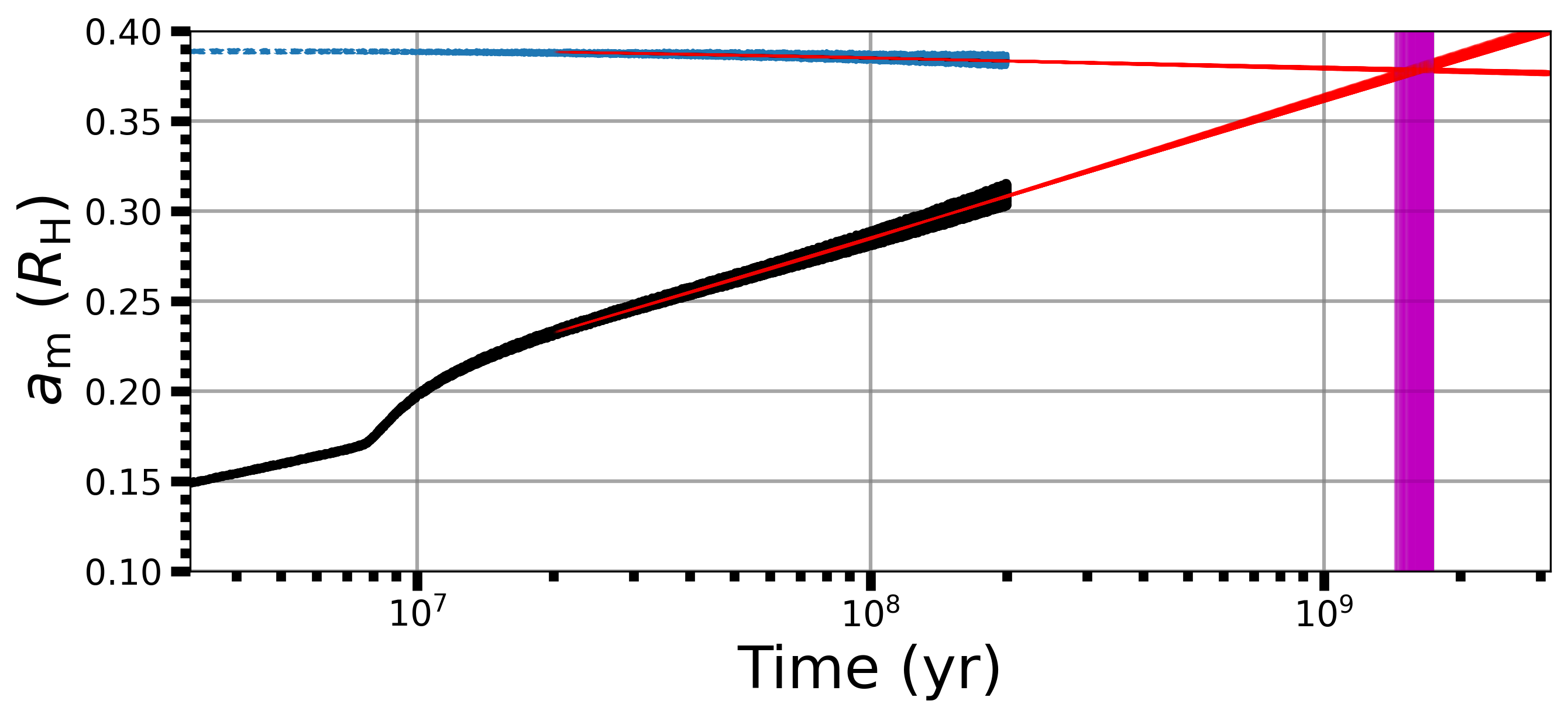
- Extrapolation validity: N-body runs are limited to 200 Myr and lifetimes for long-lived M0 cases are extrapolated, with a reported ~16% optimistic bias. Perform extended N-body integrations for the longest-lived cases to directly validate extrapolated lifetimes and refine uncertainty estimates.
- Integrator and convergence testing: The study employs TRACE and IAS15 with an initial timestep of 0.2 , but does not report timestep adaptivity, convergence checks, or cross-code validation. Provide rigorous numerical convergence and reproducibility tests for key regimes, especially near chaotic boundaries.
- Obliquity and thermal tides: Planetary obliquity and atmospheric/thermal tides (which can counteract gravitational tides and affect spin states) are not considered. Assess their role in shifting the co-rotation radius and modifying outward migration.
- Detection predictions underdeveloped: Observational implications (HWO/GMT/JWST) are qualitative. Translate dynamical predictions into testable occurrence-rate forecasts and detection yield simulations (e.g., transit timing, direct imaging) to enable falsifiable surveys.
- M-dwarf subtype coverage: Only M0, M2, and M4 are simulated. Extend the grid to M1, M3, and M5–M9 with realistic stellar parameters to confirm trends and identify any “islands of stability.”
- Stability beyond single moons: Real systems may have multiple moons. Quantify mutual moon–moon interactions (e.g., resonance chains) on survival around HZ planets.
- Habitability coupling absent: Tidal heating, eclipse cycles, and climate impacts of moons are not modeled. For cases with marginal dynamical survival, assess whether tidal heating or climate modulation would render such moons (or host planets) habitable or hostile.
- Sensitivity to initial planetary spin: A single 5-hour initial spin is used. Explore broader initial spin distributions (consistent with formation models) to quantify how spin state shapes early migration and long-term survival.
- Star’s tidal parameters: The star is treated as a point mass in dynamics; stellar tidal dissipation/rotation are not varied. Evaluate whether uncertainties in M-dwarf tidal properties materially affect planetary spin-down and moon migration.
- Stability criterion calibration for migrating moons: The adopted was derived for static satellites. Calibrate the critical boundary for outwardly migrating, resonance-excited moons via long integrations and phase-averaged statistics to reduce termination bias.
Practical Applications
Immediate Applications
Below are actionable use cases that can be deployed now, with sector tags, suggested tools/workflows, and feasibility notes.
- Optimized target selection for exomoon searches
- Sector: Space/astronomy (observatories, survey planning)
- Use: Prioritize HZ exomoon searches around earlier M dwarfs (especially M0 at outer HZ) and Sun-like stars; deprioritize M2–M9 HZ planets for Luna-sized moons given predicted instability (<108 yr for M2; <107 yr for M4).
- Tools/workflows: Add a “moon-survival prior” to target vetting in proposal tools (JWST, HST, TESS follow-up, ground-based photometry); incorporate stability maps from this paper; expose a simple API/lookup for (star type, a_p, M_p) → expected moon lifetime.
- Assumptions/dependencies: Constant time-lag tides; Earth-like tidal parameters (τ_p ≈ 698 s); stability limit from Rosario-Franco (2020); results are strongest for Luna-mass moons and Earth-sized planets.
- Interpretation of current JWST programs and near-term proposals
- Sector: Space/astronomy (proposal review, time allocation committees)
- Use: Adjust expectations for null detections and prioritize alternative signatures (e.g., transit timing variations for smaller moons) for systems like TOI-700d (M2, age >1.5 Gyr, a ≈ 0.16 au), where Luna-sized HZ moons are unlikely to persist.
- Tools/workflows: Proposal templates that include an “exomoon persistence likelihood” section; internal TAC guidance integrating lifetime priors.
- Assumptions/dependencies: Accurate stellar ages and planetary parameters; limited detectability of small moons in current photometry.
- Pre-screening pipelines for exomoon detectability studies
- Sector: Software/HPC; Astronomy data systems
- Use: Integrate a fast exomoon-stability filter (trained on the paper’s parameter sweeps) into archival searches (e.g., Kepler, K2, TESS) to triage candidates before high-cost inference.
- Tools/workflows: Lightweight ML/parametric emulator of lifetime maps; plug-ins for NASA Exoplanet Archive filters; batch scoring of planet catalogs.
- Assumptions/dependencies: Reliability of extrapolation and “MMR bump” adjustments; applicability beyond Earth-radius planets.
- Telescope scheduling and yield modeling
- Sector: Observatories/mission operations
- Use: Update yield forecasts by suppressing expected Luna-sized moon counts around HZ planets of M2–M9 dwarfs; increase time allocated to early-M (M0) outer-HZ and G/K dwarfs.
- Tools/workflows: Incorporate the paper’s lifetime grids into sensitivity simulators and science yield tools.
- Assumptions/dependencies: Survey sensitivity limits and cadence; realistic occurrence rates of Earth-size HZ planets by subtype.
- Observational strategy shift to alternative moon signatures
- Sector: Space/astronomy instrumentation
- Use: Emphasize techniques suitable for smaller or non-HZ moons around M dwarfs (e.g., precise TTV/TDV, star–planet–moon dynamical fits, cyclotron radio emission for giant-planet moons).
- Tools/workflows: Joint RV + direct imaging strategies for wide-separation planets; radio campaigns targeting giant planets around K/G stars; TTV stacking pipelines.
- Assumptions/dependencies: SNR for TTV/TDV; radio detectability thresholds; prevalence of giant planets suitable for radio methods.
- Mission design and instrument requirement guidance (near-term)
- Sector: Aerospace and instrumentation
- Use: For exomoon-focused concepts (HWO-era precursors), prioritize contrast, cadence, and wavelength ranges for earlier-type hosts and for detecting smaller moons or indirect signals.
- Tools/workflows: Requirements traceability matrices that bake in moon-survival priors by spectral type.
- Assumptions/dependencies: Science traceability assumes reduced HZ exomoon prevalence around mid/late M dwarfs.
- Methodological guardrails for researchers: do not rely on secular tides alone
- Sector: Academia (computational astrophysics)
- Use: When modeling migrating satellites, include three-body/mean-motion resonance effects (as in REBOUNDx) beyond secular tides, especially as orbits approach N:1 resonance chains.
- Tools/workflows: Standardize hybrid numerical workflows: REBOUND + tides_spin + IAS15/TRACE for close encounters; parameter sweeps with Hill-radius-based termination.
- Assumptions/dependencies: Access to HPC (simulations span 1–14 days per case); reproducible environments and code versions.
- Public engagement and curriculum updates
- Sector: Education/outreach
- Use: Update teaching modules and public materials on exomoons, habitability, Drake equation, and the Fermi paradox to reflect M-dwarf moon scarcity; emphasize the nuance that “habitable planet ≠ habitable moon-rich system.”
- Tools/workflows: Classroom labs using REBOUND notebooks; interactive visualizations of moon lifetime across stellar types.
- Assumptions/dependencies: Simplified pedagogical assumptions for clarity; licensing for code/examples.
- Strategic guidance for SETI/listening campaigns
- Sector: Policy/strategy for SETI organizations
- Use: If large moons are considered habitability boosters (climate stability, tides), reduce weight on mid/late M-dwarf targets for complex-life-leaning programs; emphasize early M and G/K targets.
- Tools/workflows: Target prioritization frameworks that include “moon-likelihood” as a habitability modifier.
- Assumptions/dependencies: Contested role of moons in complex life; dependency on other stellar activity constraints for M dwarfs.
Long-Term Applications
These require further research, scaling, or development before broad deployment.
- Next-generation exomoon detection mission design (HWO, LUVOIR/HabEx heritage)
- Sector: Space/astronomy; Aerospace
- Use: Architect instruments and survey strategies explicitly tuned to: (a) earlier M (M0) and G/K stars for HZ moons; (b) sensitivity to sub-Luna moons; (c) multi-technique campaigns (imaging + TTV/TDV + RV).
- Potential products: Starshade/coronagraph designs optimized for targets where large HZ moons are plausible; mission simulators with updated priors.
- Dependencies: Funding timelines; maturing detectors/coronagraph tech; vetted occurrence rates and age distributions.
- Rapid “exomoon survival predictor” service integrated into archives
- Sector: Software/data infrastructure; Cloud/HPC
- Use: Deliver API-scored moon survival probabilities for all cataloged exoplanets using hybrid emulators trained on N-body + tides data; auto-refresh with new planets.
- Potential products: Web services, Python client, VO protocol integration.
- Dependencies: Robust training sets spanning compositions (τ_p, k2), masses, and orbital architectures; uncertainty quantification.
- Habitability modeling that explicitly accounts for moon scarcity around M dwarfs
- Sector: Academia; Astrobiology
- Use: Update climate/obliquity/tidal heating models to explore “no-large-moon” scenarios; quantify implications for axial stability, ocean mixing, and biosignature false positives.
- Potential products: Coupled climate–dynamics simulators; parameterized “moon factor” included in habitability indices.
- Dependencies: Interdisciplinary models (atmospheres, dynamics, stellar activity); empirical constraints on small-moon occurrence.
- Constraints on planetary interiors via tidal lag inference
- Sector: Academia; Instrumentation
- Use: Infer planetary τ_p (or Q) from observed satellite systems (or lack thereof) across stellar types, using population-level modeling to back out interior/compositional properties.
- Potential products: Catalog-level Bayesian inference tools; comparative exogeophysics studies.
- Dependencies: Larger exomoon sample sizes; precise ages and masses; better Q–τ_p relations.
- Automated proposal decision-support and ROI modeling
- Sector: Research administration; Observatory policy
- Use: Predict science yield for exomoon programs under different priors; optimize time allocation by spectral subtype and technique.
- Potential products: TAC dashboards with scenario analyses; cost–benefit calculators for exomoon campaigns.
- Dependencies: Community buy-in; validation with early results; integration with observatory tools.
- ML accelerators for N-body + tides predictions
- Sector: Software/AI; HPC
- Use: Train surrogate models to emulate migration and resonance-crossing outcomes at orders-of-magnitude lower cost; enable full-survey screening.
- Potential products: Open-source surrogate models; JIT-compiled kernels for proposal-time estimates.
- Dependencies: High-fidelity training corpora; careful treatment of chaotic regimes and uncertainty; reproducibility.
- Refined exoplanet occurrence studies and SETI strategy updates
- Sector: Policy/roadmapping; SETI
- Use: Reassess the Drake-equation factors to include “moon scarcity around dominant stellar population (M dwarfs),” collaborating with occurrence-rate teams and dynamical modelers; adjust listening and biosignature strategies accordingly.
- Potential products: Updated roadmaps; target catalogs stratified by “moon-likelihood-adjusted habitability.”
- Dependencies: Agreement on the role of moons in habitability; evolving understanding of M-dwarf pre-main-sequence impacts.
- Instrument concepts for non-photometric exomoon detection
- Sector: Radio astronomy; Instrumentation
- Use: Mature cyclotron radio emission detection for moon–magnetosphere interactions (likely around giant planets not limited by tidal escape).
- Potential products: Low-frequency array upgrades; coordinated radio–optical campaigns.
- Dependencies: Theory-to-instrument link; contamination/foreground mitigation; suitable targets.
- Education and workforce development in computational astrodynamics
- Sector: Education; Workforce
- Use: Develop advanced curricula on hybrid secular–N-body tidal dynamics; teach resonance-driven migration and stability thresholds with REBOUNDx.
- Potential products: Course kits, MOOCs, open datasets and notebooks; summer schools aligned with observatory needs.
- Dependencies: Sustained funding; maintenance of software and datasets; community instructors.
Key Cross-Cutting Assumptions and Dependencies
- Tidal model choice: Constant time-lag model with Earth-like parameters (k2 = 0.298, τ_p ≈ 698 s) underpins most conclusions; very weak tides (τ_p ≈ 10 s) imply exotic interiors and are likely rare.
- Initial conditions: Luna-mass moons, starting near 3 × Roche limit; planet radius fixed at 1 R_⊕; initial spin ≈ 5 h. Deviations (e.g., smaller moons, different starts) can change lifetimes.
- Stability criterion: Conservative limit from Rosario-Franco (2020); looser criteria (e.g., ~0.49 R_H) extend lifetimes modestly but not enough for mid/late M dwarfs.
- Three-body and MMR effects: Essential near N:1 resonance chains; secular-only methods overestimate stability. Paper’s “MMR bump” heuristic (~0.035–0.05 R_H) should be incorporated in long-timescale projections.
- Ages and activity: M dwarfs’ long pre-main-sequence (≈200–400 Myr) and high activity windows overlap with predicted rapid moon loss—further reducing the probability of long-lived HZ large moons.
- Compute resources: Full N-body + tides exploration is compute-intensive; scalable emulators and HPC access improve feasibility for large catalogs.
In sum, the paper’s results immediately sharpen where and how to search for exomoons and inform telescope time allocation, while, longer term, they motivate retooling instruments, archives, and habitability frameworks around the likelihood that large, long-lived HZ moons are uncommon around the most abundant stars.
Glossary
- 3-body interactions: Gravitational dynamics involving three bodies that can produce complex, often chaotic orbital behaviors. "accounting for the effects of 3-body interactions and tidal forces"
- co-rotation radius: The orbital distance at which a satellite’s orbital period matches the planet’s rotation period; inside it, tides drive inward migration, and outside it, outward migration. "Since the moon's orbit initially lies beyond the co-rotation radius, the moon migrates outward."
- constant time-lag tidal model: A tidal model where the deformation due to tides lags the line of centers by a fixed time, controlling energy dissipation and orbital evolution. "uses a constant time-lag tidal model that follows the prescription of tides"
- critical semi-major axis: The maximum stable orbital distance for a moon around a planet before stellar perturbations destabilize it. "the critical semi-major axis , defined as"
- cyclotron radio emission: Radio waves generated by charged particles spiraling in magnetic fields, proposed as a potential exomoon detection method. "while cyclotron radio emission methods \citet{noyola14,noyola16} could emerge useful in exomoon observations."
- Drake equation: A probabilistic framework estimating the number of communicative extraterrestrial civilizations. "The Drake equation estimates the abundance of advanced civilizations in our galaxy"
- exomoon: A natural satellite orbiting an exoplanet. "As the number of exomoon candidates increases, there is heightened interest in studies of exomoon formation, orbital stability, and habitability"
- Fermi paradox: The apparent contradiction between high estimates of extraterrestrial life and the lack of observed evidence. "the Fermi paradox highlights the contradiction between this expected abundance and the lack of evidence to date"
- Giant Impact Hypothesis: The leading hypothesis that Earth’s Moon formed from debris after a collision between proto-Earth and another body. "Numerical simulations of the Giant Impact Hypothesis show that Earth's moon likely formed just exterior to "
- Giant Magellan Telescope (GMT): A next-generation 25.4-meter ground-based observatory for high-resolution astronomical observations. "Moreover, the Giant Magellan Telescope (GMT), a $25.4$ meter ground-based observatory currently under construction"
- HabEx: A proposed space telescope concept aimed at directly imaging and characterizing exoplanets. "LUVOIR \citep{luvo19} and HabEx \citep{gaud20}"
- Habitable Worlds Observatory (HWO): A proposed 6–8 meter space telescope designed to search for habitable exoplanets and potentially exomoons. "The Habitable Worlds Observatory (HWO), a proposed $6-8$ meter space telescope"
- Habitable zone (HZ): The region around a star where liquid water could exist on a planetary surface. "Earth-like planets in the habitable zone (HZ) of M-dwarfs"
- Hill radius: The radius of a planet’s gravitational dominance against the tidal forces of the star. "where and are the eccentricity and the Hill radius of the planet, respectively"
- IAS15 integrator: A high-accuracy, adaptive, 15th-order N-body integrator used for precise orbital dynamics. "along with the IAS15 integrator \citep{Rein2015}"
- IMF (Initial Mass Function): The distribution of stellar masses at birth in a population. "initial mass function (IMF) and present-day mass function (PDMF)"
- James Webb Space Telescope (JWST): A space observatory optimized for infrared astronomy, used for exoplanet and exomoon searches. "using the James Webb Space Telescope (JWST)."
- LUVOIR: A proposed Large UV/Optical/IR Surveyor space telescope concept for exoplanet and astrophysical studies. "LUVOIR \citep{luvo19}"
- M-dwarf: A cool, low-mass main-sequence star; the most common stellar type in the Milky Way. "M-dwarfs are considered the most frequent type of stars."
- mean motion perturbations: Variations in orbital motion arising from gravitational interactions affecting the mean orbital frequency. "neglects the mean motion perturbations potentially affecting the putative moon."
- mean motion resonance (MMR): A commensurability between orbital periods leading to strong periodic gravitational interactions that can alter orbits. "Eventually, mean motion resonances (MMRs) and other three-body effects become significant"
- moment of inertia constant: A dimensionless parameter describing how mass is distributed within a body, affecting its rotational dynamics. "represent the moment of inertia constant, the initial spin period, and the time-lag constant for the planet, respectively."
- N-body integrator: A numerical solver that computes the gravitational evolution of multiple bodies simultaneously. "We employ the N-body integrator rebound (v4.4.3)"
- PDMF (Present-Day Mass Function): The current distribution of stellar masses in a population. "initial mass function (IMF) and present-day mass function (PDMF)"
- pre-main-sequence: The early evolutionary phase of a star before it begins core hydrogen burning. "M0–M4 dwarfs have pre-main-sequence lifetimes of 200–400 Myr"
- radial velocity (RV) methods: Techniques that infer planetary or satellite presence by measuring Doppler shifts in stellar spectra. "\citet{vanderburg18} provides novel radial velocity (RV) methods combined with direct imaging"
- REBOUND: An open-source N-body code for simulating collisional and gravitational dynamics. "We employ the N-body integrator rebound (v4.4.3)"
- REBOUNDx: An extension library for REBOUND that adds additional physics such as tidal and spin effects. "in conjunction with the extension library reboundx (v4.3.0)"
- Roche limit: The minimum distance within which a satellite is tidally disrupted by its primary’s gravity. " represents the Roche limit of a fluid satellite."
- runaway greenhouse: A climatic state where increasing water vapor leads to uncontrollable warming, setting the inner edge of the HZ. "the runaway greenhouse (inner HZ) and maximum greenhouse (outer HZ) limits"
- secular forcing timescale: The timescale over which long-term (averaged) gravitational or tidal effects accumulate to change orbital elements. "the secular forcing timescale is only yr"
- secular tidal theory: An analytical approach averaging short-timescale dynamics to model long-term tidal evolution. "while (b-d) show outcomes from secular tidal theory \citep{Barnes_2017}"
- stability limit: The boundary beyond which a moon’s orbit around a planet becomes dynamically unstable. "when the moon crosses the stability limit \citep{Rosario-Franco2020}"
- tidal dissipation efficiency: How effectively tidal processes convert orbital/rotational energy into heat, affecting migration rates. "accounting for a range of tidal dissipation efficiencies"
- tidal migration: The gradual change in a satellite’s orbit due to tidal torques and energy dissipation. "After the tidal migration proceeds quasi-linearly in logarithmic time"
- tidal quality factor (Q_p): A dimensionless parameter quantifying energy loss per tidal cycle; inversely related to tidal time-lag. "The tidal dissipation efficiency of a planet can also be expressed via the tidal quality factor, "
- tidal time-lag: The fixed delay between gravitational alignment and the tidal bulge response, controlling tidal torque strength. "with a tidal time-lag of 698 s"
- TRACE integrator: A numerical integrator in REBOUND used to model close encounters and complex dynamics. "Our simulations use the TRACE integrator \citep{Lu2024} along with the IAS15 integrator"
- transit-timing variations: Deviations in the timing of exoplanet transits caused by additional bodies like moons, used as a detection method. "or reveal themselves through transit-timing variations \citep{Kipping2009}."

