- The paper introduces a novel shrinking-cylinder re-centering algorithm that corrects systematic biases in filament spines, boosting central density estimates by up to 1–1.5 dex.
- It demonstrates nearly universal dark matter density profiles across redshifts, accurately modeled by a triple power-law that delineates central, intermediate, and outer regimes.
- The study decomposes bound and unbound dark matter contributions, showing that early cosmic epochs feature higher smooth DM densities, which informs theories of cosmic web evolution.
Universal Dark-matter Density Profiles of Cosmic Filaments
Introduction
This work provides a systematic quantification of radial dark-matter (DM) density profiles of cosmic filaments in the IllustrisTNG TNG50-1 simulation, leveraging a high-resolution implementation of the DisPerSE filament-finding algorithm, applied at multiple redshifts (z=0–$3$). The authors identify critical limitations in current DisPerSE methodologies, introducing a dedicated "shrinking-cylinder" re-centering algorithm that addresses systematic biases in the inferred filament spine locations due to finite grid resolution. The results establish a robust, nearly universal density profile for filaments when normalized by the virial radius of their terminal halos, and they decompose the contributions of bound and unbound DM to the central filament profile.
Filament Extraction Pipeline and Methodology
The authors implement DisPerSE on a 5123 regular grid, smoothing the DM density field in log space to preserve filamentary structure, with careful calibration of persistence thresholds to ensure consistency in the connection of filaments to massive halos at each redshift. Filament candidates are post-processed to remove low-mass and boundary artifacts, associating filament maxima with resolved FoF halos.
A critical methodological advancement is the spine re-centering procedure: the raw DisPerSE spine—offset due to grid smoothing—systematically underestimates central densities and introduces artificial core flattening. The iterative shrinking-cylinder approach repositions the filament center along each segment based on the centers of mass of particles within progressively shrinking cylindrical shells. Typical corrections are of order 20 kpc, and central densities increase by up to $1$–$1.5$ dex, extending the recovered power-law interior by an order of magnitude in radius.
Network Structure and Morphology
The DisPerSE network recovers the expected large-scale cosmic web configuration in the high-resolution regime, as shown in the projected DM density and filament overlay at z=1.
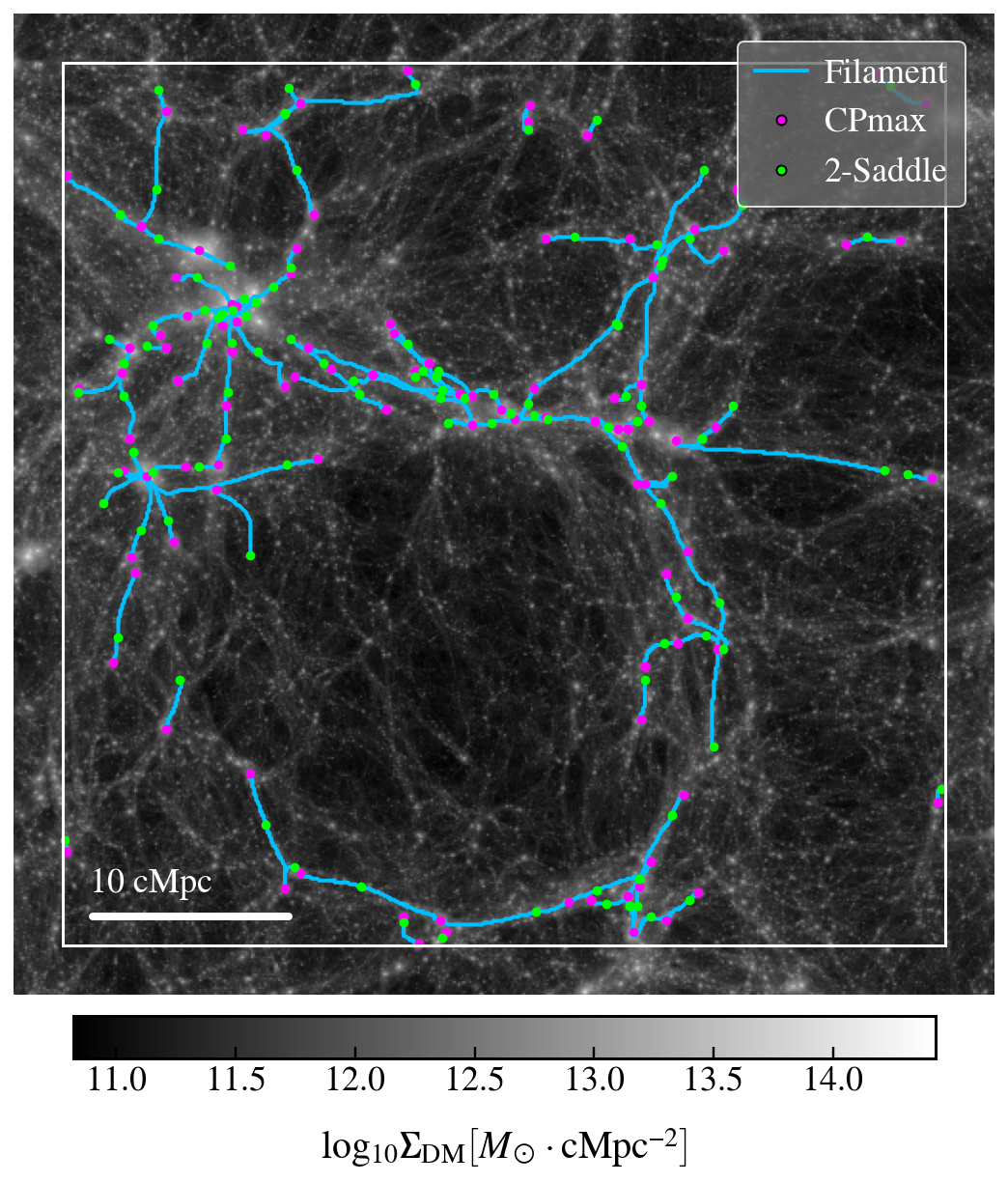
Figure 1: z=1 cosmic filament network in TNG50-1; filaments (blue) and critical points (purple, green) are overlaid on the projected DM surface density.
The use of grid-based density fields and iterative spine refinement results in a filament sample that accurately maps the true density ridges linking virialized halos, minimizing spurious identification and grid artifacts.
Properties and Universality of Filament Density Profiles
The ensemble-averaged radial density profiles are constructed in cylindrical shells about the refined filament spines, with exclusion of node outskirts to avoid halo core contamination. Normalization of radii by the virial radius of the terminal halos produces universal stacked profiles with minimal redshift dependence, signifying strong self-similarity analogous to halo universality but extended to filamentary geometry.
A generalized triple power-law (PL3) model provides an excellent parametric fit to the stacked profiles, superior to a generalized NFW (gNFW) form. Profiles exhibit three distinct regimes:
- Central core (R/Rvir≲0.1): Flattened or declining logarithmic slopes (approaching ∼−0.9 in all-DM; nearly flat with unbound DM).
- Intermediate regime (0.1≲R/Rvir≲3): Power-law slope $3$0.
- Outskirts ($3$1): Slope flattens toward $3$2.
Profile normalization and internal structural slopes are robust across variations in node mass, filament length, and redshift.
Dependence on Node Mass, Filament Length, and Redshift
The stacked profiles in bins of node mass or filament length demonstrate weak dependence on these parameters, with discernible differences only in the highest-mass nodes, potentially attributable to low-number statistics. For a fixed mass bin, the central DM density exhibits marginal evolution, increasing in time (decreasing with redshift), most notably in the lowest-mass node bin.
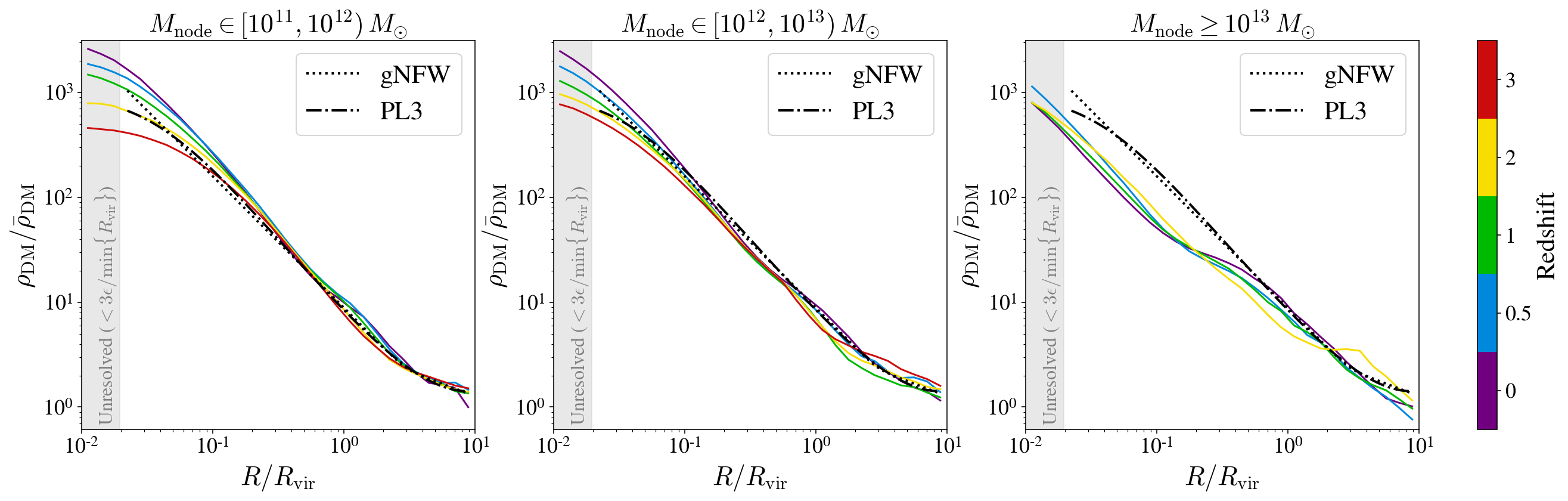
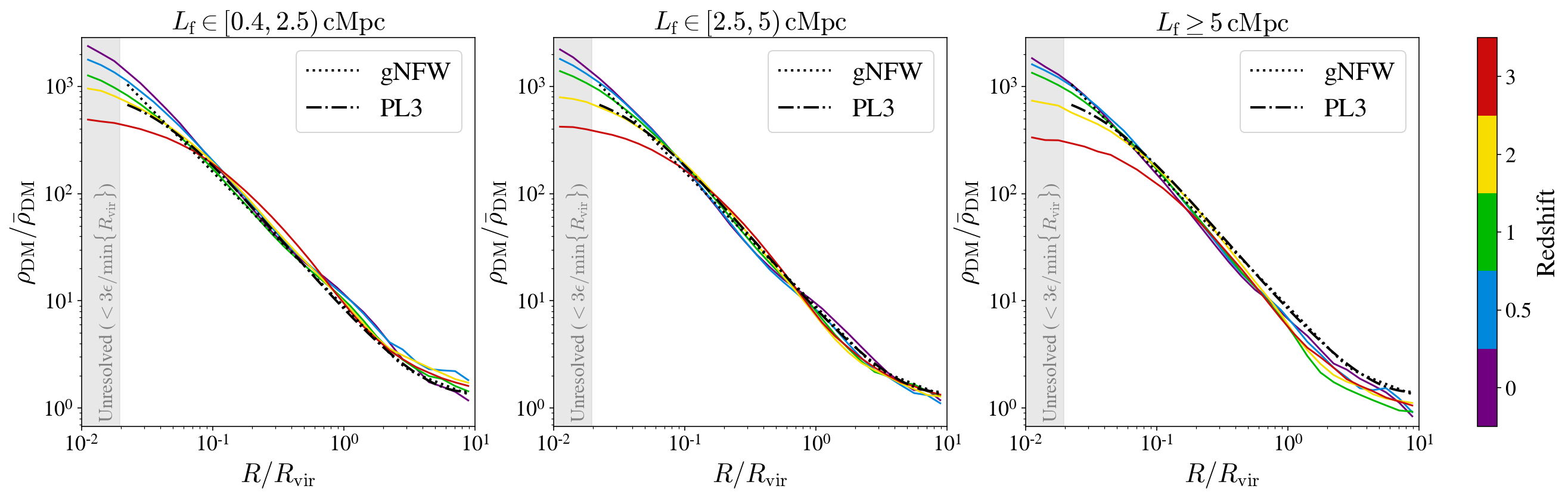
Figure 2: Length-weighted mean filament DM density profiles, stratified by node mass (top) and filament length (bottom), across redshift and compared to best-fit empirical models.
These results reinforce the conclusion that the universal profile is an excellent descriptor across the parameter space probed by high-resolution simulations ($3$3).
Role of Bound Structure: Decomposition into Clumpy and Smooth DM
By excising particles bound to halos with $3$4, the authors isolate the smoothly distributed DM component. The central cusp, prominent in all-DM profiles, is significantly suppressed—by up to $3$5 dex—in the smooth component, replaced by a flat-core structure within $3$6. This demonstrates quantitatively that the apparent central cusp is dominated by unresolved halos ("clumpy" component) embedded within the filament spine.
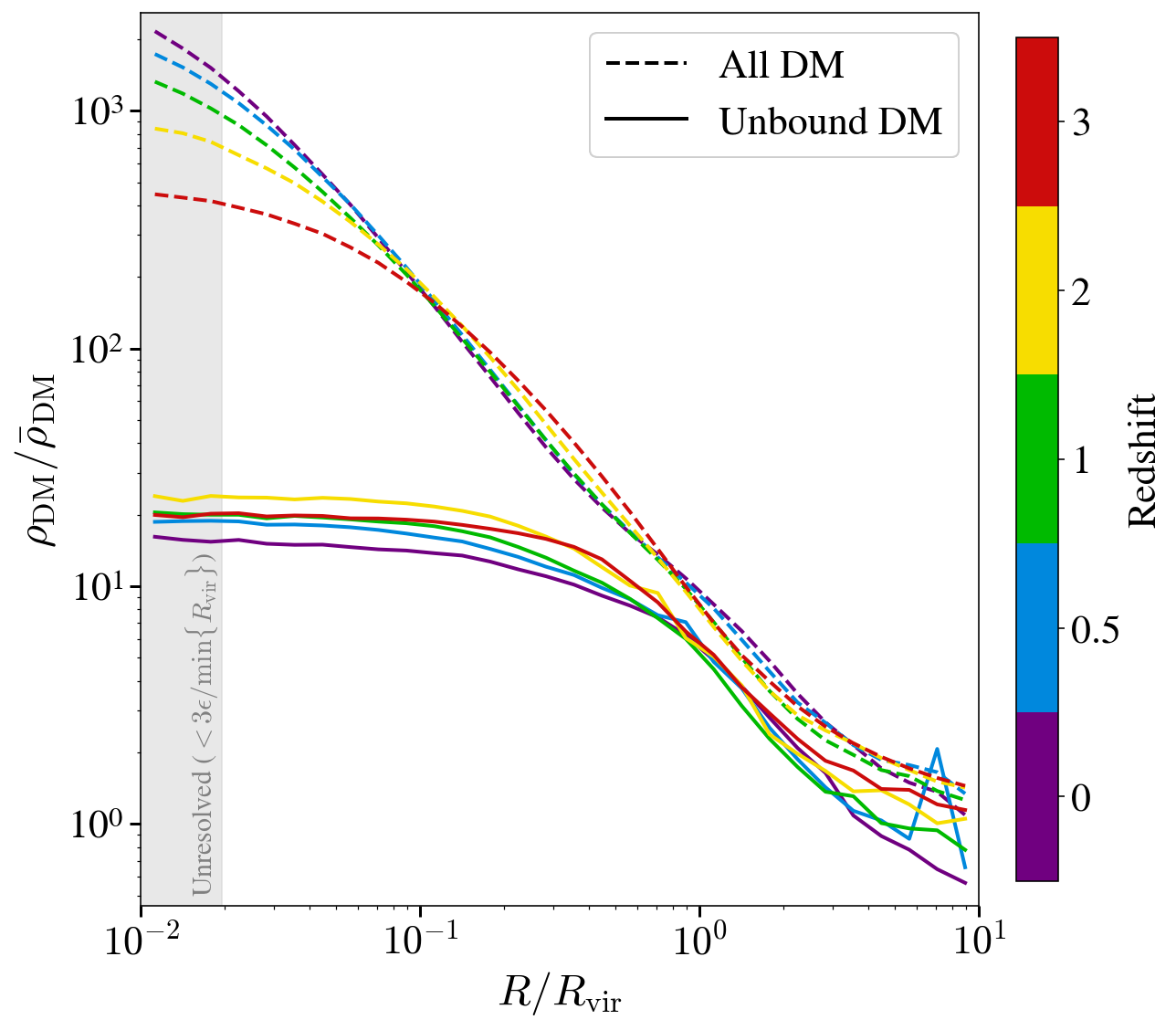
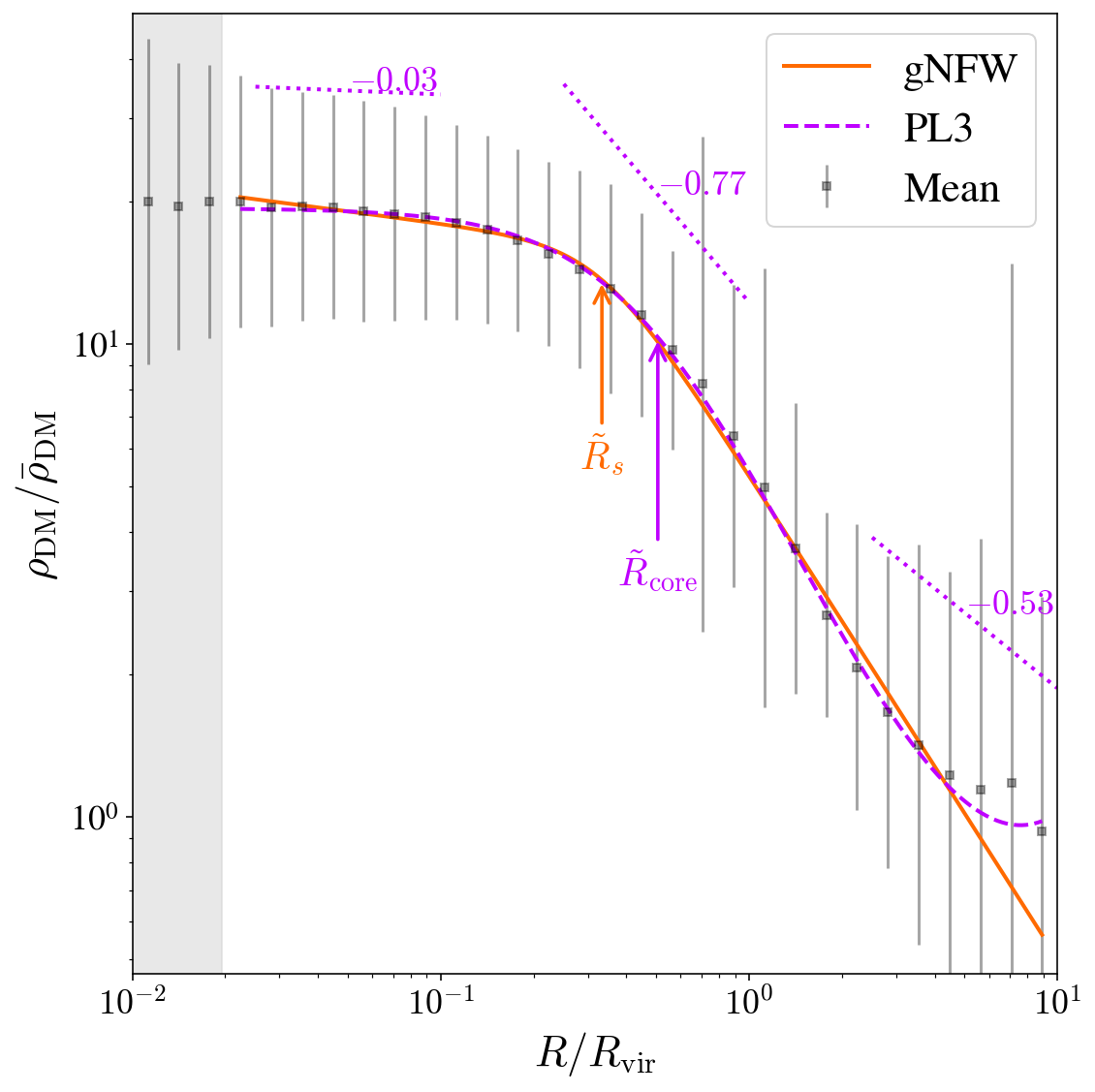
Figure 3: Comparison of filament mean density profiles traced by all DM (dashed) vs. unbound DM (solid); the contribution of embedded halos to the inner profile reaches $3$7 dex.
Moreover, the redshift evolution of the central smooth DM density reveals a reversal: the unbound DM is denser toward higher redshift—a signature of a higher smooth accretion fraction in early filament feeding, with later epochs characterized by increasingly clumpy (halo-dominated) supply.
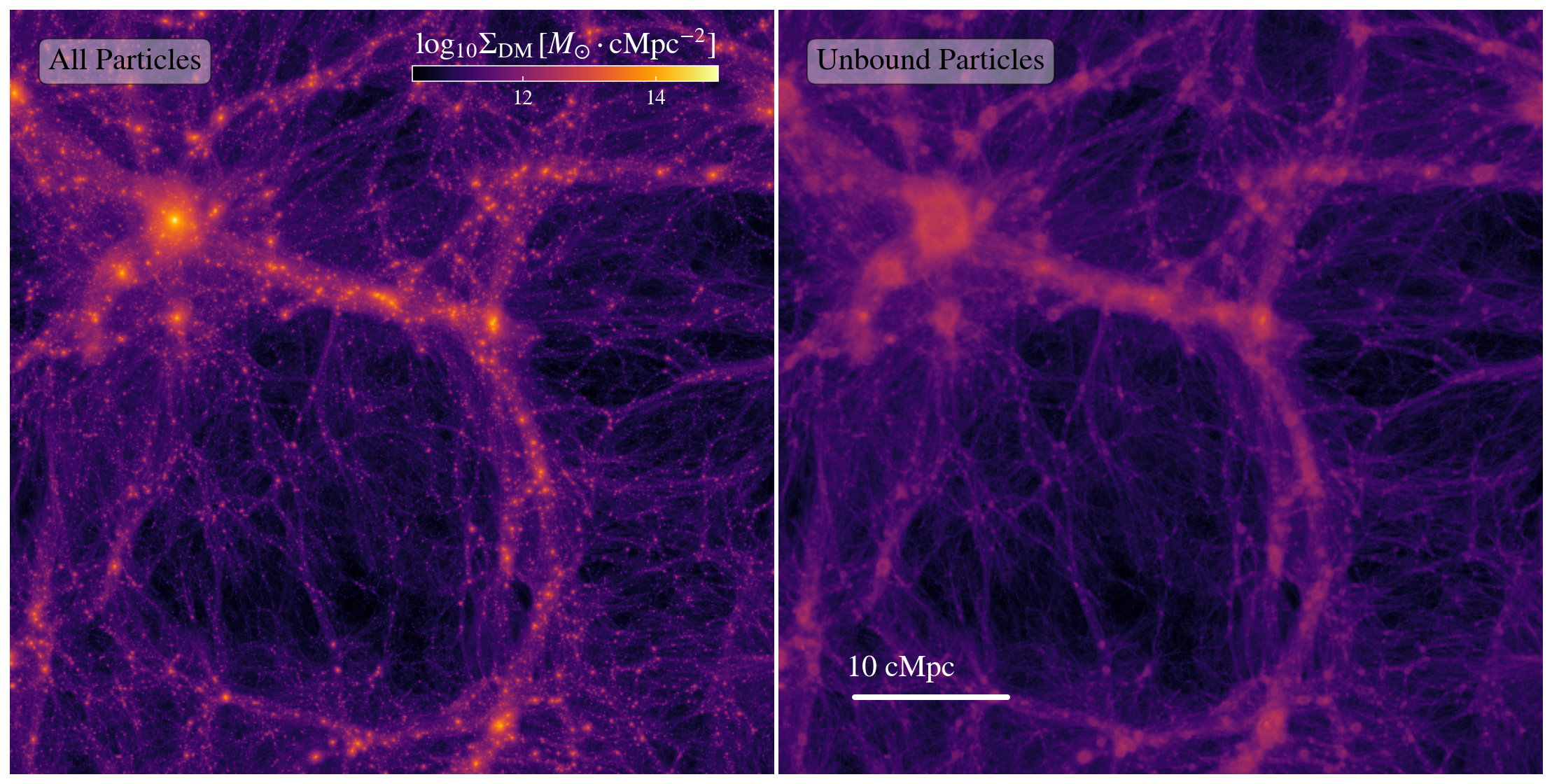
Figure 4: DM surface density projections with (left) and without (right) halo-bound particles, illustrating the dominance of halos along filament spines.
Comparison to Galaxy-traced and Alternative Methodologies
Comparison with literature profiles obtained using galaxy-traced filaments, such as those in MTNG [Wang et al. 2024], highlights systematic differences: galaxy-traced filaments are denser by up to $3$8 dex and exhibit non-monotonic slope profiles with characteristic flattening at larger radii. The DM-traced, re-centered profiles presented here display a monotonic flattening with a smaller scale, reflecting the difference between biased and unbiased tracers, as well as the importance of sampling scale, mass threshold, and method-specific artifacts.
Theoretical and Practical Implications
The demonstrated structural self-similarity and parametric universality of filament density profiles are significant for both theoretical modeling of the cosmic web and for connecting simulation-based filament identifications to observed galaxy and gas distributions. The results imply that, akin to halos, cosmic filaments can be characterized by scale-invariant internal structure when an appropriate physical length scale is used.
The analysis also directly informs observational strategies for mapping intergalactic medium structure and for modeling galaxy evolution in filaments, as the decomposition of smooth vs. clumpy components places quantitative constraints on accretion histories and environmental pre-processing.
Furthermore, the methodological advances outlined—particularly spine refinement and clean separation of clumpy vs. smooth DM—are broadly applicable to improved analysis of cosmic-web topology in both simulations and survey data, and are relevant for further development of machine learning and topological approaches to web identification.
Conclusion
This study establishes a standardized, resolution-robust framework for extracting and quantifying the internal structure of cosmic filaments in high-resolution hydrodynamical simulations. The central numerical findings are:
- Universal, weakly variant filament profiles emerge under virial scaling, with negligible dependence on mass, length, or epoch.
- A triple power-law model accurately describes all resolved regimes; gNFW fits are suboptimal.
- Inner profile slopes and normalization are significantly affected by unresolved halo substructure, clarifying the role of halo-dominated accretion.
- Central smooth DM densities are higher at early cosmic times, consistent with theoretically anticipated evolution in accretion modes.
Future advancements require larger volume, high-resolution simulations to capture the full diversity of filament populations, and further refinement (potentially via ML techniques) for mapping observed galaxy distributions to the underlying DM cosmic web. The filamentary self-similarity elucidated here sets the stage for these next-generation studies.
Reference: "Universal Dark-matter Density Profiles of Cosmic Filaments" (2604.05033)