- The paper derives a quantitative relation linking halo rarity to the characteristic filament scale that influences anisotropic infall.
- It employs a rigorous statistical framework combining Gaussian Random Field excursion set theory with numerical evaluation on a ΛCDM power spectrum.
- The derived scaling laws provide practical criteria for smoothing scale selection in surveys and zoom-in simulations to enhance cosmic web analysis.
Introduction
The formation and evolution of dark matter halos is fundamentally determined by their embedding within the multiscale, anisotropic large-scale structure—the cosmic web. The anisotropic tidal fields generated by collapsing filaments funnel matter toward haloes, controlling anisotropic infall, merger rates, and, ultimately, galaxy assembly histories. Despite increasing evidence for the impact of filaments on various halo and galaxy properties, quantitative criteria to relate halo properties to the relative scale of filamentary environments remain poorly established. Most analyses adopt fixed, somewhat arbitrary smoothing scales, lacking first-principle justification for the dynamically relevant range.
This work presents a rigorous statistical framework, rooted in Gaussian Random Field (GRF) and excursion set formalism, to delineate the characteristic scale at which the filamentary tidal field maximally influences halo formation. The authors derive analytic and numerical scaling laws, connecting the Lagrangian size and rarity of haloes to the characteristic surrounding filament scale, calibrated on the ΛCDM power spectrum. These relations yield practical guidance for the selection of smoothing scales in large-scale structure surveys and initial patch sizes for zoom simulations.
The analysis proceeds by evaluating the conditional probability of encountering a two-axis-compressive (filamentary) tidal environment, smoothed on scale Rsd, at the location of a high-density peak (halo) of rarity ν and smoothing scale Rpk. Formally, this is quantified via
P(sd∣pk)=P(pk)P(sd,pk),
where 'sd' denotes the signature of the sorted eigenvalues of the deformation tensor indicating filamentary regions, and 'pk' refers to overdensities above collapse threshold at the peak scale.
The approach leverages rotational invariants and the joint probability distribution of the field and its derivatives, following the extension of the classic peaks formalism to multiscale critical point statistics. The correlation between the density at Rpk and the tidal field at Rsd, parameterized by
γ(Rpk,Rsd)=σ0(Rpk)σ0(Rsd)4π∫dkk2Pm(k)W(kRpk)W(kRsd)
fully encodes the power spectrum dependence. The inflection point of P(sd∣pk), with respect to the scale ratio Rsd/Rpk, marks the dynamically relevant filamentary scale.
Numerical Results: Scale Ratio and Rarity Dependence
Numerical evaluation on a three-dimensional Rsd0CDM power spectrum reveals that Rsd1 is suppressed at Rsd2 (full three-axis collapse) and asymptotically approaches the unconstrained filament volume fraction at high scale ratios. The sensitivity to the filamentary scale peaks at a characteristic value of Rsd3, the position of the inflection point.
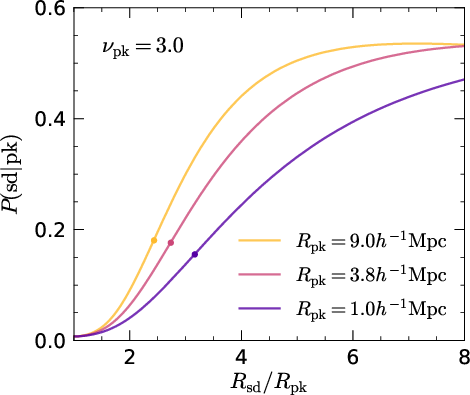
Figure 1: Conditional probability Rsd4 as a function of the scale ratio for various halo sizes; inflection points (filled circles) trace the characteristic filament scale ratio.
Crucially, the inflection point is neither universal nor constant but depends monotonically on the peak rarity and mass. For typical collapsed haloes, the scale ratio at maximum sensitivity is well-fit by a linear relation:
Rsd5
with Rsd6 over the relevant range.
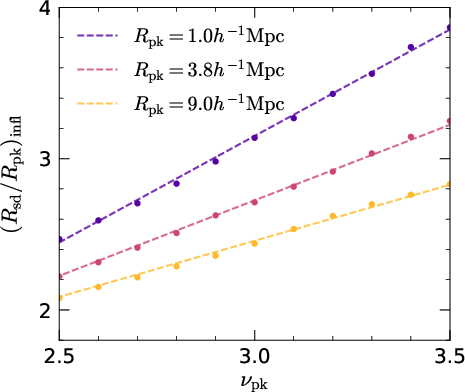
Figure 2: The characteristic filament-to-halo scale ratio at the inflection point increases monotonically with peak rarity; dashed lines provide linear fits for different masses.
The result implies that the halo response to filamentary tidal fields is realized at scales Rsd7–Rsd8 times the Lagrangian halo size, with more massive (rarer) haloes coupled to filaments over larger physical distances.
Astrophysical Scaling Relations: Mass and Redshift Evolution
By connecting peak rarity and mass to cosmological collapse thresholds and the Rsd9CDM variance, the authors formulate explicit scaling relations predicting the filamentary scale relevant for haloes of given size and redshift:
ν0
with normalization ν1 and ν2 depending on redshift, as detailed in the main work. The mass and redshift dependence is illustrated in the next figure.
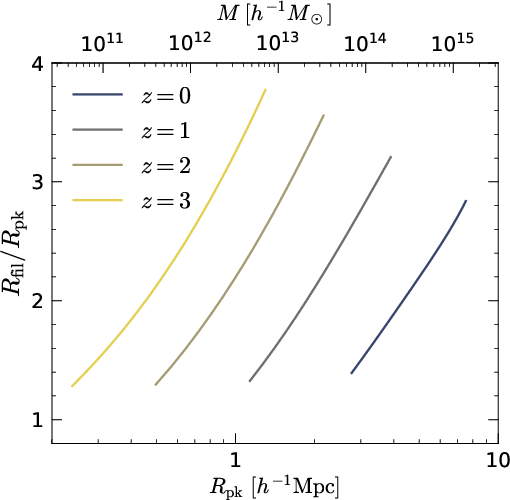
Figure 3: The filament-to-halo scale ratio as a function of Lagrangian halo radius (bottom axis) and halo mass (top axis) evolves as a power-law, systematically increasing with mass and redshift.
The filament scale, for instance, reaches ν3 for ν4 haloes at ν5, and contracts with increasing ν6 and decreasing mass. For the most prominent haloes at each epoch (ν7–ν8), the redshift evolution is captured by:
ν9
demonstrating hierarchical growth of the cosmic web.
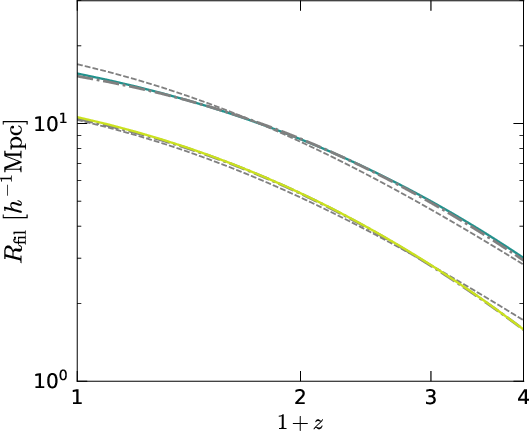
Figure 4: Characteristic filamentary environment scale for the most massive collapsing peaks as a function of redshift, along with simple analytic fits.
Practical Implications and Future Directions
These scaling laws furnish principled prescriptions for filtering and smoothing scales in both data analysis and simulation initial condition generation. In the context of zoom-in simulations, the findings provide quantitative criteria for buffer region selection, ensuring anisotropic tidal fields are adequately resolved and halo-environment coupling is preserved. For structure and filament finders in galaxy and weak lensing surveys, the results motivate rarity- and mass-dependent smoothing to isolate dynamically influential filaments, improving the interpretability of environmental trends.
On the theoretical front, the explicit dependence of the characteristic scale on the underlying power spectrum slope and the peak rarity opens avenues for constraining cosmology from the statistical properties of the cosmic web and its critical points. The general approach extends to both 2D projected fields and alternative cosmological models, as validated by additional analysis on scale-invariant spectra.
Conclusion
This paper establishes a robust statistical correspondence between halo properties and surrounding filamentary scales, rooted in GRF excursion set theory. The characteristic scale at which filamentary tidal fields dynamically influence halo formation is neither fixed nor arbitrary, but instead scales with halo rarity and mass in a quantifiable manner, typically at Rpk0–Rpk1 times the Lagrangian size. The analytic and numerical scaling relations provide essential tools for the design and interpretation of surveys and simulations targeting anisotropic infall and the cosmic web's role in structure formation. Their adoption will enhance the physical fidelity and consistency of multiscale analyses of the cosmic web and its evolutionary consequences.