- The paper presents a modular multi-agent framework that streamlines XR content creation by integrating pedagogical intent, generative asset production, safety checks, and instructional enrichment.
- The system decouples content ideation from asset generation, using a human-in-the-loop model to ensure curriculum alignment and mitigate risks of generative errors.
- The framework leverages commodity hardware and external generative APIs to lower entry barriers, promoting equitable access to immersive learning experiences in K-12 education.
Multi-Agent Framework for XR Content Democratization in K-12 Education
Introduction
This work proposes a multi-agent architecture for AI-assisted Extended Reality (XR) content authoring, specifically targeting the constraints and needs present in K-12 educational environments (2604.04728). Unlike prior XR content creation approaches that impose significant technical burdens or offer limited pedagogical alignment, this system formalizes the authoring workflow through the cooperation of four specialized agents: Pedagogical, Execution, Safeguard, and Tutor. The explicit separation of pedagogical specification, generative asset production, safety validation, and instructional enrichment introduces a clear pipeline to democratize the use of immersive learning materials on commodity hardware without requiring technical expertise from educators.
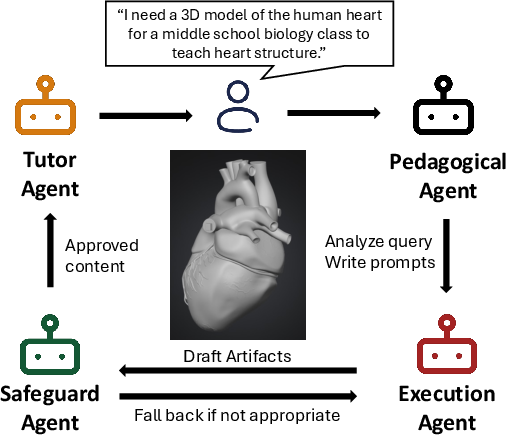
Figure 1: System architecture overview.
System Design and Agent Decomposition
The system architecture implements a sequential, human-in-the-loop pipeline operationalized through four autonomous yet interdependent functional agents.
Pedagogical Agent: The pedagogical agent parses and translates plain-language teacher prompts into structured, grade-appropriate, curriculum-aligned content specifications. This agent bridges the semantic gap between instructional intent and the specific input constraints of 3D asset generation pipelines, ensuring that pedagogical objectives, factuality constraints, and age appropriateness are all codified in the asset prompt.
Execution Agent: Employing generative APIs such as Meshy, the execution agent utilizes the structured prompt to instantiate a 3D scene or asset. This clear decoupling between pedagogical reasoning and asset instantiation ensures that generation errors or design mismatches remain isolated from instructional logic.
Safeguard Agent: Given the high-stakes requirements of K-12 educational deployment, this agent performs robust multi-criteria validation of generated content, independently verifying five dimensions: age appropriateness, factual accuracy, visual safety (absence of violence or disturbing content), lack of social bias, and instructional relevance. Content failing validation reenters the generative loop, guided by safeguard-driven feedback.
Tutor Agent: To raise the generated asset to pedagogical utility, the tutor agent systematically annotates the XR content with explanations, lesson overviews, in-context glossaries, and formative assessments. By externalizing content scaffolding from asset production, the system ensures modular curriculum enrichment, responsive to both retrieved and generative knowledge sources.
User Interaction and Workflow Integration
The teacher-facing browser interface abstracts all backend complexity. Users select education level, subject, and topic, which are internally dispatched to the respective agent pipeline. The system iteratively generates, validates, and enriches the XR experience, culminating in an embeddable and teachable artifact.
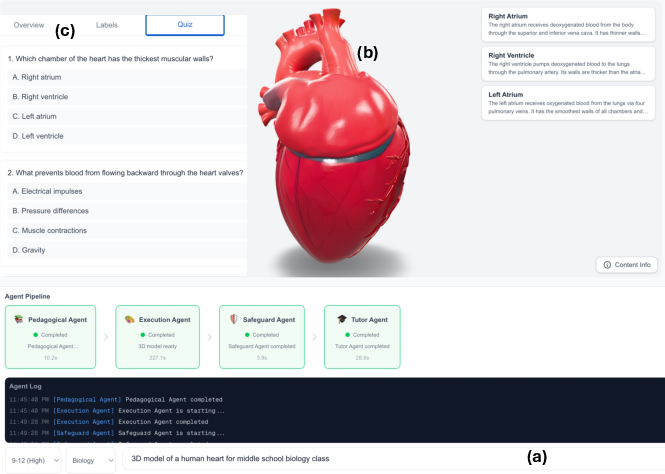
Figure 2: System interface illustrating parameter configuration, generated XR assets, and multimodal teaching materials.
Teachers can inspect and edit the pedagogical agent’s interpretation, review the safeguard agent’s compliance verdict, and deploy immediately usable lesson modules, fully decoupled from XR modeling or prompt engineering tasks.
Technical Implementation
The front-end utilizes Next.js, React, and Zustand for state management and 3D visualization (via Google model-viewer). Backend logic operationalizes agent workflows with FastAPI and Uvicorn, providing modular API endpoints for LLM access (supporting both Claude and OpenAI LLMs as modular agents). Asset generation and retrieval processes are handled via Meshy and Tavily APIs, facilitating robust 3D model synthesis and context-retrieval for curriculum construction, respectively.
Empirical and Practical Implications
The system's modular agent separation provides a significant architectural insight for AI content pipelines in education: specialization and explicit validation stages directly mitigate risks of unchecked generative hallucination, pedagogical misalignment, and safety violations. By running natively in browsers and decoupling XR deployment from proprietary headsets or expensive infrastructure, the framework improves equity and practical accessibility.
The human-in-the-loop model asserts teacher agency, offering direct review and override points at pedagogical and safety validation junctures. This is critical for compliance with evolving regulatory and ethical requirements in K-12 education.
Limitations and Prospective Evolution
Despite providing an end-to-end demo and codebase, the system's reliance on external APIs (e.g., Meshy) imposes latency and cost constraints that may limit real-world scaling. The safeguard agent’s current reliance on prompt/Image-Only validation cannot guarantee detection of subtle, geometry-based safety violations—highlighting a need for direct 3D model semantic analysis in future iterations. Absence of teacher or student field trials constrains claims about usability and genuine classroom impact.
Planned future work includes empirical evaluation with K-12 educators, optimization of generation/safety validation cycles, deeper integration with real-time classroom management systems, and research into multi-modal safety validation methods that operate directly over mesh and texture data.
Conclusion
This work formalizes a multi-agent, teacher-centered architecture for safe, curriculum-aligned XR content authoring in K-12 education, operationalizing pedagogical intent, safety validation, and instructional enrichment as composable, agent-driven pipeline stages. The implications for AI-informed educational tooling are considerable: such architectures instantiate responsible AI practices by default and considerably lower content creation barriers, promoting greater instructional diversity, equity, and teacher agency in immersive education.
(2604.04728)