- The paper presents DenZa-Gaussian, a physics-informed extension of 3D Gaussian Splatting that tackles sparse-view limitations in ADF-STEM tomography by incorporating scattering physics.
- It introduces a reparameterized 'denza' scalar field and a Scattering-View-Consistent normalization coefficient to correct projection biases and suppress missing wedge artifacts.
- Experimental evaluations show that DenZa-Gaussian outperforms traditional methods, delivering improved PSNR, SSIM, and atomic-scale detail reconstruction in both 15-view and 45-view settings.
3D Gaussian Splatting for ADF-STEM Tomography: Scattering Physics and Sparse-View Reconstruction
Introduction
Annular Dark Field Scanning Transmission Electron Microscopy (ADF-STEM) tomography is central to nanoscale materials science, supporting atomic-resolution analysis of structure and composition. The reconstruction paradigm requires combining multiple tilt-series projections, but practical constraints on electron dose—especially for beam-sensitive samples—necessitate sparse-view acquisition, severely hampering reconstruction fidelity and introducing distinctive missing wedge artifacts. The paper "3D Gaussian Splatting for Annular Dark Field Scanning Transmission Electron Microscopy Tomography Reconstruction" (2604.04693) introduces DenZa-Gaussian, a physically informed extension of 3D Gaussian Splatting (3DGS), designed to remedy the limitations of traditional and neural tomographic methods under sparse-view ADF-STEM conditions.
Scattering-Aware 3D Gaussian Splatting
The standard 3DGS framework, originally developed for real-time scene radiance field rendering, shares formal similarities with tomographic inverse problems but is mismatched with ADF-STEM’s underlying physics—most notably, its projection formation via Rutherford elastic scattering and a cone-beam imaging geometry. The authors present a reparameterization of 3DGS by introducing the “denza” scalar field, a learnable representation incorporating both local density and effective Zα, to act as a direct proxy for local scattering strength in the volume. This parameterization enables a closed-form forward model directly reflecting the ADF-STEM image formation process.
To reconcile anisotropic blur and attenuation inconsistencies across projection angles, a Scattering-View-Consistent normalization coefficient (γ) is incorporated. This term enforces view-invariant scaling of each Gaussian’s scattering contribution, remedying the projection bias inherent in the vanilla 3DGS rasterization pipeline. As a result, denza-Gaussian splats become physically meaningful, encoding not only morphology but also scattering cross-section consistent with ADF-STEM detector responses.
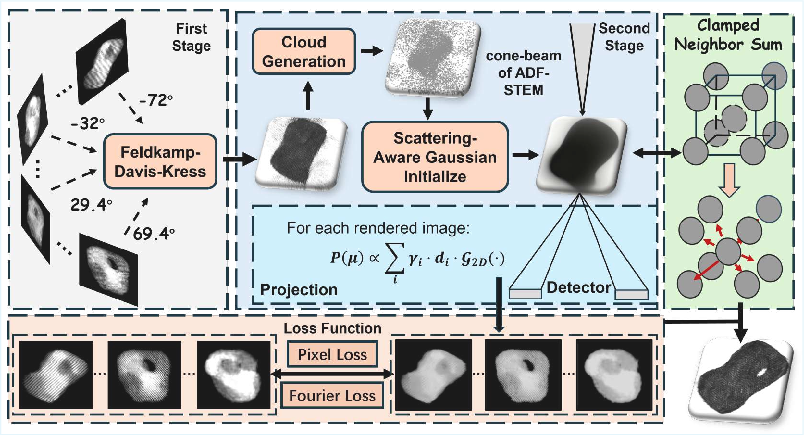
Figure 1: Pipeline of Denza-Gaussian. A physics-informed two-stage pipeline with FDK-based initialization and a view-consistent 3D Gaussian optimization tailored for ADF-STEM tomography.
Composite Loss and Regularization
ADF-STEM’s principal challenge under sparse-view regimes is information loss in the frequency domain due to insufficient angular sampling. The paper's architectural innovation is matched by a corresponding loss function combining complementary constraints:
- Pixel-wise L1 loss enforces fidelity in the spatial domain.
- A 2D Fourier amplitude loss specifically targets frequency-domain consistency, crucially addressing missing wedge artifacts.
- SSIM-based loss terms accentuate preservation of edge and contrast, capturing relative feature consistency.
- A 3D total variation regularizer promotes morphological smoothness without compromising atomic-resolution detail.
This multi-domain loss is evaluated between rendered projections (using the physically calibrated splatting pipeline) and experimentally acquired tilt images.
Experimental Evaluation
The experimental campaign leverages real 45-view and 15-view ADF-STEM tilt series of PtNi nanocatalysts, with the latter reflecting dose-limited, information-sparse scenarios typical in contemporary nanoscale materials characterization. DenZa-Gaussian is systematically compared to SIRT, FDK, GENFIRE, and classical 3DGS.
Sparse-View Projections and Artifact Suppression
Qualitative evaluation under 15-view settings Figure 2 highlights the pronounced artifact suppression and edge preservation of DenZa-Gaussian, even with aggressively limited angular sampling; competing methods (notably FDK and SIRT) exhibit distinct missing wedge and smearing artifacts, while classical 3DGS fails entirely to reconstruct meaningful content.
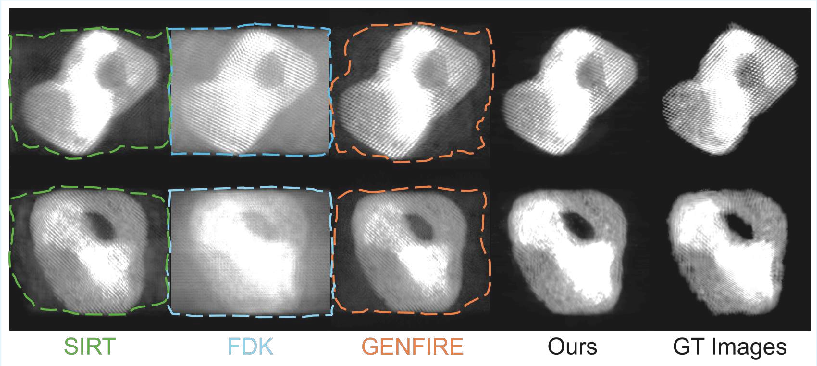
Figure 2: 15-view reconstruction comparison: DenZa-Gaussian delivers artifact-free projections versus severe distortions in traditional baselines.
High-Fidelity Volumetric Reconstruction
For well-conditioned 45-view reconstructions, DenZa-Gaussian demonstrates strong fidelity and structure recovery, maintaining physical consistency and outperforming previous iterative and neural approaches. Specifically, in 3D volume and edge detail analysis Figure 3, DenZa-Gaussian uniquely reconstructs distinct atomic centers as clear bright spots, in contrast with the blurred, non-specific reconstructions yielded by the best non-neural baselines.
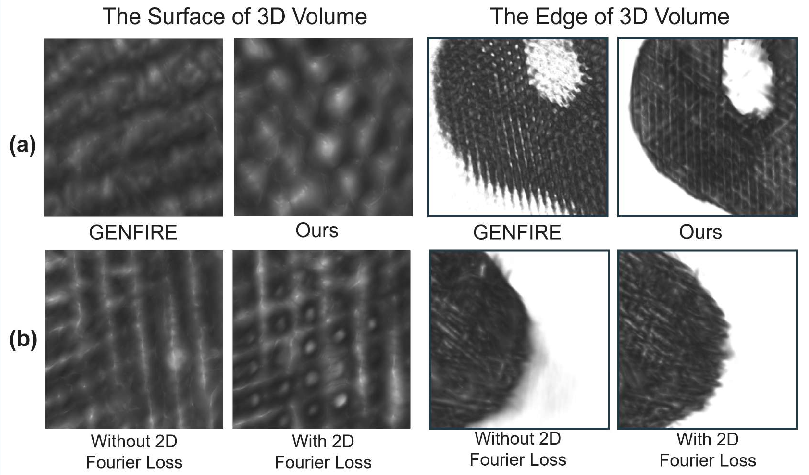
Figure 3: Comparison of 3D volume and edge reconstructions: DenZa-Gaussian preserves atomic details missing in baseline methods and ablation variants.
Ablation and Physical Validity
Ablation studies substantiate the necessity of the physically motivated modifications. Removal of the Scattering-View-Consistent coefficient (γ) or the 2D Fourier amplitude loss results in substantial numerical degradation and emergence of characteristic ADF-STEM artifacts. Furthermore, the consolidation of Density⋅Zα into a single denza parameter achieves high fidelity and physical plausibility, as alternative configurations (learning density and Z separately) deviate from true physical values without practical gain.
Resolution Sensitivity and Practical Insights
Robustness to input resolution is evaluated in Figure 4. Downsampling ground truth projections entails irreversible loss of high-frequency detail, which cannot be recovered in the final volumetric reconstruction, indicating that the method’s fidelity is fundamentally tied to the information content of the measured tilt series. This finding underscores the necessity of maintaining acquisition quality even under minimized dose constraints.
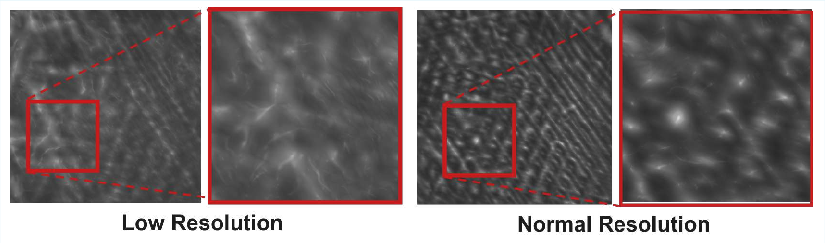
Figure 4: Input image resolution directly governs detail preservation in reconstructed 3D volumes; downsampling eliminates atomic-scale features.
Implications and Future Directions
The DenZa-Gaussian approach directly addresses the physical-modeling deficiencies of neural and analytical methods for sparse-view ADF-STEM. It delivers high-fidelity, physically faithful 3D reconstructions with significant improvements in PSNR (up to 33.02 for 45-view and 31.73 for 15-view, exceeding all baselines) and SSIM, and is robust to both moderate and severe undersampling. The methodology can generalize to other scattering-driven tomographic modalities, and the explicit connection between the learnable denza field and material parameters provides a platform for interpretable machine learning in materials science.
Potential directions for theoretical and practical expansion include explicit multi-modal constraints (to reliably disentangle density and atomic number), joint high-frequency enhancement pipelines, and the extension of scattering-informed Gaussian splatting to in-situ or dose-fractionated experiments. For AI and inverse problems, this work exemplifies the benefits of model-based deep learning, where physics-informed inductive biases directly enhance robustness, interpretability, and data efficiency.
Conclusion
DenZa-Gaussian redefines the application of neural volumetric representations to electron tomography by explicitly embedding ADF-STEM imaging physics into the 3DGS framework and devising a composite loss that mitigates adverse effects of sparse projection sampling. The superior numerical results, artifact suppression, and resolution of atomic-scale details substantiate DenZa-Gaussian as a robust platform for 3D nanoscale characterization under practical constraints, enabling advanced analysis of dose-sensitive materials in the physical sciences.