- The paper presents a GPU-optimized CT reconstruction method using adaptive 3D Gaussian kernels to accelerate convergence and reduce computation time.
- The paper introduces novel initialization strategies and efficient rasterization techniques that yield up to 13x speedup over previous approaches.
- The paper delivers a compact, high-fidelity representation that outperforms both algebraic and neural paradigms in key benchmarks.
FaCT-GS: Fast and Scalable CT Reconstruction with Gaussian Splatting
Introduction
FaCT-GS presents a high-throughput, scalable methodology for X-ray CT reconstruction utilizing Gaussian Splatting (GS) as its core volumetric model. This framework undertakes a critical overhaul of the GS pipeline to address historic bottlenecks in computational efficiency as well as initialization and scalability limitations inherent in previous GS-based CT approaches—most notably, R2-Gaussian ("R2-Gaussian: Rectifying Radiative Gaussian Splatting for Tomographic Reconstruction" [zha2024r]). The authors assert that with this regime, GS-based reconstruction not only matches, but decisively exceeds, both algebraic and neural paradigms in performance, particularly as data dimensionality increases.
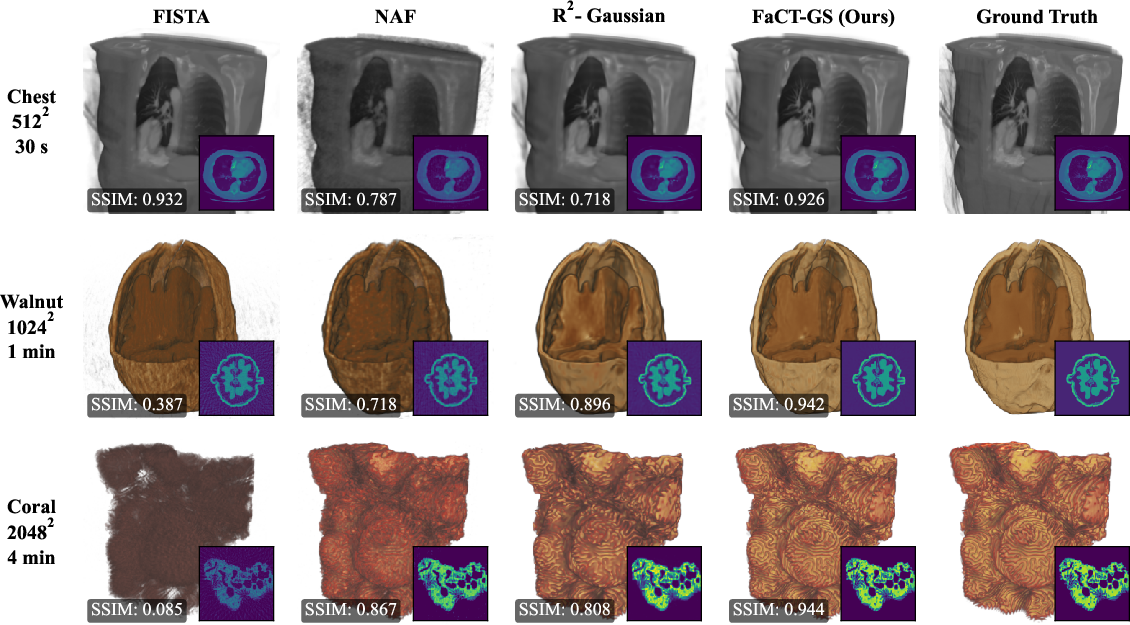
Figure 1: Reconstruction results of select baselines and FaCT-GS given a fixed time for a certain problem size. FaCT-GS provides superior CT reconstruction capabilities and scales exceptionally well with increasing projection size.
Methodological Contributions
FaCT-GS models the attenuation field as an adaptive sum of 3D Gaussian kernels with learnable density, position, and covariance parameters. The pipeline is architected for acceleration at all critical stages—rasterization, voxelization, and loss computation—via dedicated GPU kernels and data structure optimizations. Noteworthy distinctions from prior art include:
- Novel Initialization Strategies: Two approaches are introduced—a gradient-magnitude sampling of the FDK reconstruction yielding expedited coverage of high-frequency anatomical features, and a rapid fit from pre-existing volumetric priors, directly embedding domain knowledge or repetitive scan information into the model.
- Optimized Rasterization/Voxelization: Axis-aligned, density-weighted bounding boxes are deployed to minimize spurious computation, and write conflict mitigation is achieved through a per-Gaussian backward pass, resulting in substantial acceleration over R2-Gaussian and classic algebraic analogs.
- Loss Fusion: Custom CUDA implementations for SSIM and Total Variation are fused, reducing kernel invocation overhead and memory traffic, particularly for 3D volumes—a major improvement over typical PyTorch- or framework-based losses.
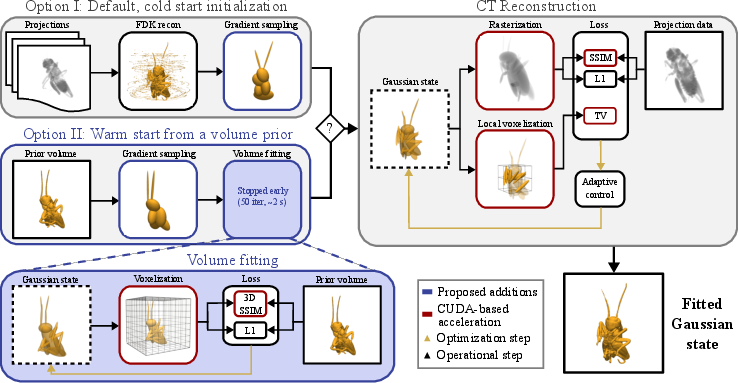
Figure 2: FaCT-GS optimization pipeline, illustrating new initialization schemes and accelerated core components (rasterization, voxelization, loss functions).
Experimental Results
Quantitative assessment is performed on the standardized R2-Gaussian dataset, alongside real projection data from the FIPS cohort and additional real and synthetic CT volumes. Three sparse-view scenarios are benchmarked (25, 50, 75 views) at resolutions up to 20482 projections and 10243 volumes. Comparisons involve both classical (FDK, SIRT, FISTA) and recent neural self-supervised pipelines, including NAF, IntraTomo, and, critically, R2-Gaussian.
Key findings:
- FaCT-GS yields over 4x speedup versus R2-Gaussian at standard resolutions, and this advantage grows to 13× at 20482 projections.
- At 400 iterations, FaCT-GS achieves the highest SSIM and second-highest PSNR among all methods; after 150 iterations (sub-20 run time), its fidelity surpasses every competitor.
- The method is the only self-supervised approach to outperform FISTA in both runtime and image quality, a milestone previously unmet by neural models.
- Scalability analysis reveals FaCT-GS iteration time and convergence rate both outpace conventional approaches at high resolutions, highlighting fundamental algorithmic advantages in data-size scaling.
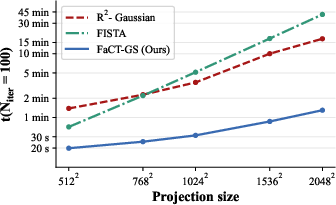
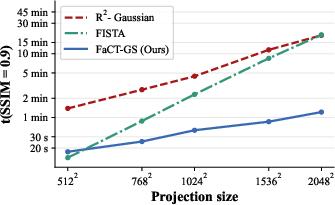
Figure 3: Time to reach 100 iterations for FISTA, R21-Gaussian, and FaCT-GS under increasing projection and volume size.
Initialization and Warm-Start Analysis
Two initialization routines are systematically benchmarked. Gradient-based FDK initialization exhibits marked improvements in edge and structure representation over classical intensity-based seeding. When a volumetric prior is available, rapid volume fitting achieves initialization SSIM on par with directly using the prior, replicating the effective warm-start behavior of algebraic methods.
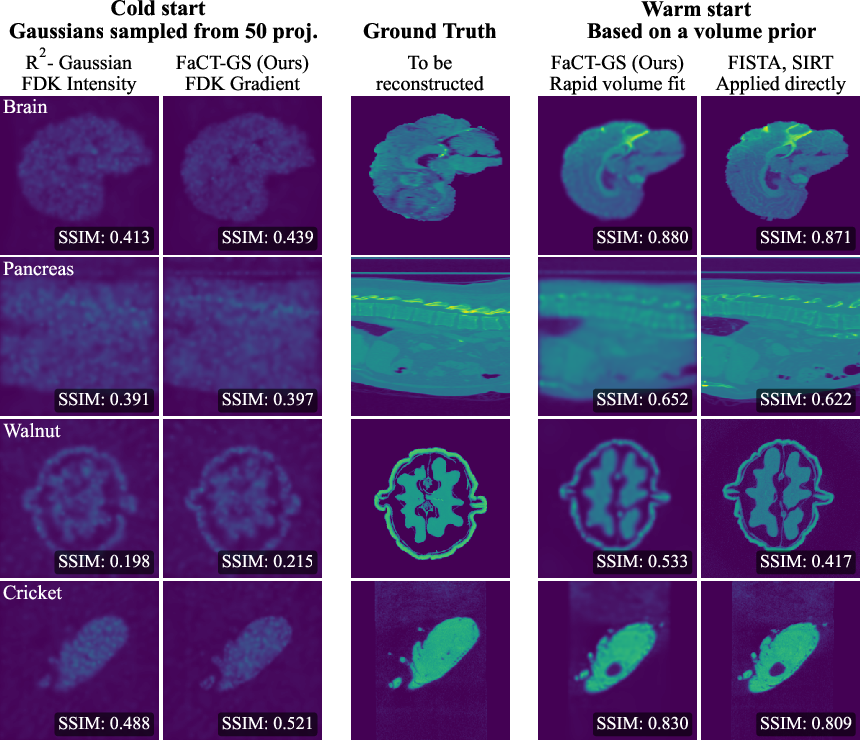
Figure 4: Comparison of reconstruction initialization strategies; gradient and prior-based methods enable substantially higher-fidelity starting states.
Supplementary experiments on the RPLHR-CT dataset demonstrate that warm-started FaCT-GS reconstructions consistently reach quality plateaus in under 2/3 the iterations required by cold-start regimes, quantifying the practical convergence gains imparted by the prior-based initialization.
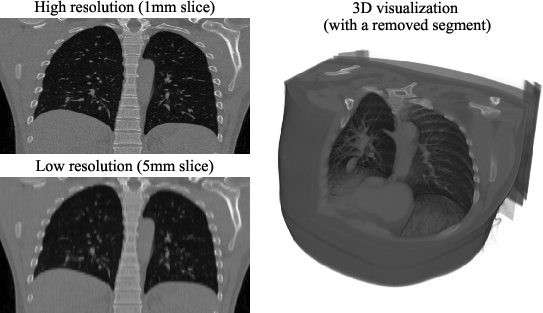
Figure 5: Example scan pair from the hyperresolution warm-start study, demonstrating the effective use of a low-resolution prior.
Volume Fitting and Compact Representation
FaCT-GS introduces a GPU-accelerated direct volume fitting pipeline, enabling compression of arbitrary 3D volumes as a GS state. Each 3D Gaussian is parameterized as an 11-value float16 vector (22 bytes/Gaussian), producing a succinct representation. Empirical analysis shows that the GS format achieves a compression ratio surpassing zipped uint8 and 2D JPEG stacks, with SSIM scores of 0.976—comparable to state-of-the-art, practical compression schemes—while continuing to offer direct differentiable access for downstream analysis.
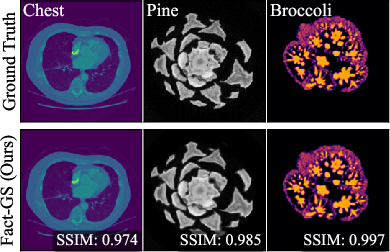
Figure 6: Qualitative examples and compression analysis of the fitted Gaussian representation; GS achieves high fidelity at sub-megabyte sizes.
Ablation: Gaussian Number Versus Data Complexity
The dependence of GS-based reconstruction quality on the Gaussian count is systematically profiled. Results indicate diminishing returns above 50,000–80,000 Gaussians for standard clinical-scale data; highly structured or noisy volumes require more splats, while smooth anatomical regions saturate at much lower counts.
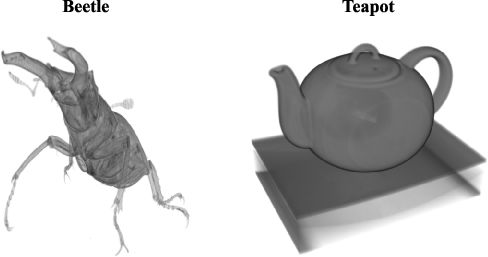
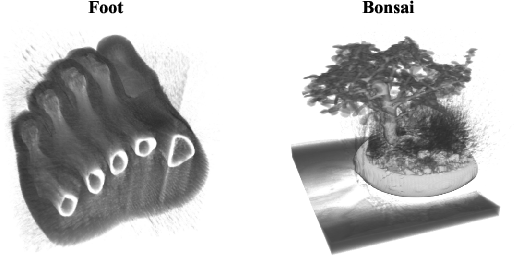
Figure 7: Beetle and Teapot require only 5,000 Gaussians, showcasing dependence on volume structural complexity.
Qualitative Results
Comprehensive volumetric slice comparisons across 25-, 50-, and 75-view settings underscore the superior consistency, edge-resolving power, and artifact suppression of FaCT-GS reconstructions relative to both algebraic and neural field-based alternatives.
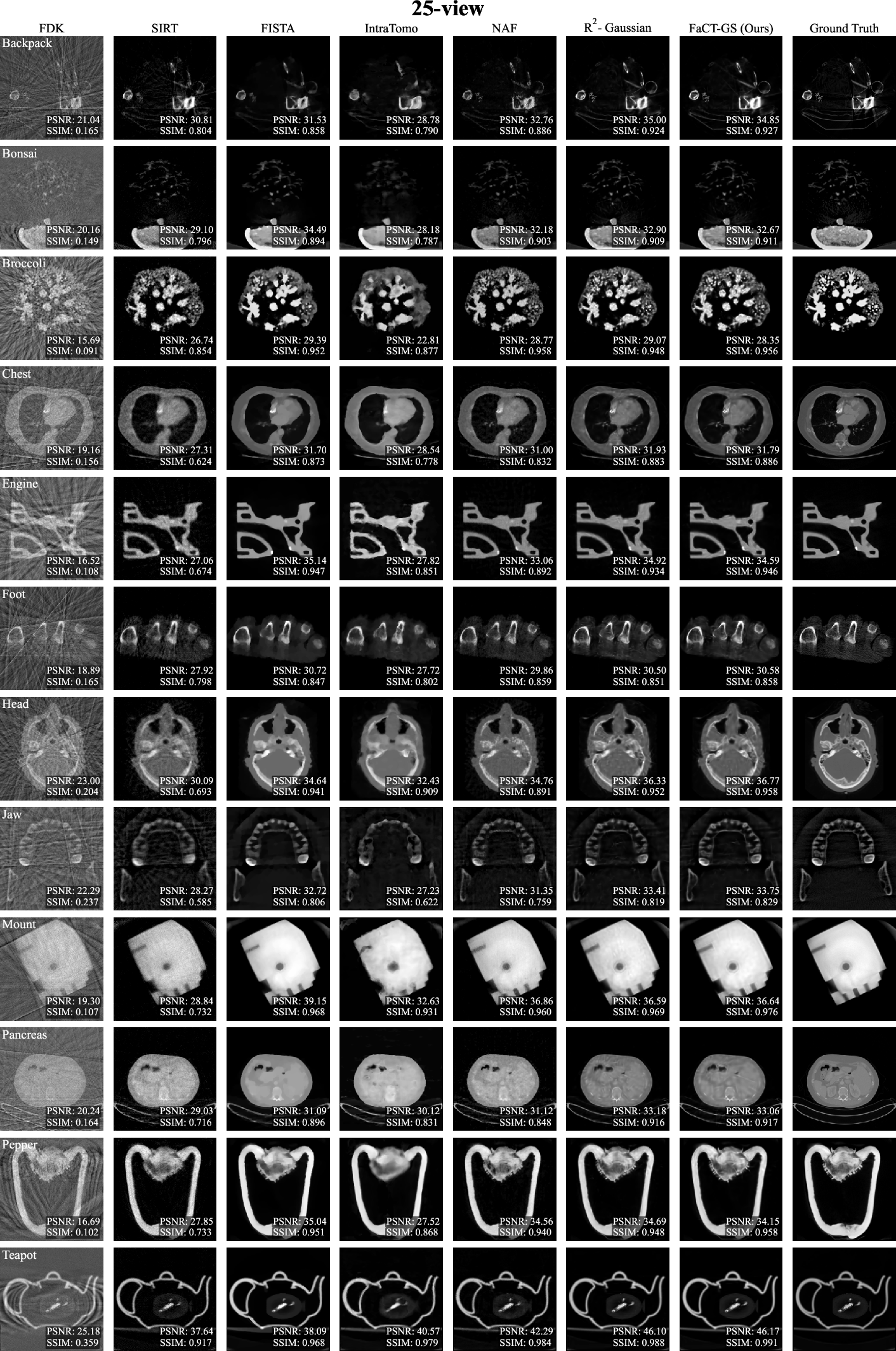
Figure 8: Qualitative comparison on challenging sparse-view scenarios; FaCT-GS maintains anatomical fidelity at extreme undersampling.
Implications and Future Directions
The architectural and implementation advances herein enable deployment of self-supervised, GS-based CT reconstruction at acquisition-relevant scales, shifting the paradigm for industrial, biomedical, and real-time imaging environments. The Gaussian prior embedding supports transfer learning, subject monitoring, or multi-resolution workflows in clinical or inspection pipelines. The compact GS representation potentially integrates reconstruction, storage, and downstream differentiable processing—streamlining the traditional post-reconstruction chain.
Theoretical avenues for future work comprise:
- Automated Gaussian Number Selection: While adaptive control mechanisms provide resilience, principled selection or prediction of required Gaussians remains elusive.
- Direct Downstream Operation on GS States: The integration of segmentation, registration, or analysis directly atop Gaussian representations, bypassing voxelization, is viable and increasingly supported.
- Application in Time-Resolved and 4D Imaging: Extensions to dynamic or multi-phase acquisition leverage the scalability advantages fully.
Conclusion
FaCT-GS achieves decisive advances in the performance, initialization flexibility, and representation compactness of CT reconstruction pipelines. The method's integration of algorithmic insight and systems-level optimization marks a practical inflection point, facilitating the deployment of GS-based volumetric reconstruction far beyond the reach of prior Gaussian or neural field models. Both its foundational improvements and empirical supremacy across a spectrum of clinical and synthetic benchmarks validate FaCT-GS as a reference implementation for the next phase of industrial and biomedical CT imaging.
(2604.01844)