- The paper introduces E-MVL, leveraging controlled sparsification as an alternative to temperature-based simulated annealing for efficient global search in Ising spin glass problems.
- It establishes an exponential-to-linear mapping between the sparsity parameter and effective temperature, ensuring robust performance across both bimodal and Gaussian coupling distributions.
- Benchmarking results show that E-MVL outperforms traditional SA, achieving hardware-level efficiency with a 6x FPGA speedup and exact solution scaling up to N=1600.
Quantum-Inspired Ising Machine via Sparsified Spin Connectivity: An Expert Analysis
Introduction and Context
This work presents a comprehensive study of extraction-type majority voting logic (E-MVL) as a quantum-inspired algorithmic framework for combinatorial optimization, focusing on Ising spin glass problems, particularly the Sherrington–Kirkpatrick (SK) model with both bimodal and Gaussian couplings. E-MVL leverages sparsification of spin interactions as a controlled analog to temperature in simulated annealing (SA), offering both algorithmic and hardware-level efficiencies. The study encompasses rigorous equilibrium analysis, systematic parameter optimization, detailed benchmarking against SA implementations, and hardware deployment using FPGAs, positioning E-MVL as a scalable, distribution-independent, and hardware-friendly alternative for solving large-scale NP-hard problems.
Mechanism of E-MVL and Sparsification
E-MVL fundamentally replaces the thermal fluctuation-driven energy landscape navigation, characteristic of SA, with a sparsity-driven paradigm. At each iteration t, the proportion Ps(t) of spin-spin interactions is temporarily disconnected, so only a randomly selected subset ("extracted spins") participates in the spin update. This controlled sparsification, depicted schematically for a 4-spin Ising model, underlies the local-minimum escape mechanism and enables efficient convergence to ground states.
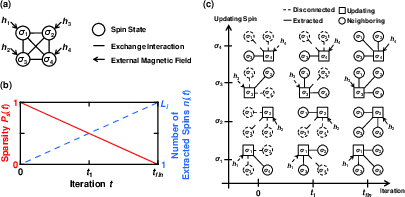
Figure 1: Ising model connectivity and the dynamic sparsification process of E-MVL, demonstrating the schedule-driven increase in the number of considered interactions for each spin.
Crucially, the temporal schedule for Ps(t) drives a gradual transition from a globally fluctuating regime (high sparsity, few interactions considered, enabling global search) to a deterministic, fully coupled regime (no sparsity, all interactions considered, enforcing convergence). This schedule—typically linear from high to low sparsity—is the principal meta-parameter, analogous to the temperature schedule in SA.
Statistical Mechanics and Equilibrium Properties
The authors systematically analyze the energy distributions of E-MVL under fixed and dynamic sparsity schedules, securing a statistical mechanics foundation for the approach. Maintaining constant Ps, E-MVL exhibits Boltzmann-like equilibrium energy distributions, analogous to thermalized systems in SA or MCMC sampling, across both SK-bimodal and SK-Gaussian instances. However, the temperature required to match the energy distributions in SA is highly problem- and size-dependent.
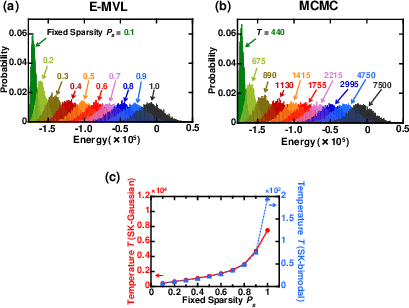
Figure 2: Equilibrium energy distributions for E-MVL and MCMC simulations in SK-Gaussian; mapping between E-MVL sparsity Ps and effective SA temperature T, evidencing exponential dependence and coupling distribution sensitivity.
The equilibrium analysis leads to several key conclusions:
- Sparsity-Temperature Mapping: The relationship between Ps and T is approximately exponential for both coupling distributions at high sparsity, becoming linear for Ps≤0.6. Thus, a linear sparsity schedule in E-MVL corresponds closely to an exponential or linear temperature schedule in SA, with the absolute scale of T varying widely by coupling (e.g., Ps(t)0–Ps(t)1 for SK-bimodal versus Ps(t)2–Ps(t)3 for SK-Gaussian).
- Scale and Distribution Invariance: Unlike SA, where Ps(t)4 must be retuned for each problem size and distribution, E-MVL's normalized energy performance as a function of Ps(t)5 is invariant to both, providing strong evidence of robustness and transferability.
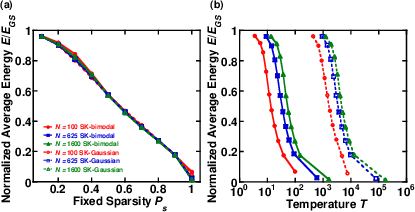
Figure 3: Normalized energy Ps(t)6 in equilibrium, plotted versus sparsity Ps(t)7 (E-MVL) and temperature Ps(t)8 (MCMC); curves overlap for E-MVL but separate by size and distribution for MCMC, showcasing invariance.
Comparative Benchmarking and Scheduling Implications
The authors directly benchmark E-MVL against a suite of SA baselines, including both conventional Metropolis-based SA and optimized SA with architecture-specific enhancements. Critically, two SA scheduling paradigms are compared:
- Conventional Schedule: Established in prior art, typically Ps(t)9 to Ps(t)0 for SK models.
- Sparsity-Mapped Schedule: Derived from the empirical Ps(t)1-Ps(t)2 mapping, specific to coupling distribution and problem size.
The results unambiguously show that conventional SA schedules lead to premature convergence and failure on large SK-Gaussian instances (freezing prior to meaningful exploration), while the sparsity-mapped schedule—suggested by E-MVL analysis—eliminates this pathology, enabling successful optimization up to the limits tested.
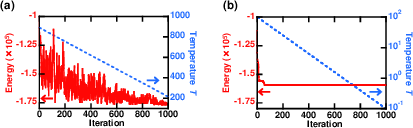
Figure 4: SA energy trajectories for SK-Gaussian with sparsity-mapped (a) and conventional (b) temperature schedules; only the former maintains energy descent throughout the optimization.
To isolate algorithmic power from implementation details, the authors use the step-to-target (STT, 99% ground-state energy with 99% probability) and step-to-solution (STS, exact ground state) complexity metrics.
- Approximate Solutions: E-MVL outperforms all SA baselines across SK-bimodal and SK-Gaussian, especially as Ps(t)3 increases. For SK-Gaussian, only the sparsity-mapped SA schedule attains competitive STT, while conventional SA essentially fails for Ps(t)4.
- Exact Solutions: The algorithmic superiority of E-MVL is more pronounced: it consistently solves SK instances up to Ps(t)5 where the best SA baseline (sparsity-mapped schedule) is limited to Ps(t)6.
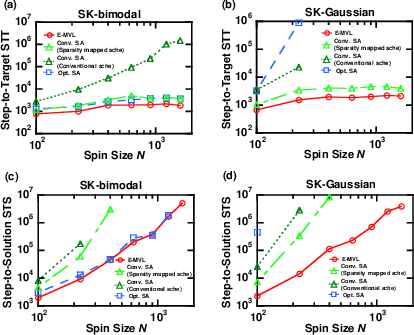
Figure 5: Comparative analysis of computational steps for achieving approximate (STT, a,b) and exact (STS, c,d) solutions; E-MVL demonstrates size- and distribution-independent scaling and superior feasible problem sizes.
Implications, Theoretical and Practical Significance, and Future Prospects
This investigation establishes several robust claims:
- Distribution- and Size-Invariant Performance: E-MVL's complexity and schedule are universal across tested distributions and scales within SK models; SA requires significant retuning and still underperforms, especially for SK-Gaussian.
- Algorithmic Superiority for Exact Solutions: The sparsification mechanism yields both enhanced local minima escape and robust final convergence, manifesting in larger feasible problem sizes for exact solution acquisition, a regime where traditional SA fails to scale.
- Principled SA Schedule Calibration: The equilibrium analysis of E-MVL provides a methodology for deriving effective SA temperature schedules for arbitrary coupling distributions, offering general utility beyond E-MVL.
- Hardware Efficiency: The circuit realization of E-MVL, which eschews floating-point arithmetic in favor of integer logic and addition, yields a 6x runtime speedup over SA in FPGA implementations, with anticipated greater gains on ASIC platforms.
The demonstrated scale- and distribution-invariance argues for broad applicability to complex, fully connected combinatorial optimization instances. The adaptability of the sparsification paradigm may further benefit hybrid metaheuristics, annealing variants, or specialized hardware Ising machines—aligning with the growing interest in quantum- and neuromorphic-inspired approaches (2604.04606).
Conclusion
E-MVL, as rigorously studied in this work, delivers key advances in algorithmic design for Ising-type combinatorial optimization. Its mechanism—grounded in controlled, schedule-driven sparsification—enables robust, scalable, and hardware-efficient navigation of complex spin glass landscapes, transcending the limitations of SA and similar heuristics. The analytic framework developed around the sparsity parameter furnishes not only improved performance but also methodological guidance for the tuning of other metaheuristics. The empirical success in both approximate and exact optimization regimes, alongside efficient hardware deployment, positions E-MVL as a leading candidate for next-generation combinatorial optimization systems and suggests fruitful avenues for hybridization and further hardware-accelerated innovations.