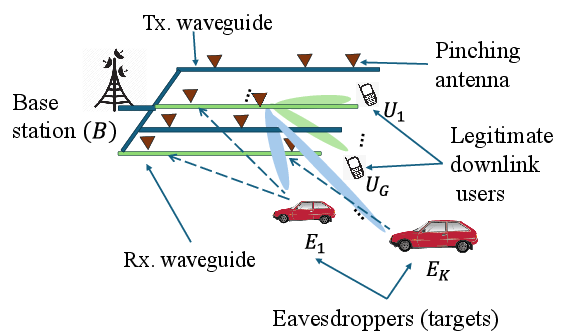
- The paper demonstrates PASS's ability to transform wireless channels through reconfigurable, spatially-deployed pinching antennas, yielding significant coverage and rate improvements.
- The methodology leverages dielectric waveguides and optimized beamforming to mitigate free-space path loss and enable fine-grained spatial control.
- The survey highlights PASS’s potential for secure communications, integrated sensing, and efficient federated learning in evolving 6G networks.
Pinching Antenna Systems (PASS): A Comprehensive System Paradigm for Reconfigurable and Controllable Wireless Channels
Introduction and Motivation
Pinching Antenna Systems (PASS) have emerged as a key avenue to revisiting wireless channel paradigms, driving the transformation from inherently stochastic and uncontrolled wireless propagation to a regime where electromagnetic channels are rendered reconfigurable, tunable, and adaptable. With the proliferation of data- and sensing-centric 6G applications, and in the context of exacerbated spectrum scarcity, there is an inherent limitation in traditional multi-antenna schemes, including MIMO and their derivatives, which are fundamentally constrained by array geometry and medium randomness. Recently, the paradigm of channel reconfigurability—encompassing technologies such as reconfigurable intelligent surfaces (RIS) and movable antennas (MAs)—has gained prominence. Nevertheless, both techniques suffer from physical and deployment limitations when faced with non-line-of-sight (NLoS) challenges and path loss constraints.
PASS addresses these limitations by leveraging dielectric waveguides with customizable, spatially-deployable radiating elements—pinching antennas (PAs). By extending RF chains over physical spaces (tens of meters) and allowing flexible PA deployment, PASS enables the formation of virtual LoS links, circumvents severe FSPL, enhances area coverage, and introduces fine-grained spatial control for communication, sensing, and secure transmission.
Principles, Architectures, and Propagation Models
Electromagnetic Foundation
A typical PASS architecture is formed by a central BS equipped with RF chains and processing resources, a set of low-loss dielectric (or alternative) waveguides, and PAs attached at strategic positions. The waveguide, constructed with a high-refractivity-index dielectric core and lower-index cladding, enables confined propagation. Controlled and intentional energy radiation occurs at the PA, forming a leaky waveguide system (Figure 1, Figure 2).
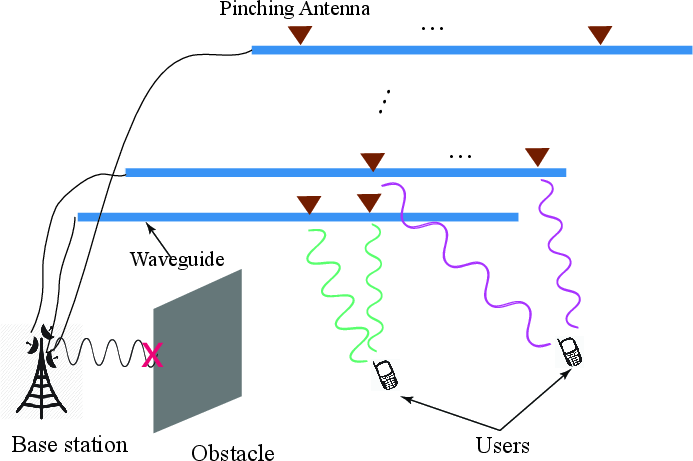
Figure 1: Schematic of a multi-waveguide, multi-PA PASS configuration depicting spatial flexibility and multi-point radiation.
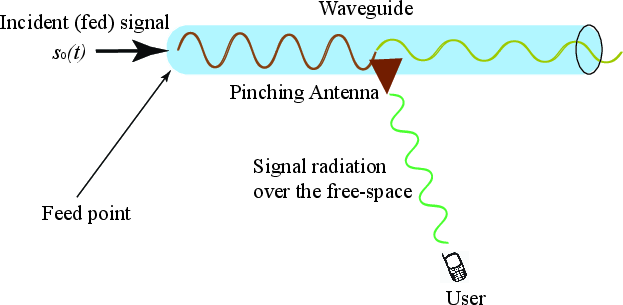
Figure 2: Signal path separation inside the dielectric medium and subsequent free-space emission from the PA.
PASS enables decomposition of the propagation channel into (i) guided wave propagation with power and phase evolution governed by material and geometric properties; and (ii) standard free-space wireless propagation, subject to spatial fading and additive noise. Models for in-guide loss, proportional/equal power radiation, orientation, and placement-dependent path gain are central in achieving analytically and physically accurate channel characterizations.
Alternative Architectures
Canonical implementations utilize dielectric waveguides, but further architectures include segmented waveguides (SWAN) for localized feed-points and loss mitigation (Figure 3), leaky coaxial cable strategies with electronic segment switching, and center-fed or wireless-fed paradigms for enhanced flexibility (Figure 4).
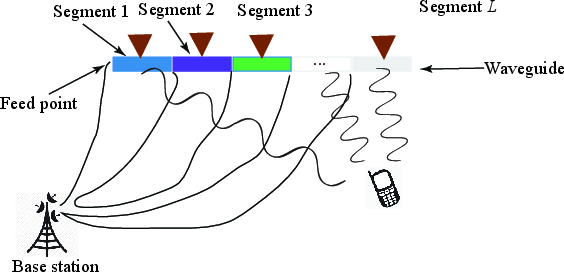
Figure 3: Segmented Waveguide Pinching Antenna System (SWAN) illustrating multiple independently-fed segments.
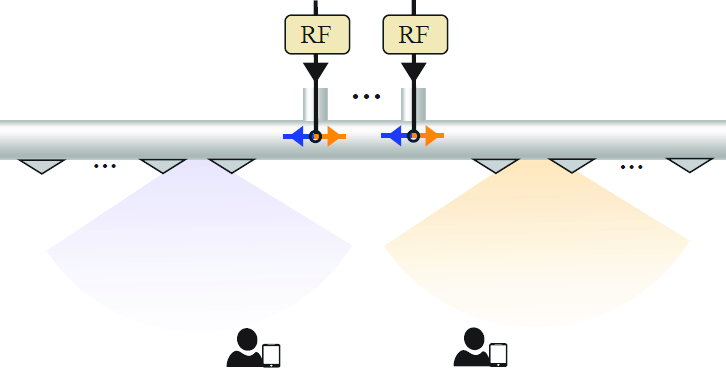
Figure 4: Center-Fed PASS (C-PASS) enabling mid-waveguide injection, bidirectional splitting, and increased DoF in resource allocation.
Additionally, metallic tube-based guided structures enabling discrete PA deployments form a physical layer compatible with massive MIMO radio stripe concepts.
Communication and Coverage Optimization
Research demonstrates PASS yields superior coverage and ergodic rate performance over traditional arrays and RIS in NLoS and high-loss regimes, leveraging flexible PA positioning to minimize FSPL, create constructive aggregation, and enable effective spatial resource multiplexing. Formal analysis shows:
- Multi-user, multi-waveguide architectures, with regularized zero-forcing and alternating optimization, yield significant sum rate improvements via spatial tuning and fine-grained user-targeted beamforming (2604.04521).
- Learning-aided schemes (GNNs, DL, meta-learning) facilitate globally-coherent and low-complexity optimization even in highly non-convex PA deployment settings (2604.04521).
- Directional models further refine achievable regions under physical constraints, and probabilistic blockage analysis highlights intrinsic PASS robustness to shadowing.
Empirical findings show substantial rate and outage benefits, with PASS maintaining channel reliability even under acute LoS obstacles.
Power, Energy Efficiency, and Deployment Tradeoffs
PASS uniquely enables granular trade-off navigation between spectral efficiency (SE), energy efficiency (EE), and deployment cost. Results indicate:
- Distributed (multi-waveguide) deployments yield multiplexing and SE gains at the cost of increased RF chain energy and complexity; centralized deployments optimize EE but reduce parallelism.
- Inclusion of PA movement energy—neglected in classical designs—profoundly impacts realistic network-wide energy profiles.
- Hybrid static/dynamic deployment modes (with activation selection and movement restrictions) afford diverse operating points, balancing cost, EE, response time, and hardware complexity.
PASS outperforms RIS in EE in mmWave regimes, with RIS requiring orders of magnitude more elements to reach matching performance levels. Analysis of loss mechanisms (e.g., waveguide attenuation) is central when scaling to higher frequency bands and wide-area deployments.
Secure and Covert Communication
PASS exhibits strong potential in physical-layer security, leveraging spatial flexibility to boost legitimate channels and degrade eavesdropper channels:
- Analytical expressions for secrecy outage probability and closed-form or iterative placement and beamforming algorithms are established.
- Beamforming with PA selection or dedicated artificial noise injection architectures can sharply improve secrecy and enable covertness, especially under uncertainty about warden/adversary locations.
- Adaptive learning-based solutions (meta-learning, DRL) are effective for highly dynamic settings and large variable spaces.
- PASS deployment enables localization of service and targeted protection, countering sophisticated eavesdropper strategies.
- Integrated ISAC (sensing-assisted eavesdropper localization) further enhances the security-performance frontier.
Multiple Access and ISAC Applications
PASS provides a powerful substrate for advanced multiple access:
Multi-waveguide architectures, dynamic activation, and reinforcement learning allow serving moving platforms (e.g. UAVs), multiple users, and multiple targets with adaptive, power-optimal resource allocation.
Cutting-Edge Directions: Federated Learning and Beyond
PASS is directly applicable to distributed AI (notably federated learning):
- Enhanced reliability for straggler nodes via targeted PA positioning boosts overall system convergence and reduces wall-clock time for model accuracy.
- Hybrid clustering strategies and DRL-guided resource allocation enable flexible client assignment and robust adaptation to time-varying conditions.
PASS is thus poised to substantially benefit over-the-air computation, straggler mitigation, and provide reliable links for edge intelligence.
Implementation Challenges and Research Frontiers
Several critical open problems remain:
- Integration with RIS/hybrid architectures: Bridging PASS and RIS for joint coverage and energy optimization, including scenario-specific activation and switching schemes.
- Attenuation at higher frequencies: Robust material and propagation engineering for mmWave/sub-THz/optical bands is required to counter increased waveguide loss.
- Real-time PA actuation: Mechanisms for millisecond-scale PA movement and activation, under strict power and cost budgets.
- CSI acquisition: Efficient pilot and estimation designs are needed, given high channel matrix dimensionality, rank-deficiency, and time-varying deployment.
- Network integration and standardization: Harmonizing PASS with legacy collocated array systems, developing unified pilot structures, and defining resource management for hybrid networks.
Future networks will benefit from dynamic, scenario-specific interplay between collocated, PASS-based, and RIS-assisted infrastructures.
Conclusion
PASS fundamentally expands the wireless system design space by transforming the channel from an uncontrollable block to a finely reconfigurable entity, enabled by strategic deployment of spatially-flexible radiating points. Across communications, sensing, security, and edge intelligence, PASS offers strong practical and theoretical gains in coverage, reliability, efficiency, and robustness. System-level adoption must contend with implementation complexity, hardware constraints, and cross-layer design. With integration into hybrid and cognitive networks, and further investigation into high-frequency regimes, PASS remains a focal research direction for 6G and beyond.