- The paper introduces a multi-stage GNN framework that optimizes PA positions, RIS phase shifts, and beamforming vectors to maximize sum rate and energy efficiency.
- It compares three optimization strategies—fully learning-based, hybrid with SCA, and model-based hybrid—to balance real-time performance with optimal transmission design.
- Simulation results demonstrate significant performance gains influenced by parameters like PA count, waveguide length, and RIS element density.
Introduction
The paper "RIS-Assisted Downlink Pinching-Antenna Systems: GNN-Enabled Optimization Approaches" (2511.20305) focuses on the integration of reconfigurable intelligent surfaces (RIS) with pinching-antenna systems (PASS) to enhance wireless communication networks. The study addresses the challenges and opportunities of integrating RIS and PASS technologies to achieve both Sum Rate (SR) and Energy Efficiency (EE) maximization, using a graph neural network (GNN) approach. This model proposes a novel multi-stage GNN framework to optimize critical transmission design parameters such as PA positions, RIS phase shifts, and beamforming vectors.
System Model and Problem Definition
In the considered setup, the system incorporates RIS and PASS technologies to facilitate multi-user downlink communication. The RIS comprises passive reflecting elements that adjust phase shifts to optimize signal pathways, while PASS leverages spatial maneuverability of antennas to reduce path loss—particularly beneficial in 6G wireless networks requiring high data rates and efficiency.
The paper formulates two key optimization problems: maximizing SR and EE, constrained by antenna positioning, power budgets, and phase shifts. The complexity of such tasks arises from the interconnected multi-parameter decision framework entailed, where traditional optimization methods may inadequately leverage potential gains due to scalability issues.
Methodology: Three-Stage GNN Optimization
Overview
The proposed GNN architecture comprises three distinct stages:
- PAGNN (PA positions): This stage configures PA positions based on user locations.
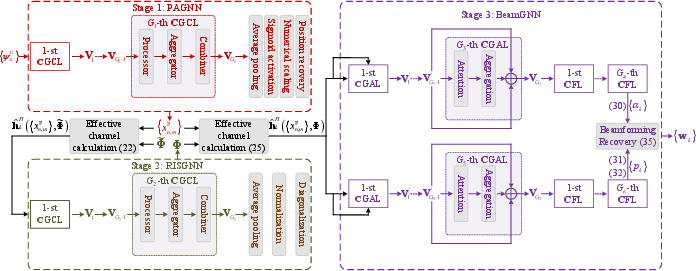
Figure 1: The structure of the proposed three-stage GNN maps the given user locations {ψkU} to a complete solution {xn,mP,Φ,wk} through three sequential stages.
- RISGNN (RIS phase shifts): This stage optimizes RIS phase shifts using composite channel conditions.
- BeamGNN (Beamforming vectors): It determines optimal beamforming vectors through unsupervised learning, leveraging customized activation functions and constraint-satisfaction mechanisms.
Implementation Strategies
The research adopts three strategies integrating learning and conventional optimization:
- Strategy I (Fully learning-based): This uses the complete three-stage GNN for rapid inference, ideal for real-time application but might fall short on absolute optimality.
- Strategy II (Hybrid with SCA): Uses GNN for PA and RIS configuration, followed by an SCA-based algorithm for beamforming optimization, balancing speed and accuracy.
- Strategy III (Model-based hybrid approach): Incorporates fixed initial beamforming via closed-form expressions combined with learning-based PA and RIS adjustments, optimizing computational efficiency.
Numerical Evaluation and Impact Analysis
Extensive simulations demonstrate the proposed approach offering significant SR and EE enhancements relative to conventional systems utilizing fixed PA or systems without RIS augmentation. Specific analyses illustrate the sensitivity of configural parameters—such as waveguide count, PA count, and waveguide length—on system performance.
Key Findings
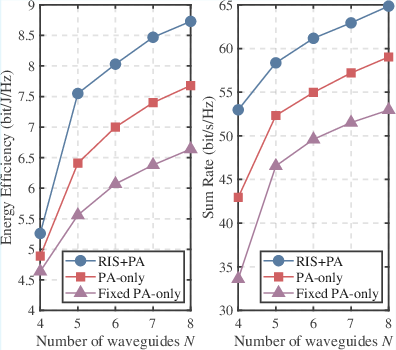
Figure 2: Impact of number of waveguides on EE and SR, with L=32, M=8, and K=4.
- Waveguide and PA Count: Growing the number boosts spatial maneuverability and precision in channel utilization, amplifying multi-user communication efficiency.
- Waveguide Length: Larger deployment regions pose greater path losses, growing the strategic importance of RIS in maintaining efficiency.
- Reflecting Element Count: Sufficient RIS elements foster optimal environmental adaptive reconfiguration, enhancing system performance but yields diminishing returns beyond a specific threshold.
Conclusion
The paper paves the way for unlocking RIS and PASS integration potentials, presenting a robust GNN-driven optimization toolkit that concurrently manages extensive decision variables for downlink transmission design. Incorporating RIS and deploying movable antennas offers exploitable advantages in signal management and spatial resource allocation, promising considerable strides in advancing 6G network capabilities. As wireless environments evolve, Adaptable GNN frameworks like this one will likely become pivotal in scaling the intelligent management of future communication systems.