- The paper establishes sharp statistical thresholds for partial and exact recovery in attributed network alignment by jointly analyzing edge (ρ) and feature (r) correlations.
- The paper introduces QPAlign, a convex quadratic programming relaxation solved via projected gradient descent, with theoretical convergence and strong empirical performance.
- The paper demonstrates that combining topology and attribute information significantly improves alignment accuracy, outperforming methods that rely on a single data type.
Attributed Network Alignment: Statistical Limits and Efficient Algorithm
This paper addresses the network alignment problem in the regime where both edge weights and node features are available and correlated between two graphs. Realistic scenarios within domains such as bioinformatics, social networks, and scholarly databases present both edge and feature information, motivating the introduction of the featured correlated Gaussian Wigner model (FCGWM). In this model, two weighted graphs are coupled under an unknown vertex permutation; both the edge weights and the associated feature vectors exhibit correlated Gaussian distributions controlled by parameters ρ (edge correlation) and r (feature correlation), with the vertex permutation inducing node-level correspondence.
The primary aim is to recover the ground-truth permutation π∗ given the two observed attributed graphs. The paper defines both partial and exact recovery criteria, and systematically investigates the minimal signal thresholds required for those objectives.
The core theoretical contributions precisely characterize the recoverability phase transitions in terms of n (number of vertices), d (feature dimensionality), and the correlations ρ,r. Two main theorems are proven:
- Partial Recovery: Exact phase transition is ensured when nlog(1/(1−ρ2))+2dlog(1/(1−r2))≳4logn with d=ω(logn). Below a lower threshold, all estimators fail with high probability.
- Exact Recovery: The threshold tightens to nlog(1/(1−ρ2))+dlog(1/(1−r2))≳4logn.
Theoretical analysis is conducted via direct analysis of the maximum likelihood estimator (MLE), exploiting likelihood cycle decomposition and precise application of concentration inequalities (notably the Hanson–Wright inequality for quadratic forms in Gaussian settings).
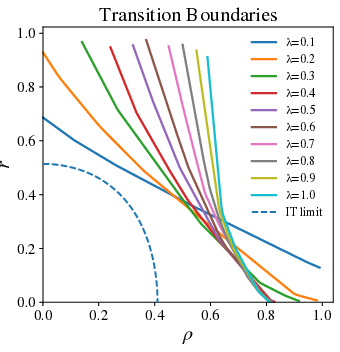
Figure 1: Phase-transition boundaries of QPAlign under different regularization parameters λ, together with the information-theoretic exact recovery limit.
Practically, these results delimit the parameter space: neither topology (r0) nor attributes (r1) alone is always sufficient, but their precise interplay can yield successful alignment in regimes previously unattainable without combined information. The results highlight a distinct gap between partial and exact recovery—feature information contributes less to partial recovery than to exact recovery at the threshold.
Algorithmic Approach: QPAlign
Given the infeasibility of brute-force MLE computation (r2-scale search), the paper proposes QPAlign, a convex quadratic programming (QP) relaxation. The alignment objective balances quadratic assignment over adjacency matrices (edge structure) and optimal assignment over attribute similarity (vertex features), weighted by a tunable parameter r3. The QP is solved efficiently via projected gradient descent over the Birkhoff polytope, using fast Sinkhorn normalization as a practical projection method and Hungarian rounding for extraction of permutation solutions.
The objective is: r4
where r5 are adjacency matrices, r6 is the feature-distance matrix, and r7 is a regularization hyperparameter encouraging extremality.
A rigorous convergence guarantee is provided for this algorithm: under mild conditions on r8 (preferably high-dimensional features), the projected gradient method delivers arbitrarily precise solutions in polynomial time (see Proposition 4.1 of the paper).
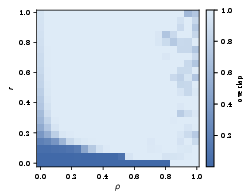
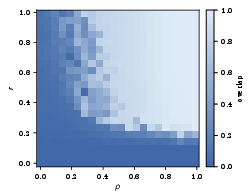
Figure 2: Gaussian Wigner model with r9 and π∗0; empirical exact recovery region as a function of edge (π∗1) and attribute (π∗2) correlations.
Experimental Results: Synthetic and Real-World Datasets
Extensive experiments are performed to validate both theoretical limits and algorithmic efficacy on:
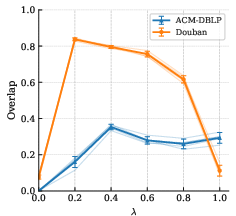
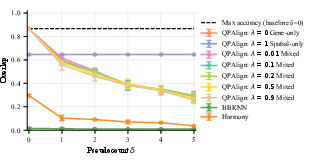
Beyond benchmarks such as FGW, REGAL, GW, or MAP, these results demonstrate that simply combining structure and features—without even elaborate model-based weighting—delivers a significant alignment boost, especially in high-noise or weak-signal settings.
Theoretical and Practical Implications
This work advances a unified framework for attributed network alignment in both theoretical and algorithmic senses:
Conclusion
This paper establishes precise statistical limits for attributed graph alignment under the FCGWM, demonstrating both information-theoretic and algorithmic advances. Feature and structure information are rigorously shown to act synergistically in yielding sharp recoverability thresholds, with QPAlign delivering efficient, practical recovery in regimes closely matching theoretical possibility. Directions for further research include extension to partial overlap, tight computational hardness bounds, and relaxing Gaussianity requirements.
Reference:
"Attributed Network Alignment: Statistical Limits and Efficient Algorithm" (2604.04365)