- The paper presents a unified framework linking EWC regularization with barrier crossing dynamics using Kramers escape theory.
- It employs Langevin dynamics and the Fokker–Planck formalism to validate adaptive temperature protocols that modulate plasticity.
- The analysis quantifies the exponential scaling of plasticity collapse in high dimensions and outlines actionable design constraints for continual learning systems.
Non-Equilibrium Stochastic Dynamics and the Kramers Escape Framework for Continual Learning
Overview
This paper presents a comprehensive non-equilibrium statistical physics approach to the stability–plasticity dilemma in continual learning. Specifically, it establishes a mapping between the elasticity regularization in elastic weight consolidation (EWC) and metastable barrier crossing governed by Kramers escape theory. It further delivers a unified Fokker–Planck formalism wherein both repetitive, incremental learning and insight-driven, rapid reorganization are interpreted as distinct noise (temperature) scheduling protocols. Numerical simulations validate the theoretical predictions, and the high-dimensional extension is connected to Fisher information geometry. These results prescribe design constraints for continual learning systems and indicate new directions for adaptive noise modulation in AI architectures.
Theoretical Framework: Langevin Dynamics and the Energy Landscape
The authors formulate the learner’s state by a scalar variable s(t) evolving under overdamped Langevin dynamics on a double-well energy landscape E(s)=(s2−1)2 with two minima, reminiscent of bistable knowledge configurations. The stochasticity in the update is modulated by an effective, potentially time-dependent, temperature T(t). The corresponding Fokker–Planck equation governs the probability density evolution.
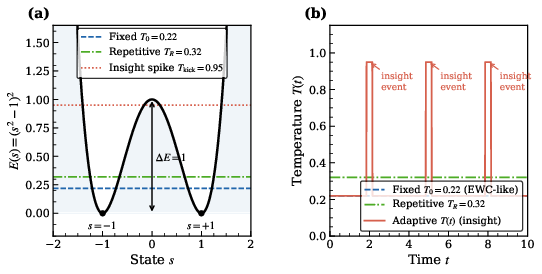
Figure 1: The schematic double-well energy landscape, indicating the barrier height and three temperature protocols—fixed (EWC-like), repetitive learning, and adaptive insight spikes.
Analytically, barrier crossing events—the transitions between knowledge states—are exponentially sensitive to the barrier height ΔE and temperature T, as described by the Kramers escape rate:
k=2πω0ωbexp(−ΔE/T)
where ω0 and ωb are the curvatures at the minima and the barrier top, respectively. Modulating the noise amplitude T(t) thus controls the system's plasticity.
Mapping EWC Regularization to Barrier Growth
A central contribution is the rigorous identification of the EWC regularization term as a growing effective energy barrier. As new tasks accumulate, each EWC Fisher penalty incrementally increases the barrier height confining the model parameters. Under broad conditions (i.i.d. Fisher increments, moderate nonconvexity), this leads to
ΔE(n)=ΔE0+2λF(n−1)
for the E(s)=(s2−1)20-th task. Substituting into the Kramers formula yields the exponential scaling law:
E(s)=(s2−1)21
Quantitative simulations with accumulating regularization corroborate this scaling, revealing rapid collapse of plasticity even under linear increases of the Fisher barrier.
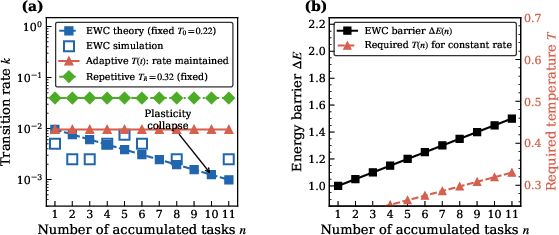
Figure 3: Exponential collapse of the Kramers transition rate with task number under accumulating EWC regularization; adaptive temperature protocol maintains a constant rate.
This analytic connection provides the first physically grounded derivation of plasticity loss in EWC-based continual learning, matching and explaining recent empirical observations on catastrophic forgetting (2604.04154).
Unified Fokker–Planck Picture: Distinction Between Insight and Repetition
Insight and gradual skill acquisition, canonically distinguished in cognitive science, are here unified as different regimes of the same stochastic process. Insight events correspond to brief, high-amplitude temperature spikes E(s)=(s2−1)22, allowing rapid barrier crossing; in contrast, repetitive training operates at a moderate, fixed elevation E(s)=(s2−1)23 above the baseline, relying on rare stochastic fluctuations for transitions.
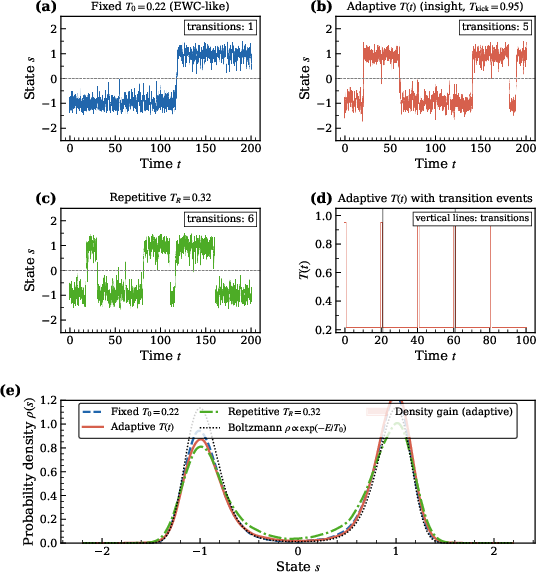
Figure 4: Sample system trajectories and steady-state densities: fixed temperature confers metastable stability, while adaptive insight-driven noise and repetitive protocols yield rapid reconfigurations or broad exploration, respectively.
Simulation results reveal qualitatively distinct statistics for these protocols: adaptive temperature spikes yield symmetric exploration of states (bimodal distributions), while repetitive learning shows broader but less symmetric densities.
Quantitative validation against the Kramers formula further demonstrates the exponential control of transition rates by temperature protocol, with measured rates matching theoretical predictions across regimes.
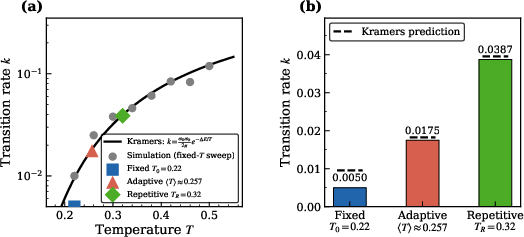
Figure 2: Simulated transition rates versus Kramers’ theoretical prediction across noise regimes, confirming Arrhenius scaling and validating the escape dynamics modeling.
High-Dimensional Extension: Fisher Geometry and Reaction Coordinates
The mechanism generalizes to high dimensions by projecting the parameter vector onto the minimum-action escape direction as determined by the spectrum of accumulated Fisher information. The effective barrier in the Kramers exponent is a weighted sum over the Fisher eigenvalues along the dominant escape direction:
E(s)=(s2−1)24
Plasticity collapse is thus governed by the joint geometry of the Fisher landscape and regularization direction. Directions aligned with soft modes suppress barrier growth, informing future continual learning architectures.
Design Implications and Future Directions
The framework yields a concrete, algorithmically actionable prescription: continual learning systems must adapt their effective temperature (noise/learning-rate scale) in proportion to the cumulative Fisher barrier to avoid kinetic arrest (plasticity collapse). This could be realized by adaptive gradient noise schedules, transient learning rate modulation, or neuromodulatory triggers based on internal signals such as prediction error or novelty.
From a neuroscientific perspective, this formalism provides a basis to mechanistically model selective plasticity—where plasticity is enabled only during relevant behavioral epochs—mirroring neuromodulatory processes.
The paper suggests several avenues for research: algorithmic realization of state-dependent temperature triggers, empirical tests of the exponential scaling law across standard benchmarks, and high-dimensional simulations linking practical optimizer dynamics to predicted kinetic regimes.
Conclusion
This work presents a physically rigorous theory connecting continual learning regularization and plasticity loss to non-equilibrium stochastic dynamics and Kramers escape. The collapse of plasticity in EWC-regularized models emerges as an inevitable kinetic phenomenon, analytically predictable via the scaling of the Fisher-induced barrier. The distinction between insight-based and repetitive learning is fully captured as distinct non-equilibrium noise protocols within a unified Fokker–Planck descriptive framework. These results offer actionable metrics for lifelong learning system design and highlight adaptive noise control as a universal lever for computational plasticity, with direct analogs in biological nervous systems. Future developments will focus on extending these results to realistic neural architectures, empirically validating the kinetic scaling, and integrating algorithmic triggers for selective, state-dependent plasticity.