- The paper introduces a taxonomy of context-binding vulnerabilities in stateful ZK proofs and demonstrates that in-proof binding effectively prevents cross-drop replay attacks.
- It presents a defense-in-depth architecture that reduces operational assumptions from 4–6 to 2, ensuring robust cryptographic commitment to application context.
- Experimental results show that in-proof binding adds negligible overhead while significantly strengthening security for location-based systems.
Context-Binding Gaps in Stateful Zero-Knowledge Proximity Proofs: A Systems Security Analysis
Problem Formulation and Context
Stateful geo-content systems, which underlie applications for location-anchored content sharing, frequently deploy zero-knowledge proximity proofs (ZKPs) as privacy-preserving means for users to demonstrate their presence within a spatial region. While ZKPs can ensure coordinate privacy and geometric soundness, they typically lack an explicit cryptographic commitment to the application's runtime semantics (the "context" — such as drop identity, policy version, epoch, and session state). This absence creates an attack surface wherein proofs valid for one application object (e.g., content drop) may be replayed for another with identical geometric parameters.
The paper categorizes the vulnerabilities emerging from this disconnect, formalizes adversarial models (notably, transcript adversaries who possess recorded proofs but cannot generate fresh witnesses), and analyzes both off-circuit (post hoc, application-layer) and in-proof (circuit-level) context binding strategies.
Defense-in-Depth Architecture and Security Modeling
A three-layer defense model is described:
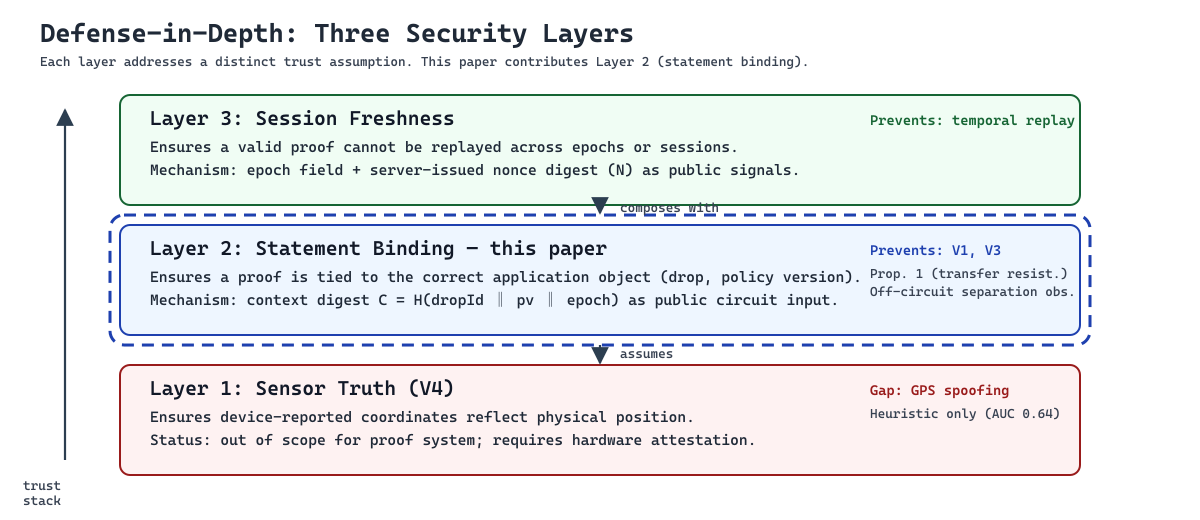
Figure 1: Three-layer defense-in-depth. This paper contributes Layer 2 (statement binding). Layer 1 (sensor truth) is out of scope; Layer 3 (session freshness) composes with Layer 2 via the epoch and nonce fields.
- Layer 1 (Sensor Trust): Concerns the trustworthiness of device-reported coordinates; outside ZKP scope.
- Layer 2 (Statement Binding): Proof commitment to the correct application context—addressed within this work.
- Layer 3 (Session Freshness): Ensures proofs are bound to a freshness window (epoch, nonce), preventing replay attacks.
The central analysis focuses on Layer 2, composing with Layer 3 while noting Layer 1's orthogonality.
Vulnerability Taxonomy
The paper introduces a detailed taxonomy:
- V1: Unbound statement (cross-drop replay): Proof transcripts can be replayed for any scene-matched drop.
- V3: Application-layer binding fragility: Off-circuit binding is bypassed by client compromise or implementation drift.
- V2 and V4: Supporting findings on underconstrained-circuit soundness and sensor-trust (GPS spoofing)—both peripheral but critical in deployed settings.
Adversary models encompass client-side code manipulation, server desynchronization, and GPS spoofing, but exclude physical compromise and global traffic analysis.
The paper formalizes off-circuit verification as a general structural model: the verifier checks proof validity and an auxiliary predicate, but unless context is embedded in the proof, equivalence of geometric parameters means old proofs remain valid for new contexts with matching geometry.
A controlled experimental matrix—crossing seven binding strategies against seven adversarial scenarios—demonstrates that only in-proof context binding (level (iii)), which binds application context, decisively closes cross-drop transfer (Scenario G) in dense deployments, while nonce-binding (level (ii)) and off-circuit checks remain vulnerable under epoch-derived nonces.
Table-driven and empirical analyses show strong findings:
- In-proof binding reduces the operational assumption set required for correctness from 4–6 (off-circuit) to 2 (cryptographic soundness + correct issuance).
- In-proof context binding does not incur measurable overhead relative to a sound geo-only baseline (≤0.12 ms median delta)—the performance cost comes from sound arithmetic, not context inclusion.
The Zairn-ZKP Primitive and Unlock Protocol
The authors instantiate their methodology as Zairn-ZKP, a Groth16-based circuit evaluated over BN128, with the following features:
- Public circuit signals include target location, unlock radius, cosine correction, context digest C (SHA-256 hash of drop id, policy version, epoch), nonce digest N, and epoch.
- Soundness-oriented design with bit decomposition, bounded comparisons, and domain-separated hashing ensure robust constraint enforcement over floating-point or fixed-precision values.
- Contextual binding’s effect: a proof for one (drop, epoch, nonce) tuple is cryptographically zero-knowledge with respect to another. Proof transcript indistinguishability is broken only in level (iii), as demonstrated by Lemma 1.
The proof flows within a realistic application unlock protocol:
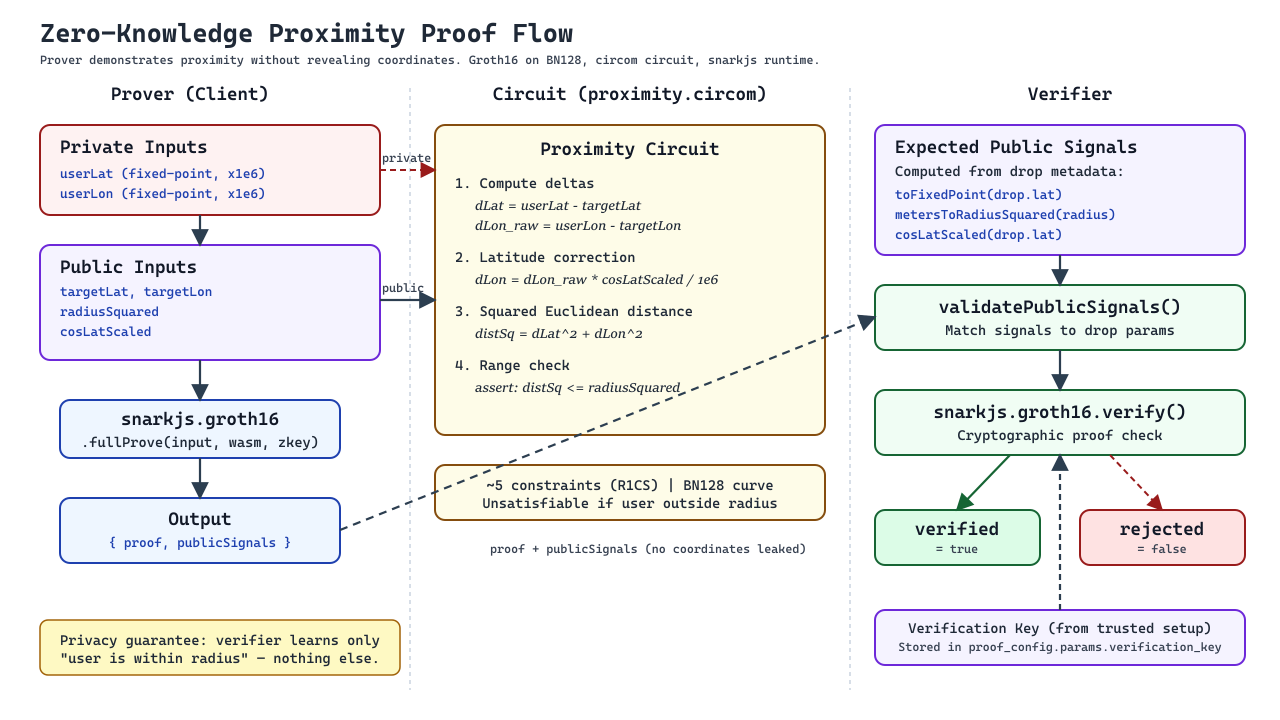
Figure 2: Context-bound Zairn-ZKP unlock flow.
Experimental Results
Security
- Cross-drop replay is eliminated with in-proof context binding (0% of attempted transfers succeeded in empirical scenario G).
- Off-circuit alternatives (e.g., nonce mapping, signature tokens) only provide equivalent security when all operational invariants are stringently maintained, otherwise implementations remain vulnerable—a plausible implementation omitted one check and stayed attackable.
- Proving times range from 31–83 ms on desktop, 194–280 ms on mobile; verification is consistently <10 ms.
- Context binding is shown to add zero measurable cost on top of the sound arithmetization baseline; all overhead is due to necessary arithmetic robustness.
Systems and Usability Implications
- Epoch-derived nonces minimize roundtrips and state but create a realistic attack surface in dense venues (100–500 vulnerable transfer pairs per minute in real deployments, depending on POI density).
- Per-request nonces close the vulnerability but introduce prohibitive latency in UI-sensitive unlock flows.
- Implementation complexity: in-proof binding requires dramatically less server code, fewer endpoints, a smaller state footprint, and fewer failure modes—supporting deployment robustness and maintenance.
Theoretical and Practical Implications
The results show that:
- Binding application context at the cryptographic statement layer is the true security boundary for stateful ZK-backed verification, reducing fragile operational invariants and implementation drift.
- For stateful systems where the set of application objects (e.g., drops) evolves, off-circuit alternatives are strictly less robust.
- The methodology generalizes to broader ZK settings: anonymous credentials, multi-tenant ZKP, ZK access tokens, and more.
For future developments, incorporation of trusted sensor attestation (to address sensor-truth, V4) and extension to asynchronous, multi-stakeholder unlock protocols are critical open lines of research.
Conclusion
The paper provides a rigorous, compositional systems-security analysis of stateful ZKP proximity proofs, introducing formal threat models, controlled system comparisons, and a deployable context-binding methodology that is provably robust under standard cryptographic assumptions and immune to realistic classes of implementation drift. The findings are strongest for dense, latency-sensitive, urban deployments, and the released artifacts support repeatable measurement. This work sets a new benchmark for deployable ZKPs in stateful applications, separating the concerns of cryptographic binding, operational invariants, and sensor trust.
References
The discussion above summarizes findings from "Context-Binding Gaps in Stateful Zero-Knowledge Proximity Proofs: Taxonomy, Separation, and Mitigation" (2604.03900).