- The paper develops a Fourier Neural Operator-based closure trained on PIC simulations that captures nonlocal heat flux dynamics with high fidelity.
- It employs spectral representations to ensure resolution independence and robust temporal extrapolation, reducing computational costs significantly.
- The results validate the model’s performance across hot spot and Epperlein–Short cases, offering practical advances for large-scale ICF target design.
Resolution-Independent Machine Learning Heat Flux Closure for ICF Plasmas
Introduction and Motivation
Modeling heat flux in inertial confinement fusion (ICF) plasmas is fundamentally challenging due to nonlocal transport effects and the breakdown of classical diffusive closures at high Knudsen numbers. Traditional approaches, such as the Spitzer-Härm (SH) model, become unreliable as λ0/LT increases, necessitating the use of kinetic treatments or advanced nonlocal closures. Despite widely adopted kinetic-inspired multigroup models like Schurtz-Nicolai-Busquet (SNB), persistent discrepancies remain in regimes relevant to ICF and astrophysical applications. The computational cost and resolution sensitivity of these models significantly hinder their practicality in large-scale radiation-hydrodynamic simulations.
Recent advances in surrogate modeling and ML have shown promise for embedding data-driven closures in PDE solvers, but conventional architectures (e.g., MLPs, CNNs) suffer from discretization locking, limiting generalization and flexibility across varied mesh spacings. In this context, this paper develops a Fourier Neural Operator (FNO)-based closure trained on particle-in-cell (PIC) data, demonstrating substantial accuracy and resolution independence. Two nonlocal electron conduction cases—hot spot relaxation and Epperlein–Short (ES) perturbation decay—are employed to test the model, with broad implications for future simulation paradigms in kinetic-fluid modeling.
Methodology: FNO-Based Surrogate Modeling
The FNO framework learns the nonlinear operator mapping from the electron temperature profile Te(x) to the divergence of the heat flux ∂xq(x), capturing the essential kinetic features of nonlocal transport. The FNO leverages spectral representations in Fourier space to encode global interactions while reducing computational complexity to O(nlogn), where n is the number of grid points. Training data are generated from high-fidelity PIC simulations (OSIRIS code) for hydrogen plasma under several test conditions, with both spatial and temporal resolution variations.
Operators F(n,m) are trained on downsampled data (varying dx and dt), and evaluated by embedding into the electron energy evolution equation, solved implicitly via iterative schemes. Tests include direct prediction, temporal extrapolation, and generalization to unseen initial conditions and finer grid deployments.
Results: Hot Spot Case
In the hot spot case, the FNO model is trained and evaluated for varying Gaussian profile widths (α). Results show that F(1,1) and even coarser resolution models Te(x)0 accurately reproduce the PIC evolution of Te(x)1 and Te(x)2, outperforming SNB closures particularly in strongly nonlocal regimes. Temporal extrapolation beyond the training interval exhibits robust accuracy, with prediction errors consistently Te(x)3 for temperature evolution.
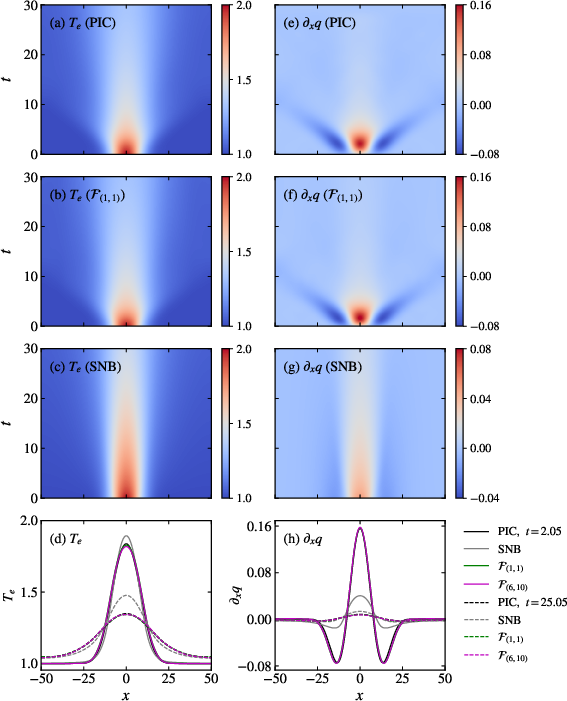
Figure 1: Spatiotemporal evolution comparison of Te(x)4 and Te(x)5 for the hot spot case between PIC, FNO closure, and SNB model.
Numerical evaluations (relative Te(x)6 error) confirm low variance and accuracy across both spatial and temporal resolutions, indicating genuine operator learning rather than dataset memorization.
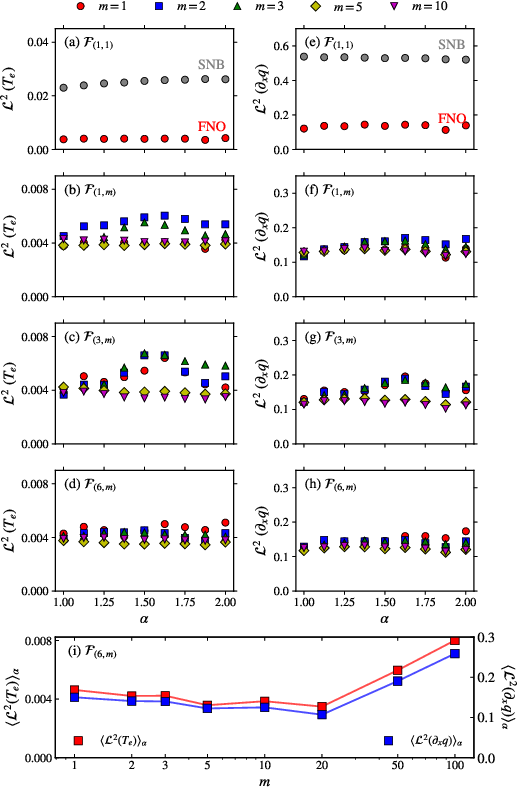
Figure 2: Relative Te(x)7 errors for Te(x)8 and Te(x)9 in the hot spot case, demonstrating the superior performance and resolution independence of FNO-based closures.
The generalization capability further extends to unseen intermediate ∂xq(x)0 values and even to altered functional forms (e.g., sub-Gaussian, super-Gaussian, Lorentzian profiles), maintaining congruence with kinetic simulation ground truth.
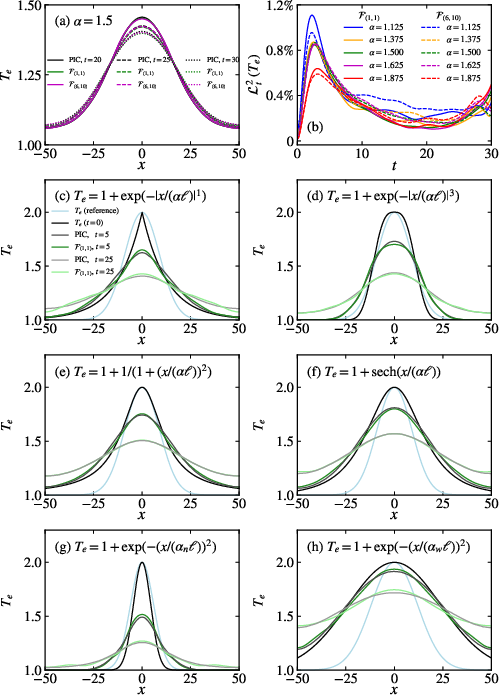
Figure 3: Assessment of temporal extrapolation and generalization; FNO model tracks PIC solutions for diverse initial profiles and outside training ranges.
Results: Epperlein–Short Case
The ES case explores sinusoidal temperature perturbation decay for varying ∂xq(x)1. The FNO closure accurately captures the temporal decay and spatial evolution of the temperature perturbation and heat flux divergence, matching PIC-derived decay rates and heat flux amplitudes, whereas the SNB closure consistently under/overestimates key rates.
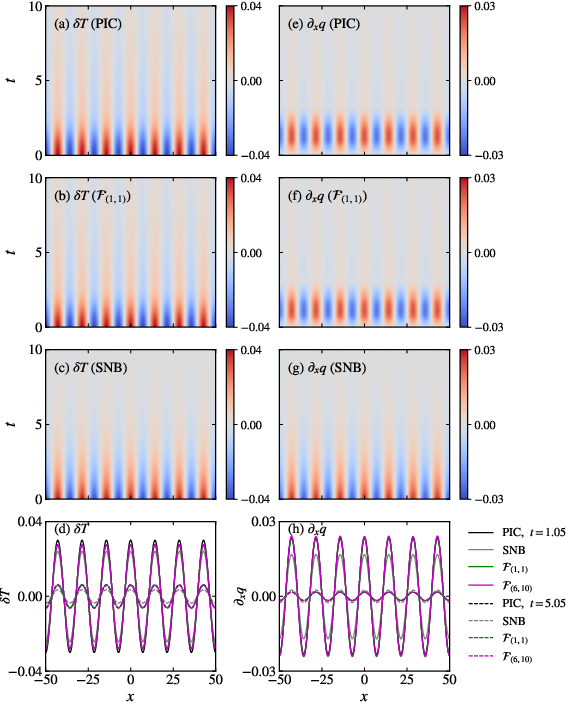
Figure 4: Spatiotemporal evolution of ∂xq(x)2 and ∂xq(x)3 for the ES case, comparing PIC, FNO, and SNB outputs for ∂xq(x)4.
The temperature decay rate ∂xq(x)5 and resulting effective conductivity ∂xq(x)6 from the FNO closure align with published VFP results, indicating kinetic consistency and broad predictive fidelity for ∂xq(x)7 up to ∂xq(x)8.
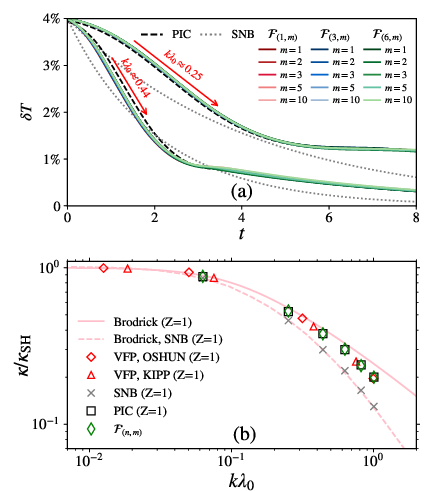
Figure 5: Temporal decay of the ES temperature perturbation and conductivity ratio ∂xq(x)9, confirming high quantitative agreement with kinetic and VFP models.
Models trained at coarse resolutions maintain accuracy on finer mesh deployments, with training data efficiency increased by orders of magnitude compared to classical or fully kinetic codes.
Discussion and Implications
The FNO-based closure demonstrates resolution independence, robust temporal extrapolation, and high generalization, contributing to a nearly O(nlogn)0 speedup over SNB-based iterative schemes with minimal compromise in accuracy. Embedding this closure enables practical hybrid kinetic-fluid simulations, critically relevant for large-scale ICF target design and analysis. The ML operator bridges the gap between kinetic and fluid modeling, allowing for accurate and efficient simulation across disparate spatiotemporal scales.
Training data efficiency is a salient advantage, as only a small fraction of simulation profiles are required for model convergence. However, generalization is currently constrained to initial conditions proximate to those covered during training. Models trained solely on hot spot data do not extrapolate reliably to ES conditions, and vice versa, presenting clear limitations in broader applicability, especially for multi-modal or highly disparate plasma states. Future work aims to further develop operator learning strategies for robust cross-domain generalization, including learning spherical harmonic components and exploring correction-based closures for SH flux.
Magnetized transport introduces additional complexity; the integration of external and self-generated magnetic fields in ML-based closures remains an active research direction and will require high-fidelity VFP data for representation learning.
Conclusion
This study demonstrates the construction and deployment of a resolution-independent ML heat flux closure for ICF plasmas, trained on PIC simulation data and based on the FNO framework (2604.03439). The surrogate model achieves high fidelity and substantial computational efficiency, with robust performance across a range of initial conditions and grid resolutions. Practical implications include rapid iterative kinetic-fluid simulation for ICF target design and analysis, and theoretical implications point to a new paradigm in surrogate operator learning for plasma physics. While generalization remains a significant challenge outside the training distribution, the approach establishes a foundation for future hybrid closures, adaptive training strategies, and extended applicability in magnetized nonlocal transport regimes.