- The paper introduces DSBD, which distills a differentiable structural basis for robust graph domain adaptation amid topology shifts.
- It employs bi-level optimization to tune synthetic adjacency matrices, aligning geometric moments and spectral properties between source and target domains.
- Empirical results across diverse benchmarks show DSBD outperforms state-of-the-art methods, improving accuracy by over 3% in challenging scenarios.
Dual-Aligned Structural Basis Distillation for Explicit Graph Domain Adaptation
Motivation and Problem Setting
Graph Domain Adaptation (GDA) addresses the challenge of transferring knowledge from a labeled source domain to an unlabeled target domain in the presence of distributional shifts in graph structures. Existing GDA literature predominantly pursues feature-centric alignment with methods such as adversarial training or projecting nodes to a shared latent space. However, these approaches neglect structural discrepancies, especially under nontrivial topology shift, where source and target graphs may differ significantly in connectivity, resulting in geometric and spectral mismatches. This undermines the reliability of GNN-based transfer, as message-passing mechanisms and spectral filtering are intimately tied to topological structure.
Key bottlenecks in GDA include:
(1) Non-differentiable, discrete structure space, impeding topology adjustment via gradient-based methods;
(2) Lack of alignment in both geometric and spectral characteristics—latent feature alignment does not regulate Laplacian spectra, causing mismatched GNN filtering;
(3) Persistent source-specific structural bias in learned operators, which are difficult to decouple from the source optimization trajectory.
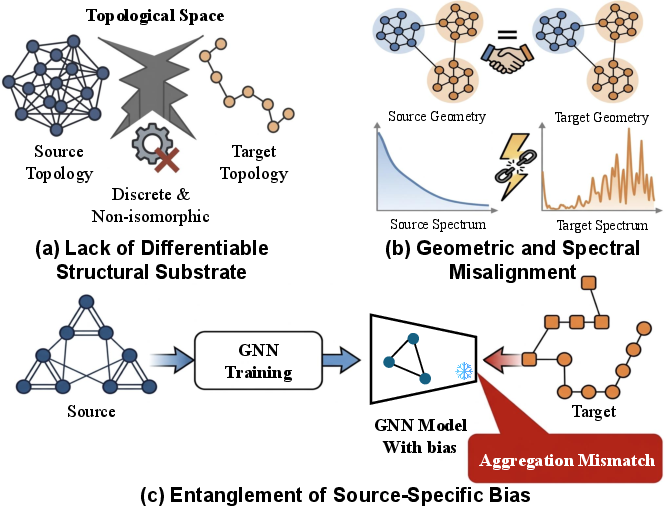
Figure 1: Overview of the three central challenges in GDA: non-differentiable topologies, geometric-spectral misalignment, and source-specific structural bias.
DSBD: Framework Overview
The proposed Dual-Aligned Structural Basis Distillation (DSBD) framework departs from feature-centric adaptation by learning a compact, differentiable set of synthetic prototype graphs, termed the structural basis. This structural basis acts as an explicit and optimizable substrate to model domain variation, supporting continuous parameterization of adjacency matrices instead of discrete, unpaired graphs.
DSBD operates in two phases:
- Dual-Aligned Structural Basis Distillation: Source-domain supervision is distilled into synthetic adjacency matrices with explicit dual alignment objectives:
- Geometric alignment through permutation-invariant topological moment matching (degree, density, triangle intensity, etc.).
- Spectral alignment via calibration of Dirichlet energy to align Laplacian-induced filtering behavior.
- Structurally Calibrated Target Inference: A new GNN is trained solely on the distilled, dual-aligned basis. Crucially, the source and distillation-phase models are discarded to avoid trajectory-induced bias, yielding a target-compatible message passing operator.
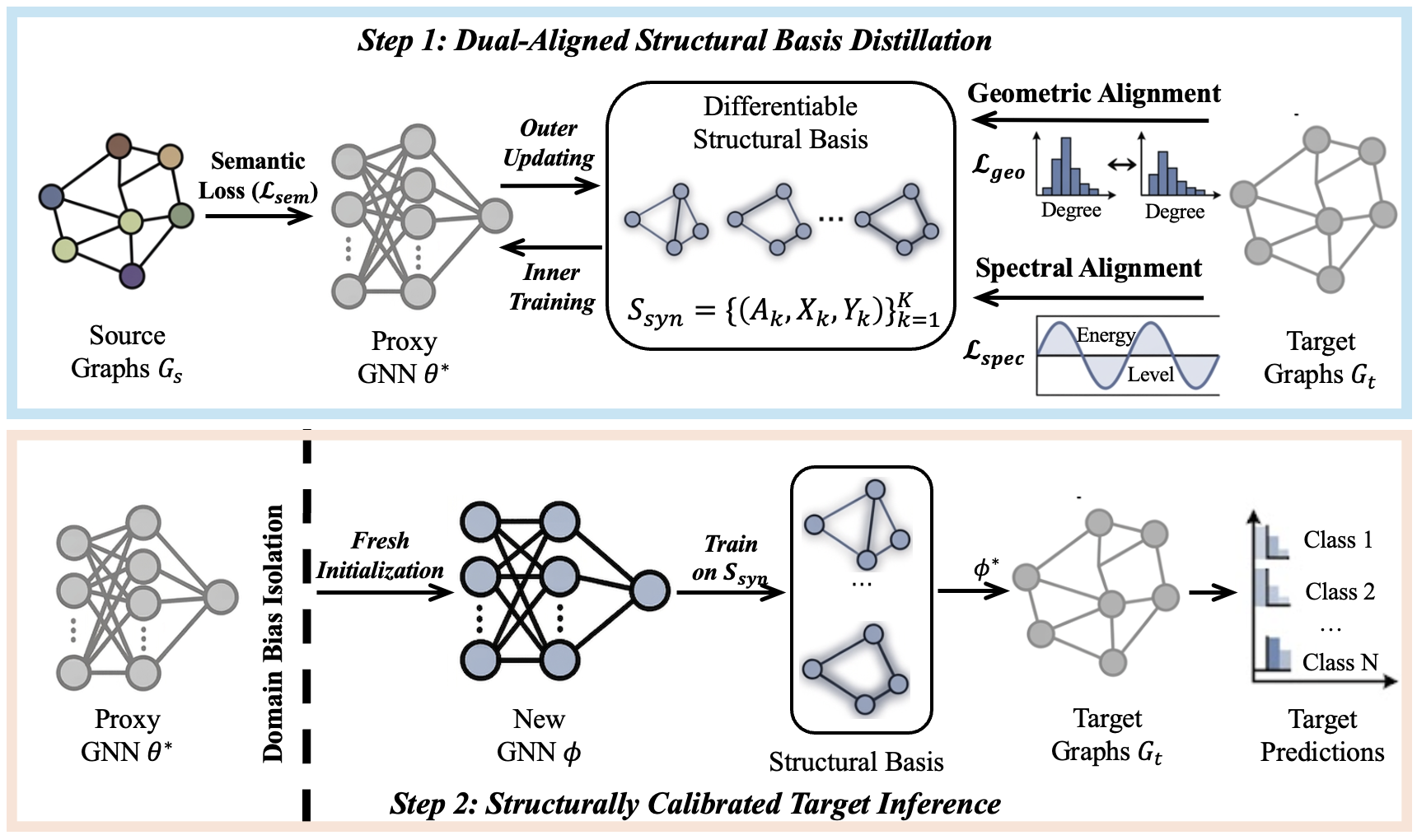
Figure 2: DSBD framework with distillation of differentiable structural bases followed by structurally unbiased inference.
Methodological Details
Probabilistic Parameterization and Bi-Level Optimization
Each prototype graph in the basis is parameterized as a probabilistic adjacency, enabling gradient-based updates in the structural space. DSBD formalizes the basis synthesis as a bi-level optimization: an inner loop trains the proxy GNN on the synthetic basis for semantic fidelity, while the outer loop updates the basis itself by minimizing a joint loss incorporating (i) semantic risk on source data, (ii) geometric moment discrepancy with the target, and (iii) spectral energy discrepancy (average Dirichlet energy).
Geometric and Spectral Alignment
Geometric Alignment
Permutation-invariant statistics (\emph{e.g.}, degree mean/std, density, triangle intensity) enable matching of local and global connectivity patterns between synthetic and target graphs without enforcing node correspondence. This is computationally efficient and differentiable compared to, e.g., Gromov-Wasserstein OT.
Spectral Alignment
Spectral properties are matched by aligning Dirichlet energy distributions, ensuring that feature smoothness under the normalized Laplacian of the basis mimics the target regime. This is essential as minor geometric perturbations can cause major shifts in spectral characteristics and downstream GNN filter response.
Structural Bias Mitigation in Inference
After basis optimization, DSBD trains a fresh GNN from random initialization, using only the synthesized basis as training data. Theoretically, this reduces generalization bound complexity by eliminating joint adaptation bias incurred during the trajectory of bi-level optimization (see Theorem 2 in the paper).
Empirical Evaluation
DSBD is evaluated across diverse benchmarks, including molecular graphs, protein-protein interaction networks, and image-to-graph tasks, under controlled node/edge/feature/correlation domain shifts. DSBD achieves consistently superior absolute accuracy and AUC compared to both graph distillation baselines (G-CRD, MuGSI, LAD-GNN, etc.) and state-of-the-art domain adaptation methods (SGDA, StruRW, PA-BOTH) on all transfer scenarios.
For example, on the Mutagenicity node shift M0→M1, DSBD attains 63.8% accuracy, surpassing the strongest baseline by >3%. On synthetic-to-real tasks and correlation shift settings, DSBD likewise demonstrates statistically significant improvements, highlighting its robustness to various domain shifts.
Ablation and Sensitivity
Ablation studies confirm the necessity of each component: semantic loss, geometric and spectral alignment, and structurally decoupled inference all contribute non-trivially to final performance. Sensitivity experiments with respect to the size of the synthetic basis (K) and balance of loss weights (λ1,λ2) indicate moderate parameter robustness; optimal alignment is typically achieved for basis sizes between 20–40 and balanced (λ1, λ2) in the 0.5–0.7 range.
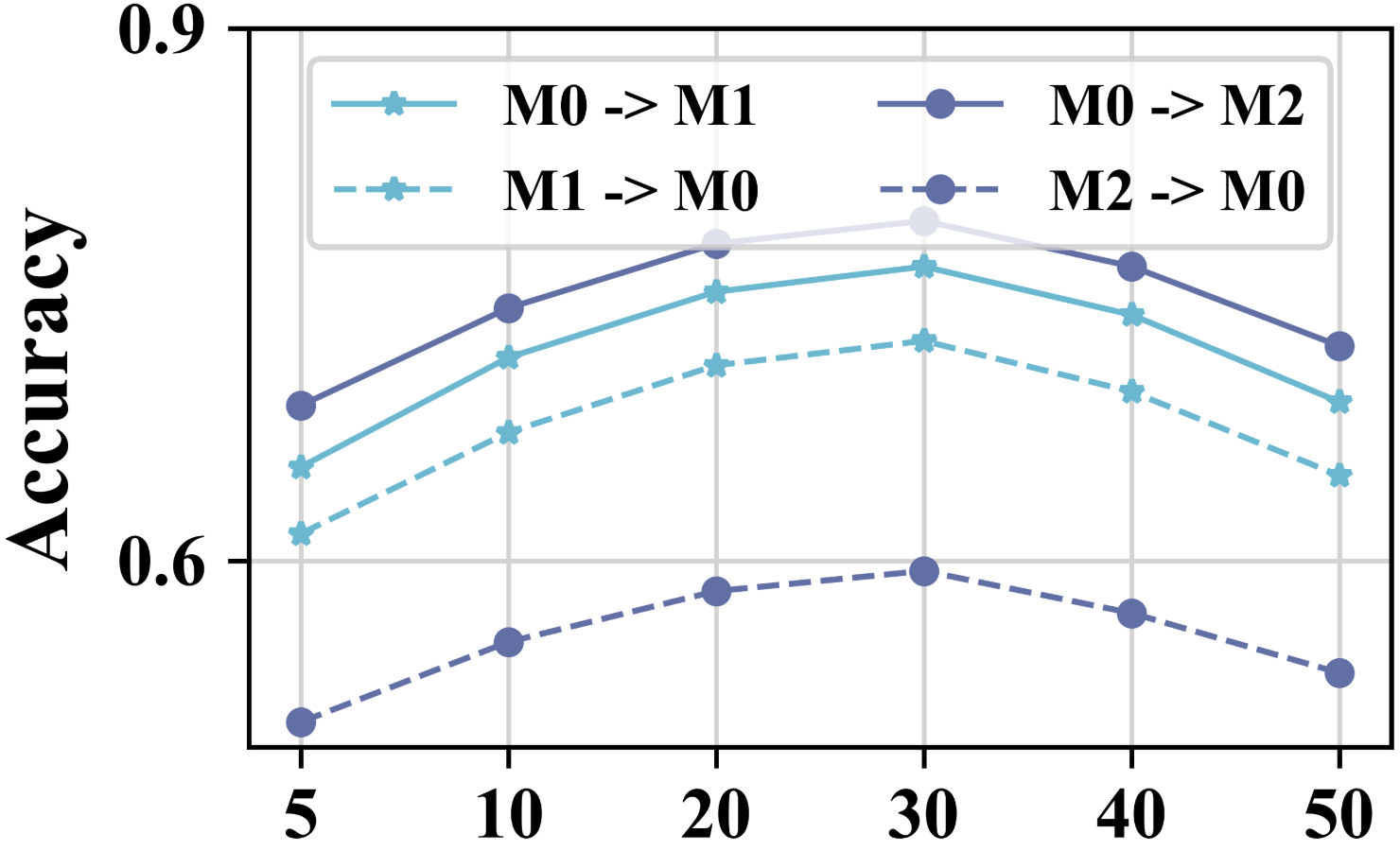
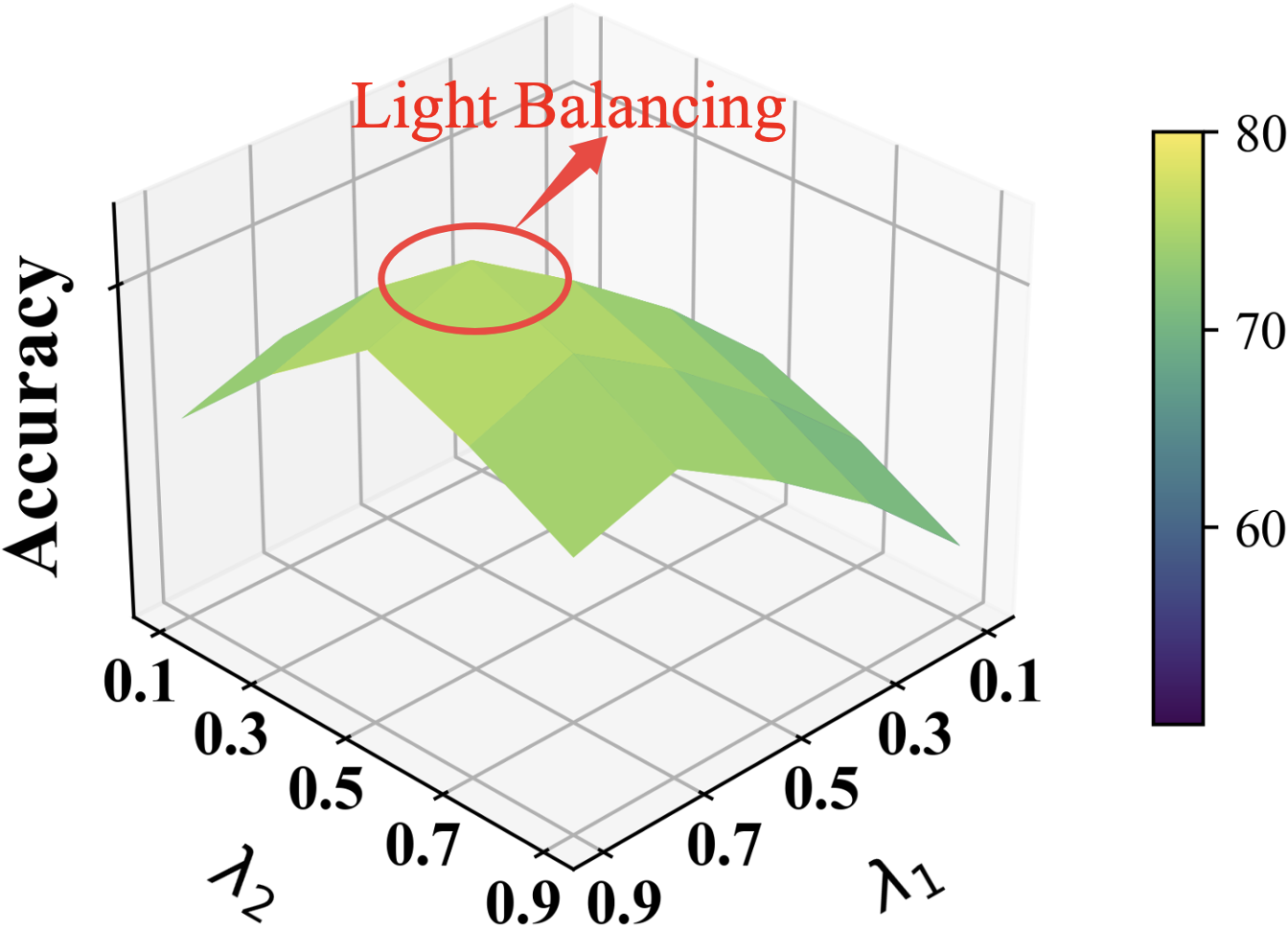
Figure 3: Effect of synthetic basis size on adaptation performance.
Qualitative and Distributional Analysis
Distribution analysis shows that DSBD matches the Dirichlet energy and graph density distributions of the target, in contrast to all baselines. Visualizations of prototype graphs sampled at varying Dirichlet energies demonstrate their structural diversity and spectral coverage, confirming effective basis representation.
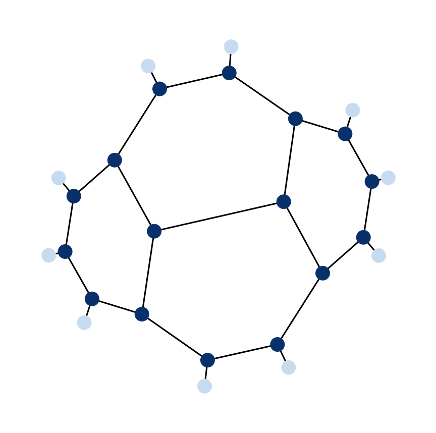
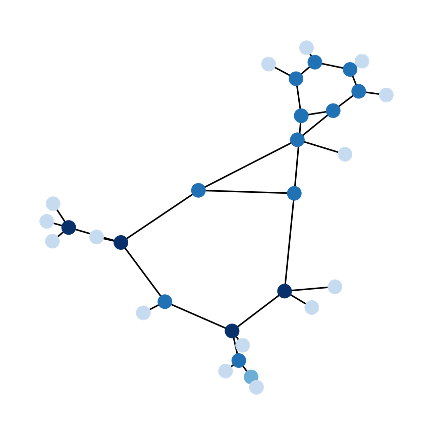
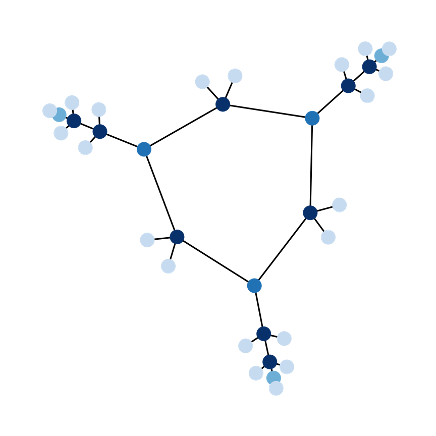
Figure 4: Visualization of a synthesized prototype graph with Dirichlet energy Ω=13.47, indicating spectral diversity in the basis.
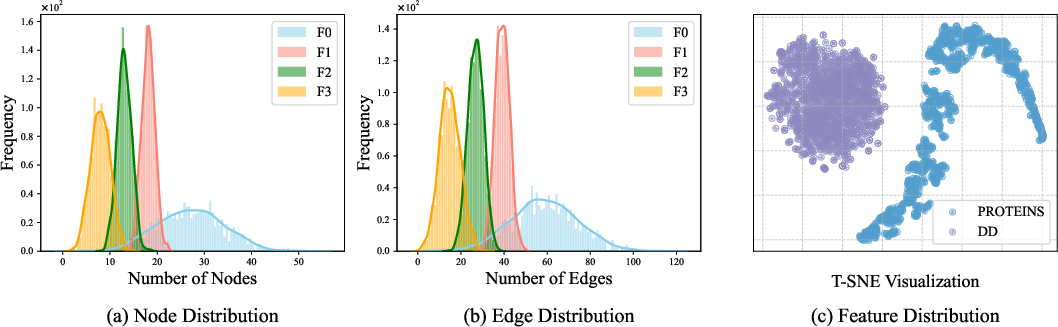
Figure 5: Visual illustration of node, edge, and feature distribution shifts across graph domains.
Theoretical Implications
DSBD provides a rigorous generalization bound decomposing target risk into empirical risk on the synthesized basis and explicit structural distributional discrepancy in geometric moments and Dirichlet energy. The dual alignment objective thus directly reduces the dominant terms governing adaptation risk in the target domain. The analysis further clarifies that retraining a fresh model over the fixed, target-aligned basis reduces generalization complexity by removing trajectory-dependent bias.
Practical and Theoretical Implications for Future AI
DSBD enables robust transfer of GNNs under severe topology and spectral domain shift, which are common in real-world applications (e.g., cross-species biology, distributed social networks with evolving connectivity, sensor or imaging artifacts). Its introduction of a learnable, differentiable structural substrate opens new directions for data-centric topology adaptation, meta-graph distillation, and model-agnostic domain transfer in graph machine learning. The isolation of propagation bias via structurally decoupled inference also has broader implications for mitigating optimization-induced bias in meta-learning and dataset distillation.
Speculatively, the DSBD methodology can be generalized to support cross-modal or multi-view domain adaptation in settings where relational and spectral characteristics play central roles (e.g., multi-omics, multimodal graph signal processing), or in foundation GNN pretraining with structure-agnostic universality as a goal.
Conclusion
DSBD advances the field of graph domain adaptation by introducing an explicit structural basis distillation paradigm, jointly aligned in geometric and spectral spaces through differentiable optimization. This dual alignment and isolation of source-specific propagation bias yields robust adaptation under broad and challenging domain shifts, and provides a new theoretical and practical foundation for future research in dataset distillation, topology transfer, and generalization bounds in graph-based AI systems.
(2604.03154)