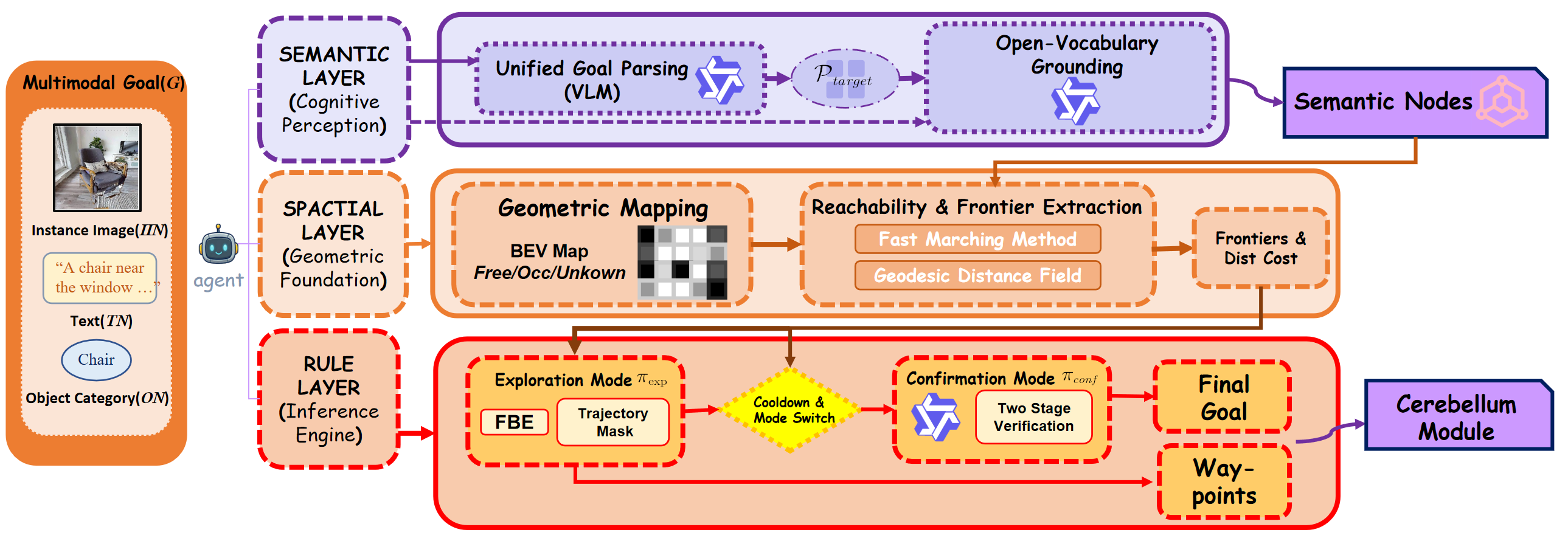
- The paper introduces a dual-brain architecture that combines high-level semantic reasoning with low-level real-time control to achieve fast, safe, and universal zero-shot navigation.
- It integrates VLM-based semantic processing with DRL-driven obstacle avoidance, outperforming state-of-the-art methods on metrics such as SR and SPL in simulation experiments.
- The system demonstrates robust cross-embodiment adaptability in both simulated and real-world deployments, enabling platform-agnostic performance across diverse robotic systems.
FSUNav: A Cerebrum–Cerebellum Architecture for Fast, Safe, and Universal Zero-Shot Goal-Oriented Navigation
Introduction and Motivation
The FSUNav framework presents a dual-brain collaborative architecture designed to address persistent limitations in vision-language navigation (VLN), particularly regarding cross-embodiment transfer, real-time safe deployment, and open-vocabulary semantic adaptation. Existing VLN approaches often exhibit strong dependence on specific robot morphologies, insufficient real-time performance, limited safety mechanisms, inadequate semantic generalization beyond predefined categories, and poor support for multimodal task inputs. FSUNav's solution comprises two principal modules: the Cerebrum (high-level semantic and spatial reasoning) and the Cerebellum (low-level, real-time motion control), working synergistically to enable platform-agnostic, efficient, and safe navigation through open-vocabulary, multi-modal goal specifications.
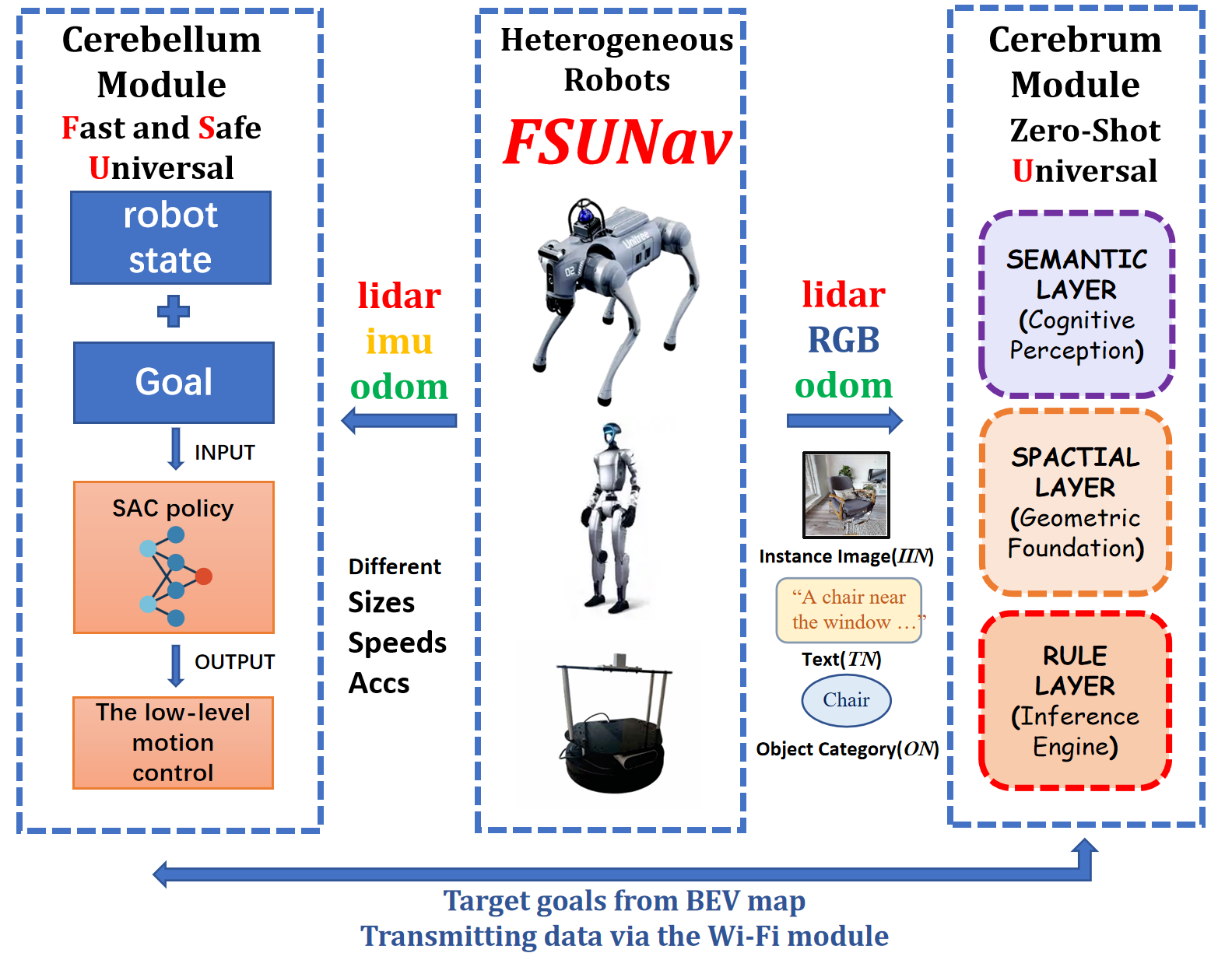
Figure 1: The FSUNav framework, featuring dual Cerebrum–Cerebellum modules to enable fast, safe, and generalizable zero-shot vision-language navigation.
Architectural Overview
Dual-Brain Design
The architecture employs a modular separation:
- Cerebrum Module: Implements high-level scene understanding, multimodal goal parsing, and target-grounded reasoning using a powerful vision-LLM (VLM) orchestrated via semantic, spatial, and rule-based layers.
- Cerebellum Module: Provides local, geometry-aware navigation and real-time obstacle avoidance through deep reinforcement learning (DRL), abstracted from platform specifics.
Cerebrum Module: Unified Multi-Layer Reasoning
The Cerebrum’s hierarchical reasoning is articulated via:
The Cerebellum module applies a DRL policy (SAC-based), where platform abstraction is achieved through:
- Dimension-configurable input representation encompassing robot size and dynamic constraints, processed by a PointNet backbone for variable sensor and embodiment generalization.
- Curriculum learning over a continuous morphology space to train adaptive and robust collision-avoiding control, enabling seamless cross-deployment on wheeled, quadrupedal, and humanoid platforms.
Experimental Results
Simulation-Based Evaluation
FSUNav_Cerebrum was evaluated on MP3D and HM3D across ObjectNav, Instance-ImageNav, TextNav, and Open-Vocabulary tasks using standardized SR and SPL metrics. Across all tasks, FSUNav_Cerebrum achieved the highest reported SR and SPL values, outperforming both supervised and training-free baselines, including ZSON, PSL, GOAT, ESC, VLFM, SG-Nav, CogNav, REST, and UniGoal. Notable advances include:
- ObjectNav (HM3D): 76.2% SR, 40.49% SPL (vs. CogNav’s 72.5%, 26.2% and PEANUT+LOG’s 64.3%, 34.2%).
- Instance-ImageNav (HM3D): 72.6% SR, 34.88% SPL (vs. IEVE’s 70.2%, 25.2% and UniGoal’s 60.2%, 23.7%).
- Text-Nav (HM3D): 39.8% SR, 21.58% SPL (vs. UniGoal’s 20.2%, 11.4%).
- Open-Vocabulary Nav (HM3D): 56.87% SR, 32.59% SPL, substantially above MTU3D (40.8%, 12.1%) and VISOR (28.48%, 17.26%).
These results constitute strong evidence for the claim that FSUNav achieves universal, training-free, task and platform-agnostic navigation with leading efficiency and robustness (2604.03139).
Real-World Robotic Deployment
The system was deployed on a Unitree Go2 EDU quadruped, equipped with an Intel RealSense D455 (RGB) and Livox MID-360 LiDAR for robust environment mapping and real-time collision avoidance. The local planner operates solely with geometric information, and the perception module demonstrates effective estimation using only RGB-derived depth, eliminating specialized sensor dependencies.
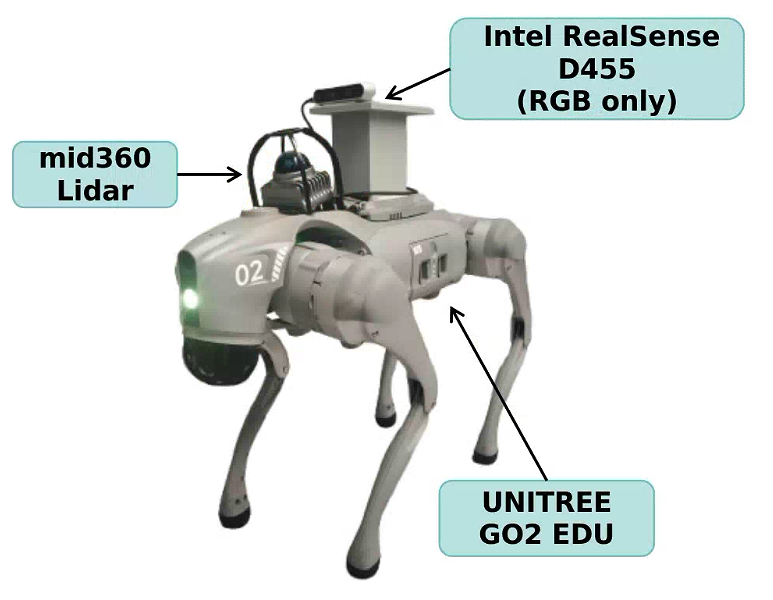
Figure 3: Real-world robot platform configuration for FSUNav experimentation.
Experiments validated that FSUNav supports high-speed navigation (0.6 m/s) with dynamic avoidance and accurate real-world object identification in unstructured environments, under open-vocabulary and multimodal goal inputs. The system's closed-loop safety and adaptability were maintained without task-specific retraining or prior knowledge of the operational scenes.
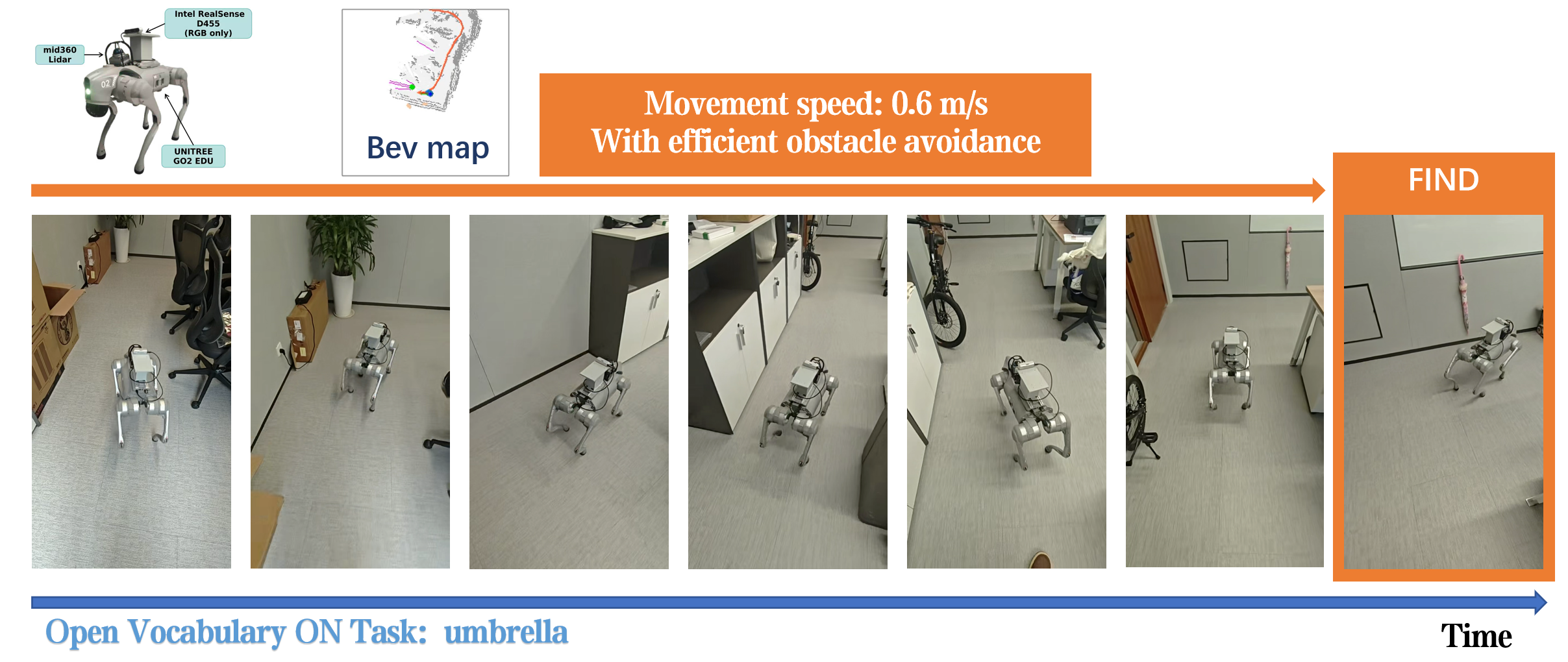
Figure 4: The robot executes open-vocabulary navigation ('umbrella') with real-time obstacle avoidance, robust object approach, and accurate identification in unstructured real-world settings.
Analysis and Implications
Advancements over Prior Art
FSUNav demonstrates several distinct advantages:
- Zero-shot universality: Training-free operation across ObjectNav, Instance-ImageNav, TextNav, and Open-Vocabulary tasks.
- Cross-embodiment generalization: Platform-agnostic deployment, validated across diverse real and simulated morphologies.
- Integrated semantic reasoning: End-to-end use of VLMs across detection, semantic exploration, verification, and scene graph construction, supplanting piecemeal pipelines.
- Multimodal interaction: Unified handling of text, image, and category goals with no architecture or training changes.
- Real-time safety: Explicit geometric embedding and DRL-based collision avoidance yielding efficient, risk-mitigating control.
Theoretical and Practical Significance
Practically, FSUNav provides a deployable solution for universal VLN, circumventing requirements for task or platform-specific data, retraining, or architectural reconfiguration. Theoretically, it demonstrates that VLM-centric reasoning, combined with appropriate geometric and RL-based control abstractions, is sufficient for robust open-world generalization, enabling future research to focus on progressive cognitive layering atop a shared reasoning and execution substrate.
Potential future directions include automated scene graph-driven high-level reasoning, transfer to hybrid indoor-outdoor domains, deeper integration with human-in-the-loop interaction, and full integration with emerging robotics foundation models for broader embodied AI.
Conclusion
FSUNav introduces an effective dual-brain architecture, supporting fast, safe, and universal zero-shot navigation with open-vocabulary, multimodal task specification. Through VLM-driven hierarchical reasoning, platform-agnostic RL-based control, and comprehensive empirical validation, FSUNav sets a new state-of-the-art in training-free universal VLN for heterogeneous robotic systems. Its robust real-world performance and flexible extensibility position it as a strong foundation for further advancements in embodied AI (2604.03139).