- The paper sets the most stringent upper limits on the branching fractions for B(s)⁰ → J/ψγ and B⁰ → J/ψγ decays.
- It employs full Run 1 and Run 2 datasets with advanced photon conversion reconstruction and multi-stage background suppression.
- The results exclude certain pQCD predictions at 99.7% CL, motivating refinements in nonperturbative QCD and new physics models.
Search for the Annihilation-Type Radiative Decays B(s)0→J/ψγ at LHCb
Theoretical Context and Motivation
The decays Bs0→J/ψγ and B0→J/ψγ are pure annihilation-type rare radiative processes in the Standard Model (SM), proceeding predominantly via W-exchange diagrams. These decay channels are highly suppressed in the SM due to CKM and color factors, with lowest-order branching fractions predicted to be O(10−7)–O(10−6) for Bs0 and an order of magnitude lower for B0 decays depending on the adopted factorization scheme and the treatment of nonperturbative effects. Among the possible enhancements, scenarios including intrinsic charm in the B-meson wave function or contributions from non-SM right-handed currents stand out, making experimental investigation of these decays valuable probes for potential new physics.
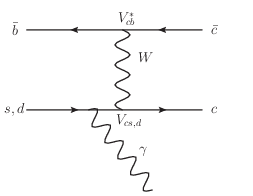
Figure 1: Feynman diagram for the leading contribution to the B(s)0→J/ψγ amplitudes, with photon emission from light quarks dominating; emission from heavy quarks is suppressed.
Experimental Approach and Analysis Strategy
The analysis utilizes the full Run 1 (3 fbBs0→J/ψγ0 at 7, 8 TeV) and Run 2 (6 fbBs0→J/ψγ1 at 13 TeV) Bs0→J/ψγ2 collision data sets from the LHCb detector, representing an integrated luminosity of 9 fbBs0→J/ψγ3. The experimental signature targeted is the reconstruction of Bs0→J/ψγ4 combined with converted photons (Bs0→J/ψγ5) in the silicon tracking system. Photon conversions are subdivided into the Bs0→J/ψγ6 and Bs0→J/ψγ7 categories based on the conversion location, impacting the achievable mass resolution and selection efficiency.
To suppress backgrounds—dominated by partially reconstructed Bs0→J/ψγ8 hadron decays such as Bs0→J/ψγ9, B0→J/ψγ0, and combinatorial sources—a multi-stage selection was implemented including trigger requirements, muon and photon identification, vertex and kinematic selections, and BDT-based classification trained to suppress both combinatorial and specific partially reconstructed backgrounds.
The signal extraction is done via simultaneous unbinned maximum-likelihood fits to the B0→J/ψγ1 spectra in both B0→J/ψγ2 and B0→J/ψγ3 categories. Signal shapes are modeled with double-sided Crystal Ball functions, with resolution parameters validated and adjusted using control channels such as B0→J/ψγ4. Backgrounds are modeled with a combination of ARGUS and polynomial functions, with normalization of certain physics backgrounds constrained using external measurements and simulation-derived acceptances.
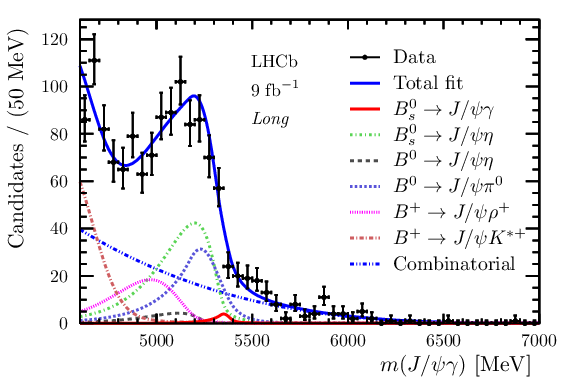
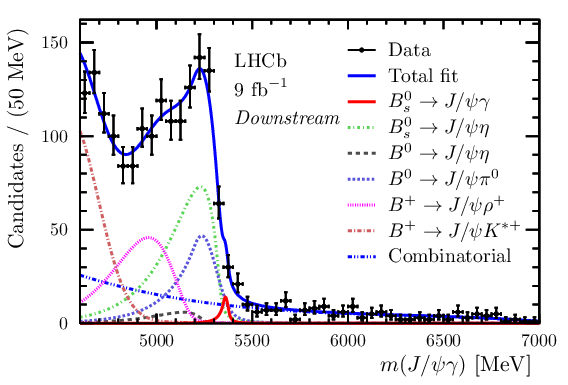
Figure 2: Invariant-mass distributions for the B0→J/ψγ5 search in the B0→J/ψγ6 and B0→J/ψγ7 photon categories with fit results superimposed.
Statistical Treatment and Results
No significant excess is observed over the background expectations in either decay channel. The best fits yield central values of
B0→J/ψγ8
where the first uncertainty is statistical and the second systematic.
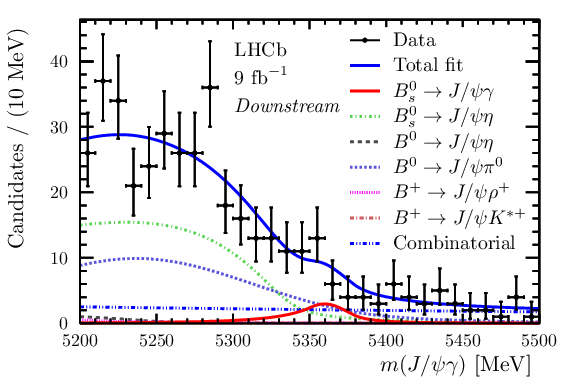
Figure 3: Invariant-mass distribution for B0→J/ψγ9 signal candidates in a narrow mass window around the W0 mass with fit result; no significant excess is seen.
Systematic uncertainties are dominated by imperfect knowledge of the photon energy resolution, background modeling, and selection efficiency mismodeling. The total systematic uncertainty remains subdominant relative to the statistical uncertainty; the analysis achieves a factor of 2.5 improvement in sensitivity over previous results for W1.
Given the absence of statistically significant signals, the W2 method is employed to set conservative upper limits. At 90% (95%) CL, the branching fraction upper limits are
W3
Notably, the W4 limit excludes the perturbative QCD prediction of W5 at the W6 CL, thus directly constraining a specific SM calculation.
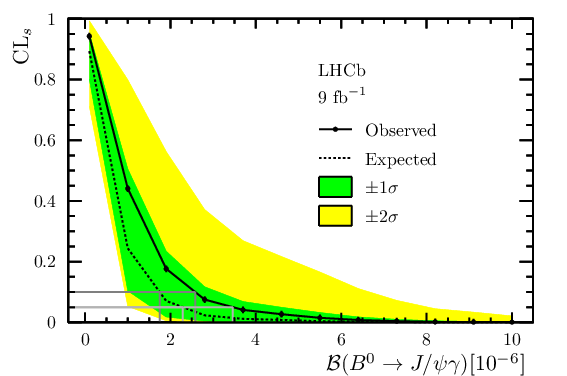
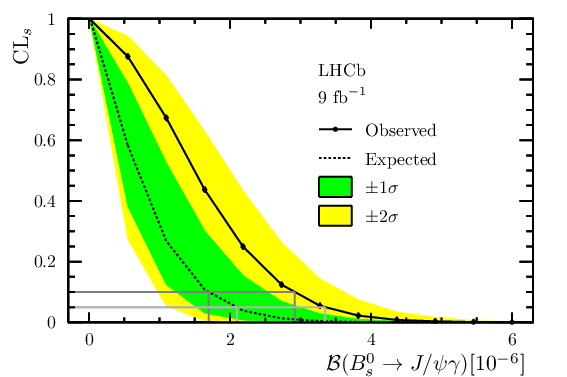
Figure 4: Expected and observed W7 values as a function of assumed branching fraction for W8 and W9, including 1O(10−7)0 and 2O(10−7)1 uncertainty bands; vertical lines show the observed/expected upper limits.
Implications and Prospects
This analysis severely constrains annihilation-type radiative decay rates and associated long-distance contributions within the SM, removing significant phase space for large nonperturbative enhancements or new-physics scenarios with moderate branching fraction enhancements. The exclusion of the O(10−7)2 pQCD model explicitly disfavors the upper edge of SM predictions, intensifying the focus on more precise nonperturbative approaches such as those predicting O(10−7)3–O(10−7)4.
From a phenomenological standpoint, these results validate the use of converted photons at hadron colliders as a competitive strategy for low-rate heavy flavor radiative decay searches, leveraging the high photon energy resolution to reject irreducible backgrounds from partially reconstructed decays. Furthermore, as improvements in photon reconstruction and data-driven efficiency calibration are realized, sub-O(10−7)5 sensitivity for these and related decay modes becomes accessible.
On the theoretical side, further refinement of hadronic form factor calculations and more systematic studies of nonfactorizable effects in annihilation-type radiative O(10−7)6 decays are motivated. Direct sensitivity to possible right-handed current effects or intrinsic charm contributions remains limited by the current statistical power, but is within reach with projected higher-luminosity datasets.
Conclusion
A comprehensive search for the rare decays O(10−7)7 and O(10−7)8 at LHCb using the full Run 1 and Run 2 data sets observes no significant signals and sets the most stringent upper limits to date: O(10−7)9 and O(10−6)0 at 90% CL (2604.02933). These constraints directly test and in some cases exclude specific SM predictions, and provide strong guidance for model building. Future enhancements in luminosity and reconstruction performance are anticipated to probe the remaining allowed SM parameter space, enabling not only branching fraction measurements but, following observation, studies of photon polarization and O(10−6)1 violation observables in these rare channels.