- The paper introduces a joint LAR-based optimization method that fine-tunes pump power and RF field to achieve maximum sensitivity.
- The paper demonstrates closed-loop frequency locking, achieving pT/Hz1/2 sensitivity and effective noise suppression for dynamic field changes.
- The paper implements frequency-multiplexed triaxial modulation to enable precise 3D vector field reconstruction in a compact configuration.
Optimization and Vectorization of a Mz-type Optically-Pumped Rubidium Magnetometer
Introduction and Motivation
The paper "Optimization and vectorization of a Mz-type optically-pumped Rubidium magnetometer" (2604.02884) addresses the design, optimization, and vectorization of an 87Rb-based Mz-type optically pumped magnetometer (OPM) utilizing a paraffin-coated anti-relaxation vapor cell. OPMs, owing to their lack of cryogenic requirements and competitive sensitivity, have emerged as strong contenders for compact and power-efficient magnetic sensing applications, offering significant advantages over conventional SQUID-based technologies. The presented system particularly targets applications in geomagnetic navigation, magnetic anomaly detection, and space-constrained environments, where low power and temperature sensitivity are paramount.
The employed paraffin-coated cell avoids buffer gas and enables near-ambient operation, mitigating thermal and power demands common to alkali vapor-based magnetometers. The paper makes strong claims regarding the joint optimization of the pump laser intensity and RF field via the linewidth-amplitude ratio (LAR), the application of closed-loop frequency locking to enhance sensitivity, and the demonstration of triaxial vector detection via superposed low-frequency field modulation—thereby overcoming the scalar limitations of conventional Mz-type architectures.
Theoretical Framework
At the core of the system is the Zeeman-split 87Rb ground state, manipulated via optical pumping and radio-frequency (RF) magnetic resonance. Optical pumping achieves spin polarization by driving the D1 transition with circularly polarized light, accumulating atoms in the mF=+2 dark state and maximizing transmission through the vapor (Figure 1).
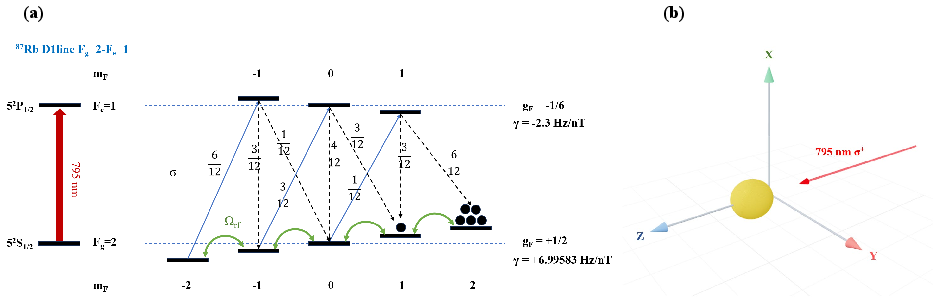
Figure 1: Schematic diagram of the working principle of the 87Rb Mz atomic magnetometer, showing the energy level structure, pumping mechanism, and induced macroscopic polarization.
Application of an orthogonal RF field at the Larmor frequency induces transitions between Zeeman sublevels, depolarizing the sample and causing a characteristic transmission dip—this is the canonical Mz signal. Both the Lorentzian linewidth and resonance amplitude are set by the interdependent parameters of RF field amplitude, pump power, and the vapor cell’s relaxation characteristics. The paper provides a succinct formulation based on the Bloch equations, elucidating how both optical power and RF intensity linearly or nonlinearly modulate the linewidth Γeff and amplitude Samp, necessitating multi-parameter joint optimization.
The LAR is rigorously justified as an optimal figure of merit to locate parameter extrema that minimize the trade-off between signal broadening (detrimental to sensitivity) and signal amplitude (beneficial for SNR), thereby identifying the optimal sensitivity point.
Vectorization is achieved by the superposition of weak, orthogonal low-frequency magnetic fields, producing modulations in the detected magnitude at the field’s respective frequencies. Using a Taylor approximation and frequency-domain extraction, the vector components (Bx,By,Bz) of the ambient field can be reconstructed from the amplitude of corresponding spectral peaks.
Experimental Implementation
The system architecture comprises a distributed Bragg reflector (DBR) laser stabilized to the D1 line, with light intensity and polarization precisely conditioned before entering a paraffin-coated glass cell (Figure 2). The cell's large aspect ratio and isotopically pure 87Rb vapor enable high spectral fidelity at near-ambient (40°C) temperatures.
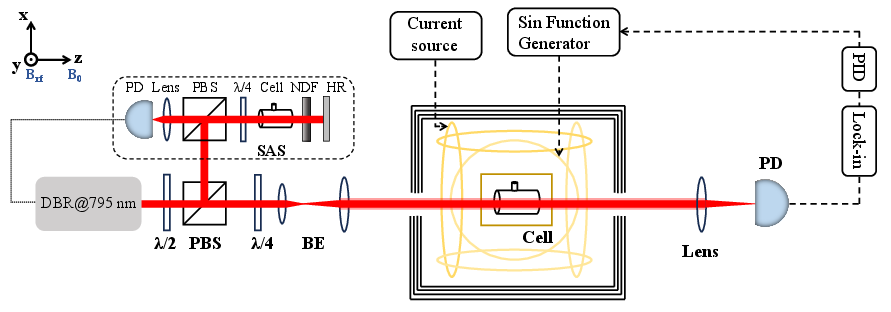
Figure 2: Schematic of the experimental setup for the Mz-type Rb atomic magnetometer, showing the vapor cell, thermal control, pump optics, magnetic shielding, and detection system.
A four-layer magnetic shield and tri-axial Helmholtz coils establish the bias, RF, and modulation fields. Detection employs transmission photometry and a lock-in amplifier, enabling both open-loop resonance scanning and closed-loop PID-based frequency locking. The critical optimization and calibration procedures are performed with environmental magnetic isolation to benchmark intrinsic device performance.
Parameter Optimization and Sensitivity Characterization
A two-dimensional LAR-based grid search determines the optimal experimental parameters. Systematic scans show that:
- RF Field Dependence: Linewidth increases linearly with RF amplitude, amplitude saturates at higher fields, and a clear LAR minimum emerges around 165 nT for all pump powers (Figure 3).
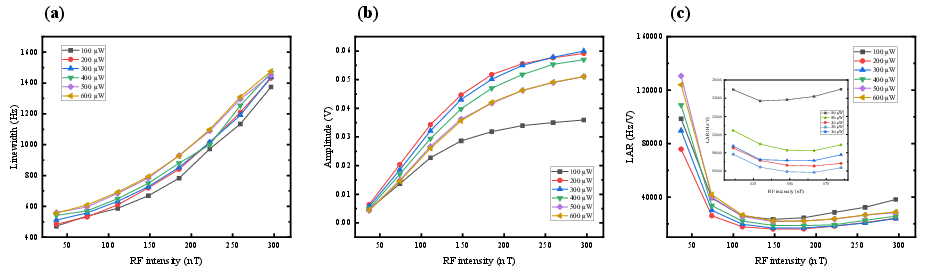
Figure 3: RF field dependence of resonance linewidth, amplitude, and LAR for various pump powers, revealing an optimal RF field for sensitivity.
- Pump Power Dependence: Resonance amplitude peaks at moderate pump powers (200 μW), while excessive power leads to power broadening. The LAR minimum is approximately at 250 μW for the optimized RF field (Figure 4).
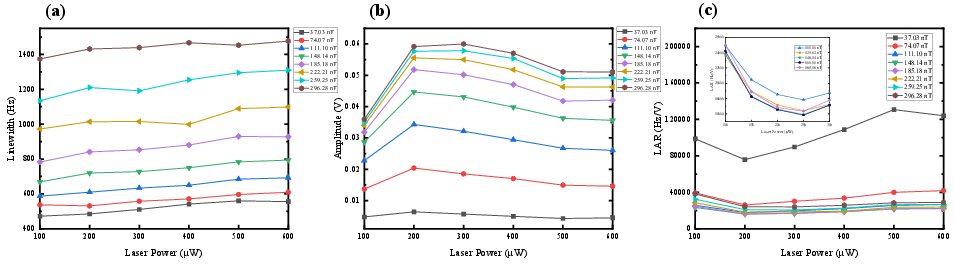
Figure 4: Pump power dependence of linewidth, amplitude, and LAR at various RF fields, with fine-scan revealing optimal power for maximum SNR.
Calibrated with a 63 Hz, 1.84 nT reference field, the open-loop power spectral density (PSD) demonstrates a sensitivity of 30.8 pT/Hz1/2 (Figure 5).
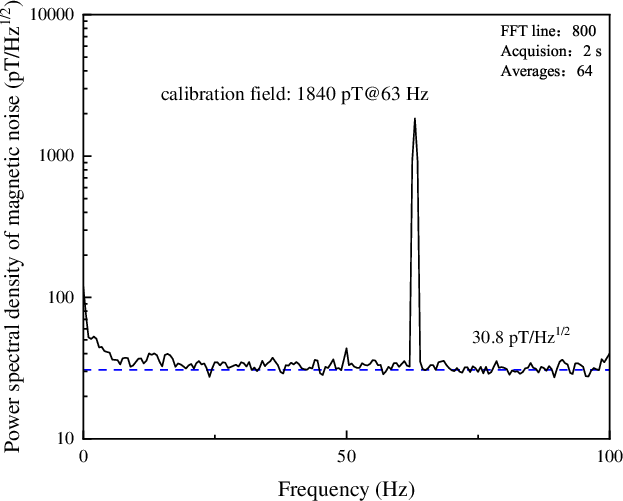
Figure 5: Open-loop magnetic noise PSD with calibration peak and indicated noise floor, yielding device sensitivity.
Closed-loop operation leverages lock-in demodulation to produce an error signal with well-defined zero-crossing and broad linear region (Figure 6), providing robust frequency discrimination for PID locking.
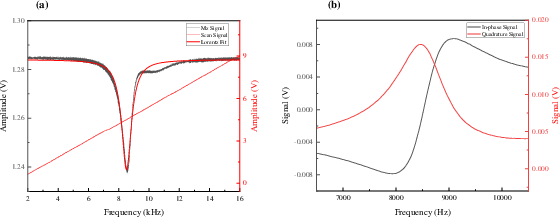
Figure 6: (a) Lorentzian Mz resonance and (b) corresponding lock-in error signal with pronounced zero-crossing used for feedback locking.
Dynamic step response tests demonstrate fast, stable tracking of abrupt 430 pT field changes without lock loss or significant overshoot (Figure 7). Under identical calibration, closed-loop sensitivity improves to 22.9 pT/Hz1/2 (Figure 8), illustrating the efficacy of feedback noise suppression. Closed-loop bandwidth testing shows a -3 dB bandwidth of 123 Hz (Figure 9), consistent with real-time low-frequency field monitoring requirements.
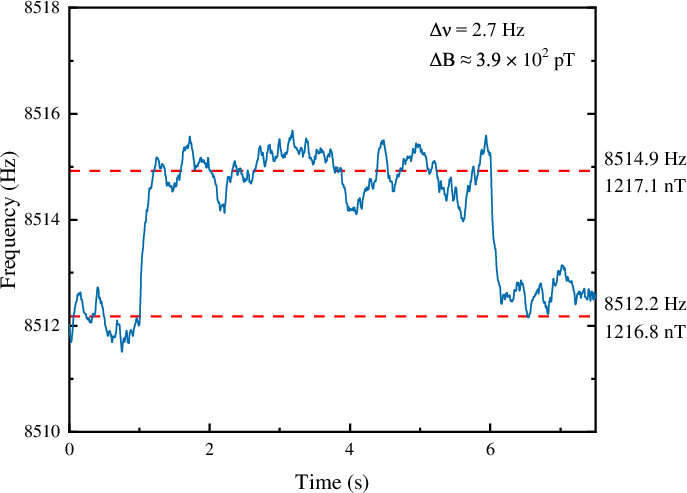
Figure 7: Step response of the closed-loop system to a 430 pT applied step, showing high tracking fidelity.
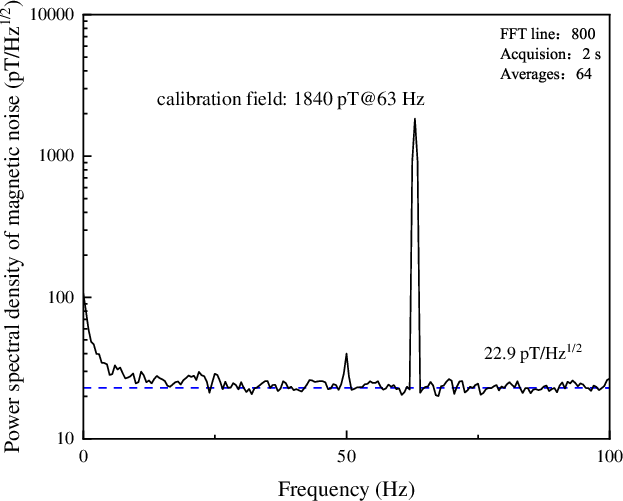
Figure 8: Closed-loop magnetic noise PSD, illustrating noise floor reduction and enhanced sensitivity.
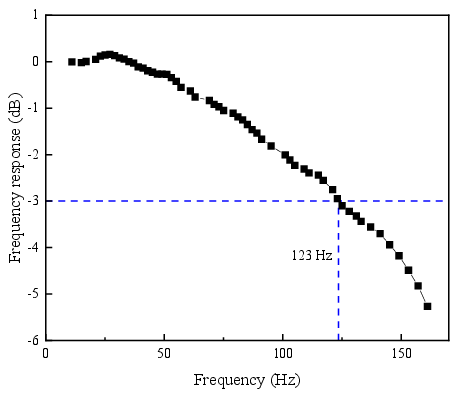
Figure 9: Frequency response of the closed-loop system with -3 dB point defining 123 Hz bandwidth.
Triaxial Vector Measurement Capability
Vector mode operation applies weak (1 nT amplitude), spectrally non-overlapping, orthogonal modulation fields at 63 Hz, 67 Hz, and 71 Hz, with extracted FFT peaks mapping directly to 870, 871, and 872 (Figure 10). The reconstruction provides clear 3D vector readout, enabling full vector field measurement in a compact, single-beam configuration.
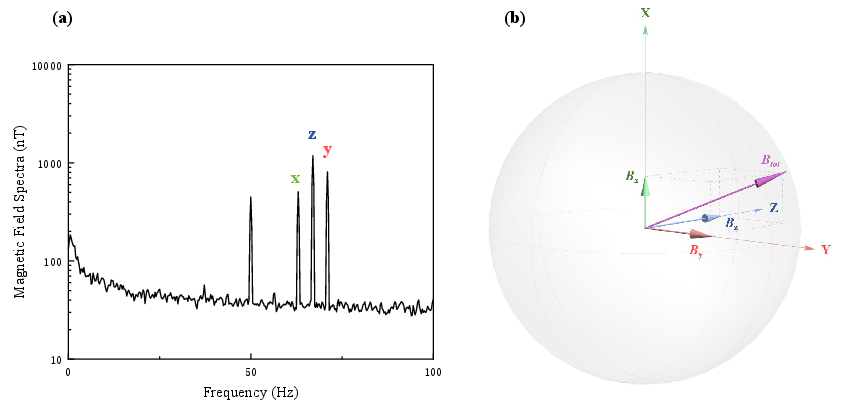
Figure 10: (a) FFT signal spectrum with resolved triaxial modulation peaks, and (b) 3D visualization of reconstructed static field vector.
While the technique enables directionality, the vector sensitivity is fundamentally limited by the scaling factor 873, yielding a vector sensitivity of 27.8 nT/Hz874 at 875 nT, 876 nT. This level is comparable to standard handheld fluxgates but retains the scalar system's pT-scale sensitivity for magnitude (a significant practical advantage).
Implications and Future Directions
This study exemplifies the maturation of Mz-type alkali vapor magnetometry into regimes relevant for geophysical, navigation, and field-deployable applications, by combining compactness, room-temperature operation, and both scalar and vector readout modalities in a single system. Practically, the demonstrated sensitivities and dynamic response position the device as a credible sensor for precision magnetometry outside laboratory contexts (e.g., CubeSat payloads, portable field surveys), while offering multi-axis readout traditionally reserved for more complex or power-hungry technologies.
Theoretically, this work underscores the necessity of multidimensional parameter optimization—mediated by LAR minimization—and provides a reproducible procedure for extracting vector field components without multiple beams or vapor cells. However, the inherent noise penalty in vector mode points to an outstanding challenge: reducing scalar and vector noise concurrently, potentially via alternative modulation strategies, adaptive filtering, or further improvements in cell coatings and coil calibration.
Further work will likely explore:
- Advanced signal demodulation techniques for improved vector noise performance
- Miniaturization and integration for networked and portable applications
- Operation in unshielded or dynamic environments with real-time compensation
Conclusion
The paper presents a rigorous study into the optimization and functional extension of a paraffin-coated 877Rb Mz-type atomic magnetometer, achieving closed-loop pT/Hz878 sensitivity at room temperature alongside triaxial vector magnetic field detection. The joint LAR-optimized approach for parameter selection is experimentally validated, and vectorization via frequency-multiplexed modulation is successfully implemented. These results establish a practical foothold for robust, high-sensitivity, cost-effective vector magnetometry and provide a clear pathway toward broader deployment in real-world sensing and navigation use cases.

