- The paper identifies the co-evolution of a young stellar population and molecular clouds within the Snake III complex across a 300×500×175 pc³ volume.
- It employs multi-wavelength data and advanced 5-D phase-space clustering to reveal spatial, kinematic, and age correlations among 5683 stars and 12 open clusters.
- The study highlights feedback-driven processes, with quantitative velocity dispersion analysis confirming the impact of stellar feedback on shaping star formation.
Co-Evolution of Stars and Molecular Clouds in the Stellar “Snake”–III Complex
Introduction
The paper "The Stellar 'Snake'-III: Co-evolution of Stars and Molecular Clouds Unveiled by Gaia, MWISP, and LAMOST" (2604.02717) offers a comprehensive, multi-wavelength analysis of a hierarchical, filamentary stellar structure (Snake III) in the Galactic plane, integrating astrometric data from Gaia DR3, CO molecular line maps from the MWISP survey, and spectroscopic measurements from LAMOST and APOGEE. This study targets the co-evolutionary dynamics between a young, spatially extensive population of stars (5683 members, median age 7.6 Myr, identified via 5-D phase-space clustering) and their natal molecular cloud environment. The authors dissect star-cloud interplay across ∼300×500×175 pc3 volume, tracing how spatial and kinematic coherence, local gas density, and stellar feedback mechanisms jointly modulate star formation pathways.
Structural and Kinematic Characterization
Snake III manifests as a prominent stellar filament embedded in the Galactic disk (90∘<l<115∘, 0∘<b<5∘). The FoF algorithm (ROCKSTAR) isolates member stars using five-dimensional phase space, supplemented with stringent parallax and proper-motion quality cuts. The spatial distribution reveals 12 embedded open clusters, each showing distinct coherence both in Cartesian space and tangential velocity planes.
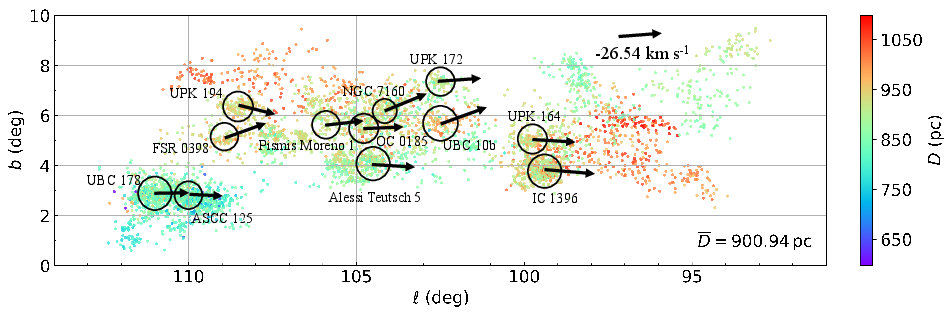
Figure 1: Spatial distribution of Snake III member stars colored by distance, with marked open clusters and median tangential velocities.
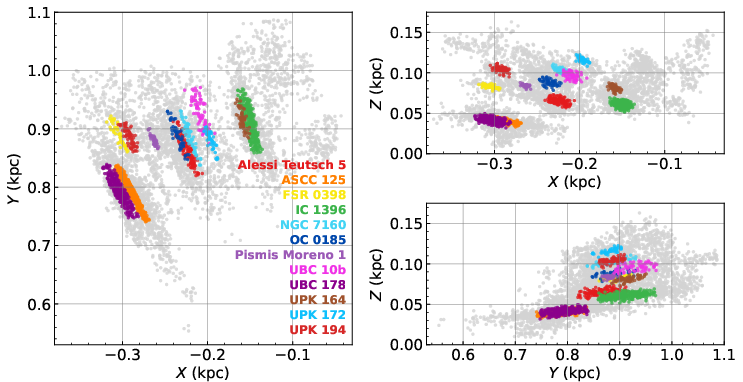
Figure 2: Cartesian (X,Y,Z) distribution of all Snake III stars and clusters relative to the Sun.
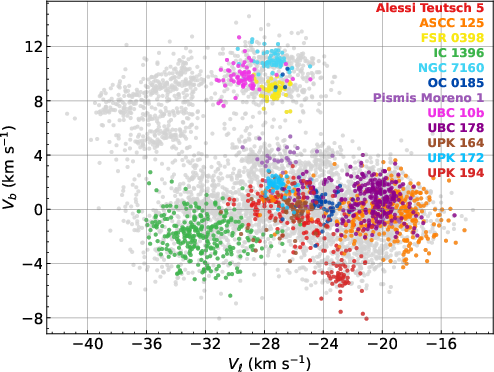
Figure 3: Tangential velocity parameters (Vl, Vb) elegantly separate cluster populations from the complex.
The kinematic profile, including radial velocity histograms, confirms a global median Vr=−20.57±0.51 km/s, underscoring physical homogeneity and common origin.
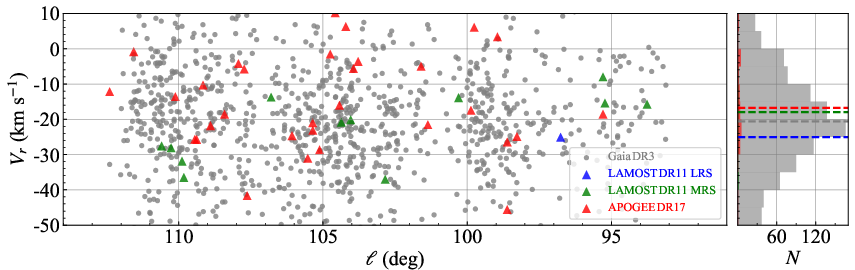
Figure 4: Radial velocity distribution of member stars along Galactic longitude, consolidated by multiple spectroscopic datasets.
Age Estimation and Population Segregation
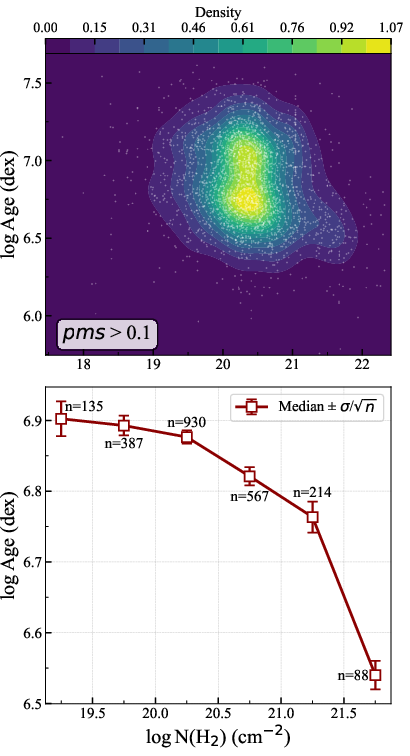
Robust age determination hinges on pre-main sequence (PMS) identification via the Sagitta neural model, cross-validated against isochrone fitting for open clusters (ASteCA, PARSEC). PMS probability thresholds (pms>0.1) ensure reliable log(Age) estimates. The four richest clusters (Alessi Teutsch 5, ASCC 125, IC 1396, UBC 178) exhibit ages spanning $4.4-10$ Myr, providing key temporal anchors across the spatial density gradient.
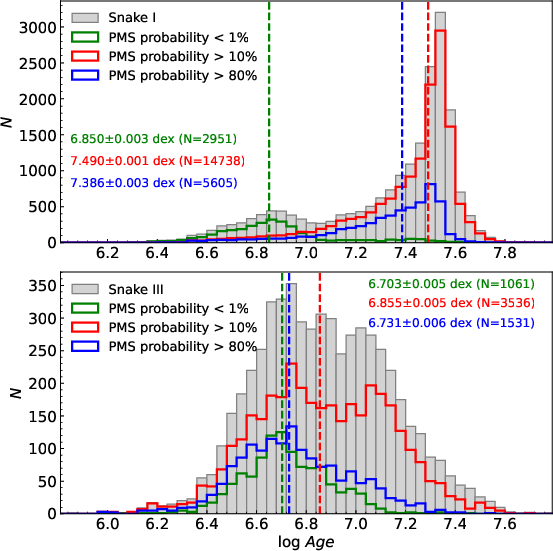
Figure 5: Age histograms for Snake I and III, delineated by PMS probability contours and cluster median log(Age).
Molecular Cloud Mapping and Physical Correlation
MWISP 30CO, 31CO, and C32O observations, coupled with 3D dust extinction maps (Green et al.), define the molecular architecture coincident with Snake III. High-precision distance anchoring (BEEP method) correlates molecular clouds (G105.2+05.0 to G117.0+03.7) spatially and kinematically with Snake III, forming the Cep OB3 complex. Cloud density, excitation temperature, centroid velocity, and velocity dispersion metrics are derived via LTE formalism and CO-33 factor conversion.
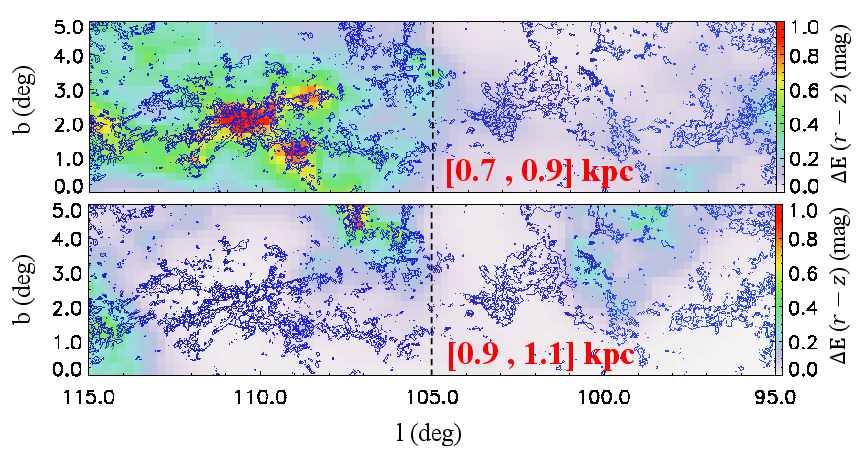
Figure 6: 3D extinction integrated dust maps overlaid with MWISP 34CO intensity contours at key distance intervals.
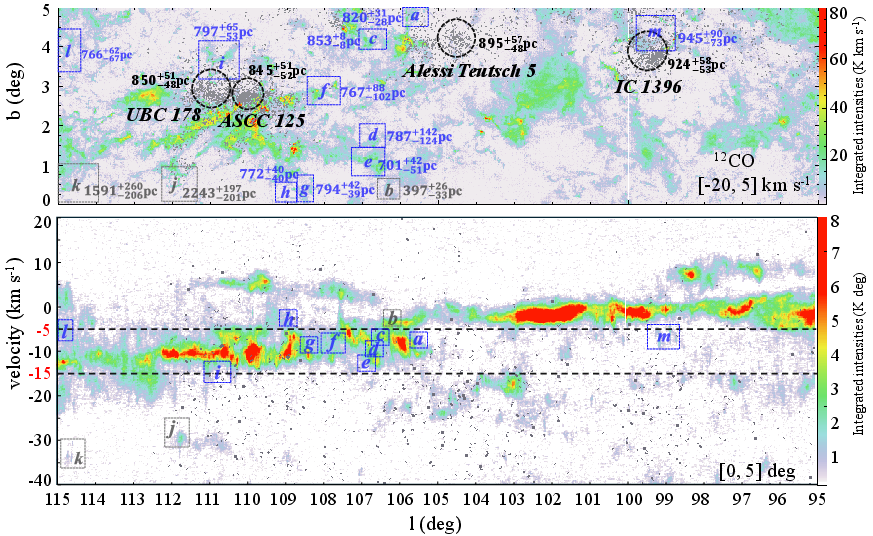
Figure 7: Galactic 35 and 36 maps of 37CO intensity, open clusters, and identified clouds; cluster distances annotated.
Cloud column density and mass mapping identifies a monotonic density increase towards higher Galactic longitude, with young clusters forming in higher-density regions (exceptions discussed below).
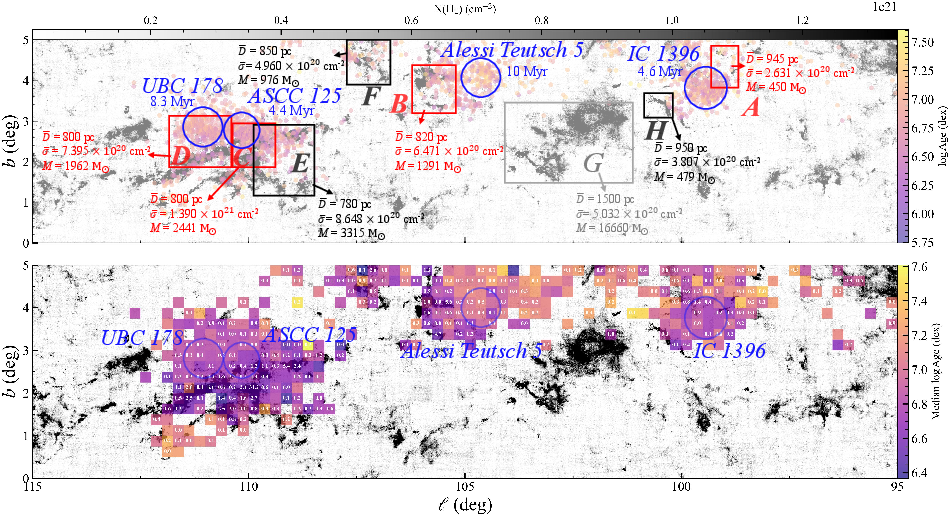
Figure 8: H38 column density background (upper: single-star ages, lower: local median ages) with key molecular regions and cluster positions highlighted.
Quantitative Star–Cloud Correlation
Statistical analysis of cluster and field star ages against local gas density reveals clear trends:
Feedback, Dynamical Coupling, and Velocity Structure
Cloud properties (integrated intensity, 90∘<l<115∘0, centroid velocity) and LAMOST H90∘<l<115∘1 emission maps are synthesized across cluster–cloud regions (A–D), revealing distinct feedback signatures (shells, bubbles, BRCs). Cluster-driven feedback compresses local gas, modulates velocity dispersions, and triggers second-generation star formation. K-S tests on velocity dispersion distributions between perturbed and unperturbed regions yield 90∘<l<115∘2 values significantly above CO sound speeds, indicating supersonic turbulence induced by feedback.
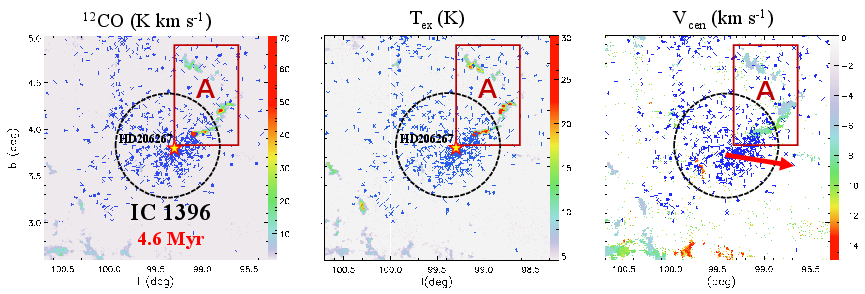
Figure 10: Region A molecular cloud properties with IC 1396, CO intensity, excitation temperature, and centroid velocity.
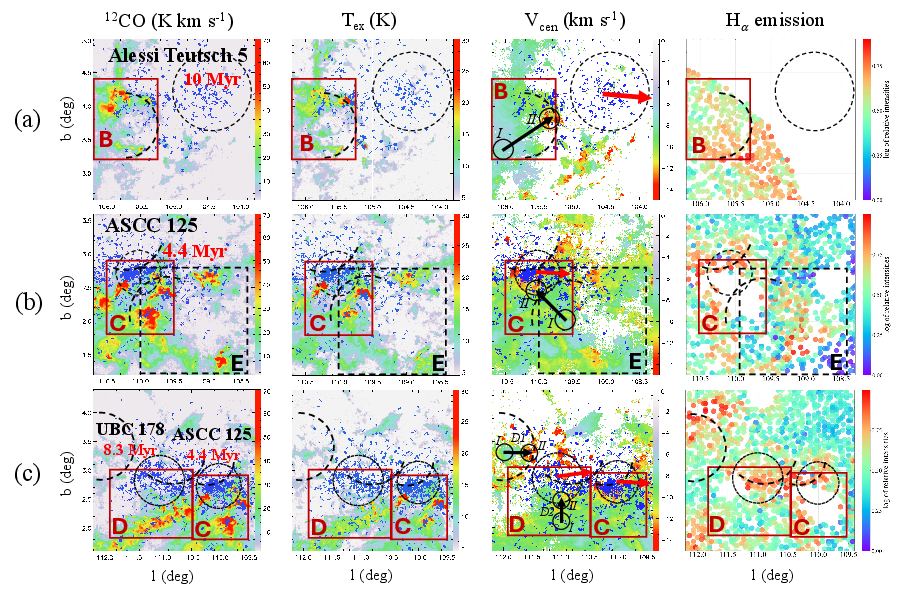
Figure 11: Regions B–D molecular maps with open clusters, feedback directions, perturbed/unperturbed areas, and H90∘<l<115∘3 emission overlays.
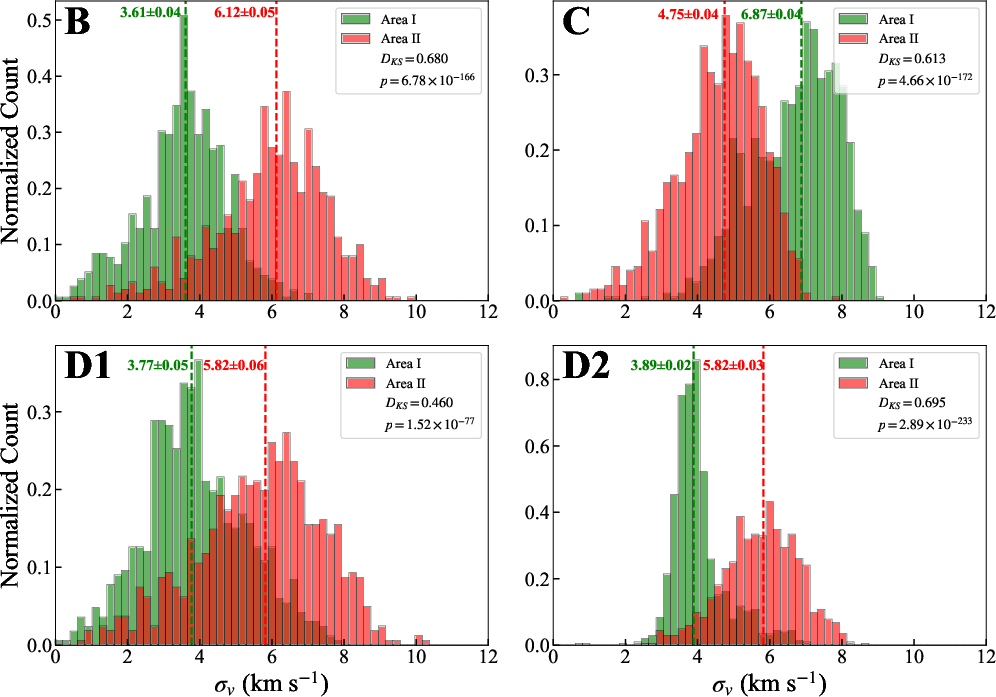
Figure 12: Velocity dispersion (90∘<l<115∘4) histograms for each region, showing significant K-S test separation between feedback-perturbed and unperturbed areas.
ASCC 125 is notably young (90∘<l<115∘5 Myr) and centrally located in the densest gas, but its formation is delayed relative to neighboring clusters. Detailed K-S testing of age distributions confirms statistically significant divergence. The cluster appears second-generation, triggered by combined feedback from UBC 178 and a possible supernova-induced bubble (“E-bubble”), with detailed P–V analysis supporting a dynamical age for the shell of 90∘<l<115∘6 Myr and measurable expansion velocities.
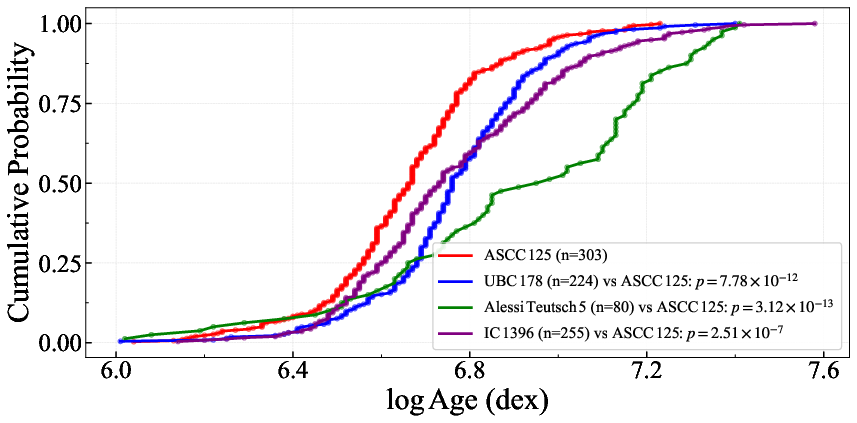
Figure 13: CDFs for Sagitta ages of four clusters, with K-S 90∘<l<115∘7-values confirming ASCC 125’s uniquely young profile.
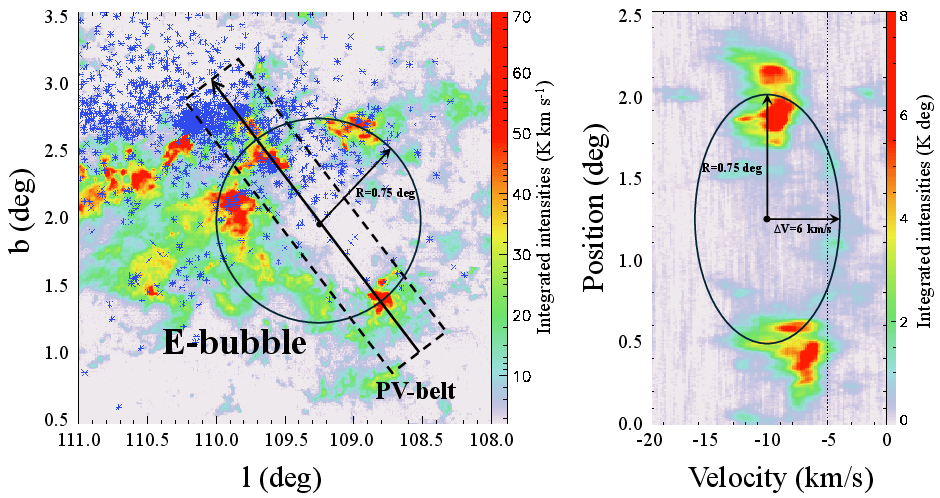
Figure 14: 90∘<l<115∘8CO integrated intensity map and P–V diagram of the E-bubble structure, evidencing dynamical impact and shell expansion.
Implications, Future Directions, and Observational Biases
This work validates hierarchical filamentary star formation within GMCs, with direct evidence for density-regulated star formation and feedback-driven propagation of stellar generations. The findings highlight the necessity of high-resolution, multi-wavelength observations to resolve star–gas interactions and to recalibrate mass function and binary fraction estimates in the presence of strong extinction and selection biases. Enhanced coverage via multi-band platforms (e.g., JWST) and interferometric imaging will sharpen constraints on SFE, IMF slope variations, and feedback efficiency.
Conclusion
Snake III exemplifies a physically and kinematically coherent young stellar complex spatially embedded within residual molecular gas, demonstrating:
- Strong numerical evidence for physical homogeneity and common origin across both stellar and molecular phases.
- Statistical correlation between stellar age and gas density, modulated by local feedback, with quantifiable velocity dispersion enhancements in feedback zones.
- The formation of anomalously young, high-density clusters (ASCC 125) through second-generation triggering by cluster winds and supernova remnants.
The study provides a template for dissecting star–cloud co-evolution in hierarchical Galactic structures. It underlines the interplay of initial cloud density gradients and stellar feedback as primary regulators of star formation, offering a uniquely young laboratory for quantifying co-evolutionary histories in star-forming regions.