- The paper demonstrates that bremsstrahlung losses severely limit pB11 inertial fusion, requiring near-complete radiation trapping to achieve scientific breakeven.
- The study uses rate equation burn modeling and numerical scans to define optimal density, temperature, and fuel mix for fusion power to exceed losses.
- Critical thresholds in areal density and pressure are identified, highlighting the gap between current experimental setups and pB11 fusion requirements.
Bremsstrahlung Constraints on Proton-Boron 11 Inertial Fusion
Introduction and Motivation
This work systematically analyzes the feasibility of inertial confinement fusion (ICF) for the proton-boron 11 (pB11) reaction, focusing on irreducible radiative losses from bremsstrahlung and the secondary effects of alpha particle poisoning. The pB11 reaction remains a subject of intense interest due to its negligible neutron emission and benign byproducts; however, the inherent challenge lies in surpassing bremsstrahlung losses, which typically exceed the generated fusion power under conventional operating regimes—especially in ICF systems, where alpha-ash removal options are severely limited compared to magnetic confinement fusion (MCF).
The authors employ rate equation burn modeling coupled with density- and temperature-dependent bremsstrahlung emission and reabsorption, using current cross-section data. The study quantitatively establishes practical density, temperature, and burn regimes which could allow scientific breakeven, and critically evaluates the proximity (or lack thereof) between these regimes and present-day experimental capabilities.
Analytical Overview: Burn Fraction and Power Balance
The paper establishes that two essential challenges must be met for net energy gain in pB11 ICF:
- High Burn Fraction: To avoid substantial energy investment losses relative to output, the burn fraction (especially for boron nuclei) must be maximized, requiring both sufficient confinement time and optimal fuel mix.
- Bremsstrahlung Capture: Given the high Z of boron, bremsstrahlung losses scale significantly with boron fraction. Hence, trapping reabsorbed bremsstrahlung within the hot spot is mandatory for sustainable burn. The study utilizes steady-state power balance equations to explicitly relate electron temperature, ion temperature, fuel composition, and burn duration to achievable Qsci (fusion output over assembly energy input).
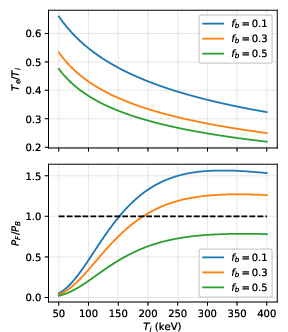
Figure 1: Steady-state electron temperature and the fusion-to-bremsstrahlung power ratio as functions of ion temperature and boron fraction.
Numerical scans establish that above certain boron fractions, breakeven is unachievable; for instance, at fb=0.3, ion temperatures of at least 200 keV are necessary for fusion power to overtake bremsstrahlung losses—but even this is not in itself sufficient for reactor-level gain.
Numerical Simulations: Rate Equation Models
Detailed particle and energy density evolution models pair cross-sectional fusion rates and fit bremsstrahlung emission formulae, explicitly integrating over electron and ion populations and the full fuel mixture. Simulations are validated via burn completion metrics and parameter sweeps across temperature, density, areal density, and fuel mix:
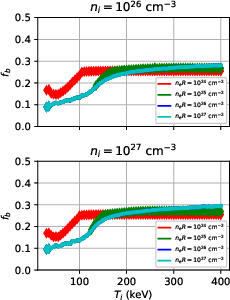
Figure 2: Optimal boron fraction for transparent-to-bremsstrahlung regime, indicating maximum possible Qsci for each Ti and neR combination.
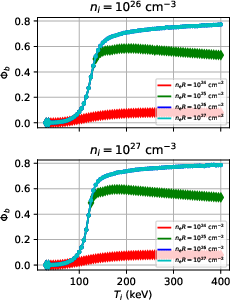
Figure 3: Simulated boron burn fraction for various densities and plasma sizes, confirming typically incomplete burn at lower areal densities.
Crucially, without any bremsstrahlung reabsorption, Qsci barely approaches 2 for the most optimistic current ICF conditions, with achievable burn fractions capped at approximately 70%, and incomplete burn for ρR<1025 cm−2. Lowering the electron temperature during assembly yields only limited improvement.
Modeling Bremsstrahlung Reabsorption
The authors develop an absorption and escape fraction model for bremsstrahlung photons, employing frequency-dependent inverse bremsstrahlung absorption rates. This is parameterized by κ (inverse absorption length), governed primarily by ne, Te, and system size R, and calculated via advanced interpolation over a four-dimensional grid.
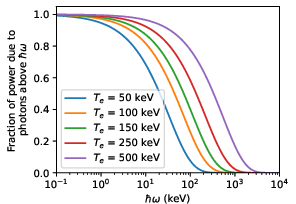
Figure 4: Fractional bremsstrahlung power above given photon energies, indicating what proportion escapes if the plasma is optically thick below a cutoff.
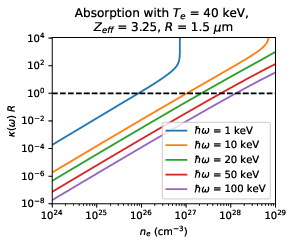
Figure 5: Density dependence of inverse absorption length, showing extremely rapid increase of κ as ne approaches critical density nc for bremsstrahlung photons.
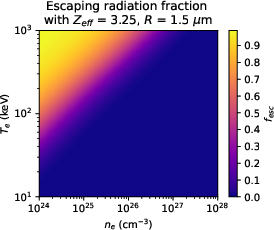
Figure 6: Escape fraction fesc versus density and temperature; only very high densities allow substantial trapping.
When incorporated into the burn model, bremsstrahlung reabsorption enables a dramatic enhancement in Qsci—values up to 15–20 are achieved at Ti∼40 keV if ne2R is sufficiently high to trap most radiation. The optimum fuel composition shifts toward higher boron fractions when bremsstrahlung losses are suppressed.
Practical Constraints: Pressure, Density, and Yield
Combining the imposed requirements on burn time, bremsstrahlung trapping, and tolerable total fusion yield, the work derives critical thresholds for density and areal density:
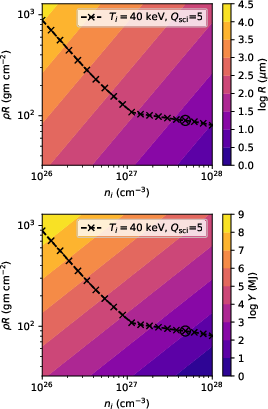
The intersection of these constraints, for a power plant scale yield (∼100 MJ), requires ion densities ni≳6×1027 cm−3 and corresponding pressures and areal densities nearly two orders of magnitude above present-day National Ignition Facility (NIF) parameters.
Model Limitations and Degeneracy Regime
It is emphasized that as density increases (at modest temperatures), electron degeneracy becomes substantial; Fermi energies rise, and the usual collision and radiative models become invalid. This regime exhibits suppressed bremsstrahlung and collisional losses but demands different EOS and reaction rate treatments.
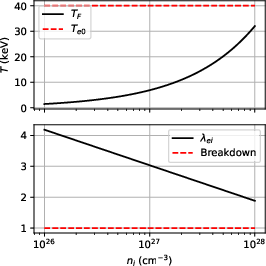
Figure 8: Fermi temperature and Coulomb logarithm versus ion density for 40 keV plasma, demonstrating non-ideal plasma breakdown at high density.
Future modeling should integrate degeneracy physics, Salpeter screening, and possibly nonuniform ("fast ignition" or shell-based) target geometries.
Conclusion
The analysis rigorously demonstrates that scientific breakeven for pB11 ICF, when accounting for irreducible bremsstrahlung losses and necessary fuel burn fraction, is unrealizable without near-complete bremsstrahlung trapping. Achieving required optical thickness and burn duration necessitates densities and areal densities two orders of magnitude above current practice. The optimal operating point approaches high-density, low-temperature regimes, where electron degeneracy is significant and conventional plasma models must be supplanted.
While not excluded by first principles, practical realization of pB11 ICF power plants awaits laser and compression advances far beyond state-of-the-art, and must contend with neutron yield from side-chain reactions. Theoretical and computational advances into the highly degenerate, strongly coupled plasma domain will be prerequisite for credible progress, possibly illuminating new pathways for high-gain, low-radiation fusion.
References
For detailed derivations, numerical values, and extended modeling assumptions, see the original manuscript "Bremsstrahlung constraints on proton-Boron 11 inertial fusion" (2511.10885).