- The paper introduces a treatment‐gated representation and a hybrid loss to effectively model zero-inflated, heavy-tailed revenue in B2B sales.
- It employs a sparse-revenue mixture model with value‐weighted ranking loss to prioritize high-value 'whale' accounts and enhance Qini scores.
- Experimental results demonstrate significant gains, including a 2.7× revenue increase per account and improved operational metrics through rigorous offline and online validation.
Value-Aware Revenue Uplift Modeling with Treatment-Gated Representation: An Expert Analysis of VALOR
Motivation and Problem Setting
In structured B2B sales environments, particularly enterprise-scale cloud computing, high-touch sales interventions are costly and resource-constrained. Unlike B2C environments, where algorithmic targeting is feasible at scale, B2B uplift modeling faces two fundamental obstacles: (1) an extreme zero-inflation in realized revenue—over 80% of potential accounts yield no incremental gain, and (2) a heavy-tailed distribution in positive instances, where a few "whale" accounts drive most value. Standard propensity models predict P(Y∣X) and thereby conflate natural conversion and intervention effect, inflating perceived ROI by capturing the "cream skimming" effect (targeting users likely to convert regardless of intervention). Causal uplift modeling on P(Y∣T=1)−P(Y∣T=0) is needed for actual incremental impact, but suffers from gradient collapse and inability to prioritize rare high-value persuadables.
The VALOR Framework: Architectural Innovations
The VALOR architecture addresses these deficiencies with a Treatment-Gated Sparse-Revenue Neural Network coupled to a custom hybrid loss. The framework processes account features (X) and binary treatment (T) in three explicit stages for robust zero-inflated modeling and capacity-aware revenue maximization. The critical architectural elements include:
- Treatment-Gated Interaction Module: Incorporates a learned bilinear gate using a sigmoid activation to reweight features adaptively based on treatment, addressing the "vanishing treatment" phenomenon by enhancing the expressiveness of conditional heterogeneity in X-T interactions.
- Sparse-Revenue Mixture Heads: Explicitly decouple the decision (conversion/hurdle) component and the value (revenue magnitude/volatility) component, parameterizing a zero-inflated log-normal (ZILN) mixture appropriate for heavy-tailed, sparse B2B revenue.
- Hybrid Objective: Integrates Focal-ZILN loss to prevent collapse under zero-dominated outcomes, and a cost-sensitive value-weighted pairwise ranking loss to prioritize revenue-maximal ordering under operational constraints.
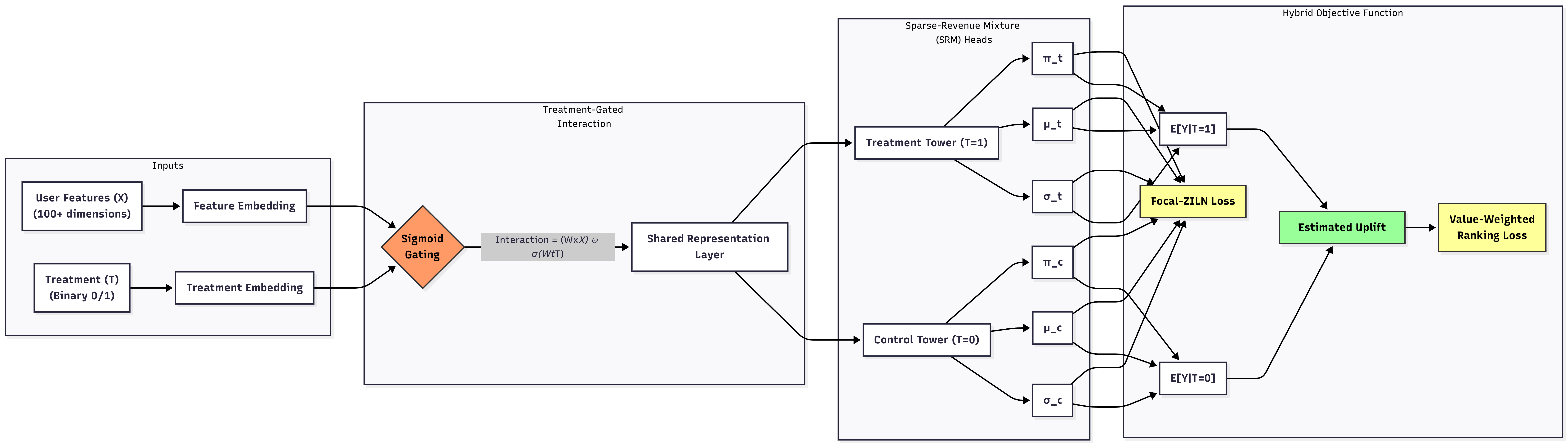
Figure 1: The VALOR training pipeline combines treatment-gated feature interaction, sparse-revenue mixture heads, and a hybrid loss to dynamically model zero-inflated uplift and maximize top-decile revenue capture.
Loss Functionality and Theoretical Justification
Focal-ZILN Loss
The Focal-ZILN loss adapts standard zero-inflated log-normal NLL to account for heavy class imbalance by applying a focusing term (with parameter γ) on the prevalence of zeros, and a balancing factor α. The regression branch operates on log-revenue for positive conversions. This design shifts optimization emphasis from "easy negatives" (ubiquitous zeros) to sparse, informative non-zero samples, shielding the gradient from collapse that would otherwise bias models to conservative (low-signal) predictions in highly imbalanced settings.
Value-Weighted Ranking Loss
The pairwise ranking objective is weighted by the absolute or log-magnitude of revenue discrepancy between every account pair, and penalizes catastrophic mis-orderings (e.g., mis-ranking high-value "whales" below non-converters) disproportionately relative to minor ranking reversals. This directly aligns model learning with downstream operational goals (maximizing AUUC and Qini), and overcomes limitations of pointwise MSE which rewards calibration rather than actionable prioritization.
Theoretical Rationale
The loss configuration is formally shown to optimize a convex upper bound on value-weighted pairwise accuracy, which is sufficient for optimizing the Qini coefficient under severe outcome sparsity, in contrast with traditional PEHE-minimizing models that can achieve low error but poor practical ranking.
Treatment-Gated Representations and Prognostic Bias Mitigation
In high-dimensional B2B telemetry, main effect signals dominate, causing standard architectures to regularize away rare but crucial HTE. The Treatment-Gated Interaction Module acts as a multiplicative feature selector, enforcing treatment-conditional subspace focus—thereby enabling the model to attenuate irrelevant prognostic variance and recover actionable conditional uplift even with noisy, sparse interventions. This mechanism is critical to convergence and stability of both focal and ranking losses in large-scale B2B settings.
Interpretable Variant: Robust ZILN-GBDT
To meet explainability mandates for high-touch account management, VALOR is distilled into a variant tree-based model (ZILN-GBDT), using a custom node-splitting criterion that maximizes uplift heterogeneity (Euclidean distance in ZILN uplift between splits) and Bayesian smoothing for distributional stability in small leaves. This enables practical, SHAP-enabled interpretability for premium accounts, complementing the DNN's strength in high-volume, long-tail routing.
Experimental Validation and Ablation
Offline Numerical Results
VALOR achieves a 20% improvement in Qini rankability over state-of-the-art baselines on synthetic data. RERUM-DragonNet, itself specialized for ZILN ranking, underperforms VALOR both in Qini (0.26 vs. 0.30) and in Kendall’s rank correlation. On production data, VALOR-CFR-WASS achieves a Lift@30 of 51.21, relative to 43.5 for the best baseline—indicating superior prioritization.
Component Ablation
Ablation experiments confirm that each modular addition—ZILN, Focal, Value-Weighted Ranking, Treatment-Gated Interaction—contributes quantifiable step-wise improvements to AUUC and Qini. Notably, the value-weighted ranking objective is the dominant factor in practical business lift, as measured by operational surrogate metrics.
Online A/B Experiment
A rigorous 4-month RCT on production traffic confirmed a 2.7× increase in incremental revenue per assigned account (\$1185 vs. \$445), and an 8.3% absolute lift in opportunity creation rate, with high statistical confidence. This translates to an annualized \$30M revenue lift, validating the substantial practical effectiveness of value-aware uplift modeling under real-world constraints.
System Deployment and Feedback Loops
VALOR incorporates system-level MLOps with drift-aware continuous training, assignment logic ensuring both A/B testability and quarterly pacing, and a mandatory 90-day cooling-off period to prevent assignment contamination and correctly attribute lagged incremental ARR gains. Data and outcome feedback loops reinforce clean, iterative causal learning and minimize bias in closed-loop operational environments.
(Figure 2)
Figure 2: Deployed system architecture, showing data pipelines, feature store integration, hybrid routing, A/B assignment, and closed-loop outcome collection with causal auditability.
Implications and Future Directions
Practically, VALOR establishes a new best-in-class for causal resource allocation in sparse, high-value B2B domains, complementing state-of-the-art direct uplift optimization (e.g., RERUM) by prioritizing both treatment-conditional representation and outcome cost asymmetry. Theoretically, it supports the argument that calibration alone is insufficient in regimes with outcome sparsity and operational capacity constraints, and that value-aware ranking losses are necessary for robust decision-making.
Future work will extend to continuous-time modeling with Temporal Point Processes (TPP) to not only optimize whom to treat, but also adapt the timing of interventions at the individual account level, leveraging event history embeddings for dynamic, rhythm-based sales optimization.
Conclusion
VALOR advances the causal modeling paradigm for B2B sales optimization by integrating treatment-aware representation learning and value-sensitive loss design. It demonstrates robust superiority over prior uplift frameworks both numerically and under operational A/B evaluation, meeting the stringent demands of real-world enterprise deployment. The bifurcated deep/tree design ensures both automation at scale and interpretability for high-value interactions. The framework is extensible to other resource-constrained, value-skewed causal environments, and paves the way for temporally aware, dynamic allocation in enterprise AI systems.
References: (2604.02472)