- The paper introduces DenOiS, a dual-domain framework that alternates between denoising degraded measurements and refining image solutions using learned models.
- It employs a combination of U-Net-based measurement refinement and physics-integrated diffusion PnP reconstruction to mitigate noise and model errors.
- Experiments show significant improvements in RMSE and ACE, demonstrating enhanced inclusion detectability and robust generalization from simulated to clinical data.
Dual-Domain Denoising for Robust Ultrasound Inverse Reconstruction: The DenOiS Framework
Introduction
Ultrasound image reconstruction for quantitative metrics such as speed-of-sound (SoS) remains a severely ill-posed inverse problem, fundamentally constrained by noisy and incomplete sensor observations and non-ideal (often linearized) physical forward models. Traditional regularized analytical inversion and deep learning (DL) approaches face robustness and generalization issues under these adverse conditions, especially when bridging the domain gap from simulated (in-silico) to real, clinical data. "DenOiS: Dual-Domain Denoising of Observation and Solution in Ultrasound Image Reconstruction" (2604.02105) introduces a unified, iterative dual-domain architecture addressing these challenges. The framework integrates learned measurement refinement with a diffusion model-based plug-and-play (PnP) reconstruction mechanism, alternating between observation and solution domain denoising steps.
Background
Conventional inverse solvers for imaging, including those for MRI, CT, and US, are predominantly based on regularized solutions to ill-posed linear systems, sometimes leveraging variational approaches with hand-tuned penalties. End-to-end DL alternatives, both for direct mapping and for denoising, have demonstrated efficacy but remain fragile to domain shift and missing input data.
Recent lines of work employ more hybridized methodologies, notably unrolling and PnP schemes, which combine explicit data consistency enforcement (using the imaging model) with learned priors in the image domain. However, the dependence of all these methods on the input measurement quality and model accuracy remains unresolved.
DenOiS frames the reconstruction process as a dual-domain cycle: the measurements themselves are denoised and corrected using a learned model informed by an approximate image solution, while diffusion models serve as flexible, powerful priors for alternating denoising under data consistency constraints.
Methodology
The DenOiS iterative framework can be decomposed into two interleaving modules:
- Measurement Refinement (M): A learned map, realized either by a U-Net or diffusion model, takes degraded observations b′, their projection from current solution estimates A′x′, and auxiliary priors P describing undersampling/missing data. It inverts degradation, performs denoising, and inpaints missing measurements.
- Physics-Integrated Diffusion PnP Reconstruction (D): A conditional diffusion model alternates with explicit data consistency updates, denoising the current solution via multiple consecutive steps before projecting back to the measurement space. Conditioning on multiple analytical reconstructions (e.g., TV-regularized ℓ1 and ℓ2 solutions) provides strong inductive bias, and the approach is robustly tailored for operation with both synthetic and real, heavily degraded data.
This alternating process harmonizes measurement and solution domain updates, facilitating convergence even under significant forward model mismatches and data incompleteness.
After describing standard and PnP-based approaches (Figure 1(a–d)), the proposed DenOiS procedure is schematized (Figure 1(e)), and its application to US SoS recovery from partial phase-shift observations is illustrated (Figure 1(f)).
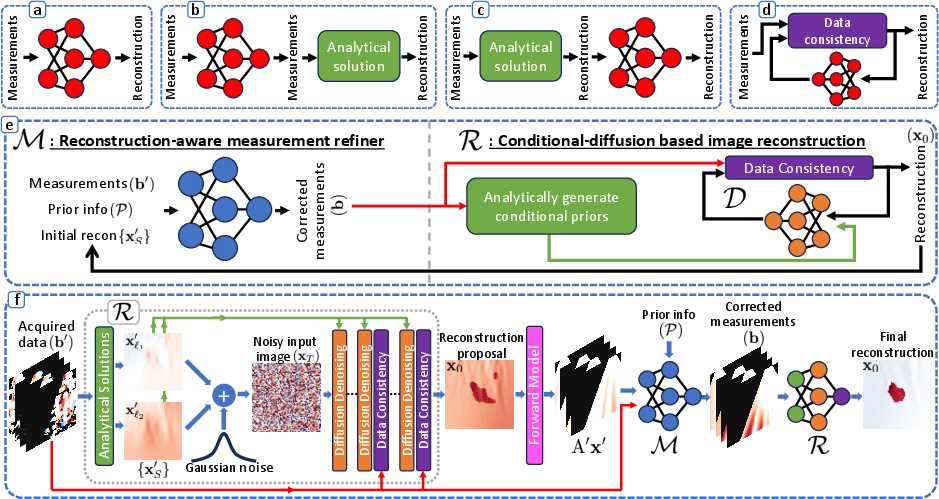
Figure 1: Deep learning approaches for image reconstruction and the proposed DenOiS iterative dual-domain denoising pipeline.
The framework is specifically instantiated for US SoS imaging through a limited-angle acquisition geometry and restricted observation set, with the imaging operator A′ capturing linearized ray optics and training datasets synthesized with and without complex forward model discrepancies.
Experimental Validation
Strong empirical evidence is supplied for DenOiS across several regimes:
- In-silico Simulations: High-resolution phantoms and k-Wave based simulations evaluate generalization from simple to complex, distribution-shifted test sets.
- Phantom Experiments: Controlled acquisition on tissue-mimicking phantoms with manufacturer-annotated SoS regions enables direct metric comparisons.
- In-vivo Breast Cancer Imaging: Domain adaptation and measurement correction are stress-tested on clinical breast images with severe observation loss and real-world noise.
Qualitative reconstructions for both simulation and experimental phantoms are depicted alongside quantitative error metrics (Figure 2(a)), with in-vivo SoS mapping results for a breast carcinoma patient (Figure 2(b)). Figure 2(c) explicitly visualizes the effect of dual-domain measurement corrections.
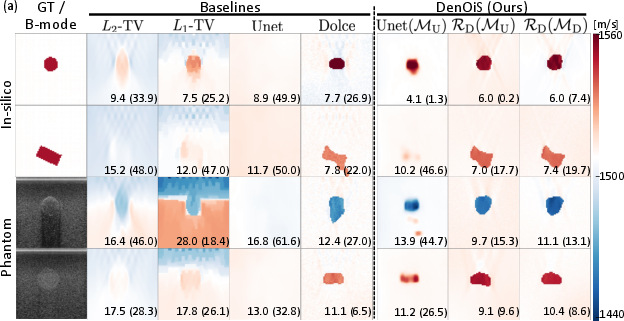
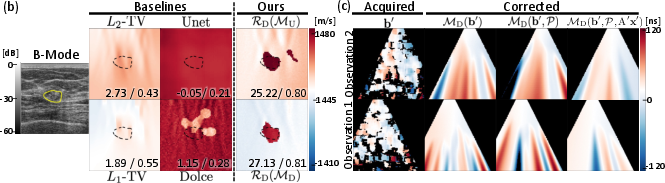
Figure 2: (a) Representative reconstructed images and corresponding error metrics; (b) In-vivo breast cancer case; (c) Measurement refinements using DenOiS modules.
Numerically, the DenOiS variants incorporating both projected solution priors A′x′ and physical prior maps P consistently achieve the lowest RMSE and absolute contrast error (ACE) across synthetic, phantom, and in-vivo data. Notably, direct mapping models (Unet) exhibit low RMSE but fail to capture inclusion contrast (high ACE), substantiating the risk of distribution shift.
Key empirical claims include:
- Measurement refinement, especially with access to projected image priors, robustly reduces both RMSE and ACE for all reconstruction models.
- The proposed conditional diffusion reconstruction module b′0 surpasses both vanilla Unet and prior diffusion-based PnP approaches (e.g., DOLCE), particularly for ACE in real and highly noisy domains.
- DenOiS generalizes from in-silico training to real clinical data, enabling robust inclusion delineation where baseline methods fail.
Implications and Theoretical Considerations
DenOiS advances the state of the art in solving inverse problems with significant degradation and forward model uncertainty, especially in the context of quantitative US. By explicitly decoupling degradation correction and leveraging iterative, conditional generative models in each domain, it overcomes both measurement noise/missingness and domain shift. The theoretical underpinning, grounded in explicitly accounting for operator error and proposing measurement refinement as a function of reconstructions (Equation 3 in the paper), formalizes a pathway for correcting model-induced biases.
The dual-domain alternating paradigm could be generalized to other imaging contexts where analytical priors are only approximate and physical observations are unreliable, such as accelerated MRI (motion/dose artifacts), sparse CT, or PET (low photon counts).
Future directions may include unsupervised or self-supervised adaptation to unseen clinical data distributions, integration with uncertainty quantification via posterior sampling, and automated discovery of relevant auxiliary priors for improved denoising.
Conclusion
DenOiS constitutes a methodologically robust, empirically validated framework for image reconstruction under imperfect models and partial/noisy data, operationalized via iterative dual-domain denoising—measurement refinement informed by projected solution priors, and physics-constrained diffusion PnP image regularization. This approach enables high-fidelity, generalizable reconstruction from in-silico to real, clinically acquired datasets, with significant improvements in inclusion detectability and contrast quantification, and is extensible to a wide array of medical imaging inverse problems.

