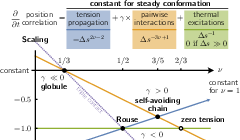
- The paper develops a unified analytical framework based on Gaussian closure and DMFT to model the conformational dynamics of self-avoiding heteropolymers.
- It demonstrates how hydrodynamic coupling and active noise yield distinct scaling regimes that predict chromatin-like compaction.
- The work recovers classical polymer scaling laws and provides testable predictions for both equilibrium and non-equilibrium polymer systems.
Gaussian Closure and Dynamical Mean-Field Theory for Self-Avoiding Heteropolymers
Introduction
This work establishes an analytically tractable framework for the conformational dynamics of self-avoiding, hydrodynamically coupled heteropolymers, notably with applications to chromatin. The central innovation is the direct treatment of the pairwise contact map via a dynamical mean-field theory (DMFT) derived from the Langevin equation, truncated at the two-point correlator using a Gaussian closure. This approach provides unified access to conformation evolution, contact probabilities, fluctuation statistics, and their controlling physical processes for a broad class of non-equilibrium polymers, going well beyond conventional linear response or phenomenological polymer models.
The conformational dynamics are formulated by Langevin equations for N-monomer polymers, with both local and hydrodynamic couplings governed by a conformation-dependent mobility tensor. Both monomer-specific and spatially correlated noise sources are included, accommodating intrinsic (thermal) and active (non-thermal) fluctuations. The key observable is the two-point correlator Xin(t)=⟨ri(t)⋅rn(t)⟩, from which all pairwise distances and, by extension, contact probabilities can be inferred.
Crucially, higher-order correlators are truncated via Gaussian closure, justified by both information-theoretic entropy maximization given experimental data (e.g., from Hi-C) and the physical symmetry properties of polymers lacking a broken-symmetry ground state. The time evolution of Xin(t) and its generalizations is then derived using the Novikov-Furutsu theorem and exploiting isotropy and causality, resulting in a nonlinear, nonlocal diffusion equation in sequence space.
Dynamical Mean-Field Theory and Physical Interpretation
The resulting DMFT generalizes previous mean-field and Hartree-Fock-like treatments, but, unlike prior field-theoretic or concentration-based approaches, operates directly on the contact map. The full time-evolution, including non-equilibrium steady states and fluctuation dynamics, is captured via self-consistent equations for Xin(t) incorporating hydrodynamic kernels (Zimm), spring networks (Rouse, Kirchhoff), and nonlocal contact energies (self-avoidance or attraction). The effective hydrodynamic coupling and response matrices are treated with orientational and pre-averaging approximations to enable tractability without sacrificing the correct asymptotic scaling.
A critical insight is that the folding process can be interpreted as nonlinear, nonlocal diffusion of correlations on a triangular domain—pairwise correlations diffuse away from the diagonal, reflecting physical tension propagation along the chain.
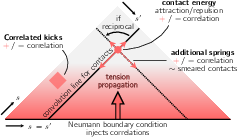
Figure 1: Effective nonlinear and nonlocal diffusion of pairwise correlations in sequence space, illustrating the dynamical mean-field evolution of the contact map.
Recovery of Classical Polymer Scaling and Regimes
The Gaussian closure-derived DMFT is shown to recover the established scaling exponents associated with different physical regimes:
Deviations from the exact numerical Flory exponent (Xin(t)=⟨ri(t)⋅rn(t)⟩0) are attributed to the same mean-field artifacts that underlie traditional Flory theory, representing a consistent and expected limitation of the Gaussian truncation.
Compaction by Active and Hydrodynamic Noise
A central theoretical advance is the prediction and analytical treatment of nonequilibrium compaction mechanisms:
- Active, spatially correlated driving: For Rouse chains subjected to large-scale, spatially coherent noise (motivated by observations of ATP-driven chromatin flows), the formalism yields exponents Xin(t)=⟨ri(t)⋅rn(t)⟩1. Specifically, for finite-range correlated flows with coherence length Xin(t)=⟨ri(t)⋅rn(t)⟩2, the Flory-type balance produces Xin(t)=⟨ri(t)⋅rn(t)⟩3, indicating chain compaction intermediate between Rouse and globule.
- Hydrodynamic coupling (Zimm regime): When strong hydrodynamic correlations are present, the DMFT predicts an even more compact state: Xin(t)=⟨ri(t)⋅rn(t)⟩4, corresponding to a fractal dimension Xin(t)=⟨ri(t)⋅rn(t)⟩5. This matches empirical observations in chromatin and captures the essential physics of hydrodynamically enhanced compaction in active systems without invoking explicit loop-extruding mechanisms or irreversible cross-links.
These results represent bold, testable predictions. Notably, the predicted exponents are in close agreement with experimental findings in chromatin imaging and tracking studies [Article::Wang_2016, Article::Shi_Thirumalai_2021].
Theoretical and Practical Implications
The Gaussian closure DMFT achieves three notable breakthroughs for the field:
- Unified description of equilibrium and non-equilibrium regimes: Prior analytical treatments were often restricted to the vicinity of thermal equilibrium; this approach extends to strongly driven/active heteropolymers and directly incorporates hydrodynamic and activity-induced compaction.
- Microscopically justified, non-perturbative framework: The closure at the level of pairwise correlators, together with the nonlocal DMFT, provides a tractable yet highly flexible description, compatible with arbitrary sequence disorder, non-reciprocal interactions, and general driving.
- Contact map-centric modeling: The framework links directly to experimentally accessible observables (e.g., from Hi-C or single-pair tracking), facilitating principled inference from data and model validation.
The theoretical impact is substantial: future work can leverage this DMFT for inextensible polymers, study sequence-dependent disorder, and systematically include tertiary and higher-order interactions. The geometric reinterpretation as nonlocal reaction-diffusion dynamics on the sequence-contact map opens connections to a broad literature in pattern formation and active matter theory [Frey_Weyer_2026, Wurthner_2023].
On the practical side, the theory generates specific, testable predictions regarding the scaling regimes and nature of compaction under different physical perturbations, applicable to chromatin, protein, and synthetic polymer systems.
Outlook and Future Directions
Several immediate extensions follow:
- Incorporating tertiary interactions, hard confinement, and chain inextensibility to probe phase separation and morphological transitions in sequence space.
- Analytical study of dynamic coupling between chromatin proteins and the polymer substate using the reaction-diffusion formalism.
- Quantitative modeling and interpretation of high-resolution imaging and tracking experiments in vivo, particularly regarding the nature of "active" genome compaction and nonequilibrium organization.
- Direct comparison with stochastic simulation (Brownian/active dynamics) and experimental perturbation studies.
Conclusion
This paper provides a comprehensive analytic framework for the dynamics of active, hydrodynamically coupled heteropolymers using Gaussian closure and dynamical mean-field theory. It unifies, extends, and validates existing scaling results for equilibrium and driven polymers, predicts hyper-compact chromatin-like conformations under active hydrodynamic coupling, and exposes the underlying mathematical structure as nonlinear, nonlocal diffusion on the contact map. The methodology opens multiple avenues for theoretical and experimental exploration of non-equilibrium genome organization, network polymers, and active soft matter (2604.02085).