- The paper presents a formal integration of warm-start strategies with constraint-preserving XY-mixers in QAOA, ensuring optimal initial state alignment.
- It employs an iterative hybrid algorithm that dynamically updates bias distributions based on quantum measurements, significantly boosting optimal solution probabilities.
- The method is validated numerically and on IBM’s NISQ hardware, demonstrating orders-of-magnitude improvements over traditional QAOA approaches.
Constrained Quantum Optimization via Iterative Warm-Start XY-Mixers: A Technical Synthesis
Introduction and Theoretical Foundation
The paper "Constrained Quantum Optimization via Iterative Warm-Start XY-Mixers" (2604.02083) addresses persistent limitations in constrained combinatorial optimization with the Quantum Approximate Optimization Algorithm (QAOA), particularly in the enforcement of one-hot constraints. QAOA, a variational quantum-classical hybrid heuristic, typically struggles with hard constraints when approached through penalty-based methods, which both increase the complexity of the search space and degrade solution probabilities. Constraint-preserving mixer strategies, most notably XY-mixers, restrict quantum evolution strictly to the feasible subspace of solutions, but cannot benefit directly from initialization biasing (warm-starting) strategies unless non-trivial mixer-initial state alignment is maintained.
Previous attempts to combine warm-start approaches with constraint-preserving mixers either failed to maintain this alignment or limited the scope of warm-starting to initial states without modifying the mixer, thus forfeiting theoretical guarantees associated with the adiabatic connection of QAOA. This paper achieves a formal and practical integration of these two paradigms through the introduction of the warm-started XY-mixer.
The primary technical contribution is the formulation and analytic proof of a warm-started XY-mixer Hamiltonian for one-hot constraints that guarantees the unique ground state is the warm-started ∣WP⟩ state—an amplitude-encoded superposition over feasible configurations determined by a bias distribution P. The construction embeds single-qubit warm-started mixers into the XY-mixer subspace, producing a Hamiltonian whose eigenstructure precisely aligns with the biased initial state.
By leveraging the Perron-Frobenius theorem, the authors prove that within the Hamming-weight-1 subspace, this state is not only an eigenstate but the unique ground state for any connected mixer topology. Hardware-efficient circuit decompositions, including Trotterized sequences and compact two-qubit Pauli rotations, render the construction directly amenable to NISQ-era QPUs.
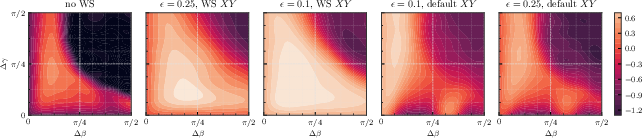
Figure 1: Contour plots show how regularized warm-starting reshapes the QAOA energy landscape, enlarging regions with high approximation ratios when using the aligned XY-mixer.
Iterative Warm-Start (IWS) Framework
The approach is embedded within an iterative hybrid quantum-classical algorithm, IWS-QAOA, which dynamically updates the bias distribution P based on measurement outcomes from prior rounds. Probabilities are updated using a Boltzmann-weighted aggregation of sampled bitstrings, regularized to avoid collapse to single configurations and balanced by a temperature parameter controlling exploitation-exploration.
Unlike approaches that warm-start with external classical solutions (e.g., SDP or relaxation-based), the iterative strategy is agnostic to classical solver selection and adapts bias based on the quantum hardware's observed performance. The parameterization is compatible with linear or more sophisticated QAOA schedules and is robust to QAOA hyperparameter selection.
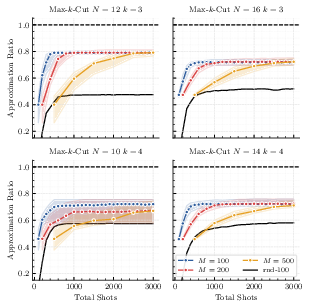
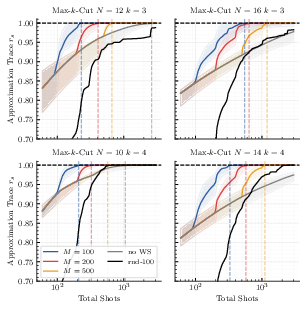
Figure 2: The evolution of the approximation ratio and best-sampled solution trace under IWS-QAOA demonstrates accelerated convergence to optimal solutions with increasing iterations and varying shot ensemble size.
Numerical and Hardware Validation
The algorithm is rigorously benchmarked on Max-k-Cut and Traveling Salesperson Problem (TSP) instances. In both problem classes, IWS-QAOA demonstrates superior performance over non-warm-started QAOA:
- Acceleration of Optimal Solution Sampling: The probability of sampling the optimal solution, Popt, is increased by up to two orders of magnitude for moderate instance sizes. The improvement holds across various shot sizes, with a trade-off between iteration count per update and the risk of local minima entrapment.
- Scaling Behavior: For TSP instances as the number of cities grows, the baseline QAOA fails to find optimal solutions reliably at practical shot budgets, while IWS-QAOA maintains a marked improvement in the approximation trace and Popt. However, at larger sizes or insufficient depth, IWS-QAOA can stagnate in local minima if not properly seeded.
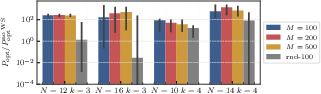
Figure 3: Bar graphs quantify the substantial median improvement of Popt under IWS-QAOA as compared to baseline QAOA across problem types and sizes.
- Finite Depth and Warm-Start Necessity: The method’s efficacy scales with QAOA depth parameter p. At p=1, performance improvements are dramatic for moderate-size instances, but for larger instances, increasing QAOA depth is necessary to consistently reach optimal solutions with IWS-QAOA.
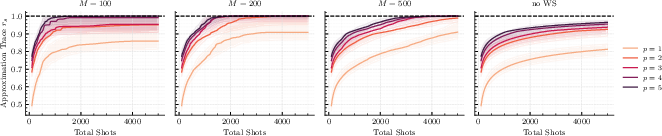
Figure 4: Approximation traces for increasing QAOA depth (p=1 to 5) on 9-city TSPs illustrate that the iterative warm-start enhances optimization throughout the QAOA stack.
NISQ Hardware Demonstration
A significant empirical demonstration is provided on IBM’s Heron r3 QPU (ibm_boston). The authors generate hardware-tailored 144-qubit instances with 48 parallel one-hot constraints (triplets), maximizing feasible two-body interactions through swap layers and aggressive mapping optimization.
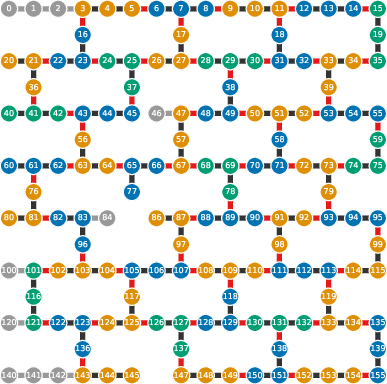
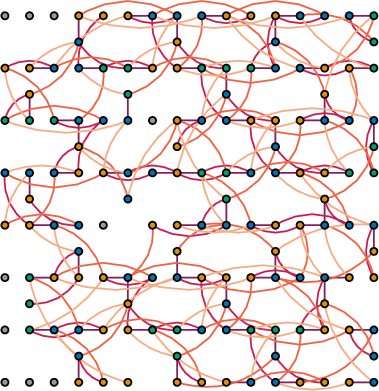
Figure 5: Visualization of the ibm_boston device mapping and corresponding effective interaction graph showcases the embedding of one-hot constraints and design of hardware-efficient interactions.
On real hardware, quantum noise drives frequent constraint violations among bitstrings sampled from the quantum device. A post-processing repair heuristic performs local greedy descent in the QUBO cost, efficiently restoring feasibility with high success, thus highlighting the hybrid nature of practical NISQ algorithms.
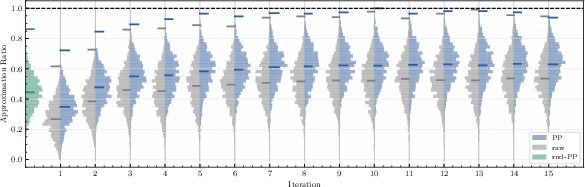
Figure 6: Histograms track shifts in the sampled solution quality distribution on ibm_boston across IWS iterations, before and after post-processing, validating consistent improvements and robustness to hardware noise.
The empirical findings:
- IWS-QAOA, with hardware-efficient warm-started mixers, consistently finds or approaches the known optimal solutions for all five 144-qubit problem instances, outperforming both the baseline QAOA and random-sampling-augmented with post-processing.
- The requirement of classical post-processing for enforcing feasibility is a direct consequence of NISQ hardware limitations; however, the quantum algorithm is shown to strongly bias the outcome distribution even under practical levels of error.
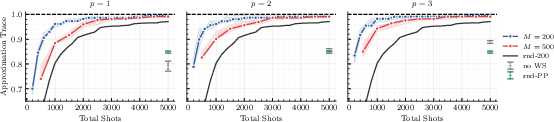
Figure 7: The best solution quality as a function of total shots compares baseline QAOA, IWS-QAOA, and classical random sampling heuristics on hardware, with IWS-QAOA achieving the lowest objective values.
Implications and Outlook
The introduction of the warm-started XY-mixer provides a direct path to achieving theoretically optimal alignment between initial state and mixer, preserving the desired connection to adiabatic-style evolution even in the presence of constraints. The IWS paradigm further bridges practical quantum hardware with adaptive classical heuristics, enhancing robustness, solution quality, and effective search space compression for a range of constrained combinatorial problems.
In practical terms, the results portend scalable approaches to utility-scale quantum optimization [mohseni2026] as hardware fidelity and qubit count increase. The analysis suggests key directions:
- Extending the formalism to broader constraint classes (e.g., higher Hamming-weight, cardinality, or custom logic constraints).
- Development of novel probability adaptation schemes (e.g., explicit exploration mechanisms, genetic search integration).
- Joint optimization of QAOA parameter schedules under iterative distribution shifts and techniques for mitigating hardware-induced infeasibility without full post-processing.
On a foundational level, the work substantiates the necessity of mixer-initial state alignment for high-quality optimization in both classical-quantum hybrid and fully quantum regimes [he2023].
Conclusion
The formulation of the warm-started XY-mixer Hamiltonian and its iterative integration into QAOA constitutes a powerful advance in constrained quantum optimization, yielding large gains in optimal solution probabilities, accelerated convergence, and robustness on both simulators and NISQ-era hardware. Theoretical rigor in subspace construction, hardware-efficient circuit design, and comprehensive empirical validation collectively establish a new standard for quantum heuristics operating over constrained feasible sets. Future theoretical and algorithmic investigations should extend these models to a broader class of constraints, error models, and adaptive hybrid algorithms as quantum hardware matures.