- The paper introduces CFRTransformer, a physics-informed complex Transformer architecture that accurately reconstructs missing multi-band CFR data using holomorphic processing.
- It leverages factored self-attention and composite loss functions to ensure amplitude, phase, and temporal fidelity even under high interference and mobility.
- Empirical evaluations demonstrate CFRTransformer's superior performance over traditional methods, achieving PDP similarity factors up to 0.87 in diverse scenarios.
Introduction
The paper presents CFRTransformer, a physics-informed complex-valued Transformer architecture for reconstructing wideband channel frequency responses (CFR) from time–frequency grids with missing fragments due to realistic, bursty interference. The model targets practical applications in integrated wireless sensing and communication systems, such as passive localization, user detection, and physical-layer sensing in 5G NR and IEEE 802.11bf, where full-band CFR is unavailable because of co-channel interference. Unlike conventional gap-filling or CNN-based approaches, the design emphasizes physical constraints, complex-valued processing, and efficient 2D sequence modeling, incorporating domain knowledge through a composite training objective.
The multi-band CFR is observed across Nb non-overlapping sub-bands, yielding F=NbFb frequency bins, with observations captured over T snapshots. Physical effects—multipath, Doppler shifts, and nonstationary scatterer behavior—are modeled via a sum-of-paths CIR, with Doppler incorporated as randomized per-sample velocity and phase increments. Co-channel interference is staged as a two-state Discrete-Time Markov Chain (DTMC) binary mask, realistic for dynamic spectrum sharing and occupancy, affecting entire sub-bands over contiguous time windows.
Inputs to the model are three per-grid features: real and imaginary parts of the masked CFR and the interference mask.

Figure 1: The masked channel, which is the input tensor to the CFRTransformer.
These are embedded via a holomorphic ComplexLinear layer, applying weight tying that enforces the Cauchy-Riemann conditions to guarantee preservation of amplitude–phase relationships critical for accurate path profiling in delay and Doppler domains. This approach avoids the breakdowns seen when treating real–imaginary parts independently.
Frequency Positional Encoding
Absolute spectral location is provided via sinusoidal encoding along the frequency axis, ensuring that each bin's spatial context is unambiguous and that the model is not invariant to band permutation—crucial in multi-band, fragmented spectra.
Factored Self-Attention
The architecture uses a two-pass, axis-wise (factored) self-attention block rather than a fully flattened TF-length attention, drastically reducing computational complexity from O((TF)2) to O(TF2+FT2):
- Frequency attention: Models spectral correlations within a time slice, enabling inference of missing bands from their neighbors.
- Time attention: Learns Doppler-coherent channel evolution and captures multi-snapshot interference patterns.
A position-wise feed-forward network with residuals and normalization bridges each block, and the output head is another holomorphic linear projection to the complex domain.
The composite loss is central to enforcing physical plausibility:
- Spectral fidelity (LCFR): Enforces amplitude and phase accuracy between estimates and ground truth.
- PDP fidelity (LPDP): Minimizes the MSE over the power delay profile—essential for temporal resolution, evaluated via a normalized similarity metric.
- CIR sparsity (Lsparse): Encourages reconstructions with realistic (physically motivated) sparse path structures.
- Temporal smoothness (Ltemp): Penalizes nonphysical, abrupt fluctuations in CFR, parameterized by a velocity-dependent smoothness cost.
Randomization of velocity per training instance ensures coverage of multipath-Doppler regimes from pedestrian to vehicular, preventing domain overfitting and fostering robustness to mobility.
Evaluation and Results
Qualitative Analysis
CFRTransformer reconstructs both CFR amplitudes and PDPs with high fidelity, sharply localizing delay taps and minimizing spurious power smear compared to historical, zero-fill, or spline interpolation strategies.
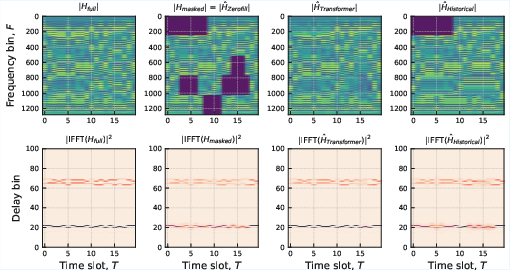
Figure 2: CFR magnitude (top) and PDP (bottom) for a single representative trace at 30% interference occupancy; CFRTransformer preserves both major delay components and amplitude structure relative to heuristic reconstructions.
PDP Similarity Across Interference Occupancy
The model sustains a mean PDP similarity factor F=NbFb0 for interference probabilities up to 0.5, markedly exceeding the best baseline (historical fill at F=NbFb1 and spline at F=NbFb2) under realistic spectrum fragmentation.
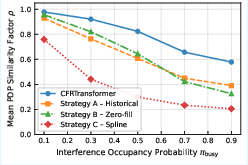
Figure 3: Mean PDP similarity factor F=NbFb3 vs. interference probability F=NbFb4; CFRTransformer exhibits superior robustness as spectrum occupancy increases.
Mobility Robustness
Dynamic evaluation over a 60× velocity range verifies that performance degrades smoothly from F=NbFb5 (quasi-static) to F=NbFb6 (vehicular) with CFRTransformer, while baselines lose coherence or do not exploit temporal redundancy.
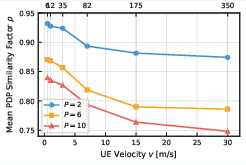
Figure 4: Mean PDP similarity factor F=NbFb7 vs. UE velocity at three levels of channel complexity; CFRTransformer maintains a gradual and limited performance drop, even as Doppler spread and multipath richness increase.
Sub-band Count and Spectral Diversity
Performance increases with the number of sub-bands, validating that greater spectral observations supply richer context for cross-band inference. Models trained with more sub-bands consistently achieve higher F=NbFb8.
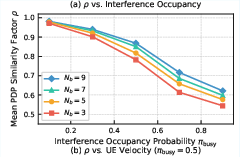
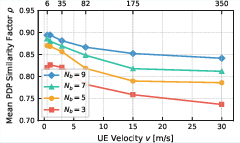
Figure 5: Mean PDP similarity factor F=NbFb9 for CFRTransformer as a function of (a) interference occupancy and (b) UE velocity across different numbers of sub-bands, highlighting the benefit of increased spectral diversity.
Effect of Training Regimes
Ablation experiments show that training with per-sample velocity randomization is essential for maintaining performance across mobility regimes and precludes the domain shift issues observed with fixed-velocity models.
Theoretical and Practical Implications
From a practical standpoint, CFRTransformer provides a deployable tool for wideband wireless systems confronted with unpredictable band occupancy, enhancing the reliability of downstream physical-layer sensing (e.g., localization, Doppler radar, or gesture recognition). Theoretically, the approach sets a precedent in combining holomorphic neural designs, physics-consistent multi-objective loss functions, and efficient axis-wise attention to balance scalability and physical expressiveness. The design is adaptable to arbitrary numbers of bands, time windows, or mobility levels—critical for next-generation communication systems deploying in heterogeneous, highly dynamic environments.
The physics-informed composite loss and factored architecture present a unified recipe for addressing other multidimensional reconstruction tasks in applied signal processing where both computational and physical constraints are stringent.
Conclusion
CFRTransformer establishes a new standard for wideband CFR reconstruction in multi-band, interference-limited environments, surpassing classical interpolation or extrapolation baselines by leveraging complex-valued modeling, factored attention, and physics-informed learning objectives. Its robustness to co-channel interference and mobility variations is validated empirically and supported by ablation analysis. Future work may extend these results to real-field wireless data and further reduce inference latency, opening avenues for robust, real-time, spectrum-adaptive physical layer intelligence.