- The paper introduces an agent-based framework showing that excessive information sharing in high homophily conditions leads to polarization and reduced epistemic performance.
- It demonstrates that limited communication capacity improves collective accuracy when homophily is low, as supported by quantitative multilevel regression analyses.
- The study reveals that unconstrained information exchange in digital networks can undermine collective intelligence and exacerbate epistemic inequality.
Model Architecture and Simulation Paradigm
The study introduces an agent-based computational framework to interrogate the interaction between communication capacity and homophily in epistemic environments populated by Bayesian agents. Each agent possesses a private piece of evidence with quantifiable signal quality, referencing the probability that the evidence aligns with the true binary state of the world. Initial beliefs are determined via Bayes’ rule applied to these evidence items.
Agents are probabilistically paired for information exchange, with pairing likelihood governed by a homophily parameter h, promoting interactions among belief-similar agents. Communication capacity k dictates the maximum number of evidence signals exchanged per interaction, where agents select their highest-quality items for sharing, proportionally by current belief. Upon receiving new evidence, beliefs are updated using Bayes’ rule. Notably, information flow is fully cooperative, and agent cognition is perfect.
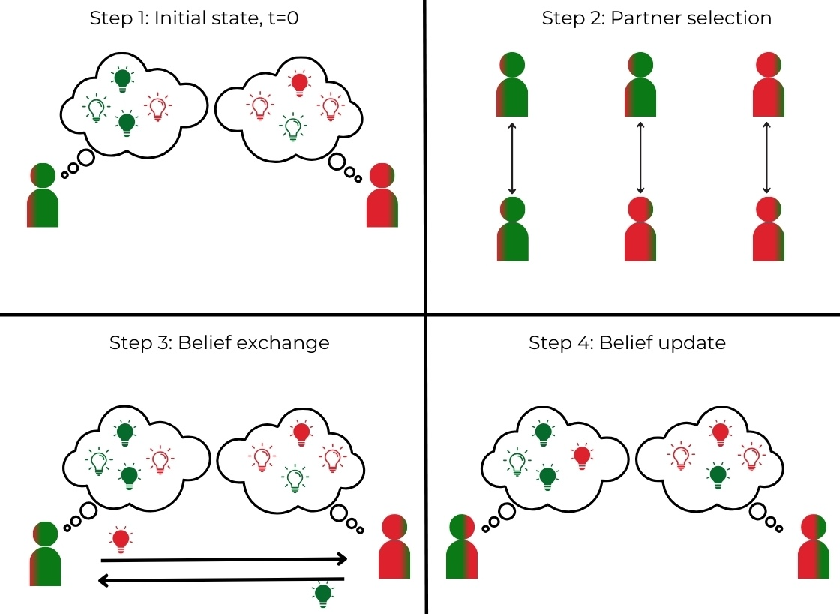
Figure 1: Representation of agents' belief states and evidence quality, highlighting the setup of private observations, homophilous partner selection, evidence exchange, and Bayesian belief evolution.
Impact of Homophily and Communication Capacity on Belief Dynamics
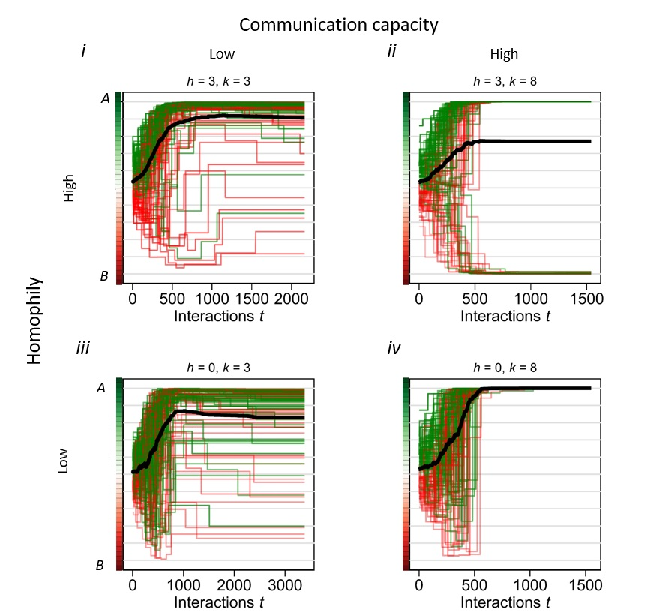
Simulation results reveal a complex dynamic between homophily and communication capacity:
This emergent polarization is attributed to the feedback loop in homophilous interactions; agents with incorrect priors preferentially interact with similarly misinformed peers, exchanging disproportionate quantities of reinforcing evidence, thereby entrenching erroneous beliefs.
Quantitative Analysis of Epistemic Gains and Inequality
Multilevel regression analyses demonstrate:
- Epistemic gain (ρi) for initially correct agents is positively associated with communication capacity and weakly influenced by homophily.
- For agents with incorrect priors, homophily’s negative impact on epistemic gain far outweighs any benefit from increased communication capacity.
- Group-level and population-level measures (WA, k0, k1, k2) indicate the interaction between k3 and k4 exacerbates epistemic inequality, with high k5 + high k6 driving maximal polarization and reduced collective epistemic accuracy.
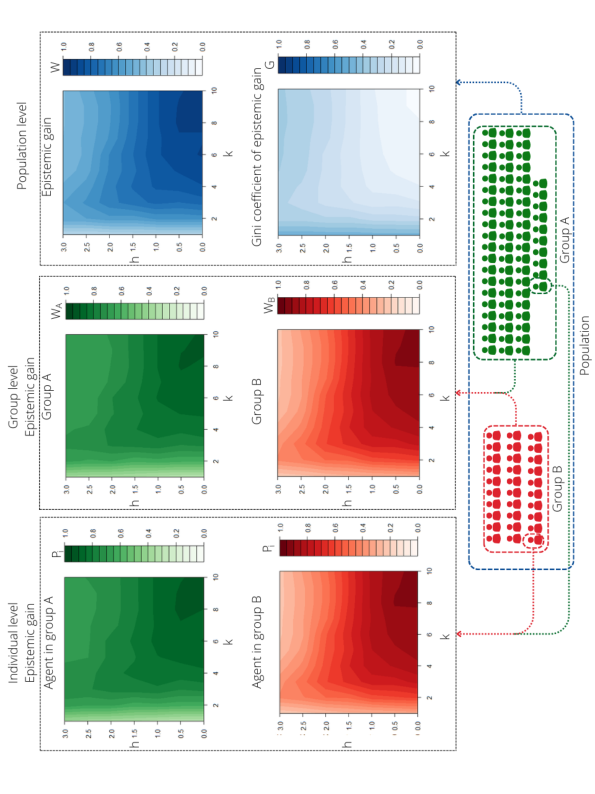
Figure 3: Mapping of individual, group, and population-level epistemic gains, and related inequalities as functions of communication capacity and homophily.
Even in idealized settings, unconstrained information exchange under high homophily fails to consistently promote epistemic improvement for disadvantaged groups and undermines population-wise information aggregation.
Robustness, Extensions, and Practical Implications
The findings are robust to alternative model configurations, including variation in population size, evidence distribution, and simultaneous broadcasting, as well as to less cooperative belief-sharing and scenarios with group salience. Further, integration of outgroup rejection mechanisms (group identities) parallels the disruptive effects of homophily.
Methodologically, explicit modeling of evidence quality and exchange—rather than simple belief averaging—affords deeper insight into the recursive effects of network structure and information flow. The model advances previous treatments by isolating the role of communication capacity, revealing that excessive information sharing can amplify polarization in epistemically vulnerable subpopulations.
Implications extend to the design of digital information networks, notably social platforms, where unconstrained information dissemination is widely assumed to enhance collective intelligence. The study undermines this assumption, showing that structural features must be considered, and that intentional limits on information flow may outperform unlimited exchange in homophilous social environments.
Theoretical and Future Directions
Theoretically, the results reinforce the importance of interaction structure in epistemic aggregation, aligning with prior empirical and computational observations on wisdom-of-crowds degradation under social influence and homophily. Additionally, the work suggests that moderation of information flow is a valid intervention for mitigating polarization in practical information systems.
Future research should generalize these results to more complex decision settings—ordinal, multi-dimensional, or temporally dynamic—and incorporate bounded rationality, adversarial information flows, and real-world cognitive biases. The explicit modeling of evidence in signal-quality terms lends itself to such extensions, as well as possible integration with richer Bayesian network representations.
Conclusion
Unconstrained information exchange within homophilous social networks disrupts epistemic performance, even under idealized Bayesian computation and cooperation. Limiting communication capacity can mitigate polarization and promote more equitable information aggregation, challenging foundational assumptions in the design of digital information networks. Structural moderation of information flow constitutes a necessary design principle for future collective intelligence systems.