- The paper demonstrates a novel integration of input convex neural networks with attention-based gating within an MPC framework, achieving up to 62.5% higher imbalance profits in large battery scenarios.
- The method significantly improves price prediction accuracy by 23% and increases robustness by 8% under noisy conditions, while reducing computation time by 50% compared to benchmark models.
- The approach provides a scalable, real-time solution for implicit balancing in European electricity markets by ensuring convexity and leveraging structure-preserving constraints for optimal control.
Neural Network-Assisted Model Predictive Control for Implicit Balancing
Introduction
The paper "Neural Network-Assisted Model Predictive Control for Implicit Balancing" (2604.01805) addresses the operational and computational challenges associated with implicit balancing in European electricity markets, where Battery Energy Storage Systems (BESS) are deployed by Balance Responsible Parties (BRPs) to strategically take out-of-balance positions. The efficacy of such strategies in Model Predictive Control (MPC) is closely tied to the accuracy of the underlying balancing market models. Conventional approaches, relying either on convex market clearing approximations or direct machine learning forecasts, suffer from a lack of realism and/or impede direct integration with MPC due to their non-convexity. This work proposes a data-driven balancing market model built on input convex neural networks (ICNNs) augmented with trainable attention-based input selection, enabling accurate and computationally tractable integration with MPC schemes for both price-taker and price-maker scenarios.
Implicit balancing is formulated as a finite-horizon optimal control problem, where BESS charge/discharge policies are computed to maximize imbalance profit (or equivalently, minimize imbalance cost) against future market outcomes. The market model is required to capture the nonlinear and partially observable dynamics of imbalance pricing, driven by sub-quarter-hour system imbalances, unidentified TSO actions, and BRP strategies. The critical technical innovation is to embed the market response function within the MPC framework so that the resulting optimization is a mixed-integer quadratic program (MIQP) for which global optimality can be guaranteed.
A formal convexification argument is presented, leveraging properties of input convex neural networks to ensure that the transformed objective function remains convex in the relevant decision variables. This property is essential for computational tractability, especially given the bilevel nature of the problem and the requirement for real-time or near-real-time solution times.
The proposed framework incorporates a modular, ICNN-based surrogate for the real-time balancing market mechanism. The key architecture components include:
- Attention-based input gating: Embedding and attention mechanisms preprocess high-dimensional input spaces, such as bid stacks and historical imbalance trajectories, gating only the most relevant information into the ICNN (Figure 1).
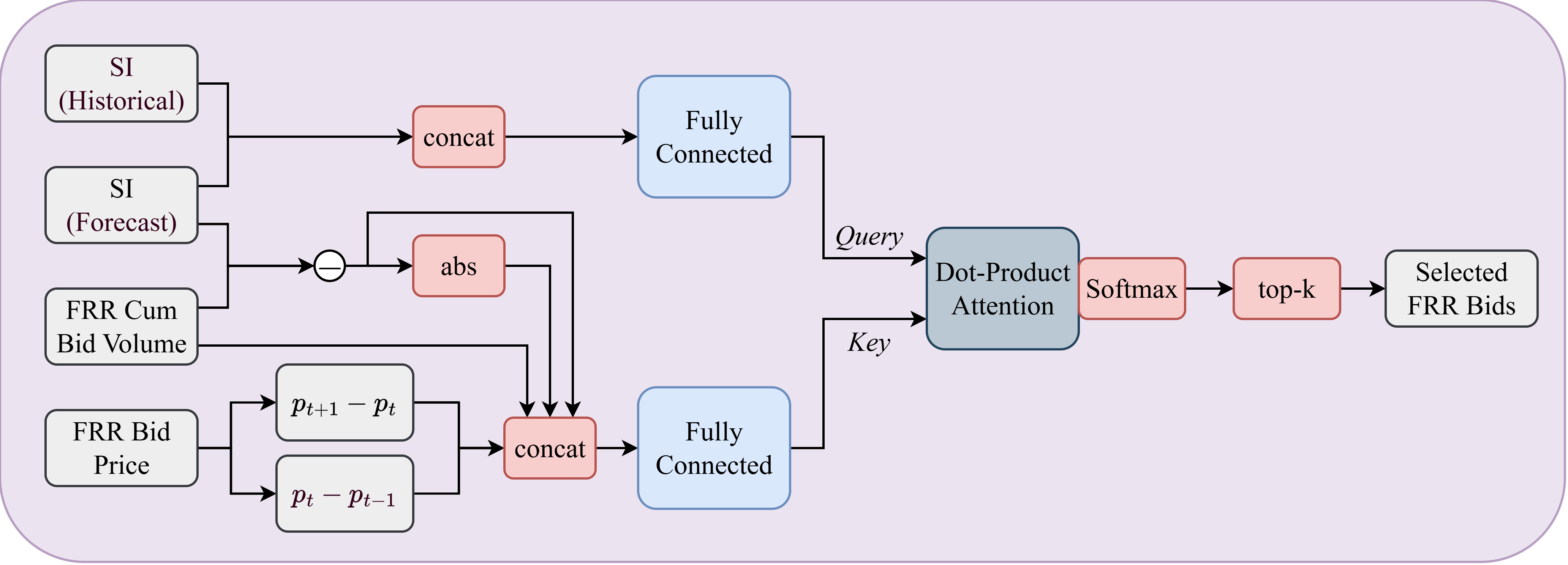
Figure 1: The attention layer architecture used in the proposed market model, employing SI-related queries to select context-relevant bids.
- Input Convex Neural Network (ICNN): The ICNN layer ensures convexity with respect to BESS actions and monotonicity consistent with economic constraints—charging actions increase imbalance price, while discharging decreases it (Figure 2).
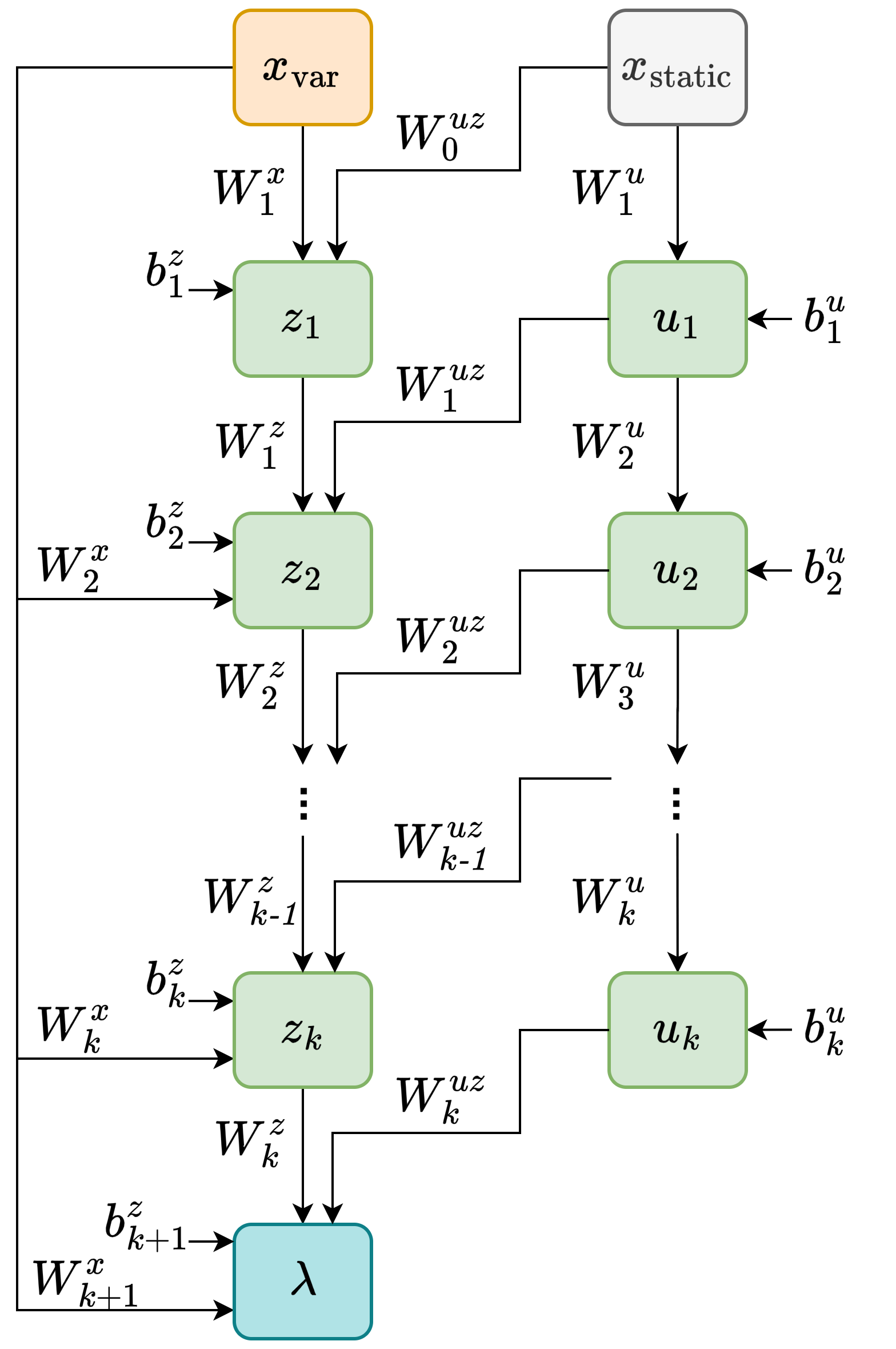
Figure 2: The ICNN architecture, decomposing the market model by convex/monotone action dependencies.
This composition (shown in Figure 3) ensures that the integration of learned market models into the MPC maintains favorable numerical properties for solver efficiency.
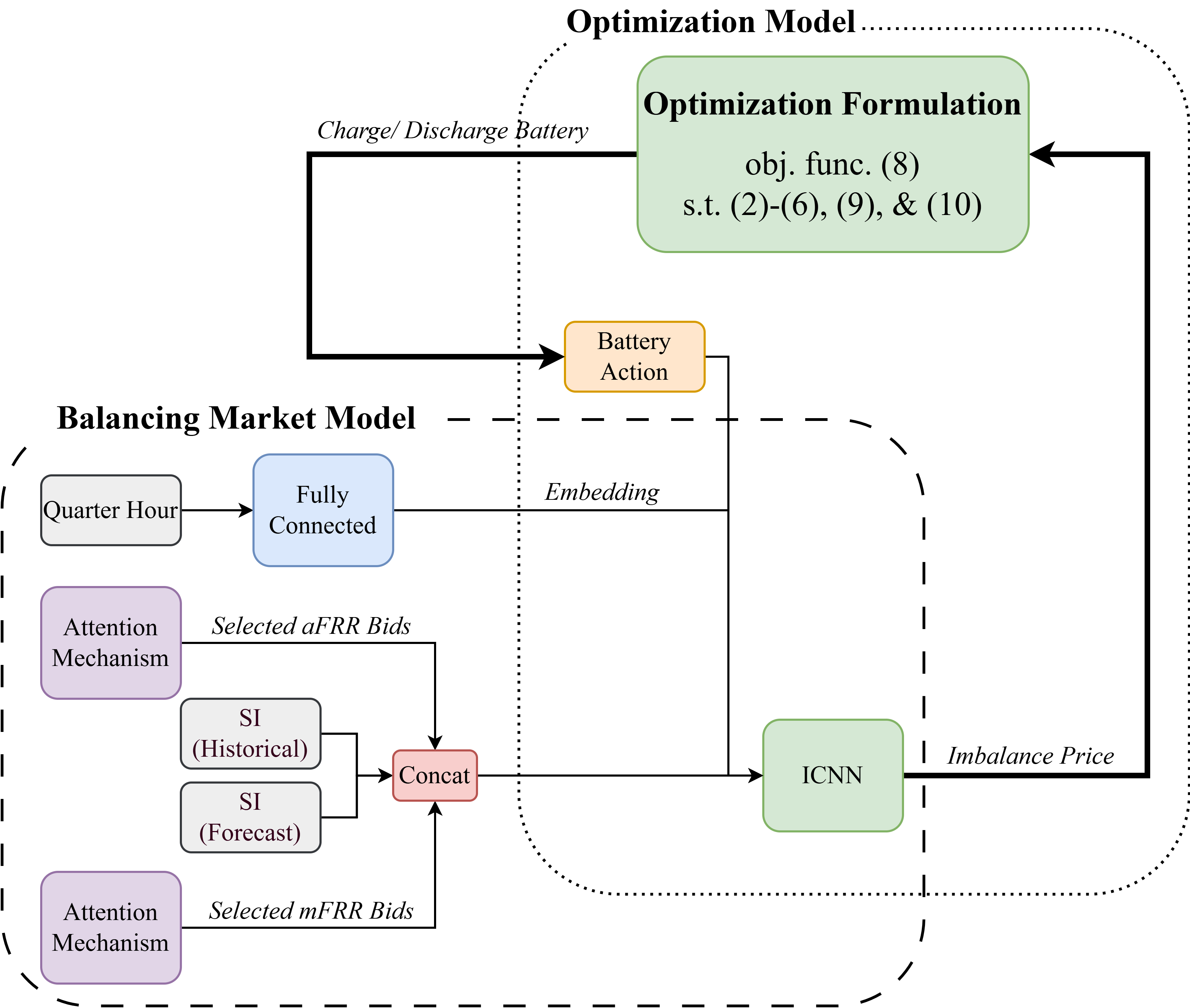
Figure 3: The proposed implicit balancing framework, integrating MPC, attention-based preprocessing, and ICNN market modeling.
Experimental Evaluation
The framework is empirically validated on the Belgian imbalance settlement mechanism using a comprehensive 2023 market operations dataset. Both small (1 MW/2 MWh: price-taker) and larger (10–100 MW: price-maker) battery configurations are assessed.
For price-taker batteries, results show that the ICNN-based approach achieves profit within 11% of the optimal policy in perfect foresight settings, and improves price prediction RMSE by 23% in high system imbalance situations relative to classical clearing approximations. Moreover, under noise in system imbalance forecasts, the proposed method shows 8% higher robustness than clearing-based baselines, resulting in up to 35.4% higher imbalance revenues.
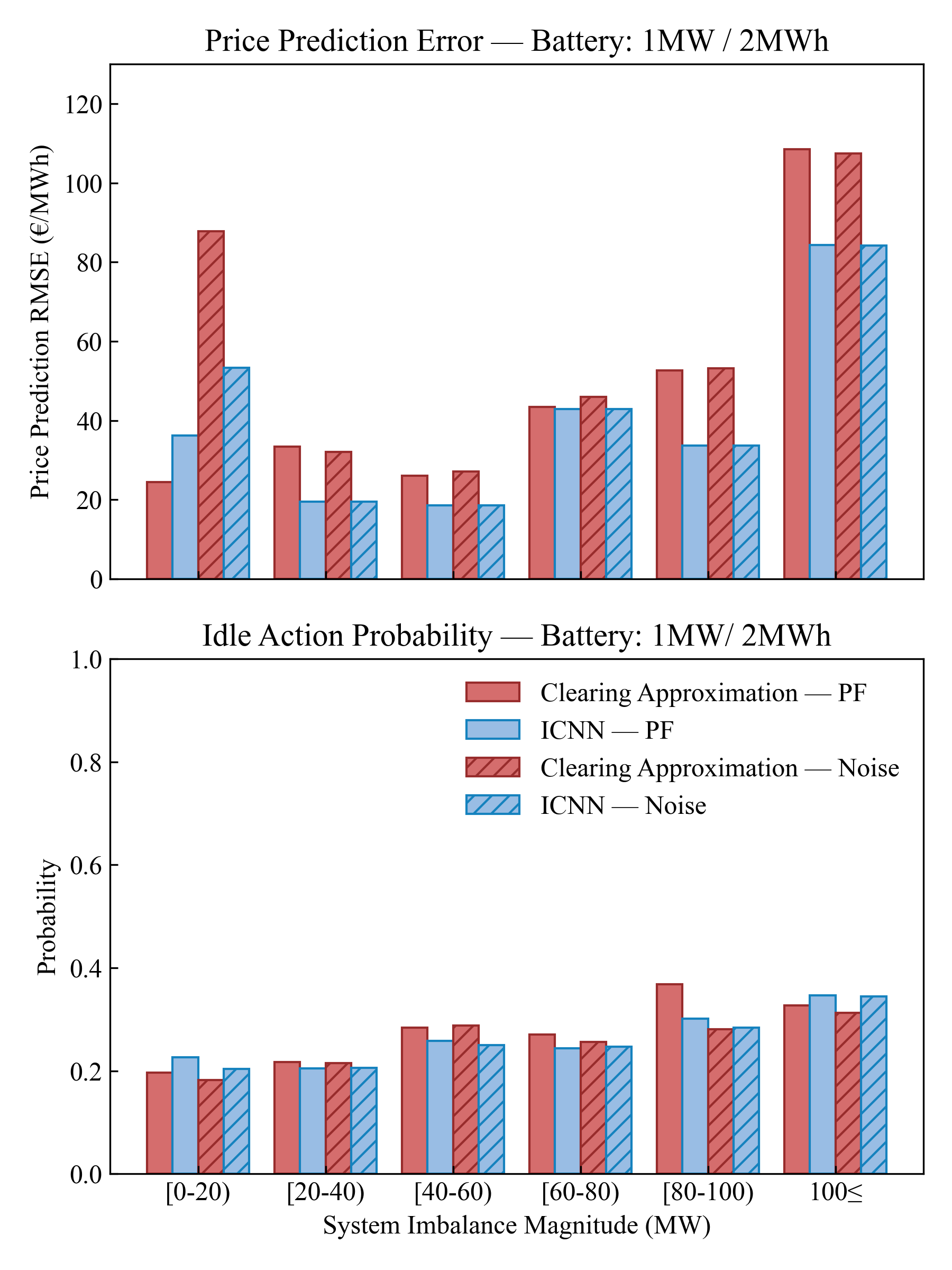
Figure 4: Price prediction error and probability of idle action for 1 MW/2 MWh battery, indicating improved performance on larger SI events.
For larger price-maker batteries, the significance of properly modeling the battery’s endogenous price impact becomes more pronounced. The ICNN model delivers up to 62.5% higher imbalance profits for a 100 MW/200 MWh battery relative to the clearing model, with the advantage growing with battery scale. The approach’s higher rate of optimal idle actions in low system imbalance intervals mitigates spurious losses associated with spurious trades, despite local increases in prediction RMSE for those intervals.
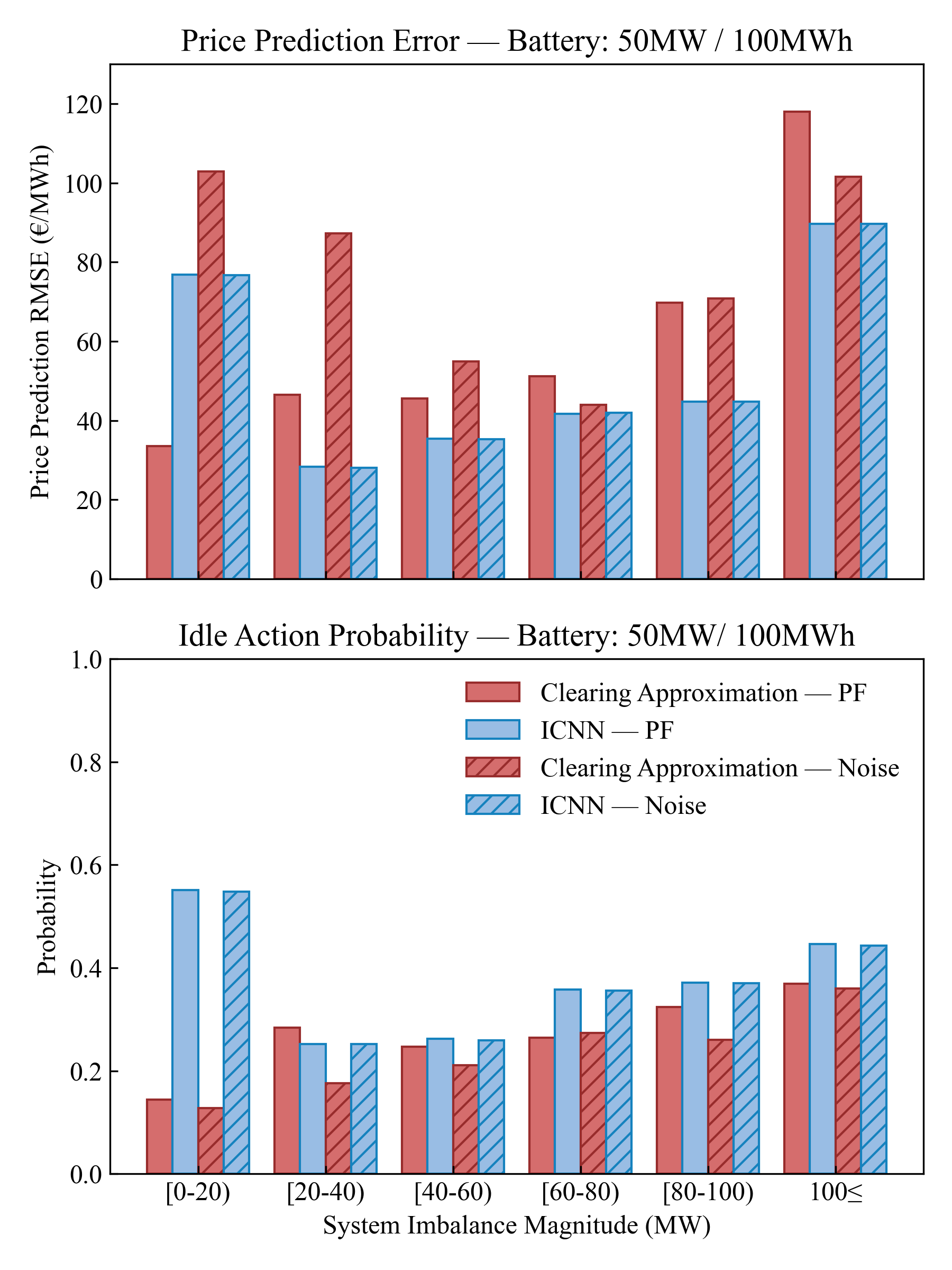
Figure 5: Price prediction error and probability of idle action for 50 MW/100 MWh battery, illustrating the scaling benefit of the ICNN approach in price-maker regimes.
Additionally, the ICNN market model contributes to a 50% reduction in computational time per time step compared to benchmark approaches, supporting deployment in real-time operational contexts.
Practical and Theoretical Implications
The proposed framework facilitates scalable, real-time implicit balancing for BESS operators in modern European market contexts, supporting the transition to high-penetration renewable electricity systems. By ensuring convexity and monotonicity by design, the method enables the use of advanced deep learning models without surrendering guarantees of tractable optimization or solution optimality. The differentiation of battery policy by size (price-taker vs. price-maker) underscores the necessity of accurate endogeneity modeling within MPC-based trading strategies.
From a theoretical standpoint, the approach sets a precedent for integrating neural network surrogates with structure-preserving constraints directly into optimization-based controllers. It strengthens the connection between differentiable programming, market-aware control, and stochastic optimization under partial observability.
Future Directions
The framework suggests the possibility of extending input representations (e.g., incorporating longer historical windows, grid congestion signals, or richer temporal features) and using deeper network architectures for context extraction. There is clear potential for exploiting minute-level or sub-minute control/market data, as the ICNN architecture remains efficient under increased input dimensionality. Another extension involves integrating more complex BESS operational constraints beyond the linear SoC models employed. The approach has implications for broader market-aware asset coordination, multi-agent scenarios, and hybrid model-based/model-free reinforcement learning protocols.
Conclusion
This work demonstrates that input convex neural network surrogates, when embedded within MPC schemes and augmented by attention-based gating, support both accurate and computationally efficient implicit balancing strategies for BESS in European electricity markets. The architecture yields consistent profit improvements across a range of battery scales and market conditions, while also providing robustness in the face of input uncertainty and reducing computational latency. These results substantiate the value of neural convex optimization as a medium for operationalizing deep learning in energy market processes, with clear applicability to scalable, real-world grid operations.

