- The paper finds that AI tools are extensively used for content creation and teaching media, but remain underutilized in curriculum development.
- The paper employs a nationwide, cross-sectional survey of 349 teachers across 25 provinces, highlighting significant differences in adoption and satisfaction levels.
- The paper identifies key challenges including generic output and limited infrastructure, underscoring the need for localized, teacher-centered AI solutions.
Grounding AI-in-Education Development in Teachers' Voices: A Nationwide Survey of Indonesian K–12 Teachers
Introduction
The integration of AI within K–12 classrooms represents a salient development in the Indonesian education landscape, impacting over 52 million students. Despite growing AI adoption, there exists a dearth of large-scale, empirical evidence describing actual usage patterns, teacher needs, and practical obstacles. This national survey of 349 Indonesian teachers systematically investigates how AI tools are used across pedagogical domains, which support structures are prioritized, and what limitations impede further integration. The findings critically inform the design of context-appropriate AI systems and policy frameworks, with a core emphasis on teacher agency.
Survey Methodology
A cross-sectional online survey was administered to a broad sample of Indonesian teachers, recruited through educational networks across at least 25 provinces. The survey instrument focused on six components of instructional practice—content knowledge development, pedagogy, assessment/evaluation, curriculum development, teaching media, and professional practice. Tool categories included LLM-based text assistants, MT, generative image/video tools, grammar checkers, and speech technologies. Rigorous quality controls such as attention checks were employed; responses were normalized and analyzed for subgroup differences using statistical significance testing (p<0.05).
Patterns of AI Adoption: Frequency and Satisfaction
Analysis of usage frequency and satisfaction yields discriminative insights into component-level and group-specific adoption curves. AI tools are primarily leveraged for content knowledge development and teaching media preparation, with over 64% of teachers reporting frequent utilization in these domains. In contrast, curriculum development remains episodic and largely unsupported through existing AI systems. Satisfaction rates parallel frequency, peaking in teaching media and bottoming in professional practice, with overall dissatisfaction below 3%. Statistically significant disparities were found between usage and satisfaction across all domains except content knowledge development, indicating a gap between AI potential and realized utility.
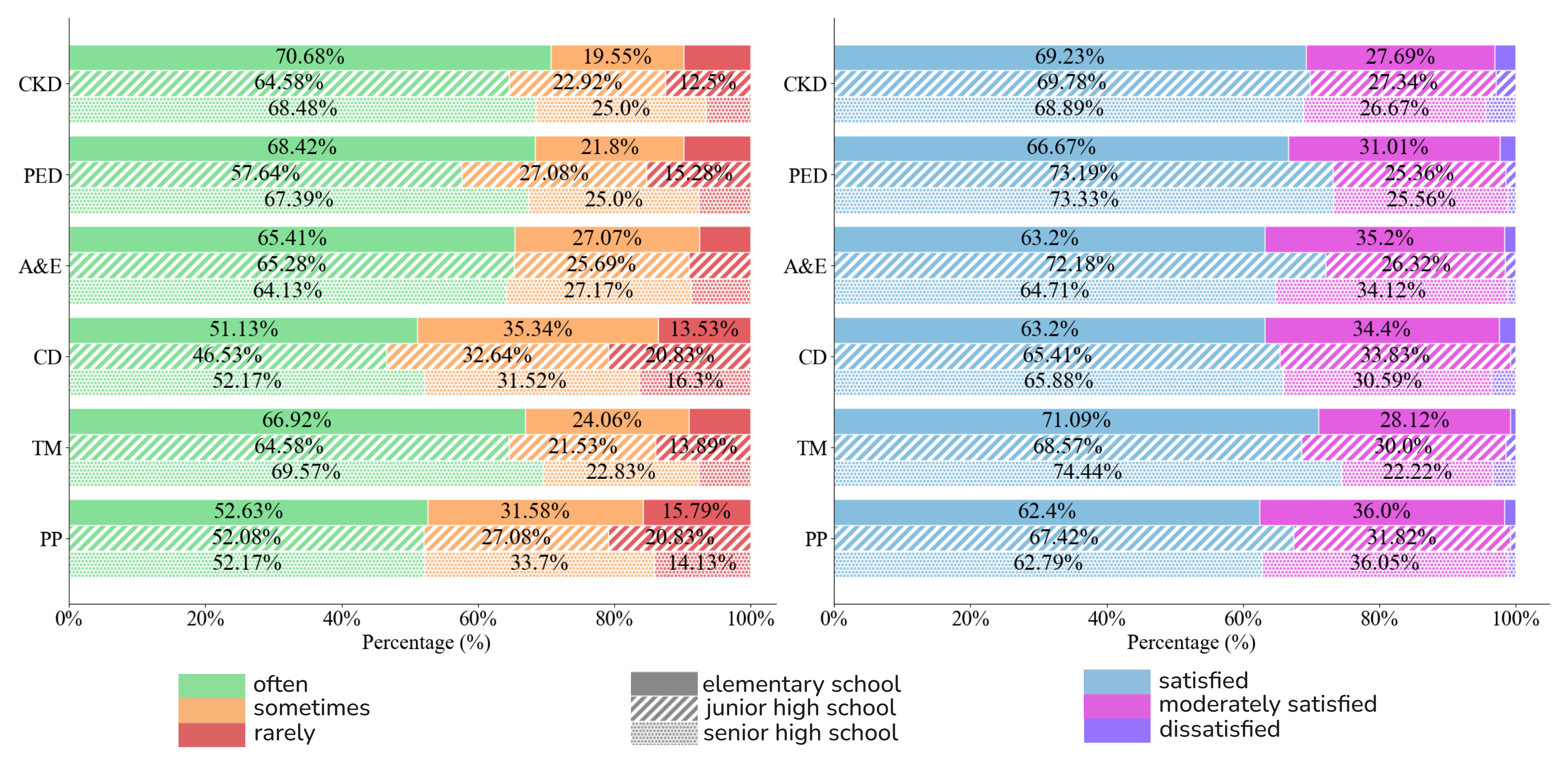
Figure 1: Frequency (left) and satisfaction (right) levels of AI tool usage in Indonesian education across components of effective teaching and learning, stratified by school level.
Differential AI Adoption Across Teacher Subgroups
Disaggregated analysis exposes pronounced heterogeneity in adoption. Arts, sports, and specialized-subject teachers demonstrate the highest engagement with AI, whereas language teachers and those specializing in social sciences show comparatively reduced usage. Elementary educators display more consistent adoption rates than their junior and senior high school counterparts. Notably, teacher experience inversely correlates with AI use; those exceeding 15 years in the field are significantly less engaged compared to mid-career cohorts. Geographically, educators in Eastern Indonesia report distinctly higher perceived importance and usage of AI tools, underscoring an appetite for educational technology in high-need locales despite persistent infrastructure deficits.
LLM-based text assistants are the most widely adopted across instructional functions, particularly for content creation and lesson planning. MT utilities and image-generation models follow in prevalence, mainly supporting teaching media development and visual content production. Video generation and speech technologies are less dominant but provide discrete value for specialized tasks. This stratification of tool use aligns with Indonesian teachers’ prioritized need to minimize administrative and content-preparation workload.
Teachers’ AI Support Needs and Integration Challenges
The survey identifies explicit areas where AI support is most coveted: assessment item creation (72.2%), syllabus and lesson planning (69.6%), development of interactive teaching materials (69.1%), visual aids (67.6%), and general instructional content (67.6%). Administrative and pedagogical scaffolding were also highlighted by roughly half of participants. Assessment reliability (e.g., answer checking, support for classroom action research) surfaces as a secondary but nontrivial need.
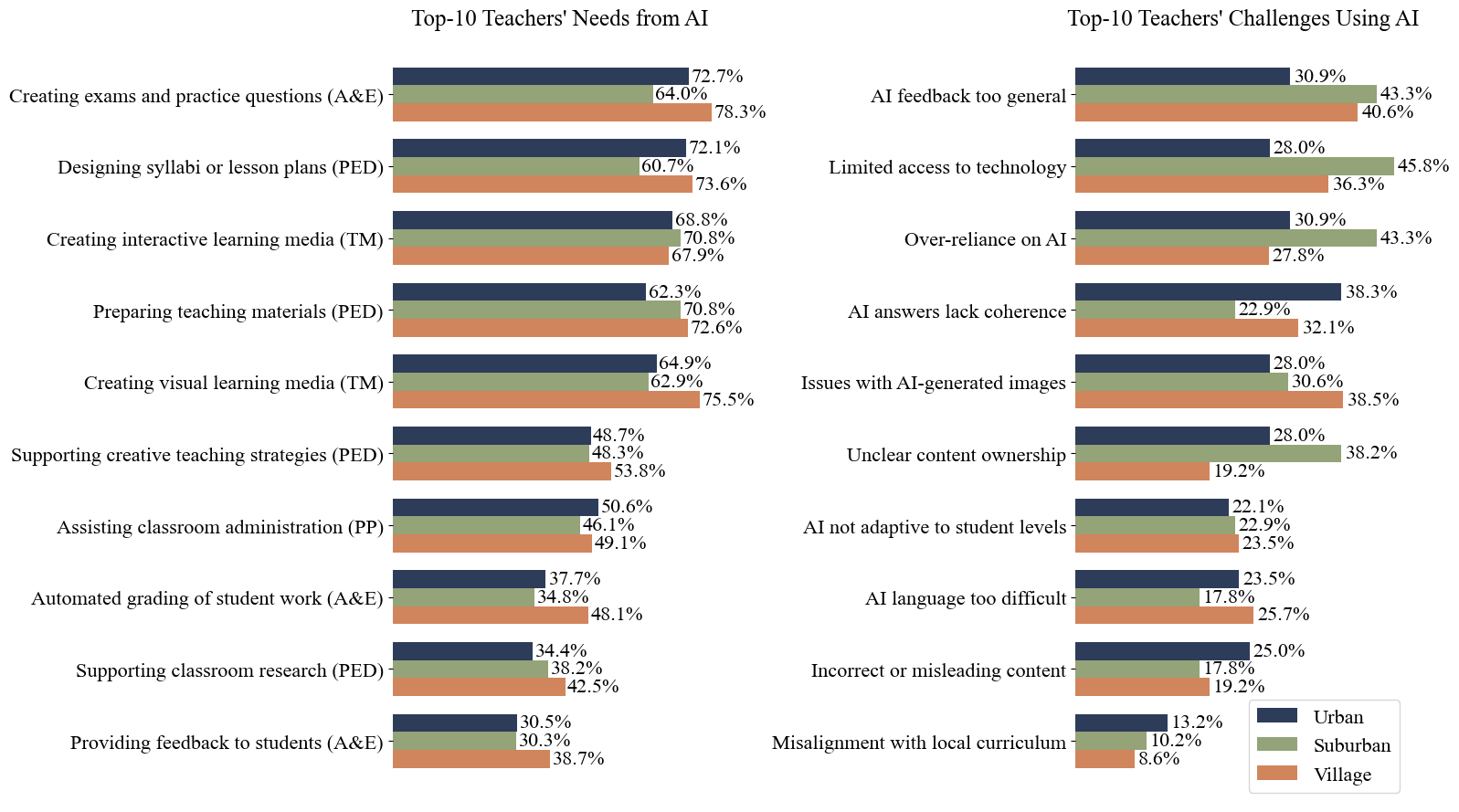
Figure 2: Top-10 support needs (left) and challenges (right) of AI tool adoption, segmented by school setting (urban, suburban, village).
Conversely, the leading challenge is the generic nature of AI-generated responses, cited by 37% of respondents. Limited infrastructure access (35.1%), concerns about excessive dependence on AI (33.1%), and ambiguous or irrelevant feedback also remain crucial obstacles. Image generation inaccuracies and residual uncertainty regarding IP rights further compound implementation friction. Factual inaccuracies and curriculum misalignment, while present, are less predominant as deterrents.
Theoretical and Practical Implications
This study demonstrates that teacher-centered perspectives are vital for the effective contextualization of AI in education. The prioritization of preparation and evaluation tasks for AI intervention emphasizes the administrative and cognitive load experienced by Indonesian teachers, especially in settings with scarce resources. The dissatisfaction with generic outputs reveals a technical and design imperative: localization, deeper curriculum integration, and pedagogically-aware modeling are necessary for classroom adoption to progress beyond superficial augmentation. Furthermore, the regional disparities in both infrastructure and utilization suggest that national strategies must incorporate connectivity, device accessibility, and ongoing professional development to democratize AI benefits.
From a machine learning standpoint, the findings highlight significant design challenges in transfer learning and domain adaptation for low-resource and context-sensitive educational environments. The multifaceted needs of teachers implicate research avenues around controllable generation, bias mitigation, low-latency deployment, and user-in-the-loop system design.
Prospective Directions for AI in Indonesian Education
Enhanced localization for local languages and curricula (possibly leveraging instruction-tuned, open-weight LLMs such as Cendol [Cahyawijaya et al., 2024]) shows potential for addressing issues of relevance and specificity. The documented dissatisfaction with content generality and IP ambiguity further motivates human-AI collaborative frameworks, where teachers mediate, adapt, and supervise AI outputs rather than relying on end-to-end automation.
Lightweight, infrastructure-tolerant deployments (e.g., quantized on-device LLMs, occasionalization strategies) are prerequisite for equity across rural and urban divides. Professional development and teacher-centered co-design are essential for increasing practical trust and instrumental fit of future AI tools in the Indonesian education system.
Conclusion
This nationwide survey evidences robust, domain-varied AI adoption in Indonesian K–12 education, with substantial but uneven use informed by teacher, subject, and geographic heterogeneity. Strong, actionable needs include workload reduction in preparation and assessment and the elevation of contextual relevance and reliability. Systemic limitations—generic output, infrastructure, and overreliance—demand renewed research on local adaptation, teacher-AI interaction, and policy innovation. As AI systems proliferate, centering the voices and practicalities of the classroom practitioner remains critical for sustainable, effective integration.